Commercial & Industrial
Commercial & Industrial Doors
Every opening in your building, from one contractor — supplied, installed and serviced across Toronto and the GTA since 1979. Storefronts and steel doors, overhead and dock equipment, fire-rated assemblies, automatic operators and shutters, with 24/7 emergency repair behind all of it.
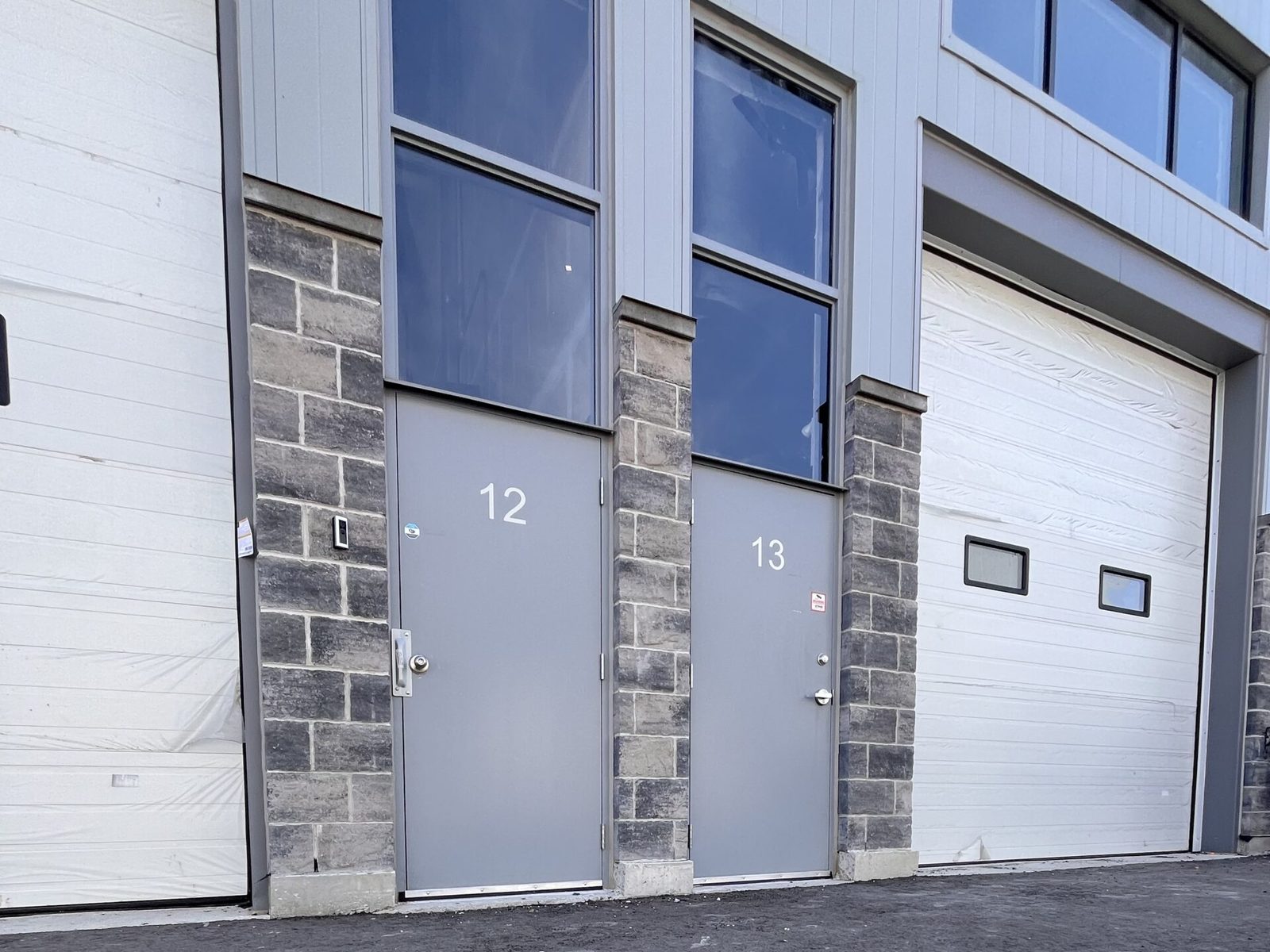
A commercial door is any door that a business, its staff, its customers or its goods depend on — and unlike a house door, it is governed by the building and fire codes, has to survive continuous use, and usually carries hardware that has to be specified rather than bought off a shelf. Canuck Door Systems has supplied, installed and repaired those doors across the GTA since 1979.
We cover every opening on purpose. Most door companies do one family well — overhead, or glass, or hardware — which leaves a facility manager holding three vendors and no single point of responsibility. We cover 17 categories, from the glazed entrance at the front to the dock leveler at the back, with one number to call when any of them stops working.
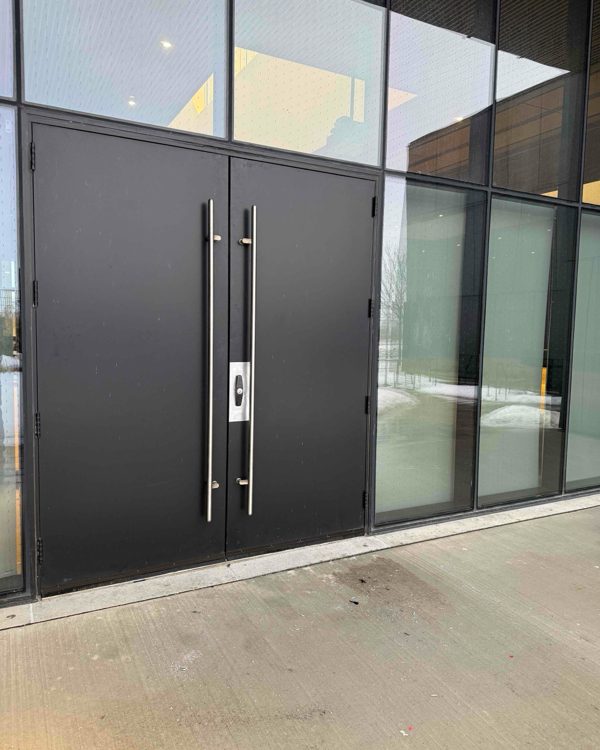
That includes the ordinary case: a commercial entry door — the main exterior door into a business. There is no single product behind that phrase, which is why it is worth saying plainly what the choice actually is. A commercial entrance door is usually one of three things: a glazed aluminum entrance where the building wants light and a shopfront look, a hollow metal door where it needs strength, security and a fire rating, or a solid-core wood door where the opening is interior or front-of-house in a finished space. We supply and install all three, and the right answer is set by the opening — its exposure, its traffic, its rating and what the code requires of it — not by preference.
Every commercial door we supply, install and service
Glass & glazing
Everything glazed at the front of the building — the entrance customers use, the shopfront it sits in, and the glass that gets broken.
Aluminum-framed entrances, curtain wall, frameless and sliding glass — the glazed front of the building.
The full glazed shopfront wall the entrance door sits in, from framing to glass.
Commercial Glass & Window Repair
Broken commercial glass and windows, including after-hours board-up to make the opening safe tonight.
Metal, fire, wood & acoustic doors
The doors that have to be strong, rated, or built for one specific job — back-of-house, stairwells, exits and the openings an inspector looks at.
Steel doors and welded frames for exits, stairwells, mechanical rooms and any opening that takes abuse.
Labelled fire assemblies in steel and wood, plus the annual inspection the fire code requires.
Solid-core and veneer wood doors for offices and finished spaces, plus hospital, hotel and cleanroom openings.
STC-rated acoustic doors in steel and wood, for boardrooms, studios, mechanical rooms and hotel suites.
Overhead, docks & traffic
Where goods move. Overhead and rolling doors, the dock equipment that loads them, and the interior doors that take a forklift twice a minute.
Sectional, roll-up, rolling steel and high-speed doors, with the operators, springs and parts that run them.
Levelers, dock plates, seals, shelters and bumpers — the whole dock, serviced as one system.
Impact and traffic doors for kitchens, warehouses and any opening that swings hundreds of times a day.
Access & automation
Powered and barrier-free entrances, plus the hardware that decides whether any door closes, latches and locks the way it should.
Automatic sliding and swing doors, plus AODA barrier-free operators for accessible entrances.
Closers, exit devices, locks, hinges, thresholds and weatherstripping — supplied, fitted and repaired.
Security & partitions
Closing a space off — after hours at a storefront or counter, or on demand across a hall that has to be two rooms by Tuesday.
Rolling shutters, counter shutters, rolling grilles and folding gates for closing a storefront or counter after hours.
Operable panel walls and folding accordion partitions that turn one room into two.
Installation, repair & maintenance
The same crews, whatever the door is. We service doors we did not install, and we run emergency dispatch around the clock.
Door Installation & Replacement
New doors and straight replacements, scheduled around your operation — often after hours.
Repairs on any commercial door, whoever installed it: closers, hardware, frames, glass, operators.
A door that won't lock or close, right now. We secure the opening first and schedule the permanent fix after.
Scheduled service plans that catch the failure before it becomes an after-hours call-out.
What makes a door “commercial”?
Use and code, not material. A commercial door is specified for continuous traffic, has to satisfy the Ontario Building Code and — where the opening demands it — a fire rating, and carries hardware graded for that duty. A residential door is specified for insulation, appearance and quiet. That single difference drives everything in the table below, and it is why a residential-grade door fitted in a commercial opening fails early and can fail an inspection.
| Commercial / industrial | Residential | |
|---|---|---|
| Typical construction | Hollow metal (16–18 gauge steel), aluminum, rolling steel, glass | Insulated steel, fibreglass, wood |
| Duty | Continuous daily cycles; operators specified by cycles per day | Domestic use |
| Fire rating | Labelled assemblies where the code requires: 20 / 45 / 60 / 90 / 180 minutes | Rarely rated |
| Hardware | Commercial-grade closers, panic / exit devices, access control | Residential locksets |
| Frames | Welded or knock-down steel; grouted into masonry | Wood or light-gauge steel |
| Common sizes | 3′0″ × 7′0″ single; pairs to 8′0″ wide; overhead sized to the opening | Standard stock sizes |
| Service model | Preventative-maintenance contracts + 24/7 emergency | Repair when it breaks |
Which door for which building
The building type usually decides the door before anyone opens a catalogue — a warehouse needs dock equipment and rolling steel, a clinic needs barrier-free entrances and rated corridor doors. Find your building below and it will point you at the right systems.
Warehouses & distribution
Dock levelers, seals and shelters at the back; rolling steel and high-speed doors that cycle all shift; hollow metal on every exit.
Retail & restaurants
A storefront entrance that looks right and stays open all day, security shutters for after hours, and impact doors between front and back of house.
Healthcare & clinics
Barrier-free automatic entrances, easy-clean stainless and lead-lined openings, and rated doors on corridors and stairwells.
Schools & institutions
Doors that survive a thousand students a day, labelled fire assemblies on every corridor, and operable walls that split a gym or hall.
Manufacturing & food processing
Impact and kitchen traffic doors, air curtains and high-speed doors — openings that hold temperature while people and pallets keep moving.
Offices & towers
Glazed lobby entrances and vestibules, automatic operators, access-controlled hardware and the stairwell doors behind them.
Auto dealerships & service
Glass showroom entrances at the front, sectional overhead doors on the service bays, and the operators that run them all day.
Banks & secure sites
Hardened openings, grilles and shutters, controlled-access hardware, and the barrier-free entrance the code still requires.
The codes your doors have to meet
Four rule sets govern most commercial openings in Ontario, and between them they decide what can legally go in the hole in the wall. Getting them wrong is expensive twice — once at inspection, and again when the door is replaced.
- Ontario Building Code (OBC) — sets what the opening requires in the first place: exit widths, swing direction, hardware, glazing and where a rating applies.
- Fire ratings & NFPA 80 — a rated opening needs a labelled door, frame and every piece of hardware listed for it, and rated assemblies must be inspected annually. Replacing a labelled door with an unlabelled one voids the assembly.
- ULC listings — the Canadian listing that puts the label on the assembly, tested to CAN/ULC-S104 for door assemblies and S105 for frames. If the label is painted over, damaged or missing, the door no longer counts as rated, whatever it is made of.
- AODA accessibility — barrier-free entrances, operating force and push-plate or automatic operators on the doors the public uses.
Not sure what your openings need? Send us the drawings, or we will walk the building and tell you what is compliant, what is not, and what it takes to fix it.
One contractor for every opening in the building
The reason to use one supplier across 17 door categories is not convenience — it is accountability. When the storefront, the dock and the fire doors come from three companies, every fault starts with an argument about whose it is. When they come from one, there is a single number, a single history of the site, and one company that cannot blame anybody else.
Supply & install
New openings and straight replacements, measured, ordered and fitted by our own crews — scheduled after hours where the work would otherwise close you.
Repair & 24/7 emergency
Any commercial door, whoever installed it. A door that will not lock or close is secured first and permanently repaired after — around the clock, including holidays.
Preventative maintenance
Scheduled service on doors, operators and dock equipment, plus the annual inspection your fire-rated assemblies are required to have.
Recent commercial work across the GTA
Eight jobs across the door systems on this page — an amusement park, two school campuses, a relief charity, a property manager, a general contractor, a golf club and an underground contractor — four of them completed in 2026. Real clients, real buildings, from our own project files.
Canada's Wonderland
Aluminum storefront and window systems fabricated and installed across the park in 2026, on a site we have also supplied hollow metal and traffic doors to since 2022.
Toronto Catholic District School Board
Ten architectural aluminum storefront and entrance assemblies removed and replaced in 2026 — old units hauled away, new ones glazed and hung.
Doodle All Daycare Inc
Replacement of exterior windows with all new black anodized aluminum windows and…
Eitz Chaim & Kollel School
The design, supply, and installation of a high-end operable wall system for a client.
Toys R US
Supply and installation of steel doors and frames , glass, and hardware.
Canadian Millwork
AVR Underground Co. LTD
The installation of new exterior Glass Aluminum storefronts with automatic door operators and hollow metal…
Granite Shore Homes Inc
Names Ontario knows — Canada’s Wonderland, Tim Hortons, Canadian Tire, the LCBO, Metrolinx, Marriott & Hilton hotels, the University of Toronto — plus thousands of businesses, warehouses, schools and hospitals across the GTA. Dependable people, quality products, since 1979.
Commercial door service across Toronto & the GTA
We install and service commercial doors right across the core GTA, dispatched from our shop in Mississauga. Emergency repair runs 24/7, every day of the year.
Core GTA
- Toronto
- Mississauga
- Brampton
- Vaughan
- Markham
- Scarborough
- North York
- Etobicoke
- Richmond Hill
- Oakville
- Burlington
- Milton
Southern Ontario belt
Not on the list? We run crews from Niagara to Barrie and east to Oshawa — call and ask. See all service areas
What our customers say
It was a pleasure dealing with Canuck door systems. Moji was excellent to deal with. He responded extremely fast and a technician was here within 2 hours and did an excellent job on our commercial doot repair. I highly recommend them.
Called Canuck doors for one of our warehouse doors that was malfunctioning , the technician that came was very knowledgeable and efficient, it took him to time to find the issue and fix it. 5 stars
Had some doors on our clinic unit repaired. Responded and quotes very quickly. Pricing was fair. Quick turn around time was greatly appreciated.
What a commercial door costs — and how to get a firm number
There is no honest single price for “a commercial door”: a hollow metal leaf in an existing frame and a dock leveler with a seal and shelter are not the same purchase. What actually moves the number is short enough to list, though — and once we have measured the opening, the quote is firm and itemised, not a range.
- The door type and the size of the opening
- Whether the frame is being reused or replaced
- Hardware — closers, exit devices, access control, automatic operators
- Whether the opening needs a fire rating, and at what level
- Glazing, finish and any insulation or thermal requirement
- Site conditions, and whether the work has to happen after hours
Common questions about commercial doors
What is the difference between a commercial door and a residential door?
A commercial door is built for traffic and governed by code; a residential door is built for comfort and appearance. In practice that means heavier materials (16–18 gauge steel, aluminum, rolling steel instead of insulated residential panels), hardware rated for continuous use rather than domestic use, and openings that may have to carry a fire label, an exit device or a barrier-free operator. The table above sets the two side by side.
What does “commercial door” mean?
It describes how a door is used and regulated, not what it is made of. Any door in a building where the public, staff or goods pass through — a shop entrance, a stairwell exit, a warehouse dock, a hospital corridor — is a commercial door, and it has to satisfy the Ontario Building Code, its fire rating if it has one, and accessibility requirements. The material follows from the job the opening does.
How much does a commercial door cost?
There is no useful single number, and a “from” price would be misleading. A hollow metal door in an existing frame, a glazed aluminum entrance with panic hardware, and a dock leveler with a seal and shelter are three different orders of magnitude. What moves the price is the door type, the size of the opening, whether the frame is being replaced, the hardware and any fire rating, and whether the work has to happen after hours. We measure the opening and send a firm, itemised quote at no charge.
What size is a commercial door?
The most common commercial swing door is a 3′0″ × 7′0″ single leaf, with pairs made up to 8′0″ wide, and 8′0″-tall leaves used where equipment has to pass. Overhead, dock and rolling doors are sized to the opening rather than to a standard, so they are measured on site. If you are matching an existing door, send us a photo and the rough opening dimensions and we will confirm.
What are industrial doors?
Industrial doors are the heavy-duty end of the same family — the doors that move vehicles, pallets and air rather than people. Rolling steel, high-speed fabric, sectional overhead, dock equipment and impact traffic doors all sit here. They are specified by cycle count and opening size rather than by appearance, and they usually come with a motor, which means they need scheduled service.
What is a commercial door operator?
It is the motor and control that opens a door without someone pulling it. The word covers two different products: the automatic operator on a pedestrian entrance (sliding or swing, including barrier-free push-plate operators), and the overhead-door operator that lifts a sectional or rolling door. We supply, install and repair both — tell us which door it is and we will point you at the right one.
What is the lifespan of a commercial door?
A hollow metal door and frame can last for decades; what fails first is almost always the hardware — closers, hinges, pivots, locks — and, on powered doors, the operator, springs and cables. That is why the honest answer is that lifespan depends far more on service than on the door. Doors on a preventative-maintenance schedule outlive identical doors that only get attention when they fail.
Do you repair doors you did not install?
Yes, and it is a large part of what we do. We service commercial doors, operators and dock equipment regardless of who supplied them, including brands we do not sell. If the door is beyond economical repair we will say so and quote the replacement, but the first visit is about getting the opening working again.
One building, one door contractor.
Tell us what the opening has to do and we’ll quote it. Door down right now? Call and we dispatch 24/7.