
Commercial & Industrial
Soundproof & Acoustic Doors
STC-rated door assemblies for rooms that have to be quiet — meeting and board rooms, hotel suites, studios, mechanical rooms and clinical space. Wood and steel leaves with the seals, drop seals and frames that make the rating real, supplied and installed across Toronto and the GTA.
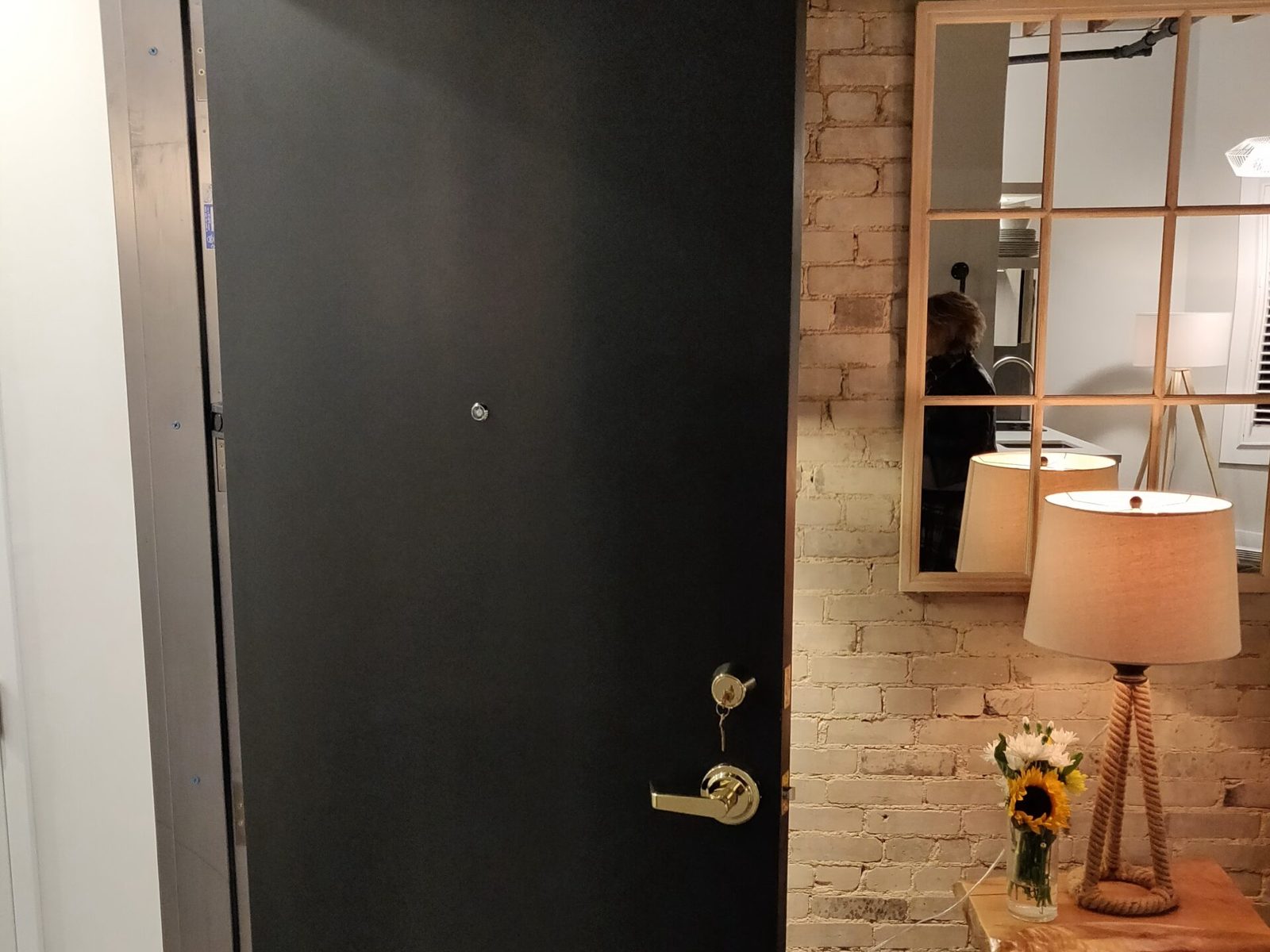
An acoustic door is not a heavier door. It is an assembly — a dense, layered leaf, a frame that seals against it on all four sides, perimeter gasketing and an automatic drop seal — tested together and quoted as one Sound Transmission Class number. Change any part of it on site and the number goes with it.
That is worth stating plainly, because "soundproof door" is a term the internet has attached to draught excluders and foam panels. What buildings actually need is a rated assembly and a frame that was part of the design. Canuck Door Systems specifies, supplies and installs those across the GTA — in meeting rooms and hotel suites, clinical and legal offices, studios, and the mechanical rooms nobody wants to hear.
Acoustic assemblies we supply and install
By material
The same acoustic requirement in the two constructions — steel for back-of-house and high ratings, wood for finished space.
Metal Acoustic & Soundproof Doors
STC-rated steel acoustic doors and frames for mechanical rooms, plant walls and studio openings.
Wood Acoustic & Soundproof Doors
STC-rated wood acoustic doors for boardrooms, hotel suites and teaching space — quiet, and still finished.
What an STC number actually buys you
| STC | What you hear through it | Typical use |
|---|---|---|
| 25–30 | Normal speech audible and mostly intelligible | An ordinary door with no seals — the baseline, not a spec |
| 35 | Loud speech audible, quiet speech not | General office privacy |
| 40 | Loud speech faint; normal speech inaudible | Meeting rooms, hotel guest rooms |
| 45 | Loud speech barely audible | Board rooms, HR and consultation rooms |
| 50 | Loud speech inaudible; heavy noise reduced | Confidential space, studios, plant rooms |
| 55+ | Serious isolation | Music rooms, test cells, mechanical enclosures |
STC is a laboratory number for a whole assembly. The figure a building actually achieves is set by the weakest path — a missing drop seal, an unsealed frame, or a partition that stops at the ceiling grid instead of the deck.
The four parts that make the rating
- The leaf — mass and layering. Acoustic doors are heavy by design, which is why the hinges and closer are specified with them rather than after.
- The frame — part of the acoustic assembly, with a stop the seals compress against and a sealed junction to the wall.
- Perimeter seals — adjustable gasketing on the head and both jambs, set to compress rather than merely touch.
- The drop seal — an automatic seal in the bottom of the leaf that lowers as the door closes. Almost every disappointing acoustic door is missing this one part.
Where acoustic doors go
Board & meeting rooms
The most common request — a room where the conversation stays in the room.
Hotel guest rooms
Rated at the corridor and quiet enough that the corridor does not wake the guest.
HR, legal & consultation
Rooms where confidentiality is a requirement rather than a preference.
Clinical & counselling space
Privacy for the patient, and often a fire rating on the same leaf.
Studios & music rooms
The high end of the scale, usually as pairs of doors with an air gap between.
Mechanical & plant rooms
Keeping equipment noise inside — steel assemblies, high ratings.
Classrooms & lecture space
Speech privacy between teaching spaces on the same corridor.
Server & generator rooms
Noise containment where the equipment runs at all hours.
When the door is not the answer
Sometimes the honest advice is that a better door will not fix the problem.
- The partition stops at the ceiling — sound goes over the wall through the plenum, and no door rating touches it.
- Shared ductwork or a common return — a direct air path between rooms; the fix is in the mechanical system.
- The floor was replaced — a new finish leaves a bigger undercut and undoes the seal at the sill.
- A moving wall is what is needed — where a room has to divide and rejoin, the acoustic problem belongs to an operable wall or partition rather than to a door.
We would rather say that up front than sell a door that cannot succeed.
Fit-out and interior work from our files
Recent interior-door jobs from our own records, listed as client and date — documented as dated job folders in the company photo library rather than as written project briefs.
- Keogh ConstructionFebruary 2026
- HN Construction Ltd.December 2025
- Maxximum Media Inc.March 2025
- Tri-Phase GroupMarch 2025
- Seven Building Services Inc.March 2025
- Omni King Edward HotelDecember 2025
Quiet rooms for names Ontario knows — Canada’s Wonderland, Tim Hortons, Canadian Tire, the LCBO, Metrolinx, Marriott & Hilton hotels, the University of Toronto — plus hotels, clinics, studios and offices across the GTA. Dependable people, quality products, since 1979.
Acoustic door work across Toronto & the GTA
We measure, supply and install acoustic assemblies across the core GTA and the Southern Ontario belt from our Mississauga shop — usually as part of a fit-out, a hotel refurbishment or a noise complaint that has to be solved.
Core GTA
- Toronto
- Mississauga
- Brampton
- Vaughan
- Markham
- Scarborough
- North York
- Etobicoke
- Richmond Hill
- Oakville
- Burlington
- Milton
Southern Ontario belt
- Hamilton
- Oshawa
- Whitby
- Ajax
- Pickering
- Barrie
- Aurora
- Newmarket
- Bradford
- Guelph
- Kitchener
- Niagara Falls
Not on the list? Acoustic work is specified rather than urgent, so it travels well — anywhere from Niagara to Barrie. Call and ask. See all service areas
What our customers say
It was a pleasure dealing with Canuck door systems. Moji was excellent to deal with. He responded extremely fast and a technician was here within 2 hours and did an excellent job on our commercial doot repair. I highly recommend them.
Called Canuk door systems to come repair a door within our commercial unit. They responded quickly and the turn around time was very quick. Very pleased with the services provided
Great company! I had a broken industrial door and Canuck responded quickly to fix the problem! I was very impressed and now they will be doing more work for our company. Jay, the Sales Guru is amazing! He is friendly, knowledgeable, and well informed about all doors. Thanks Canuck Doors!
What drives the price of an acoustic door
Sound is bought in decibels, and every few points of STC costs more than the last. What moves the number:
- The STC rating the room actually needs — 30, 40, 45, 50 and up
- Leaf construction — mass, layered cores, and whether steel or wood suits the space
- The seal set — perimeter gasketing, an automatic drop seal, and a sealed threshold
- The frame, which has to be part of the acoustic assembly rather than an ordinary frame
- Whether the opening also has to be fire-rated, and the listing that combines both
- Vision panels, which need acoustic glazing and cost a rating point or two
- Pairs and double-egress openings, where the meeting stile is the weak point
- Site conditions — an undercut floor or an open plenum will undo a good door
A door is only as quiet as its worst gap. Most disappointing acoustic openings are a good leaf with an ordinary threshold and no drop seal.
Common questions about acoustic doors
What is an acoustic door?
A complete assembly designed to stop sound: a heavy, layered leaf, a frame that seals against it on all four sides, perimeter gasketing, and an automatic drop seal at the bottom. Its performance is quoted as an STC rating from a laboratory test of the whole assembly. The individual parts matter less than the fact that they were tested together — which is why an "acoustic door" bought as a leaf alone rarely delivers what the brochure said.
What does STC mean?
Sound Transmission Class — a single number summarising how much airborne sound an assembly stops across speech frequencies. Higher is better, and the scale is not linear: normal speech is generally unintelligible through STC 45 and inaudible through about STC 50, while a standard commercial door with no seals lands somewhere in the twenties. Every additional few points costs noticeably more than the last.
What STC rating do we need?
It depends what is on the other side. Roughly: STC 30–35 for ordinary office privacy, 40–45 for meeting and board rooms and hotel guest rooms, 45–50 where confidentiality is a requirement — HR, clinical consultation, legal — and 50 plus for studios, music rooms and mechanical spaces. We would rather ask what you are trying not to hear than sell a number.
Can you soundproof an existing door?
You can improve it, and sometimes that is enough. Fitting proper perimeter seals, an automatic drop seal and a sealed threshold to a solid-core door typically gains several STC points and costs a fraction of a new assembly — and it fixes the commonest problem, which is that the sound is going under the door rather than through it. What retrofitting cannot do is turn a hollow-core or lightweight leaf into a rated acoustic assembly.
Why is my new acoustic door still noisy?
Almost always a gap. The three usual culprits are an undercut at the bottom with no drop seal, a threshold that was left off, and a frame that was not part of the acoustic assembly. After that come flanking paths — sound going over the wall through an open plenum, through shared ductwork, or around a partition that stops at the ceiling tile. A door cannot fix a wall that does not reach the deck.
Can an acoustic door also be fire-rated?
Yes, and in hotels, hospitals and offices it usually must be. The rating comes from the core and edges, the sound from mass and seals, and assemblies are listed for both together. What is not permitted is adding gasketing or a drop seal to a labelled fire door on site and assuming the label survives — the combination has to be specified and listed from the start.
Steel or wood for an acoustic door?
Both work; the room decides. Steel assemblies reach the higher ratings and belong in mechanical rooms, plant, studios and back-of-house. Wood assemblies suit finished space — meeting rooms, hotel suites, clinical and office interiors — and reach the ratings most of those rooms need. Where the door also has to look like the millwork, wood is generally the answer.
How long do acoustic doors take?
An acoustic door can take up to 8–12 weeks to produce and to source the hardware. Then 1–2 weeks to schedule the job and install it, depending on the size of the project. These are engineered assemblies rather than stock items — the leaf, frame and seal set are ordered as a set, and substituting any part of it changes the rating. Hanging one acoustic door and frame is usually a day on site; a studio or school fit-out with many openings runs over several weeks.
A room that has to be quiet?
Tell us what is on both sides of the wall and we'll specify the assembly — leaf, frame and seals — and quote it as one thing.