
Guides & FAQ · Soundproof doors
How to Soundproof a Door: STC & Acoustic Door Questions Answered
To soundproof a door, close the gaps first and add mass second. Most noise goes around a door, not through it: under the bottom, past the jambs and through the frame. Seals, a drop seal and a sealed threshold on a heavy leaf fix most rooms; a tested acoustic assembly fixes the rest. Below are the questions building owners and contractors ask us most, answered briefly.
The answers below come from the same place as our acoustic door pages: the assemblies we specify and install, and the rooms we are called back to because they are still not quiet. Where an answer needs more room, it links to the page that covers it in full.
Four decades of doors for names Ontario knows — Canada’s Wonderland, Tim Hortons, Canadian Tire, the LCBO, Metrolinx, Marriott & Hilton hotels, the University of Toronto — plus thousands of businesses across the GTA. Dependable people, quality products, since 1979.
How to soundproof a door
Sound behaves like air. Wherever air can get past the door, sound follows it, so the gaps come before anything else.
How do you soundproof a door?
Work from the biggest leak to the smallest. First the bottom: an automatic drop seal in the leaf, or at least a proper door bottom, plus a threshold for it to seal against. Then the head and jambs: adjustable perimeter gasketing set so it compresses when the door closes. Then the leaf: a hollow or lightweight door has little mass to stop sound, so it is replaced with a heavy solid-core or acoustic leaf. Last the frame and wall: the frame has to be sealed to the wall, and the wall has to be as good as the door.
What is the most affordable way to soundproof a door?
Seal the gaps on the door you already have. An automatic drop seal, perimeter gasketing and a threshold cost a fraction of a new door, and on a solid, heavy leaf they typically gain several STC points, because the gap under the door is where most of the sound was going. If the leaf is hollow-core, seals alone will not get far, and replacing the leaf is the better use of the money.
Do door sweeps and draft stoppers block sound?
A little. A brush or fin sweep closes some of the gap under the door but not all of it, and a loose draft stopper only lies against it. Both are better than an open undercut. An automatic drop seal does the job properly: a gasket inside the bottom of the leaf that drops onto the threshold as the door closes and lifts as it opens, so it seals without dragging on the floor.
Does putting a towel under the door muffle sound?
Somewhat, for the same reason a drop seal works: it fills the gap where most sound escapes. It is a stop-gap for a hotel room or a home office, not a fix for a building, and it does nothing for the gaps at the head and jambs.
Do acoustic foam panels on a door work?
Not for blocking sound. Foam and fabric panels absorb sound, which cuts echo inside the room, but they add almost no mass, so very little of the noise that passes through the door is stopped. Blocking sound takes mass and airtightness: a heavier leaf and seals on all four sides.
Do soundproof door blankets and noise blockers work?
Heavy blankets hung over a door add some mass and can cover the gaps, so they help a little on a light door. They are temporary and have to come down every time the door is used. For a room that has to stay quiet, the permanent version of the same idea is a heavier leaf with seals built in.
Can a hollow-core door be soundproofed?
Only a little. Sealing the gaps still helps, but a hollow-core leaf is two thin skins over a cardboard or honeycomb core, and there is not enough mass in it to stop much sound. For any room where sound matters, the answer is a solid-core leaf, and for rooms that need a real rating, a tested acoustic assembly.
STC ratings for doors
Sound Transmission Class (STC) is the number doors are specified by. It is a laboratory test of a whole assembly, not a property of a slab.
What is an STC rating on a door?
A single number for how much airborne sound a door assembly stops across the range of speech frequencies, measured in a laboratory. Higher is better, and the scale is not linear: each extra point is harder to get than the last. The number belongs to the tested assembly, meaning the leaf, frame, seals and threshold together, not the leaf alone.
What does each STC rating mean in practice?
Roughly: at STC 25–30, normal speech is audible and mostly understood. At 35, loud speech is audible but quiet speech is not. At 40, normal speech is inaudible and loud speech faint. At 45, loud speech is barely audible. At 50, loud speech is inaudible and heavy noise is reduced. Studios, music rooms and plant enclosures go past 55.
Is an STC rating of 27 good for a door?
No, it is the baseline. An ordinary commercial door without seals lands in the twenties: through STC 27, normal conversation is heard and mostly understood. It is fine for an office door that only needs to be closed, not for a meeting room, a hotel suite or a consultation room.
What is an STC 50 door?
A door assembly that tested at STC 50: loud speech on the other side is inaudible. That is confidential-room territory, reached by heavy steel or specialist wood leaves in a purpose-built frame with perimeter seals and a drop seal. Rooms that need more than a single door can give usually get two doors with an air space between them.
What is the STC rating of a solid-core door?
A standard particleboard-core commercial door is usually quoted at about STC 28–32, and the seals and frame decide how much of that the installed door achieves. Wood acoustic assemblies, with denser layered cores and full seal sets, commonly reach the low-to-mid 40s. The core helps, but it is the complete assembly that carries the rating.
What a room needs
The rating comes from what is on the other side of the wall, not from the door catalogue.
What STC rating does a conference room door need?
Usually STC 40–45. At 40, normal speech in the room is inaudible in the corridor; at 45, even raised voices barely carry. Board rooms, HR offices and consultation rooms where the conversation is confidential are specified at 45–50. The wall and the glass around the door need a matching rating, or the door is wasted.
Does the Ontario Building Code require soundproof doors?
The Code's sound requirements are about separations between dwelling units: walls and floors between suites in apartments, condominiums and similar buildings, rated at STC 50 (or an apparent rating of 47 measured in the building). Offices, meeting rooms and clinics have no Code STC for their doors; the rating there is set by the owner, the designer or the tenant's standards.
Can a soundproof door also be fire-rated?
Yes, when it is built and listed as both from the start. Hotel suites, hospital rooms and mechanical rooms often need both. What is not allowed is adding a drop seal or new gasketing to an existing labelled fire door on site: the change voids the fire listing.
Glass, partitions and flanking noise
A quiet door in a noisy wall is still a noisy room. These are the other paths sound takes.
Why is my room still noisy after a new door?
Look for the path around it. The usual causes are a missing drop seal or threshold, a frame that is not sealed to the wall, a partition that stops at the ceiling tiles instead of running up to the deck, a shared return-air path, or single glazing beside the door. Sound takes the weakest route, and a door cannot fix a wall.
Can glass walls be soundproof?
They can be made quiet, not silent. Laminated glass, or two panes with an air space, stops considerably more than a single pane, and the seals around the glass matter as much as the glass. A glazed office front with an acoustic door still performs at the level of its weakest pane, so the screen and the door are specified together.
Can a partition wall be soundproof?
A movable partition can give a genuinely useful separation, enough to run two meetings side by side, but not the performance of a built masonry wall. Operable panel walls are rated in STC like doors, and the result in the room depends on the seals at the top, bottom and between panels, and on the ceiling above the track being closed off too.
Cost and lead times
The price of a quiet room depends on how quiet it has to be.
How much does a soundproof door cost?
Less than people fear to improve, more than they expect to rate. Fitting seals, a drop seal and a threshold to a good existing door is the inexpensive end. A tested acoustic assembly costs several times a standard door, and every step up in STC costs more than the last: the target rating, steel or wood, the seal set, glass and a combined fire rating are what move the price. We quote the opening as one thing after a site visit.
How long does it take to get an acoustic door?
A seal retrofit on an existing door is usually a single visit. A tested acoustic assembly typically takes 4–6 weeks to produce once the shop drawings are approved, longer for matched veneers, custom hardware or combined fire-and-acoustic listings, then 1–2 weeks to schedule and install.
In-depth guides
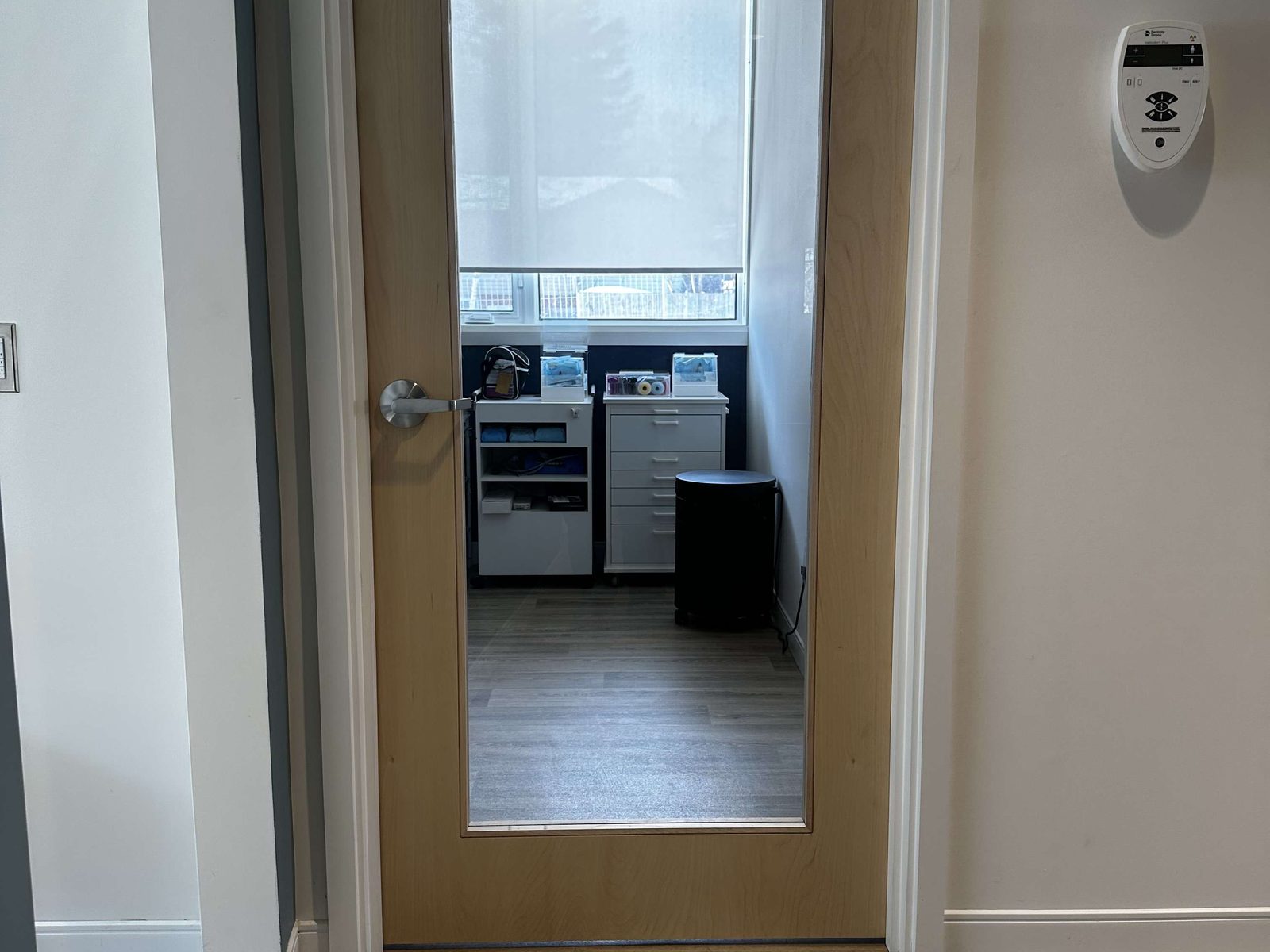
Solid Core vs Hollow Core Doors — and Why Commercial Buildings Use Solid
What is inside each type, what the difference means for sound, strength and fire ratings, and how commercial wood doors — hotel room doors included — are actually specified.
Get a door that keeps the sound in
A room that has to be quieter?
Tell us what is on both sides of the door. We will say whether seals on the existing door will do, or whether it needs an acoustic assembly, and what each costs.