
Comparison
Solid Core vs Hollow Core Doors — and Why Commercial Buildings Use Solid
A hollow core door is two thin skins over a cardboard honeycomb: light, inexpensive, noisy, and never fire-rated. A solid core door is filled with particleboard, composite lumber, staves or mineral board: several times heavier, quieter, stronger at the hinges, and — unlike hollow core — able to carry a fire rating. Commercial openings use solid core.
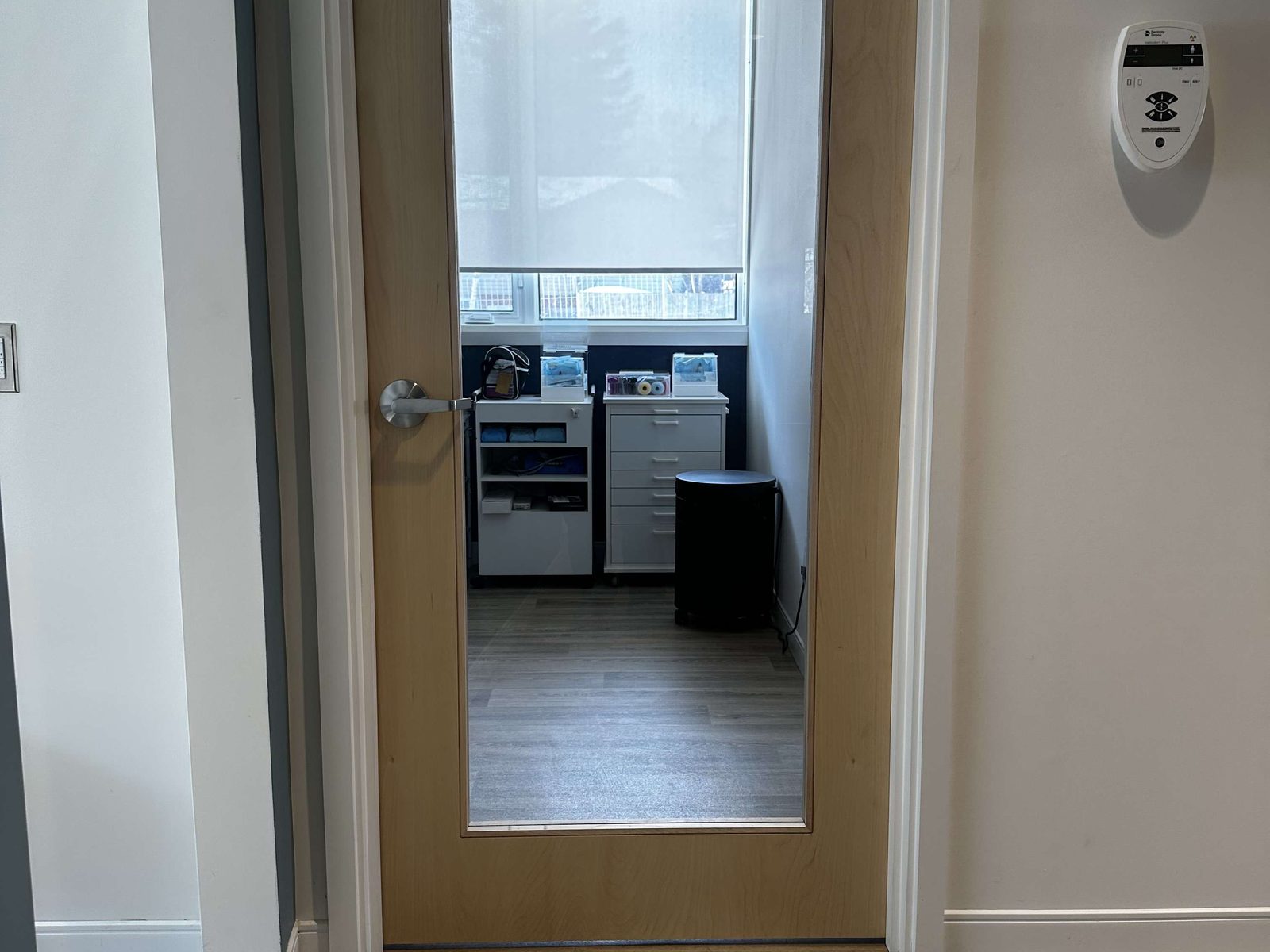
In a house, hollow core versus solid core is a question of budget and quiet. In a commercial building it is barely a question at all: a hollow core door cannot carry a fire rating, will not hold commercial hardware for long, and does not survive a corridor's worth of carts. What matters commercially is which solid core, and what goes on its face.
This guide covers both ends — the homeowner's choice and the specifier's — along with what hotel room doors, some of the hardest-working wood doors in any building, actually have to do.
Four decades of doors for names Ontario knows — Canada’s Wonderland, Tim Hortons, Canadian Tire, the LCBO, Metrolinx, Marriott & Hilton hotels, the University of Toronto — plus thousands of businesses across the GTA. Dependable people, quality products, since 1979.
What is the difference between solid core and hollow core doors?
The core. A hollow core door has a honeycomb cardboard or mesh core between two thin face sheets; a solid core door is filled edge to edge with a solid material. That one difference decides the door's weight, how much sound it stops, how well it holds screws, and whether it can be fire-rated.
Commercial flush doors are built on four families of solid core, plus the hollow core used for light-duty interiors. Published weights for a standard 3070 (3 ft by 7 ft) door show the gap (CDF Distributors, commercial flush door construction types):
| Core | Approx. weight, 3070 door | Sound (where published) | Fire rating | Typical use |
|---|---|---|---|---|
| Hollow core (honeycomb or mesh) | 15–20 lb | Minimal | Not available | Closets, light-duty interiors |
| Particleboard | 50–60 lb | Moderate (about STC 28–32) | 20 minutes | Standard office and corridor doors |
| Structural composite lumber | Denser than particleboard | Not stated | 20 minutes; some makers list higher | Extra heavy duty; more durable than particleboard |
| Stave lumber | 60–80 lb | Superior to particleboard | Up to 20 minutes | Heavy hardware, high-abuse openings |
| Mineral | 70–90 lb | Not stated | 20 to 90 minutes | Fire-rated openings |
The mineral-core ratings follow manufacturers' own listings of 20, 45, 60 and 90-minute wood fire doors (Haley Bros, fire-rated wood doors); higher ratings are steel.
Are solid core doors worth it?
Yes, anywhere sound, security or a fire rating matters — which is every commercial opening and most of the private rooms in a house. A solid core door stops noticeably more sound, feels solid in the hand, holds hinge and lock screws, and resists the knocks that punch through a hollow core skin.
Where a hollow core door is still the sensible choice is a closet, a pantry or a low-traffic interior door in a house, where the lower cost and light weight are the point. For residential interiors, see our interior doors page.
What are the disadvantages of solid core doors?
Weight and cost. Several times the weight of a hollow core door means a solid core door needs a sound frame and firmly fixed hinges, and it is more work to hang. It also costs more.
There is one commercial subtlety. Mineral-core fire doors are softer inside than particleboard, so the blocking that hinges, closers and locks screw into is built in at the factory. That is why a lock changed on site with a hole saw can write off a fire-rated wood door: the fixings have nothing to bite into, and the label is gone either way.
Can a solid core door be fire-rated?
Yes — and a hollow core door cannot. In Ontario, Part 9 of the Building Code (houses and small buildings) accepts a 45 mm solid-core wood door built to CAN/ULC-S113 wherever a 20-minute door is permitted, provided it has no more than 6 mm clearance beneath it and 3 mm at the sides and top (2024 Ontario Building Code Compendium, Article 9.10.13.2).
For larger buildings, rated wood doors are labelled assemblies with particleboard or mineral cores, hung in labelled frames. Which rating a door needs is set by the wall it sits in; our guide to fire door ratings sets out the Ontario table, and wood fire-rated doors covers what we supply.
What kind of doors do hotels use?
Solid core wood doors, fire-rated to the corridor, sound-sealed, and built to take an electronic lock. A hotel room door is one of the hardest-working wood doors in any building, because it has to do four jobs at once.
- Fire. The Ontario Building Code allows a 20-minute door between a public corridor and a suite, and between a corridor and sleeping rooms, in separations of up to 1 hour (Article 3.1.8.12) — which is exactly the hotel-room door. It must also self-close and positively latch.
- Sound. Keeping corridor noise out of the room depends on the core, the perimeter seals and the door bottom working together, so they are specified together.
- Security. An electronic lock has to be prepared for in the door, not cut in afterwards — on a labelled door, a retrofitted lock or drop seal can cost the label.
- Looks. Veneer on the guest side, matched to the room's millwork, and a face that stands up to luggage.
The same logic runs through the rest of a hotel: rated doors on stairs and service rooms, operable walls to divide the ballrooms, and traffic doors between the kitchen and the floor. The guest-room side is covered on hospital, hotel and cleanroom doors.
How are commercial wood doors specified?
By duty level, core, face and hardware — and the door is specified with its frame. The Window and Door Manufacturers Association sets duty levels by the amount and severity of use; one manufacturer's examples put private restrooms and low-use office doors at standard duty, office entries and exam rooms at heavy duty, and classrooms, hospital patient rooms and dormitory rooms at extra heavy duty (Oshkosh Door, core types and WDMA duty levels).
The face is the other half of the decision. Hardboard is the economical paint-grade face; wood veneer gives a natural finish in species from birch and maple to walnut; plastic laminate stands up to cleaning in hospitals and food service; and FRP faces suit wet rooms. On a hotel floor or an office, veneer can be sequence-matched so a run of doors reads as one piece of millwork.
The design directions we wrote about for commercial interiors in 2022 are still the ones we see specified:
- Wider and taller doors, for accessibility, for beds and equipment in hospitals, and for the look of a taller opening.
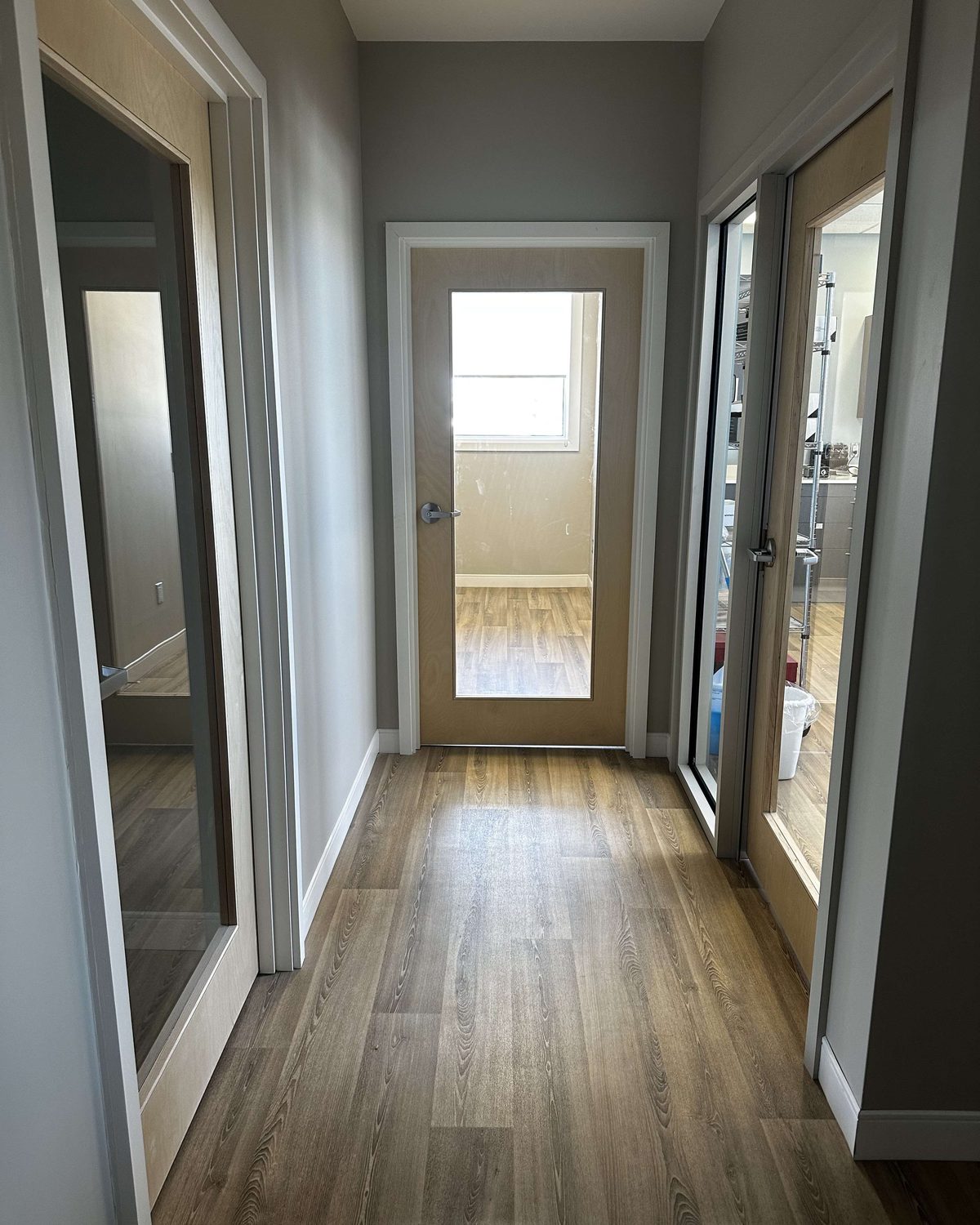
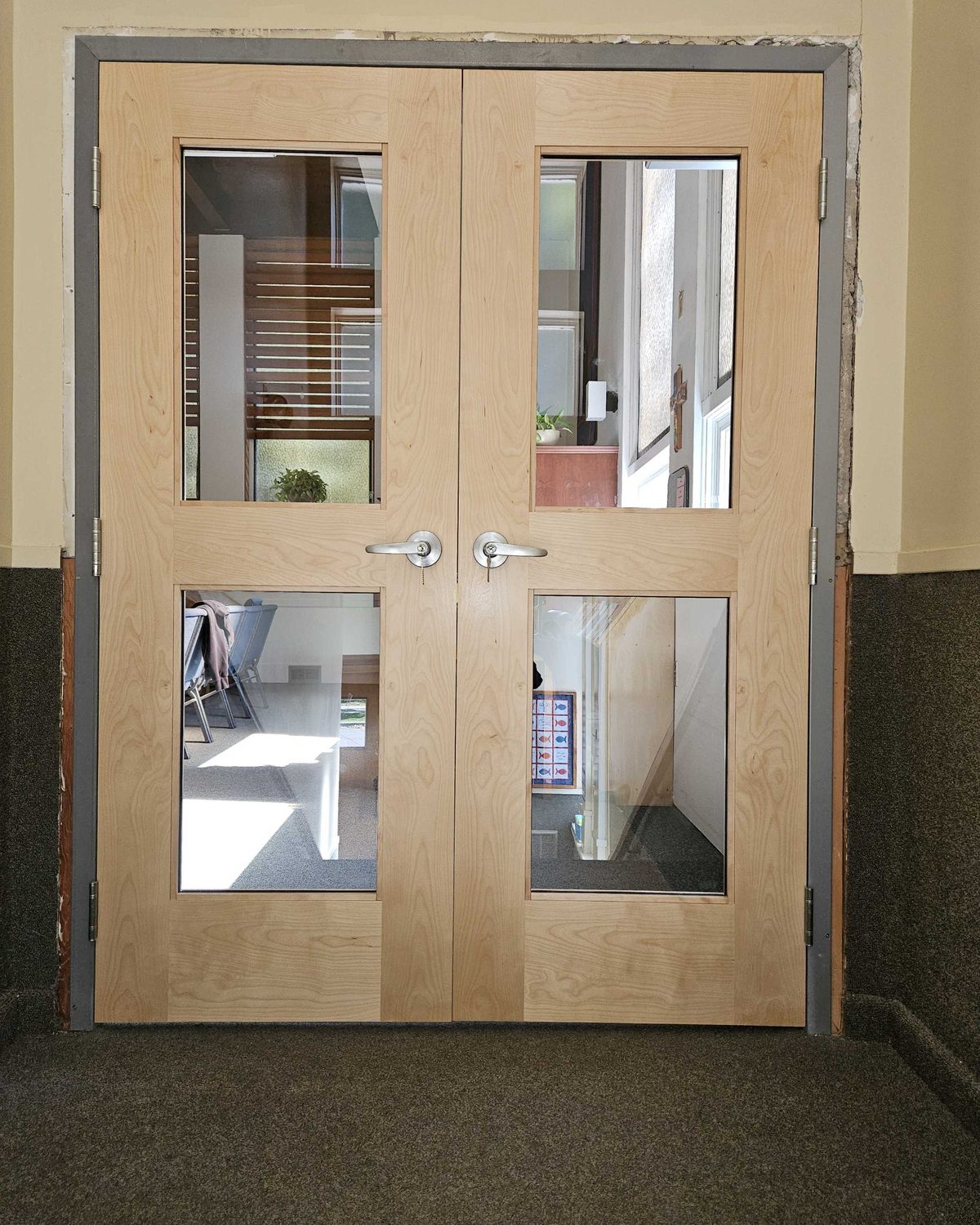
- Glass lites — full-height or narrow — to carry daylight into interior rooms and corridors.
- Flush, minimal faces in veneer or laminate, easy to clean and suited to modern interiors.
- Darker stains and bolder colours on veneer, in place of the all-white interiors of the last decade.
- Space-saving sliding and pocket doors where a swing door will not fit, and folding partitions to divide larger rooms.
Choosing the core
Hollow core for closets and light-duty rooms in a house. Particleboard solid core for ordinary commercial doors. Structural composite or stave core where heavy hardware or abuse is expected. Mineral core where the door must be fire-rated beyond what a 20-minute solid core door covers — and on anything rated, the frame, hinges and lock are part of the same listing.
When a North York condominium replaced every one of its 123 wood doors, each was measured in its own suite and made to its own opening, because no two openings or hardware positions were quite alike — the Sedona Place job is written up in full. For new work, a standard-size wood door takes 1–2 weeks to prepare the hardware and install it; a custom size or specific hardware can take 8–12 weeks to produce the door and source the hardware, then 1–2 weeks to schedule and install. Factory-finished, matched-veneer and fire-rated doors sit at the longer end. See commercial wooden doors for what we supply.
Common questions
Are solid core doors worth the extra cost?
For any commercial opening, yes, because a hollow core door cannot take commercial hardware or a fire rating and will not survive the traffic. In a house, they are worth it wherever sound matters — bedrooms, bathrooms, a home office — and less so for a closet or pantry.
What are the disadvantages of solid core doors?
Weight and cost. A solid core door is several times heavier than a hollow core one, so it needs a sound frame, properly fixed hinges and more care to hang, and it costs more to buy. A mineral-core fire door is also softer inside than a particleboard one, so its hardware reinforcement has to be built in at the factory.
Can you replace a hollow core door with a solid core door?
Usually, yes. A solid core slab of the same size fits the same opening, provided the frame is sound and the hinges are fixed firmly enough to carry the extra weight. On a commercial opening the frame is normally steel and the question does not arise; in a house, check the hinge screws reach the framing behind the jamb.
How do I tell if my door is hollow or solid core?
Knock on the face away from the edges: a hollow core door sounds hollow and drummy, a solid core door gives a dull thud. Lift or swing it: a solid core door is noticeably heavier. A fire-rated door will also carry a label on its hinge edge or top.
Is a solid wood door or a solid core door better?
For most interior and commercial uses, a solid core door. Solid wood looks traditional but moves with humidity, while a solid core door with a veneer face stays flatter, takes any finish and can be made to a fire rating. Solid wood is the choice for heritage looks, not performance.
Pricing a job like this?
Specifying or replacing wood doors?
Send us the door schedule, or a count of the openings and what each one has to do — rating, sound, hardware, finish. We supply the door, frame and hardware as one assembly and install it.