
Commercial & Industrial
Commercial Wooden Doors
Solid-core commercial wood doors — veneer and laminate faces, hung in steel frames, rated where the separation calls for it. Offices, hotels, hospitals, schools and boardrooms across Toronto and the GTA, supplied, installed, refinished and repaired since 1979.
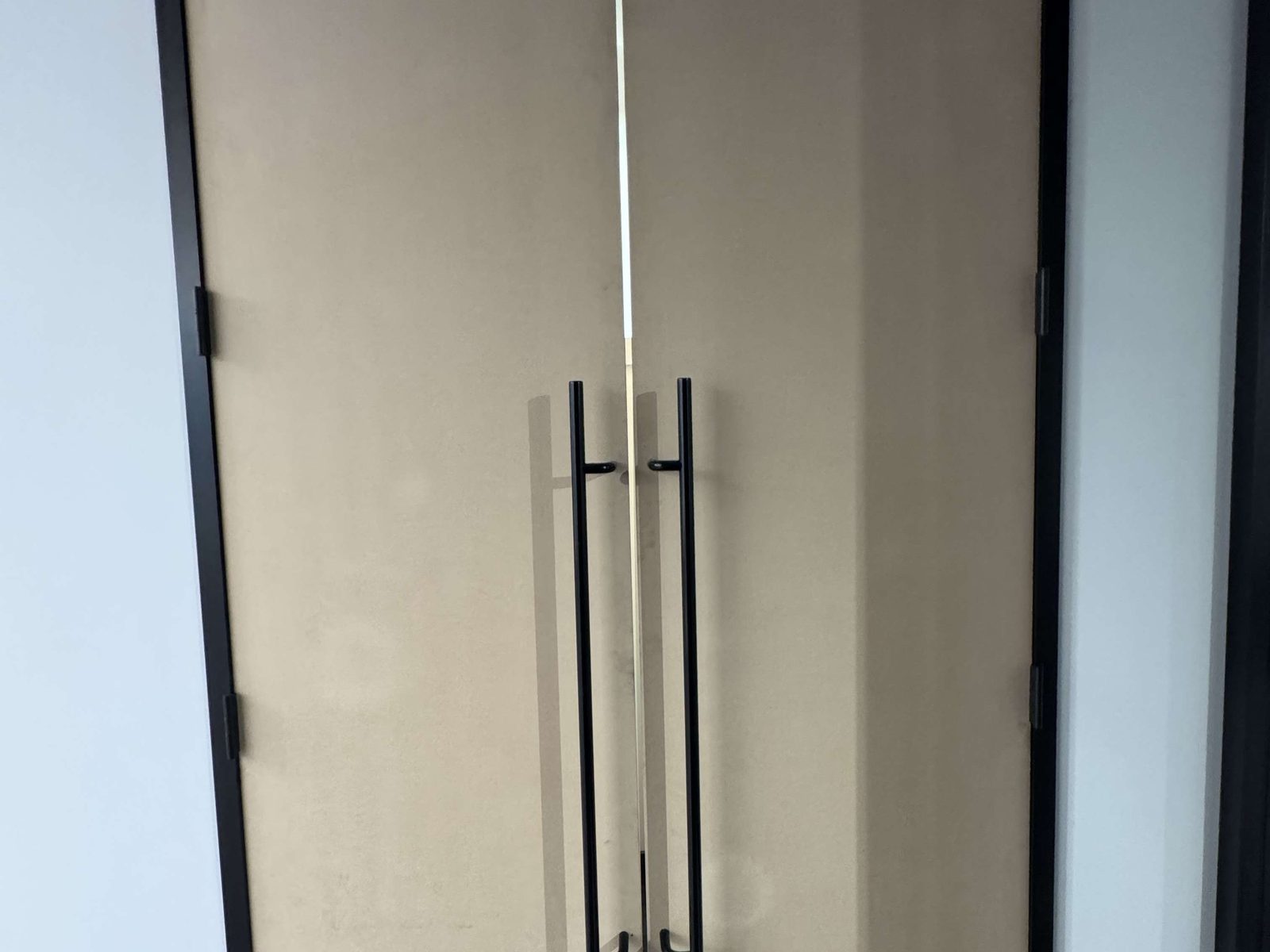
A commercial wood door is the door people actually see: office and boardroom entries, hotel and condo suites, hospital corridors, classrooms and the fit-out doors in every tenant space. It is a solid-core leaf faced in veneer or laminate, edged in hardwood, and hung in a steel frame — which is why it looks like joinery and behaves like commercial hardware.
Canuck Door Systems supplies, installs, refinishes and repairs these doors across the GTA. Most of the work arrives as a fit-out or a refurbishment: a floor of offices, a wing of a building, a hotel corridor. We do the doors, the frames and the hardware together, because on a commercial opening those three things are one decision.
Wood doors we supply, install and service
Specialist wood openings
Where a wood door has to satisfy infection control, guest security or a controlled environment as well as look right.
Hospital, Hotel & Cleanroom Doors
Hospital, hotel and cleanroom doors in wood, laminate and steel — openings specified around infection control, quiet and a cleaning regime.
What is inside a commercial wood door
| Core | What it is | Specified for |
|---|---|---|
| Particleboard | Bonded wood particles, the commercial workhorse | Offices, corridors, general fit-out |
| Staved lumber (SLC) | Glued blocks of solid lumber | Heavier duty, and where a door may be trimmed within limits |
| Mineral | Non-combustible mineral board | Fire-rated assemblies, 20 to 90 minutes |
| Acoustic | Layered dense core with seals and a drop seal | STC-rated openings — meeting rooms, studios, hotels |
| Lead-lined | Lead sheet laminated into the core | X-ray and imaging rooms |
Faces, and how they age
- Wood veneer — maple, birch, oak, walnut, cherry, mahogany; plain-sliced, quarter-cut or rotary; book, slip or random matched. Warm, refinishable, and worth sequence-matching in a corridor of doors.
- Plastic laminate — durable, cleanable, and indifferent to carts and hands. The default in hospitals, schools and back-of-house corridors.
- Factory finish — consistent across a run, cured properly, and the only realistic way to match a large set of doors.
- Site finish — flexible when a colour is still being decided, but slower and harder to keep even across many leaves.
Veneer is thinner than people expect — a fraction of a millimetre. It can be refinished, usually more than once, but it is not solid wood: aggressive sanding goes through it. Where a set of doors is deeply damaged, refacing or replacing the leaf is the honest answer.
Where commercial wood doors go
Office fit-outs
Tenant, meeting-room and private-office doors across a floor.
Hotel & condo suites
Rated at the corridor, finished on the guest side, hung in the hundreds.
Hospitals & clinics
Laminate faces for cleaning, with the rating the corridor requires.
Schools & universities
Classroom doors with vision lites, on hardware chosen before the door.
Boardrooms & executive space
Matched veneer, tall leaves and long pulls, where the door is furniture.
Long-term care & retirement
Resident doors that have to feel domestic and pass an inspection.
Churches & community buildings
Entrance and hall doors in wood, often paired and often rated.
Back-of-house in finished space
Storage, service and riser doors flush with the corridor finish.
What we do with wood doors
- Supply and install — doors, labelled steel frames and hardware as one assembly, made to the opening.
- Match existing floors — species, cut, colour and match, with an honest answer where an exact match to twenty-year-old doors is not achievable.
- Refinish and repair — sanding and refinishing where the veneer allows, edge and corner repairs, and hardware upgrades on doors worth keeping.
- Rated work — mineral-core assemblies on wood fire-rated doors, labelled with their frames.
- Acoustic work — STC-rated wood assemblies with the seals that make the number real, on wood acoustic & soundproof doors.
- Hardware — closers, locks, electrified access control and the reinforcement they need built into the leaf.
Wood door work across the GTA
Recent wood-door jobs from our own records, listed as client and date — documented as dated job folders in the company photo library rather than as written project briefs.
- Keogh ConstructionFebruary 2026
- ONIT ConstructionJanuary 2026
- HN Construction Ltd.December 2025
- ZGEMI Inc.March 2025
- Tri-Phase GroupMarch 2025
- Realcor ConstructionMarch 2025
- Primary Construction Inc.December 2024
- St. Cuthbert's Presbyterian ChurchOctober 2024
One wood door job is written up in full: all 123 suite doors in a North York condominium, each made to its own opening and installed two floors a day around the residents — condo wood door replacement at Sedona Place.
Finished openings for names Ontario knows — Canada’s Wonderland, Tim Hortons, Canadian Tire, the LCBO, Metrolinx, Marriott & Hilton hotels, the University of Toronto — plus hotels, hospitals, schools and offices across the GTA. Dependable people, quality products, since 1979.
Commercial wood door service across Toronto & the GTA
We supply, install, refinish and repair commercial wood doors across the core GTA and out into the Southern Ontario belt, from our shop in Mississauga — usually a floor, a wing or a fit-out at a time.
Core GTA
- Toronto
- Mississauga
- Brampton
- Vaughan
- Markham
- Scarborough
- North York
- Etobicoke
- Richmond Hill
- Oakville
- Burlington
- Milton
Southern Ontario belt
- Hamilton
- Oshawa
- Whitby
- Ajax
- Pickering
- Barrie
- Aurora
- Newmarket
- Bradford
- Guelph
- Kitchener
- Niagara Falls
Not on the list? A fit-out's worth of doors is worth the trip anywhere from Niagara to Barrie — call and ask. See all service areas
What our customers say
Had some doors on our clinic unit repaired. Responded and quotes very quickly. Pricing was fair. Quick turn around time was greatly appreciated.
Canuck Doors provided outstanding service for our new flagship store in Cambridge. Their competitive pricing and superior quality were evident in the flawless installation of our 12-foot oversized glass panels for the storefront system and a side door, a challenging task that nearly all other …
Read the full review
I had an old metal and class commercial door that was sagging. I opted for a re-hinging with new continuous hinge system. Process from quote to job done was very easy and competitive priced. Technicians were on time and did the job professionally. My door opens and closes beautifully.
What drives the price of a commercial wood door
A commercial wood door is priced by what is inside it and what is on the face of it, and the face is where a budget is usually won or lost. What moves the number:
- Core — particleboard, staved lumber, or mineral where the door has to be rated
- Face — plastic laminate, standard veneer, or a premium or matched species
- Whether veneer has to be sequence-matched across a run of doors
- Factory finishing versus site finishing, and the stain or paint specified
- Fire rating, and the hardware reinforcement the listing requires
- Vision lites and louvres, and rated glazing where the door is labelled
- The frame — a new labelled steel frame, or reusing what is in the wall
- Hardware, including closers, electrified locks and access control
Wood doors are made to the opening. Sizes, undercuts and prep are set at the order stage — a commercial leaf is not something to trim on site, and a rated one cannot be.
Common questions about commercial wood doors
What is a commercial wood door?
A solid-core door built to a commercial standard and hung, in almost every case, in a hollow metal frame. The core is particleboard, staved lumber or mineral board; the faces are wood veneer or plastic laminate; and the edges are hardwood or rated composite so the door holds hardware. What separates it from a residential interior door is the core, the hardware reinforcement and the fact that it is made to the opening rather than bought off a shelf.
What is the difference between solid core and hollow core?
Hollow-core doors have a cardboard honeycomb inside and belong in houses. A commercial solid-core door has a continuous core — particleboard, staved lumber or mineral — which gives it mass, stiffness, sound attenuation and something for hinges and locks to hold. Hollow core in a commercial corridor fails quickly: the hardware works loose, the faces dent, and it does nothing for noise.
Can commercial wood doors be fire-rated?
Yes — with a mineral core, rated edges and a labelled steel frame, wood doors are certified at 20, 45, 60 and 90 minutes. It is how hotels, hospitals and offices meet a rating without putting a steel door in a finished corridor. The details are on our wood fire-rated doors page.
How long do commercial wood doors last?
Decades, if the frame and the hardware are right. What usually ends a commercial wood door early is not the wood: it is a closer slamming it into the frame, hinges pulling out of an unreinforced edge, or moisture at the bottom rail in an entrance vestibule. Faces can be refinished, edges repaired and hardware upgraded — replacing a whole floor of doors is rarely the first answer.
Can wood doors be refinished instead of replaced?
Often, and it is a fraction of the cost. Veneer faces can be sanded and refinished where the veneer thickness allows, damaged edges repaired, and hardware and closers replaced. Where refinishing does not work is on doors whose veneer has been sanded before, delaminated faces, and water-damaged bottom rails — and on rated doors, where any repair has to stay within the listing.
What veneer species can we get?
Maple, birch, oak, walnut, cherry and mahogany cover most commercial work, in plain-sliced, quarter-cut or rotary cuts, with book, slip or random matching. Plastic laminate is the alternative where durability matters more than grain — hospitals, schools and back-of-house corridors — and it is far easier to keep looking new.
Do wood doors hang in steel frames?
In commercial buildings, nearly always. A hollow metal frame is the standard partner for a commercial wood door: it holds its shape, takes the hinge and strike reinforcement, and is what a rated assembly is listed with. That is why our wood doors and our steel frames are quoted together — see steel door frames.
How long do commercial wood doors take?
If the wooden door is a standard size, it takes 1–2 weeks to prepare the hardware and install it. If the door is a custom size or needs specific hardware, it can take 8–12 weeks to produce it and source the hardware. Then 1–2 weeks to schedule the job and install them, depending on the size of the project. Factory-finished, matched-veneer and rated doors sit at the longer end of that, because the finishing and the certification are part of the fabrication. Once the doors are here, a single opening is usually a day's work, and a full building of suite or classroom doors is phased over several weeks.
A floor of doors to supply — or a tired set to bring back?
Send us the schedule, the finish you have to match, or a photo of what is there now, and we'll quote it.