
Commercial & Industrial
Commercial Door Hardware
Closers, exit devices, locks, hinges, thresholds and seals — specified, fitted, adjusted and repaired on the doors they belong to. We are a door contractor rather than a catalogue, which is the difference between hardware arriving and hardware working. Across Toronto and the GTA since 1979.
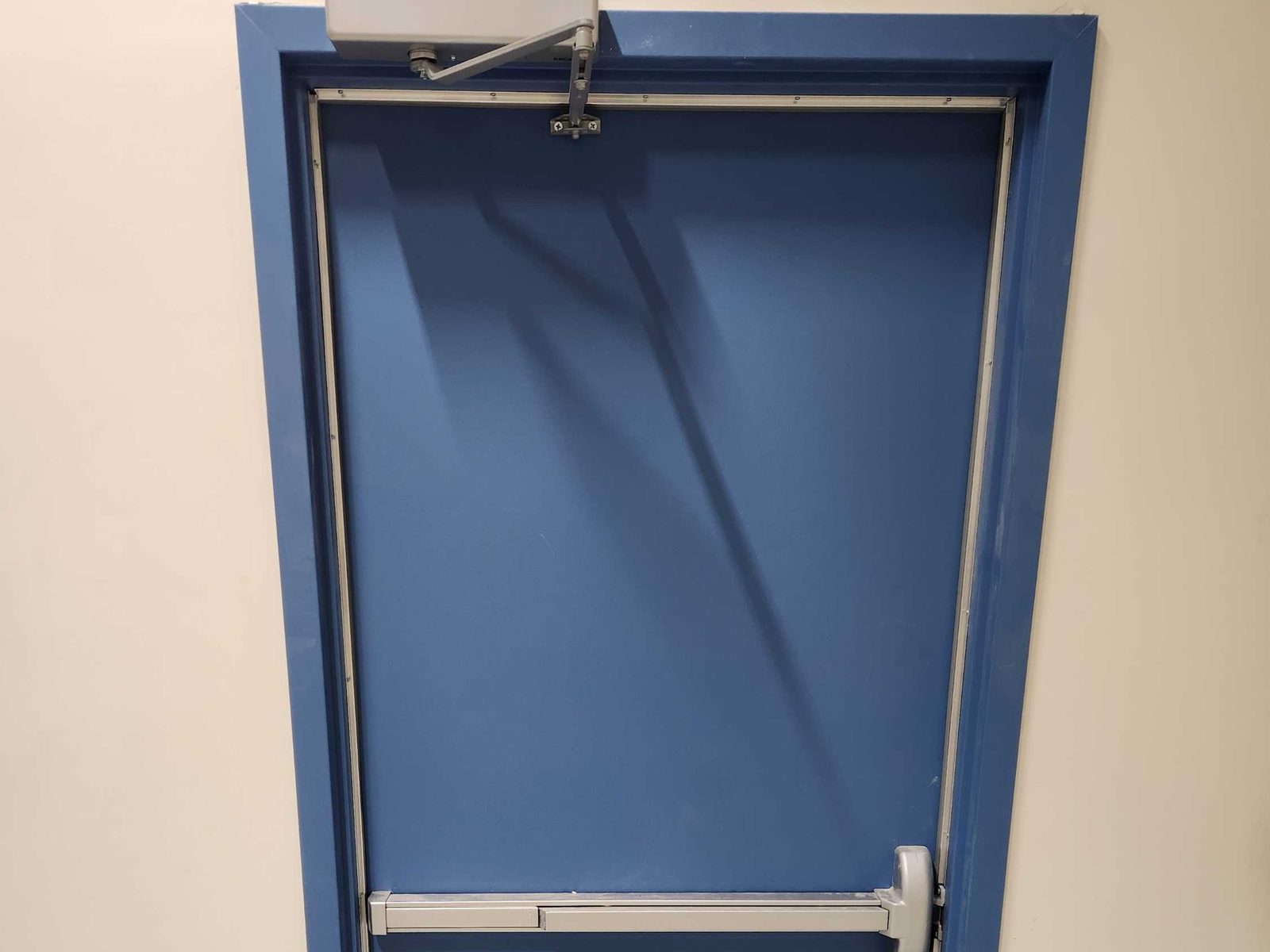
Search for commercial door hardware and you will find suppliers: catalogues, part numbers and same-day shipping. That is a real service and sometimes it is exactly what you need. It is not what we do.
We are a door contractor. Hardware reaches us as part of an opening — a closer sized to the leaf it has to control, an exit device that matches what the Building Code asks of that exit, a strike that lines up with a frame that has moved since 1994, a keyway that fits the way the building is actually run. Fitting and adjustment are most of the value, and neither ships in a box. Canuck Door Systems has been doing it across Toronto and the GTA since 1979.
Door hardware pages
Seals & perimeter
The hardware that decides whether the opening is sealed once it is closed.
Perimeter gasketing, sweeps, automatic door bottoms, thresholds and astragals — the parts that decide whether a closed door is actually shut.
The hardware on a commercial opening
Every door is the same short list of parts. What changes between a stairwell, a suite entry and a cold-room door is which grade of each, and what the code says about it.
| Hinges | Butt hinges in standard, heavy or ball-bearing weight; continuous (piano) hinges where a heavy leaf has to stay aligned for decades |
|---|---|
| Closers | Surface-mounted, concealed in the frame, or floor-mounted. Sized to the leaf and adjustable for sweep, latch and backcheck |
| Locksets | Cylindrical for economy and speed; mortise where the door is heavy, busy or an entrance |
| Exit devices | Rim, mortise, and surface or concealed vertical rod. Fire exit hardware carries a label and cannot be dogged |
| Strikes | Standard, electric, or an electric strike interfaced with access control |
| Electrified hardware | Maglocks, electrified locksets, power transfer hinges, request-to-exit devices, delayed egress where permitted |
| Protection | Kick, mop and armour plates; edge guards where carts and pallets make contact |
| Pairs | Astragals, coordinators and flush bolts, so both leaves close in the right order and latch |
| Perimeter | Thresholds, gasketing, sweeps and automatic door bottoms — see weatherstripping and seals |
| Keying | Master key schedules, restricted keyways, and the cylinders to match |
Grades — the number that actually matters
Commercial hardware is graded by testing, and the grade is a cycle count more than anything else. The heaviest commercial grade of lockset is tested to around a million open-close cycles; the lighter grades to a fraction of that. A door used two hundred times a day reaches a million cycles inside fifteen years, which is why grade is not an upsell on a busy opening — it is the difference between hardware that lasts a decade and hardware that is replaced twice in three years.
The same principle runs through closers and exit devices. Two practical rules from doing this for forty-odd years:
- Match the grade to the traffic, not to the building's prestige. The back door of a warehouse takes more abuse than the executive floor.
- Match it across the opening. Grade 1 hardware on a door with tired hinges and a bent strike will fail early anyway, and it will look like the hardware's fault.
What the code has to say
Three requirements come up on nearly every commercial job, and they are all worth knowing before hardware is ordered.
- Fire-rated openings. A fire door assembly must be self-closing and positive latching — it has to latch every single time it closes. Hardware on a labelled door must be listed for that use, and fire exit hardware cannot be dogged down in the open position. Held-open rated doors are only permitted on hold-opens that release on alarm.
- Exits. Where the occupancy and occupant load require it, exit doors need panic or fire exit hardware, and a door on an exit route must be openable without a key, a tool, or special knowledge.
- Accessible routes. There are limits on the force needed to open a door, and hardware has to be operable without tight grasping, pinching or twisting — which is why levers replaced knobs, and why a stiff closer on an accessible door is a compliance problem and not just a nuisance.
If your building has rated openings, the annual fire door inspection is the least expensive hardware audit there is: it goes door by door and produces the list of what fails.
What goes wrong, and what it usually is
| Symptom | Usually | Sometimes |
|---|---|---|
| Door will not latch | Closer too weak for the seal, or a strike out of alignment | Hinges worn and the leaf dropped; a door that has swollen |
| Door slams | Closer valves misadjusted, or a closer sized above the door | Wind load on an exterior opening with no backcheck |
| Door will not close fully | Closer at the end of its life, or a hinge screw pulled out of the frame | A dropped leaf binding on the threshold |
| Handle loose or spins | Fixings backed off, or a spindle worn round | Lockset at the end of its cycle life — usually a light-grade set on a busy door |
| Key turns but nothing happens | Cylinder tailpiece or cam | Lock body failing internally |
| Pair does not close in order | Missing or maladjusted coordinator | Astragal fouling; flush bolts out of adjustment |
| Exit device rattles or drags | Vertical rods out of adjustment | The frame has moved and the top latch no longer engages |
| Electric strike buzzes but the door stays locked | Alignment between strike and latch | Voltage drop over a long run, or a failing power supply |
Roughly nine in ten "the door is broken" calls we take are hardware, not the door. That is the good news — most of them are fixed in a single visit for a small fraction of what the caller feared.
Where we do this work
Office buildings
Suite entries, stairwell doors and washrooms, changed floor by floor around tenants and usually after hours.
Schools & universities
High-abuse openings on a master key system, with rated corridor doors that have to latch every time.
Hospitals & clinics
Hardware chosen for cleaning, for one-handed use, and for doors that never stop moving.
Retail & franchise
Back-of-house exits, delivery doors and the storefront entrance hardware customers touch all day.
Warehouses & distribution
Man doors beside the docks, where the abuse is carts, pallets and weather rather than volume.
Manufacturing plants
Mechanical and electrical rooms, plus openings where dust, washdown or temperature rules out a standard finish.
Condominium & residential property
Common-area doors, stairwells, garages and lockers — the openings a property manager gets called about.
Municipal & institutional
Buildings that are audited: rated openings, exit hardware, and accessible operating force on every accessible route.
How a hardware job usually runs
- Survey. Door by door: what is fitted, what it is doing, what the opening's job is, and what the rating or exit requirement demands.
- Schedule. One document that says what goes on each opening, in one finish family and one key system. This is the deliverable that saves money later.
- Supply. Common items in days to a couple of weeks; electrified, restricted-keyway and labelled hardware longer. For a whole-building schedule, plan on 4–6 weeks to supply once approved.
- Fit and adjust. Machining where the door was never prepped for it, then closers set for sweep, latch and backcheck, and strikes aligned.
- Come back. Doors move as buildings settle and seasons change; the adjustment visit six months later is what makes the difference between hardware that works and hardware that was installed.
Door work across the GTA
Hardware is rarely the subject of a photograph — these are documented door jobs from our own project files, every one of which carried a full hardware schedule.
AVR Underground Co. LTD
The installation of new exterior Glass Aluminum storefronts with automatic door operators and hollow metal…
Toys R US
Supply and installation of steel doors and frames , glass, and hardware.
CuraLeaf Holdings
This is interior expansion project for Curaleaf at a site, Brampton…
Allyant Design
St. Joseph's Healthcare Hamilton
Omni King Edward Hotel
Four decades of doors and hardware for names Ontario knows — Canada’s Wonderland, Tim Hortons, Canadian Tire, the LCBO, Metrolinx, Marriott & Hilton hotels, the University of Toronto — plus thousands of businesses across the GTA. Dependable people, quality products, since 1979.
Door hardware work across Toronto & the GTA
We fit, adjust and repair commercial door hardware right across the core GTA and out into the Southern Ontario belt, from our shop in Mississauga. Hardware work is rarely one door — it is usually a floor, a building or a portfolio, and it is scheduled around the tenants.
Core GTA
- Toronto
- Mississauga
- Brampton
- Vaughan
- Markham
- Scarborough
- North York
- Etobicoke
- Richmond Hill
- Oakville
- Burlington
- Milton
Southern Ontario belt
A single failed closer is not worth a drive to Barrie and we will say so. A hardware survey across every door in a building is — and that is how most of our belt hardware work starts, usually alongside the annual fire-door inspection. See all service areas
What our customers say
I called in on Saturday as the back entry door of my restaurant had an issue with the panic bar! They serviced my door same day as it was an emergency and the service tech Ahmed did a wonderful job and answered all my concerns! They even changed the lock for me and fixed the door. …
Read the full review
I had an old metal and class commercial door that was sagging. I opted for a re-hinging with new continuous hinge system. Process from quote to job done was very easy and competitive priced. Technicians were on time and did the job professionally. My door opens and closes beautifully.
As a small Landlord in the East end of Toronto I respond to my Tenants professionally in a timely cost effective way. This occurred over the Xmas holidays with a broken commercial door hinge. …
Read the full review
What commercial door hardware costs
Hardware is the least expensive part of a door and the most expensive part to get wrong, because it decides whether the opening latches, closes and locks for the next fifteen years. What moves the number:
- Grade — heavy-duty commercial hardware is tested to far higher cycle counts than the retail equivalent
- What the opening does: a stairwell exit, a suite entry and a mechanical room are three different specifications
- Fire rating, which dictates labelled hardware, self-closing and positive latching
- Whether the door is on an exit route, which can require panic or fire exit hardware
- Electrification — strikes, maglocks, electrified locksets, and the power transfer to get current into a moving leaf
- Keying: how the building is mastered, and whether the keyway is restricted
- Finish and consistency across a floor or a building
- Whether the existing door and frame are prepped for what you want, or need machining
- Labour access — after-hours work on occupied floors, and how many openings are done in one visit
The most expensive hardware decision is a mixed building: eleven closers from five makers, three keyways and a stairwell nobody can standardise. A hardware survey that produces one schedule is usually less expensive in year two than the savings that created the mess.
Common questions about commercial door hardware
What is the difference between commercial and residential door hardware?
Cycle life, mostly, and then everything that follows from it. Commercial hardware is graded and tested against a number of open-close cycles — the heaviest commercial grade runs to around a million — where residential hardware is built for a door used a few times a day. Commercial hardware also has to satisfy things a house never faces: fire ratings, exit requirements, accessibility limits on operating force, master keying and electrification. A retail lockset on a public washroom door will physically fit and will fail within a year.
What is panic hardware on a commercial door?
A device that unlatches a door when someone pushes against a horizontal bar or pad running across it — so a crowd moving toward an exit opens it simply by arriving at it. It is required on exits serving certain occupancies and occupant loads, which is a Building Code question rather than a preference. "Panic hardware" and "fire exit hardware" are not interchangeable: fire exit hardware is panic hardware that carries a fire label, and it cannot be dogged down, because a fire door has to latch every single time it closes.
What are the different types of commercial door handles?
By function, four families cover almost everything. Cylindrical locksets pass through the door and are the standard, economical choice. Mortise locksets sit in a pocket machined into the leaf edge — heavier, longer lived and the usual specification for entrances and high-traffic doors. Exit devices replace both on exit doors. And push-pull hardware goes on doors that never latch. Levers rather than knobs are the norm on any accessible route: a lever can be worked with a closed fist, which is the test that matters.
What are the parts of a commercial door?
The opening is the leaf, the frame, and the hardware that connects them. That hardware, in the order it usually fails: hinges or a continuous hinge; a closer; a lockset or exit device; a strike in the frame; a threshold and seals at the perimeter; protection plates where carts and feet land; and, on rated or paired doors, a coordinator, flush bolts, an astragal and labelled gasketing. Almost every "the door is broken" call turns out to be one item on that list rather than the door itself.
Why does my door not latch, and does it matter?
It usually means the closer, the strike alignment or the hinges — a door that has dropped, a closer that is too weak to overcome a stiff seal, or a strike that no longer lines up after the frame moved. On an ordinary door it is an annoyance. On a fire-rated door it is a failure: a fire door has to close and positively latch every time, and a door held closed only by its seal does nothing in a fire. That is one of the first things a fire-door inspection checks.
Can you re-key a whole building?
Yes, and it is usually a better project than it sounds, because the real question is not the keys but the key system. Buildings that have been added to over decades end up with several keyways, no working master and a cabinet of keys nobody can account for. We rebuild the schedule — which doors group together, who holds what, whether the keyway should be restricted so keys cannot be copied at a kiosk — and then change the cylinders to suit it.
How long does hardware take to arrive?
Common commercial closers, cylindrical locksets and exit devices in standard finishes are usually a matter of days to a couple of weeks. What stretches is anything special: electrified hardware, restricted keyways, non-standard finishes, and hardware for a rated opening where the label dictates the part. For a whole-building schedule, plan on 4–6 weeks to supply once the schedule is approved, then 1–2 weeks to schedule the labour — and doors on occupied floors are normally changed after hours.
Do you supply hardware without installing it?
We are a door contractor, and hardware is most valuable to a client when it comes with the specification, the machining, the fitting and the adjustment — the parts that decide whether the opening works. We are dealers for many door hardware distributors. We can source and supply the hardware according to your hardware schedule; it may well end up coming from a dozen different suppliers. We will do all of that work for you and prepare your door hardware package.
Hardware to specify, or a door that will not latch?
Tell us what the opening is and what it is doing wrong. Most hardware problems are diagnosed from a description and two photographs, and quoted from there.