
Residential · 24 hours a day, every day
Garage Door Repair
A garage door that will not open, will not close, or came down with a bang. We repair every make of residential garage door across Toronto and the GTA — springs, cables, rollers, tracks, sections and hinges — whoever installed it, and we replace failed openers rather than rebuild them. The line is answered 24 hours a day, and crews dispatch from our own shop in Mississauga.
Call 800-522-6825Book a Repair
All makes, whoever installed it · spring sizes, cables and rollers carried · commercial door contractors since 1979
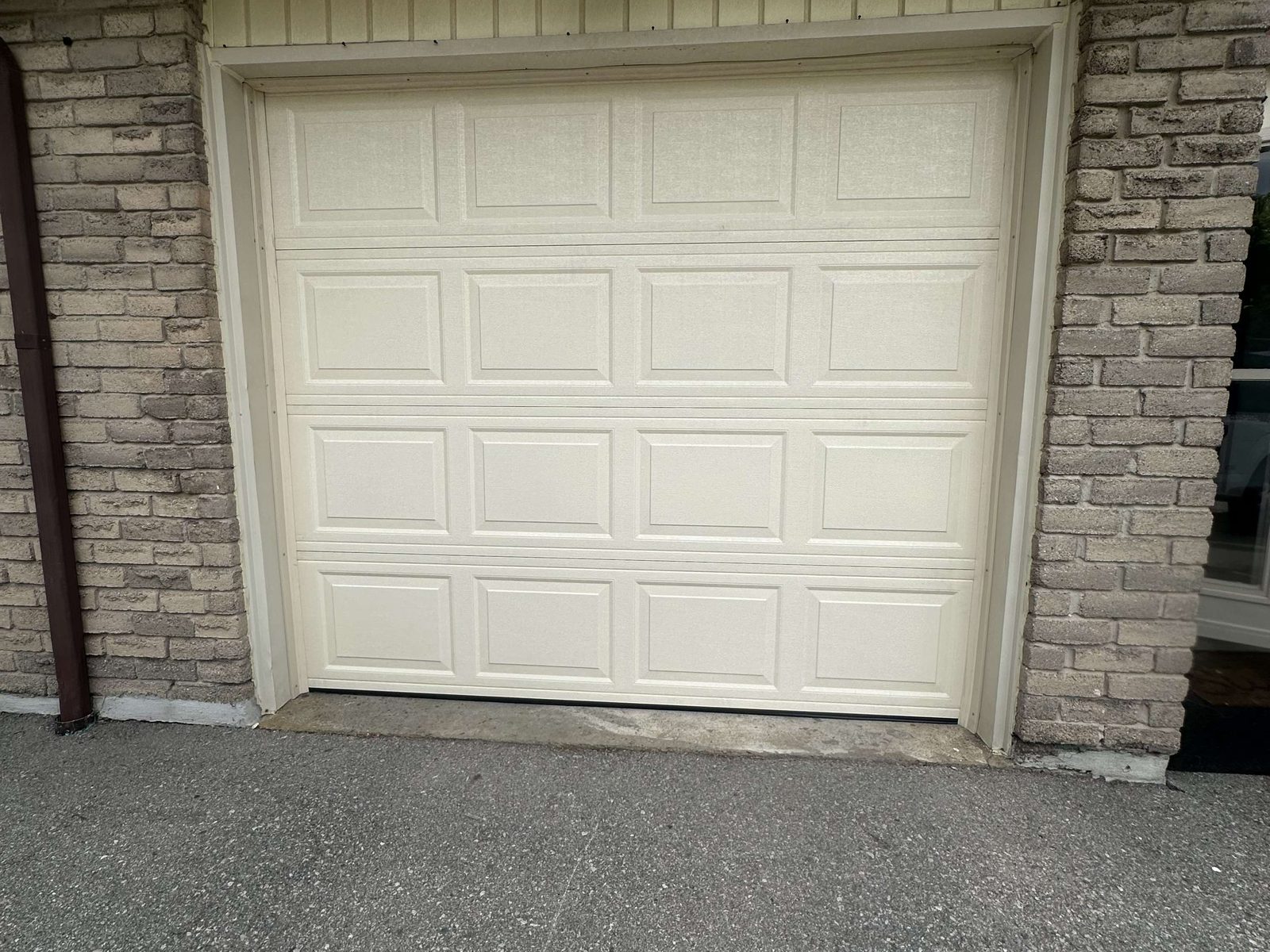
If the garage door will not open, will not close, or came down with a bang, call 800-522-6825. The line is answered 24 hours a day. On a booked repair most jobs are one visit and one to two hours on site — including the failure that brings most people to this page, a broken torsion spring, because we carry the residential spring sizes along with the cables, drums and rollers. Tell us what the door is doing when you book and the right stock comes with the technician; where the exact size turns out not to be on the truck, we order it and return.
Canuck Door Systems has been a door contractor since 1979. Most of our work is commercial — the overhead doors on warehouses, plants and dealerships across the GTA — and the same technicians, trucks and parts stock look after houses. That is the practical difference between us and a garage-door-only outfit: the person diagnosing your door does the same thing on a hundred-cycle-a-day industrial door, and is not learning on yours.
Call, don't fill in a form
If the door is down, the phone is the fast route. Four answers are enough to send the right technician with the right parts:
- The address, and whether the garage can be locked — this is what sets the priority, not how annoying the fault is.
- What the door is — single or double, sectional panels or a one-piece tilt door, and roughly how old.
- What it is doing — will not lift, will not close, stuck part-way, crooked in the track, or the motor runs but the door does not move.
- Whether you heard a bang. That one answer usually identifies a broken spring before anyone is on site, and it changes which parts come on the truck.
What we repair, and what it usually turns out to be
| What you're seeing | Usual cause | What the repair involves |
|---|---|---|
| Loud bang, then the door will not lift at all | Broken torsion spring — the most common failure by far | Spring replacement matched to the door's weight, normally fitted and rebalanced the same visit |
| Door lifts a foot and stops, or feels enormously heavy | Broken spring, or a spring that has lost its rating | The same job; do not keep trying the opener, it will strip the gears |
| Door is crooked, jammed, or hanging at one corner | Cable off the drum or snapped | Cable and drum work, re-levelling the door, and checking the spring behind it |
| Screeching, grinding or banging on every cycle | Dry or worn rollers, loose hinges, door out of balance | Rollers, hinges and a balance check — the least expensive visit on this list |
| Opener runs, door does not move | Trolley released, or the drive inside the opener has failed | Re-latch the trolley; if the motor still runs free, the opener is replaced rather than rebuilt |
| Door reverses just before it closes | Photo eyes misaligned or dirty | Wipe the lenses and straighten the brackets — a homeowner job, and never bypass them |
| Door will not close from the remote but will from the wall button | Photo eyes obstructed, or a flat remote battery | Check the lenses and the battery first; a dead receiver means a new opener |
| Bottom of the door is rusted, split, or the seal has gone | Salt, water sitting on the slab, and age | New bottom seal and retainer; a rusted-through bottom section is replaced |
| Door came off its track after being hit | Impact — usually a vehicle | Track straightening or replacement, section repair, and a look at what it hit |
| Gaps at the sides, daylight, cold garage | Perished weatherseal, or a door hung out of square | Perimeter seal and bottom seal; re-squaring where the frame has moved |
Two symptoms mean stop using the door immediately rather than "try it again in the morning": a bang followed by a door that will not lift, and a door hanging crooked in its track. Both mean the counterbalance has failed, and running the opener against a failed counterbalance is how a spring job becomes a spring, drum, cable and opener job.
Springs and cables: what actually breaks
The spring lifts the door, not the opener
A double door weighs well over 100 kg. The torsion spring stores enough energy to counterbalance all of it; the opener only supplies the push. That is why a broken spring stops everything.
Springs are rated in cycles, not years
One cycle is one open and one close. A door used four times a day and one used twenty times a day wear at completely different rates, and nothing about the two doors looks different.
They fail suddenly, and loudly
There is rarely a warning. The bang people describe as a gunshot in the garage overnight is a torsion spring letting go inside its shaft.
A spring is matched to your door
Wire size, inside diameter, length and wind direction, set against the door's weight and drum. Get the rating wrong and the door is out of balance and the opener pays for it.
Change the pair, not the one
Where a door has two springs and one breaks, the other is the same age with the same cycles on it. Replacing both costs less than being here twice.
Cables go with them
The lift cables run from the bottom bracket to drums on the shaft, under the same tension. A frayed cable, or one that has jumped its drum, drops a corner of the door.
Never a homeowner job
Torsion springs, cables, drums and bottom brackets are all under stored tension. This is the one part of a garage door where a video and a set of pliers puts people in hospital.
What you can safely do
Rollers, hinge bolts, the bottom seal, remote batteries, keypad codes and wiping the photo-eye lenses. All fair game, and all worth doing.
Full detail on ratings, cable failures and what a replacement involves: garage door spring & cable replacement.
When it is the opener rather than the door
Roughly a third of "the garage door is broken" calls turn out to be the opener. That is a different job with a different answer, and it is worth knowing which one you have before you spend anything.
We do not repair openers. On a residential unit a logic board, a gear kit or a motor costs a large fraction of a new opener installed, and it goes into a machine whose remaining parts are exactly the same age — so we quote a replacement instead. We supply and fit LiftMaster and Chamberlain, belt, chain and jackshaft, and a straight swap is normally one visit. The full arithmetic is on opener repair or replacement.
Two opener faults cost nothing and do not need us at all, and they are the two we are called out for most:
- Dirty or knocked safety photo eyes. The sensors either side of the opening, about 150 mm off the floor. A smeared lens or a nudged bracket stops the door closing exactly as a child would. Wipe both and check the brackets.
- A flat remote battery. If the wall button still works, the motor is fine.
There is a test that separates the two halves in thirty seconds: with the door closed, pull the red release cord and lift it by hand. If it comes up smoothly and stays put at waist height, the door is sound and the opener is the problem. If it is enormously heavy, the counterbalance has failed and that is a repair — ours, and the one on this page.
A door that is out of balance also destroys openers quietly over months, which is why an opener that failed at six or seven years is usually telling you about the door rather than about itself.
How long each repair takes
- Springs and cables — normally one visit, one to two hours. The residential spring sizes, cables and drums are carried, so the door is usually re-sprung and rebalanced before the technician leaves. Where your door takes a size that is not on the truck, it is ordered and fitted on a booked return.
- Other carried parts — rollers, hinges, drums, seals and cables: same visit again.
- Sections — a damaged panel on a sectional door is ordered to match, then swapped on a scheduled visit, normally in under a day.
- A new opener — usually same visit, since we carry the LiftMaster line we fit most. We replace openers rather than repair them; the reasoning is on opener repair or replacement.
- A full new door — allow 4–6 weeks to produce it once the opening is measured, then 1–2 weeks to schedule the install, because the door is made to your opening rather than pulled off a shelf.
On a commercial overhead door the spring answer is different, and worth knowing if you also look after a building: those springs are wound to the individual door over 1–2 days, so that job is two visits. See commercial overhead door springs & parts.
When a repair stops being the right answer
We would rather tell you this on the phone than after an invoice. A door is worth repairing while the door itself is sound — everything mechanical on it is replaceable. Replacement becomes the better value when:
- the bottom section has rusted through, which is where road salt and standing water finish a steel door;
- panels are bent across their width from an impact, or dented repeatedly over years;
- the profile is discontinued and a matching section can no longer be had;
- the door is uninsulated and the garage is attached to heated rooms, in which case a replacement pays for part of itself;
- you are on the third repair in two years and each one has been a different part — that is a door at the end of its service life, not bad luck.
Where that is the answer, the door is made to your opening: see new garage doors.
The same crews maintain doors for names Ontario knows — Canada’s Wonderland, Tim Hortons, Canadian Tire, the LCBO, Metrolinx, Marriott & Hilton hotels, the University of Toronto — plus warehouses, dealerships, schools and several thousand houses across the GTA. Dependable people, quality products, since 1979.
Before you call — three things worth knowing
- You do not need to know what is wrong. Describe what the door is doing and whether you heard a bang. Diagnosing it is our job, and the wrong guess only matters if it sends the wrong parts.
- Ask what the attendance charge is. We quote it before dispatching. Getting that number on the phone is the single best question a homeowner can ask any trade.
- Say if it can wait. A noisy door, a slow opener or a door that still locks is a daytime booking at the ordinary rate, and we will say so rather than sell you an emergency — see what actually counts as an emergency.
What our customers say
After having Canuck Door Systems replace the springs in our garage door opening system earlier this year, we continued to have problems with the operation of the door. After an attempt to fix this did not last, Stan ascertained that we needed a new motor, which Sergei installed. …
Read the full review
My garage door had issues last week after the winter storm. As soon as I closed it opened again. There was a sticker on the machine and I googled the company and had good reviews. I called the company and was provided service the same day and the issue was identified. …
Read the full review
Excellent service. The technician was on time (actually he arrived early), and got the job done as per the quoted price and time required. Would definitely use them for any future garage door repairs; which hopefully won't be for a long time.
Garage door repair across Toronto & the GTA
Crews dispatch from our shop at 1645 Bonhill Road in Mississauga — central to the region rather than at one end of it — and the line is answered 24 hours a day, every day of the year, including holidays.
Core GTA
- Toronto
- Mississauga
- Brampton
- Vaughan
- Markham
- Scarborough
- North York
- Etobicoke
- Richmond Hill
- Oakville
- Burlington
- Milton
Southern Ontario belt
Garage door repair travels further than most of what we do, because the parts ride on the truck and the job is an hour or two rather than a crew and a lift. Niagara and Barrie are a long drive for a 2am call and we will say so on the phone — a daytime booking there is straightforward. See all service areas
What a garage door repair costs
A repair is labour plus the part plus the hour of the call. Which of the three dominates depends on what actually failed:
- What broke — rollers and hinges are the least expensive visit on the page, a spring set and a replacement section are at the other end
- Whether the part is on the truck or has to be ordered: springs, cables, rollers, hinges and drums are carried, though not every spring size on every vehicle; a replacement section is always made to match your door
- Single or double door, and whether a pair of springs is being changed rather than one
- The hour — after-hours, weekend and holiday call-outs carry a labour premium on the labour, not on the parts
- Whether the door is sound and only its hardware failed, or a section is bent and has to be replaced
- Headroom and how the door is sprung — a low-headroom or side-mount conversion is a different job from a standard torsion set
- Whether the real cause is the door or something that keeps hitting it
We give you the attendance cost on the phone before a truck rolls, and the repair cost once the technician has seen the door. Where a door is at the end of its life we say so and quote a replacement instead — on a rusted-through or repeatedly bent door, another set of parts is the expensive option.
Common questions
How much does it cost to repair a garage door?
It is attendance plus labour plus the part, and the part is what moves the number. Rollers, hinges and a cable off its drum are at the inexpensive end; a spring set, a bent section or a new opener are at the other. Two things are worth knowing before you ring anyone. First, ask what the attendance charge is — we quote it on the phone before a truck leaves, and a company that will not is a company you find out about on the invoice. Second, the parts do not cost more at midnight; the after-hours premium is on the labour, and it is disclosed.
What is the most common garage door repair?
Broken torsion springs, by a wide margin, followed by cables off the drum. The spring stores the energy that lifts the door — the opener only steers it — so when a spring goes the door becomes its true weight, well over 100 kg on a double, and nothing lifts it. It is also the failure that announces itself: a bang like a gunshot from the garage, and a door that will not move. After springs come worn rollers and hinges, tracks knocked out of line, and safety photo eyes that have been knocked out of alignment.
Do you repair garage doors you did not install?
Yes, and that is the majority of what we do. Cables, rollers, hinges, drums, tracks, bottom seals and rollers fit across makes, and a spring is matched to the door's weight and drum size rather than bought as a brand part — so the make of the door does not decide whether we can spring it. Where a door is genuinely obsolete and a section can no longer be matched, we will say so instead of selling you a repair that will not last.
How long does a garage door repair take?
Usually one visit, and one to two hours on site. Cables, rollers, hinges, drums, seals and a range of residential spring sizes ride on the trucks, so most faults are diagnosed and finished the same visit — which is why it helps to describe the door and the symptom when you book. Two things take a second visit: anything made to your opening (a damaged section, a whole new door), and the occasional job where the exact spring your door takes is not on the truck that day. Commercial overhead doors are a different matter again — those springs are wound to the individual door over 1–2 days, so they are always two visits.
Can a damaged garage door be repaired, or does it need replacing?
Usually repaired, up to a clear line. Everything that moves — springs, cables, drums, rollers, hinges, tracks, seals and the operator — is replaceable, and a door with new moving parts is effectively renewed. On a sectional door a single damaged panel can be swapped rather than the whole door. The line is the door itself: rusted through along the bottom, repeatedly dented, bent across its width, or a discontinued profile that cannot be matched. We will tell you which side of that line you are on, with a number for each option.
Can I replace a garage door spring myself?
Please do not. A torsion spring holds the entire counterbalance energy of the door — the whole weight of it, stored — and releasing it without the correct winding bars and technique causes serious injuries every year. It is also not a job where partial knowledge helps: the spring has to be matched to the door's weight and drum size, and the wrong rating quietly destroys the door and then the opener. Cables are under the same tension and are no safer. Rollers, hinges, weatherseals, remotes and photo-eye alignment are all reasonable homeowner jobs; springs, cables and drums are not.
How do I open the garage door when the power is out?
Pull the emergency release — the red cord hanging from the trolley on the opener rail — and the door disconnects from the operator so it can be lifted by hand. Do this with the door closed wherever you can: if a spring is broken, the door is no longer counterbalanced and releasing it part-open lets it fall. If the door is open and you must get it down, have a second person and take the weight. Once power is back, close the door and pull the release cord again (or run the opener) to re-engage the trolley.
My garage door is noisy. Is that worth a call?
Yes, and it is the least expensive call you will make on this page. Noise is almost always dry or worn rollers, loose hinges, or a door out of balance — all inexpensive now, and all of them things that wear the spring, the opener and eventually the sections if left. A door that has started screeching, banging or shuddering is telling you the thing that will break, months in advance.
The door reverses as soon as it touches the floor. What is wrong?
Almost always the safety photo eyes, and that one you can fix yourself in a minute. They sit about 150 mm off the floor either side of the opening, and a knocked bracket, a dirty lens or a spider's web across one of them makes the opener refuse to close — wipe both lenses and straighten the brackets until the indicator lights are steady rather than flashing. If the eyes are clear and it still reverses, the opener's own force and travel settings have drifted, which on a unit of any age is the beginning of the end for it rather than a repair worth buying. Either way, never work around it by holding the wall button down: that bypasses the safety reversal, which on an attached garage is protecting a person.
Do you charge extra for a weekend or overnight call?
There is an after-hours premium on the labour, and none on the parts. It is quoted before a truck is dispatched, so the decision is made with the number in front of you. Plenty of garage door faults honestly can wait until the morning at the ordinary rate — a noisy door, a slow opener, a door that still closes and locks. We will tell you when yours is one of them.
Door stuck, noisy, or won’t close?
Call the line — it is the fastest route to a technician. Tell us what the door is doing and whether the garage can be locked, and we will tell you what happens next and what it costs to come out.