
Residential · the part that actually breaks
Garage Door Spring & Cable Replacement
A bang from the garage and a door that will not lift is a broken torsion spring — the most common garage door failure there is. We replace springs, cables, drums and bottom brackets on every make across Toronto and the GTA, normally in a single visit of one to two hours, because the common residential spring sizes ride on the trucks.
Call 800-522-6825Book a Repair
Usually one visit · matched to your door's weight, not guessed · pairs replaced together
At a glance
| What we replace | Torsion and extension springs, lift cables, cable drums, end bearings, bottom brackets and centre bearing plates |
|---|---|
| Turnaround | Normally one visit of 1–2 hours — the common residential spring sizes, cables and drums are carried; an uncommon size is ordered and fitted on a booked return |
| Typical standard rating | Around 10,000 cycles; one cycle is one full open and close |
| High-cycle option | Rated several times higher, worth it on a door that is the family's main entrance |
| Pairs | Where a door has two springs we replace both — the second is the same age with the same cycles on it |
| Makes | All makes, whoever installed the door — springs are matched to the door, not bought as a brand part |
A bang from the garage, and then a door that will not lift: that is a broken torsion spring, and it is the most common garage door failure by a wide margin. The spring does the lifting — the opener only steers — so when it goes the door becomes its own full weight, well over 100 kg on a double, and nothing will move it. Stop using the opener. Running a motor against a failed counterbalance is how a spring job becomes a spring, cable, drum and opener job.
Canuck Door Systems has replaced door springs across the GTA since 1979, on residential doors and on the industrial doors that cycle two hundred times a day. On a house it is normally one visit: the common residential sizes are stocked and carried, so the technician measures the door, fits the right spring and rebalances it before leaving. An uncommon size is ordered and fitted on a booked return, and we will tell you which you have once the door has been measured. What we will not do is quote it over the phone — the rating comes off the door's actual weight, height and drum size, and a number given without seeing it is a number for somebody else's door.
Is it the spring? A ninety-second test
With the door closed, pull the emergency release cord on the opener rail and lift the door by hand:
- It lifts easily and stays half open. The counterbalance is fine. The fault is the opener — see garage door opener repair.
- It is enormously heavy, or will not lift at all. The spring has failed. Put it back down, leave it closed, and do not re-engage the opener.
- It lifts but crashes back down. The spring has lost its rating, or one of a pair has broken. Same answer.
- The door is hanging crooked. That is a cable, not a spring — a single visit, and still not one to leave.
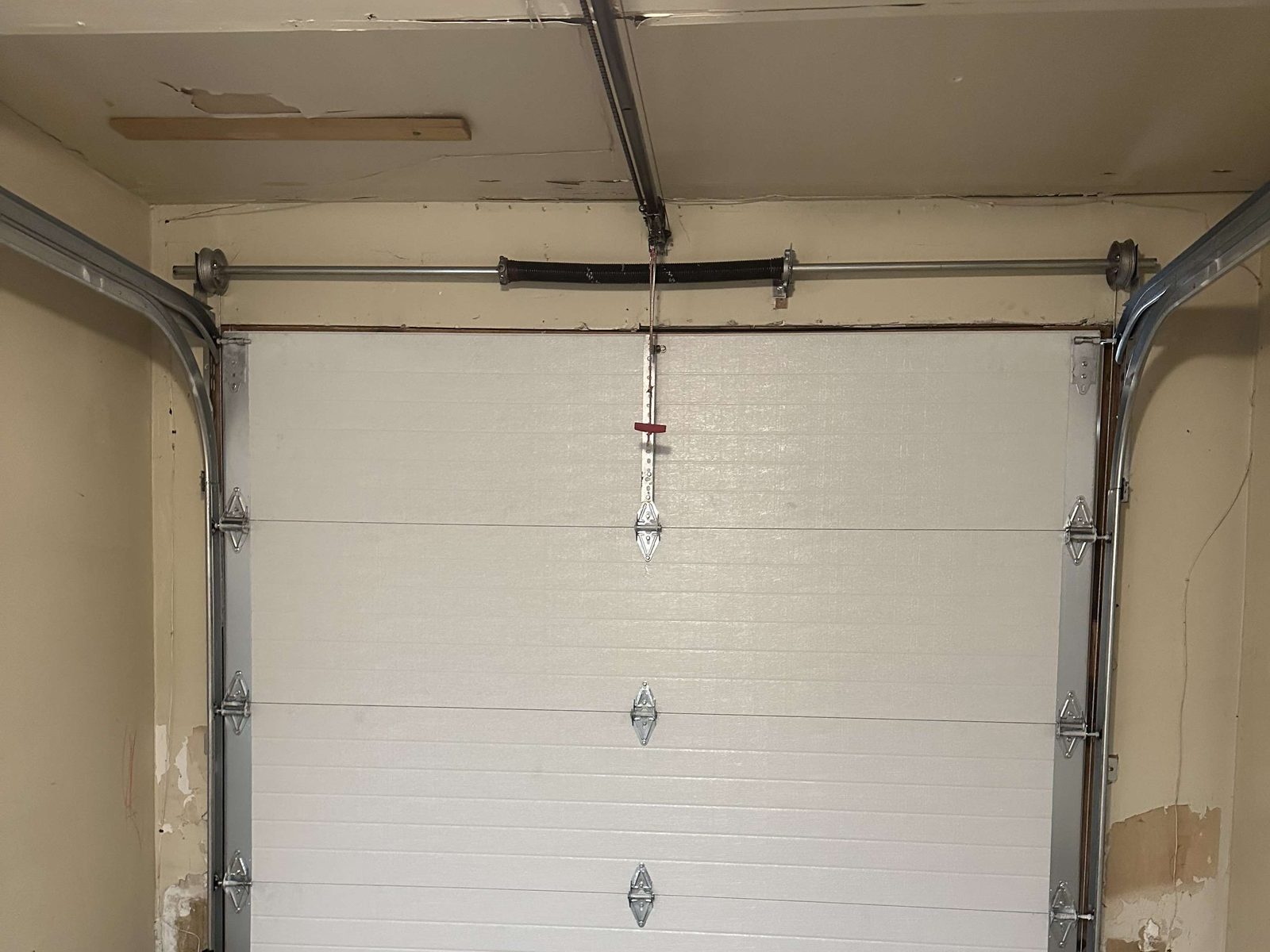
You can usually see it too. A broken torsion spring shows a clean gap of two or three inches in the coil, on the shaft above the door.
If the door is stuck open with a broken spring, do not try to bring it down on your own. There is nothing counterbalancing it. Two people, hands either side, walking it down slowly — or leave it and tell us on the call, and we will treat it as an emergency.
What we replace, and why the parts travel together
| Part | What it does | When it is replaced |
|---|---|---|
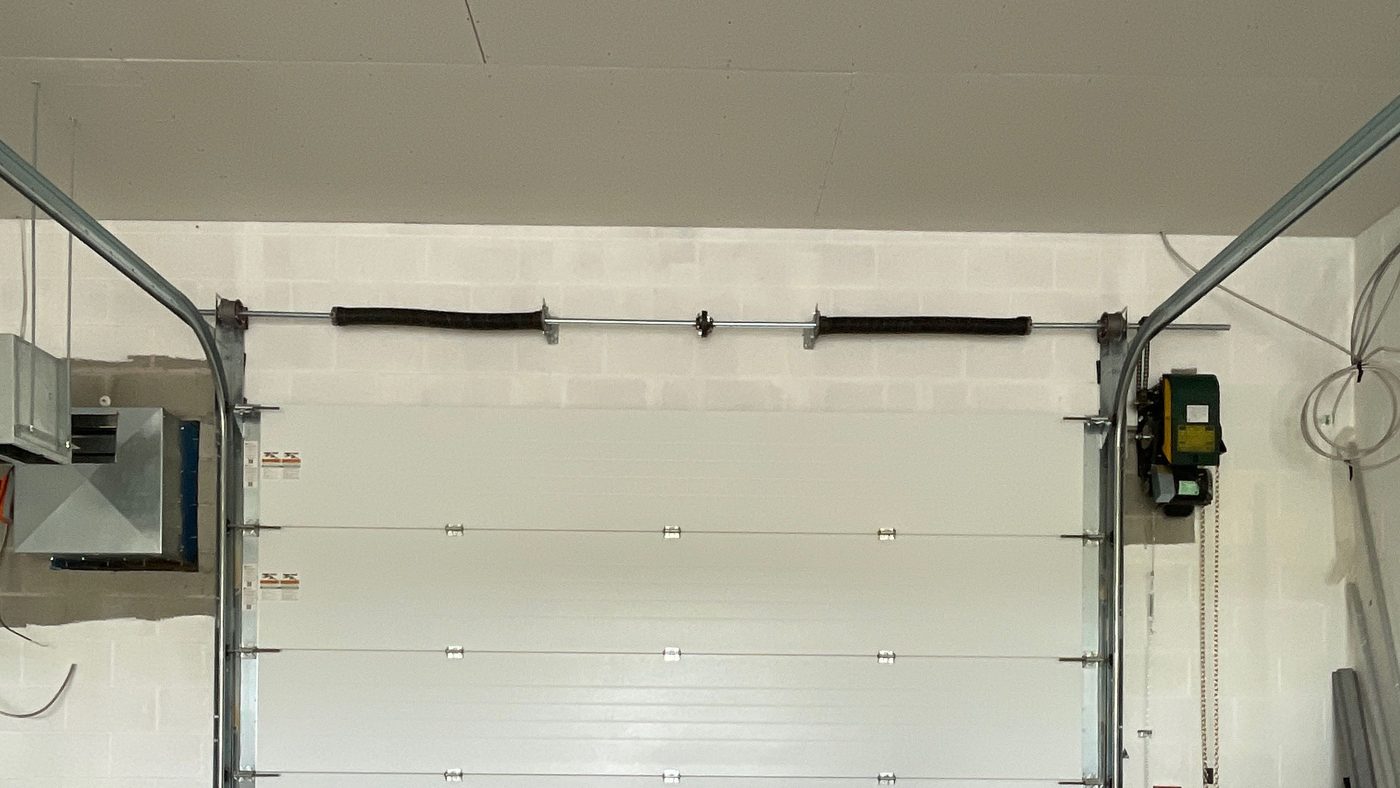
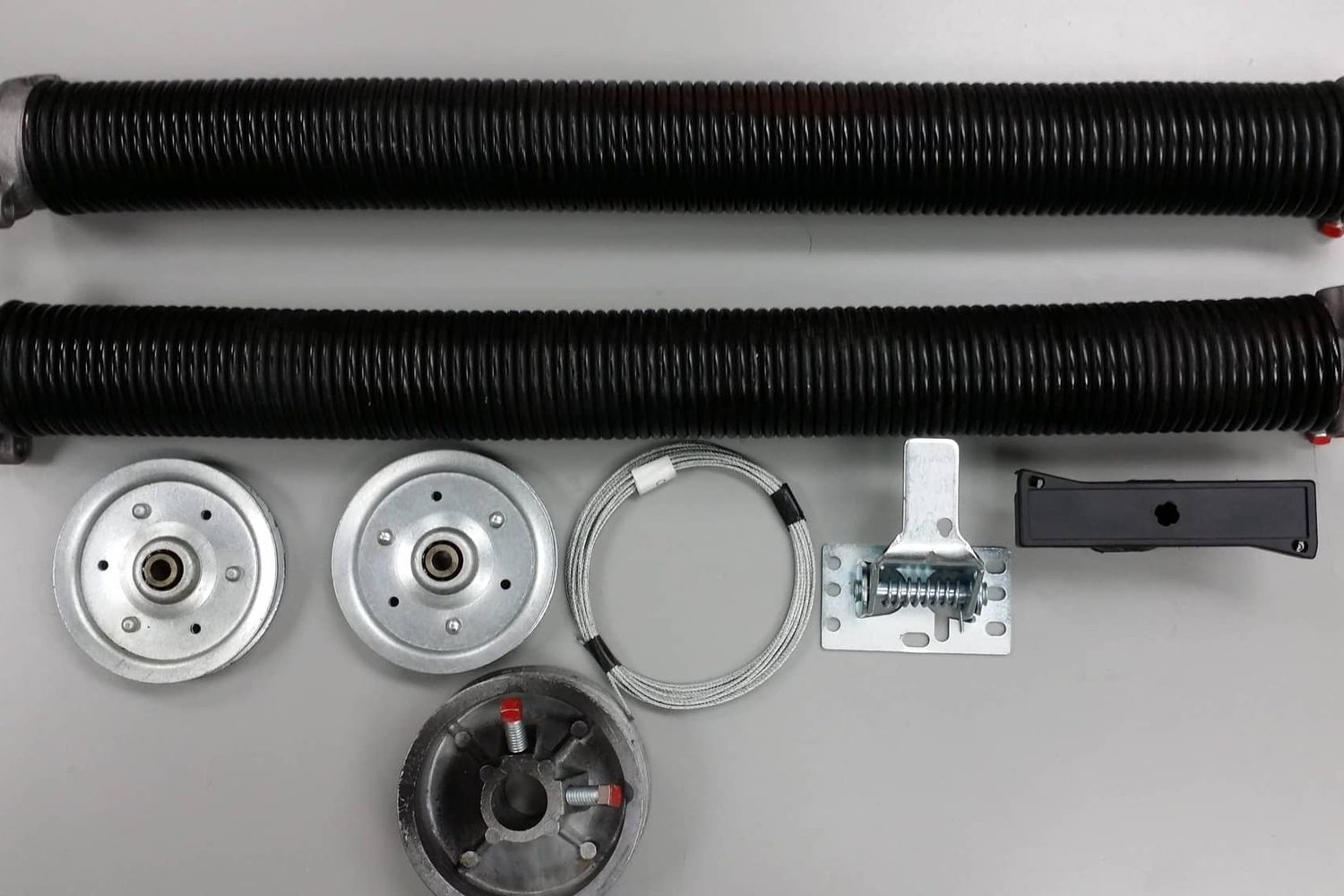
| Torsion spring | Stores the counterbalance energy on a shaft across the header | On failure, or on rating loss; in pairs where the door has two |
| Extension springs | The older system — stretch along the horizontal tracks | On failure; always with containment cables fitted |
| Lift cables | Carry the door's weight from the bottom brackets to the drums | On fraying, snapping, or whenever the drums come off; always in pairs |
| Cable drums | Wind the cables onto the shaft; sized to the door's height | When grooves are worn, after a snap, or on a headroom change |
| End bearings & centre plate | Carry the shaft and let it turn freely | When they are dry, seized or wobbling — a common cause of "new" noise |
| Bottom brackets | Anchor the cable at the bottom of the door | When bent or corroded. Under full spring tension — never a homeowner part |
| Shaft | The tube the springs and drums live on | Rarely; when bent by a spring failure or an impact |
Cycles, not years — how to predict the next one
A spring is rated for a number of cycles, where one cycle is one full open and one close. A standard residential spring is commonly rated around 10,000 cycles. That single number explains almost everything people find puzzling about spring failures:
| How the garage is used | Cycles per day | 10,000 cycles arrive in |
|---|---|---|
| Occasional — the car lives on the driveway | 2 | About 13 years |
| Typical — one car in and out daily | 4 | About 7 years |
| Main entrance — two cars, school runs | 10 | Under 3 years |
| Two drivers, a teenager, a dog walker | 16 | Under 2 years |
The figures above are arithmetic on a nominal 10,000-cycle rating, not a warranty — real life adds cold, salt and a door that has been out of balance for a year. But they make the point: if the garage is how your family enters the house, a standard spring is the wrong part, and a high-cycle spring costs a fraction of replacing a standard one three times.
What happens on the visit
- Diagnosis and measurement. We confirm it is the spring, weigh up the door, and take the wire size, inside diameter, length and wind direction, plus the drum size — that is what decides the rating, and it is why nobody can quote it from a photograph.
- The number, before the work starts. Including whether the cables, drums, bearings or bottom brackets should go with it, and what a high-cycle set would cost instead.
- Fitted and balanced. The old spring comes off under control, the new one goes on, and the door is balanced by hand before the opener is reconnected. A correctly balanced door stays where you leave it at waist height; if it does not, the job is not finished.
- The opener is reconnected and the door run through a full cycle — including the safety reversal, tested with the door running against an obstruction. If a door that is now correctly balanced still will not run properly, the opener is the remaining fault, and that is a replacement rather than a repair.
Total, normally one to two hours. Two cases run longer. An uncommon spring size that is not on the truck is ordered and fitted on a booked return. And a commercial overhead door is two visits by definition — those springs are wound to the individual door over 1–2 days, see commercial overhead door springs & parts. If you are calling after hours, treat the repair as the good outcome and securing the door as the job.
Extension springs, and the safety cable people forget
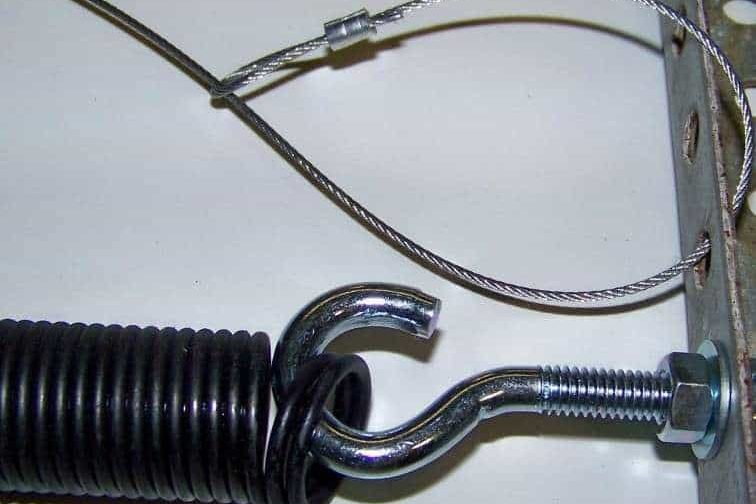
Plenty of older GTA houses still run extension springs: two long springs stretched along the horizontal tracks either side of the door rather than a torsion shaft above it. They work, and we service them — but they carry one requirement that is routinely missing.
An extension spring under load is a stretched steel line. When it snaps it does not stay put; it whips. A containment cable threaded through the middle of each spring and anchored at both ends turns that into a contained failure. It is an inexpensive part, it takes minutes, and on a door where children park bikes underneath it is not optional. If we are on site for anything else and yours are missing, we will say so.
Four decades of springs, cables and counterbalance for names Ontario knows — Canada’s Wonderland, Tim Hortons, Canadian Tire, the LCBO, Metrolinx, Marriott & Hilton hotels, the University of Toronto — plus warehouses, dealerships and several thousand houses across the GTA. Dependable people, quality products, since 1979.
What you can do yourself, and what to leave alone
- Fair game: rollers, hinge bolts, the bottom weatherseal, remote batteries, keypad codes, wiping the photo-eye lenses, and lubricating rollers and hinges with a garage-door lubricant (never grease on the track).
- Leave alone: torsion and extension springs, lift cables, cable drums and bottom brackets. All four are under stored tension, and all four are why emergency departments see garage door injuries every year.
- Worth doing today, free: pull the release with the door closed, lift it by hand and let go at waist height. If it does not stay, the door is out of balance and is working its spring and its opener harder than either was built for.
What our customers say
Garage door wasn't working properly so called Canuck. They came next day, on time and very polite and competent. Door was fixed in no time. Canuck installed these doors about 19 years ago with no problems. I would highly recommend them for either new doors or servicing of existing doors.
After having Canuck Door Systems replace the springs in our garage door opening system earlier this year, we continued to have problems with the operation of the door. After an attempt to fix this did not last, Stan ascertained that we needed a new motor, which Sergei installed. …
Read the full review
My garage door had issues last week after the winter storm. As soon as I closed it opened again. There was a sticker on the machine and I googled the company and had good reviews. I called the company and was provided service the same day and the issue was identified. …
Read the full review
Spring & cable replacement across Toronto & the GTA
Crews dispatch from our shop at 1645 Bonhill Road in Mississauga, where the spring sizes, cables, drums and brackets a residential door takes are stocked — and the common ones ride on the trucks.
Core GTA
- Toronto
- Mississauga
- Brampton
- Vaughan
- Markham
- Scarborough
- North York
- Etobicoke
- Richmond Hill
- Oakville
- Burlington
- Milton
Southern Ontario belt
A spring job travels well precisely because it is usually one visit: a technician arrives with the parts and leaves with the door working. Distance is what makes the exceptions expensive, so in the belt it is worth describing the door properly when you book — and a 3am run to Niagara or Barrie is a long drive we will be honest about on the phone. See all service areas
What a spring or cable replacement costs
It is labour plus the part, on one visit. What moves the number:
- Single or double door — a double is heavier, and heavier means a higher-rated spring
- One spring or a pair, and whether the second is the same age as the one that broke
- Standard or high-cycle rating, which costs more up front and lasts several times longer
- Torsion (above the door) or extension (along the tracks), which are different jobs
- Whether the drums, bearings, cables or bottom brackets have to go with it — after a snap they often do
- Low-headroom or side-mount (jackshaft) sets, which are not a standard torsion swap
- Whether the door is out of balance for another reason and the spring was only the symptom
We will not quote a spring from a photograph, and neither should anyone else: the rating depends on the door's actual weight, height and drum size. What we will do is give you the attendance cost on the phone, and the full number on site before the work starts — same visit, so you are not paying for a diagnosis and a repair separately.
Common questions
How much does it cost to replace a garage door spring?
It depends on the door's weight and height, the spring rating, whether one or both are being changed, and whether the cables and drums go with them. Three things are worth knowing before you compare quotes. A spring is sized to your door — wire gauge, inside diameter, length and wind — so a firm price quoted sight-unseen is a price for something generic. Where a door has a pair and one has broken, changing both is usually the better value, because the second has the same cycles on it. And a high-cycle spring costs more up front and is the least expensive thing on this page over a few years on a busy door. We give you the number once the technician has seen the door.
How long does a garage door spring last?
Springs are rated in cycles, not years — one cycle is one full open and one close. A standard residential spring is commonly rated around 10,000 cycles. So a household that opens the door four times a day reaches that in roughly seven years, and one that uses the garage as the main entrance, say ten times a day, gets there in under three. Nothing about the two doors looks different, which is why "how old is it" is the wrong question and "how often do you use it" is the right one.
Can I replace a garage door spring myself?
Please do not. A torsion spring holds the entire counterbalance energy of the door — well over 100 kg of stored force on a double — and releasing it without the correct winding bars and technique causes serious injuries every year. It is also not a job where partial knowledge helps: the spring has to be matched to the door's weight, height and drum size, and the wrong rating destroys the door and then the opener. Cables, drums and bottom brackets are under the same tension. Rollers, hinges, seals and remote batteries are all reasonable homeowner jobs; these are not.
Is a broken spring one visit or two?
On a house, normally one. We carry the common residential spring sizes along with the cables, drums, bearings and brackets that usually go with them, so the technician measures the door, fits the spring and rebalances it before leaving — one to two hours. The exception is an uncommon size: a spring is matched to your door's weight, height and drum, and if yours is not on the truck it is ordered and fitted on a booked return. That is also why an after-hours call is a different question — the vehicle that reaches you fastest at 2am is not necessarily carrying your size, so the night job is to secure the door and the repair may follow. And a commercial overhead door is two visits by definition: those springs are wound to the individual door over 1–2 days.
One spring broke. Should I replace both?
On a two-spring door, yes, in nearly every case. The second spring is the same age, has done exactly the same number of cycles, and is by definition close to the end of its own life. Replacing it now costs the price of the spring; replacing it in four months costs the price of the spring plus a second call-out plus another door that will not open on a Monday morning. The exception is a door where one spring was already replaced recently and you know when.
How do I know whether it is the spring or the opener?
Pull the emergency release cord with the door closed and lift the door by hand. A correctly balanced door is light — most people can raise it with one arm — and it should stay roughly where you leave it, half open. If it is enormously heavy, will not lift at all, or slams back down, the counterbalance has failed and the fault is the spring. If it lifts easily by hand but the opener will not move it, the fault is the opener. Look at the spring itself too: a broken torsion spring shows a clear gap of two or three inches in the coil.
What is the difference between torsion and extension springs?
Torsion springs sit on a shaft across the header above the door and wind up as the door comes down; extension springs run along the horizontal tracks either side and stretch. Torsion is the better system — more controlled, longer-lived, and it fails in place rather than flying — and it is what nearly every door built in the last twenty years uses. Extension springs are still common on older GTA houses, and they should always have containment cables running through them, so that if one snaps it cannot travel. If yours does not have them, that is worth fixing whatever else we do.
My cable snapped but the spring looks fine. What happened?
Usually the cable frayed where it wraps the drum, or the door was run while something was blocking one side, and the slack let the cable jump off the drum. The door then hangs crooked on one corner. It is a single visit — cables and drums are stocked — but it is not a "leave it until next week" fault: every further cycle winds the good cable unevenly and can bend the track or the bottom bracket. Cables should be replaced in pairs for the same reason springs are.
Do you do high-cycle springs?
Yes, and on a door that is the family's main way in and out they are the recommendation. A high-cycle spring is rated several times a standard one — wound from heavier wire on a bigger drum — and costs more up front. On a door doing ten or more cycles a day, it stops the three-year cycle of breakages that makes people think they need a new door.
Will you fit a spring on a door you did not install?
Yes — that is nearly all of this work. A spring is matched to the door's weight and dimensions rather than bought as a brand part, so the make of the door is irrelevant to whether we can spring it. What does matter is whether the shaft, drums, bearings and brackets are sound, and that is part of what the first visit establishes.
Heard a bang and the door won’t lift?
Stop using the opener — running it against a failed spring turns a spring job into a spring, cable, drum and opener job. Call the line and we will make the door safe first.