
Commercial & Industrial
Commercial Automatic Doors & Operators
Automatic sliding entrances, low-energy swing operators and barrier-free push-plate openings — supplied, installed, inspected and repaired across Toronto and the GTA since 1979. Dealers for Record, Assa Abloy and Entrematic, with AAADM-certified inspection and 24/7 emergency service.
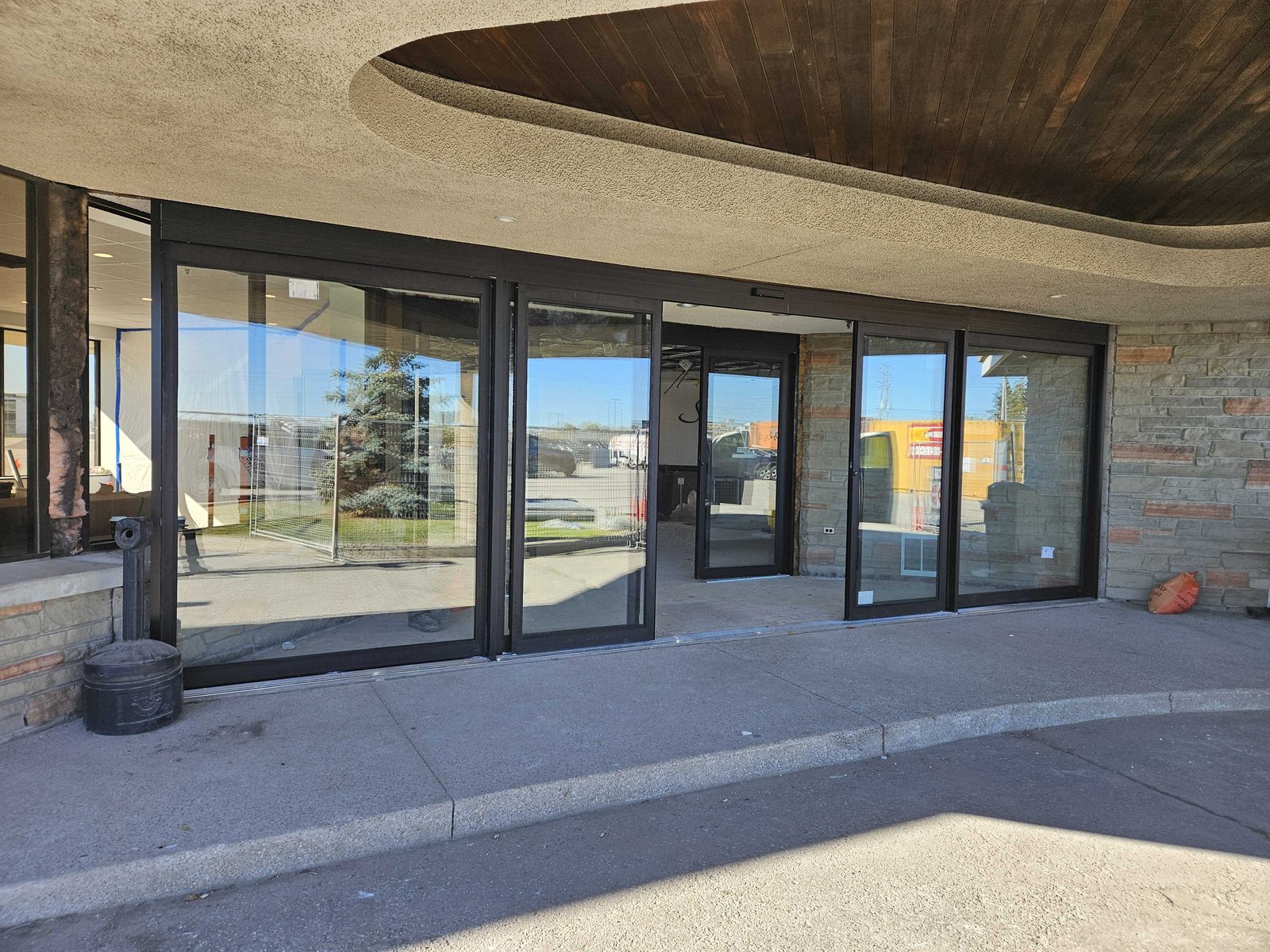
An automatic door is a machine that the public walks through, and that is the whole reason it is a specialty. The door itself may be ordinary — an aluminum entrance, a steel leaf, a pair of glass sliders — but the moment an operator, a sensor and a safety device are added to it, the opening has to be specified, installed and inspected to a standard, and it has to keep behaving safely for years afterwards.
Canuck Door Systems has been installing and servicing automatic entrances across Toronto and the GTA since 1979. We are dealers for Record, Assa Abloy and Entrematic, our technicians carry AAADM certification for the annual inspection of automatic pedestrian doors, and the emergency line is answered 24 hours a day. We also service automatic doors we did not install, which is most of the ones we look after.
Automatic doors we supply, install and service
Powered entrances
What the opening is, and what the operator has to move.
Powered sliding entrances — single-slide, bi-parting and telescopic — with the operator, sensors and break-out that make them legal to walk through.
Handicap & Barrier-Free Door Operators
Low-energy operators and push plates that turn an ordinary swing door into a barrier-free entrance, usually on a door you already own.
The whole accessible-washroom door package — operator, lock, occupancy indication, emergency release and call station — wired as one sequence.
Service
The half of automation nobody quotes for on day one — and the reason most of these doors need us again.
Automatic Door Repair & Installation
Sensors, belts, carriers, boards and operators on every make of automatic door, 24/7 — plus the annual AAADM inspection and new installations.
For a recent example, see Record sliders and a new vestibule for Signature Aviation in Mississauga: bi-parting and telescopic doors, with the hardware adapted for an airport's security access.
The three kinds of automatic door
Almost every powered entrance in a commercial building is one of three things, and the difference decides both the standard it is built to and what it costs to keep running.
| Full-energy automatic | Low-energy operator | Power-assist | |
|---|---|---|---|
| What it is | A door that opens itself for anyone approaching — the sliding entrance at a supermarket or lobby | A door that opens when someone presses a plate or waves at a sensor, slowly and gently | A door you push, with the operator taking most of the effort out of it |
| Typical opening | Main public entrances, vestibules, high-traffic retail and healthcare | Barrier-free entrances, washrooms, interior doors on an accessible route | Existing swing doors that are simply too heavy |
| Opens on | Motion and presence sensors | Push plate, wave sensor, card reader, or an actuator | Your hand on the door |
| Governing standard | ANSI/BHMA A156.10 | A156.19 (swing) and A156.38 (sliding and folding) | A156.19 |
| Safety package | Sensors, guide rails, signage, presence detection in the door path | Slow opening and closing speeds do most of the work | Minimal — the user is in contact with the door |
| Where it fails | Sensor drift and floor or lighting changes | Being asked to serve traffic it was never rated for | Doors that were badly hung to begin with |
The distinction that matters commercially: a full-energy door has to detect people and stop for them, so it carries a real sensor and signage package. A low-energy door is made safe by moving slowly — it opens over at least three seconds and closes just as gently — which is why it can be fitted with far less equipment and costs a fraction as much.
What the Ontario code actually asks for
Three documents matter here, and they do different jobs.
- The Ontario Building Code, Section 3.8 (barrier-free design). This is the one that bites, because it applies when you build or renovate. It sets the clear width of a barrier-free doorway, the force allowed to open a door on an accessible route, and where power operators are required.
- The AODA's Design of Public Spaces standard. It governs exterior paths of travel, parking, and certain new or redeveloped entrances rather than every door in the building.
- CSA B651, Accessible design for the built environment. The technical reference the other two lean on for dimensions, reach ranges and operating forces.
Two practical consequences we spend most of our time explaining. First, nothing here orders an existing building to automate every door — the trigger is almost always a permit, a renovation or a tenant requirement. Second, an operator alone does not make an entrance compliant: the clear opening width, the approach space beside the latch, the height and position of the actuator and the force needed if the power is off are all part of the same test, and an operator bolted to an opening that is too narrow fixes nothing.
Activation and safety — the part that decides how the door behaves
The operator moves the door. Everything about when it moves, and whether it stops, is the sensor package — and it is where almost all service calls originate.
| Motion sensors | Microwave or radar detection of someone approaching. Opens the door. Blind to a person who has stopped moving |
|---|---|
| Presence sensors | Infrared detection of someone standing in the door path. Holds the door open, and is what stops a slider closing on a stationary person |
| Safety beams | A break-beam across the opening, used mainly on swing doors and as a backup |
| Push plates | Hard-wired or wireless, surface or flush, in the code's reach range. The standard barrier-free activation |
| Touchless actuators | Wave-to-open plates. Common since 2020 in healthcare and food premises, and a straight swap for a push plate |
| Access control | Card reader, fob or intercom releasing the operator — one system, two trades, and the interface is where it usually goes wrong |
| Guide rails | Physical barriers keeping people out of the swing path of a full-energy door. Not optional on the doors that require them |
| Signage | "AUTOMATIC DOOR", "CAUTION" and activation decals, specified by the same standard as the door |
Where automatic doors belong
Hospitals & clinics
Barrier-free entrances, vestibules and department doors where staff arrive with a bed, a cart or both hands full.
Long-term care & retirement
Residents on walkers and in chairs, and doors that must be usable one-handed and slowly.
Retail & grocery
Full-energy sliders on the main entrance, where a door that fails is a store that is shut.
Office & condominium lobbies
The building's front door, usually a slider, usually tied into an intercom or a card reader.
Schools & universities
Barrier-free entrances on an accessible route, plus the washroom packages the same route implies.
Municipal & community buildings
Arenas, libraries and civic offices, where the accessibility standard is applied most visibly.
Food & pharmaceutical plants
Powered sliders between production zones, where people move product through and nobody should touch a handle.
Hotels & restaurants
Entrance sliders and low-energy operators on the routes guests use with luggage, strollers and mobility devices.
Inspection and maintenance
An automatic door is the only door in most buildings that is a powered machine in continuous public contact, and it is maintained on that basis.
- The daily safety check — building staff, about a minute. Watch a full cycle, confirm nothing is missing, confirm the door does not touch anyone.
- The annual inspection — by an AAADM-certified technician. Sensor coverage and hold-open times, opening and closing speeds and forces, safety devices, break-out where fitted, signage, guide rails, and the mechanical condition of the operator.
- Planned service — sensors cleaned and re-aimed, rollers and tracks cleaned and checked, belts and drive components examined, controls re-verified against the standard.
- The failure you want to avoid — a door that has been "adjusted" to open faster because someone complained. Speed and force are specified, not preferences, and a door tuned outside them is a claim waiting to happen.
The commonest cause of a call-out is not the operator. It is a building change nobody linked to the entrance: a new floor finish that fools a sensor, a mat that sits in the door path, a display that blocks a presence detector, a sign taped over the safety decal. Those are five-minute fixes if you know to look for them.
What we do that a specialist cannot
Every automatic-door contractor in the GTA can hang an operator. What they cannot usually do is deal with what the operator is fitted to. The frame is out of square, the storefront needs reglazing, the header will not take the load, the fire-rated door down the corridor failed its inspection at the same time — those are the jobs that turn one visit into three contractors.
We supply and install the glass and aluminum entrance itself, the hollow metal door the operator is mounted to, and the hardware that decides whether the leaf latches when the operator lets it go. One crew, one quote, one company to call when it stops.
Automatic door work across the GTA
One job from each of several kinds of building — construction, healthcare, property management and general commercial. Real clients, from our own project files.
Canadian Millwork
Fox & Falcon Electric Inc
MTCC 650 - Atrium II
Alliance Corporation
Royalty General Construction
Ecopack Canada Inc
Four decades of doors for names Ontario knows — Canada’s Wonderland, Tim Hortons, Canadian Tire, the LCBO, Metrolinx, Marriott & Hilton hotels, the University of Toronto — plus thousands of businesses across the GTA. Dependable people, quality products, since 1979.
Automatic door work across Toronto & the GTA
We install, inspect and service automatic entrances right across the core GTA and out into the Southern Ontario belt, dispatched from our shop in Mississauga. An entrance that will not open is a building people cannot get into, so this is 24/7 work — and we service doors we did not install.
Core GTA
- Toronto
- Mississauga
- Brampton
- Vaughan
- Markham
- Scarborough
- North York
- Etobicoke
- Richmond Hill
- Oakville
- Burlington
- Milton
Southern Ontario belt
Annual inspections travel well; a 3am call to Niagara does not, and we will say so on the phone rather than leave you waiting. If you run several buildings we inspect the whole portfolio in one pass, which is how most of our belt work starts. See all service areas
What our customers say
I hired them for installing a handicap door opener. They did a great job. I would definitely hire them again. If you have a tight deadline, I would definitely give Them a call. Thanks,
As a small Landlord in the East end of Toronto I respond to my Tenants professionally in a timely cost effective way. This occurred over the Xmas holidays with a broken commercial door hinge. …
Read the full review
The wind blew my commercial glass door open and it broke. Canuck Door systems came fast and board it up. They then replaced the glass door and everything is perfect now.
What an automatic door costs — and what moves the number
Nothing here has a list price, because "automatic door" covers everything from an operator added to a door you already own to a bi-parting slider with a full sensor package. What actually moves the number:
- New automatic entrance against automating a door that is already hung
- Sliding or swing — and, on a slider, single-slide, bi-parting or telescopic
- Full-energy or low-energy, which decides the operator class and the safety package
- Opening width, height and the header available to hide the operator in
- Activation — push plates, motion and presence sensors, touchless, or access control
- Safety devices, guide rails and signage the standard requires for that door type
- Power at the opening, which is the single most common surprise on a retrofit
- Interfaces — fire alarm, card access, intercom, and break-out for egress
- Whether the existing frame, glass and floor can take an operator without rework
On a retrofit the honest first question is not "which operator" but "is there power at that header, and will the frame carry it". We look at both before quoting, because an operator specified around a door that cannot hold it is how an inexpensive quote turns into an expensive job.
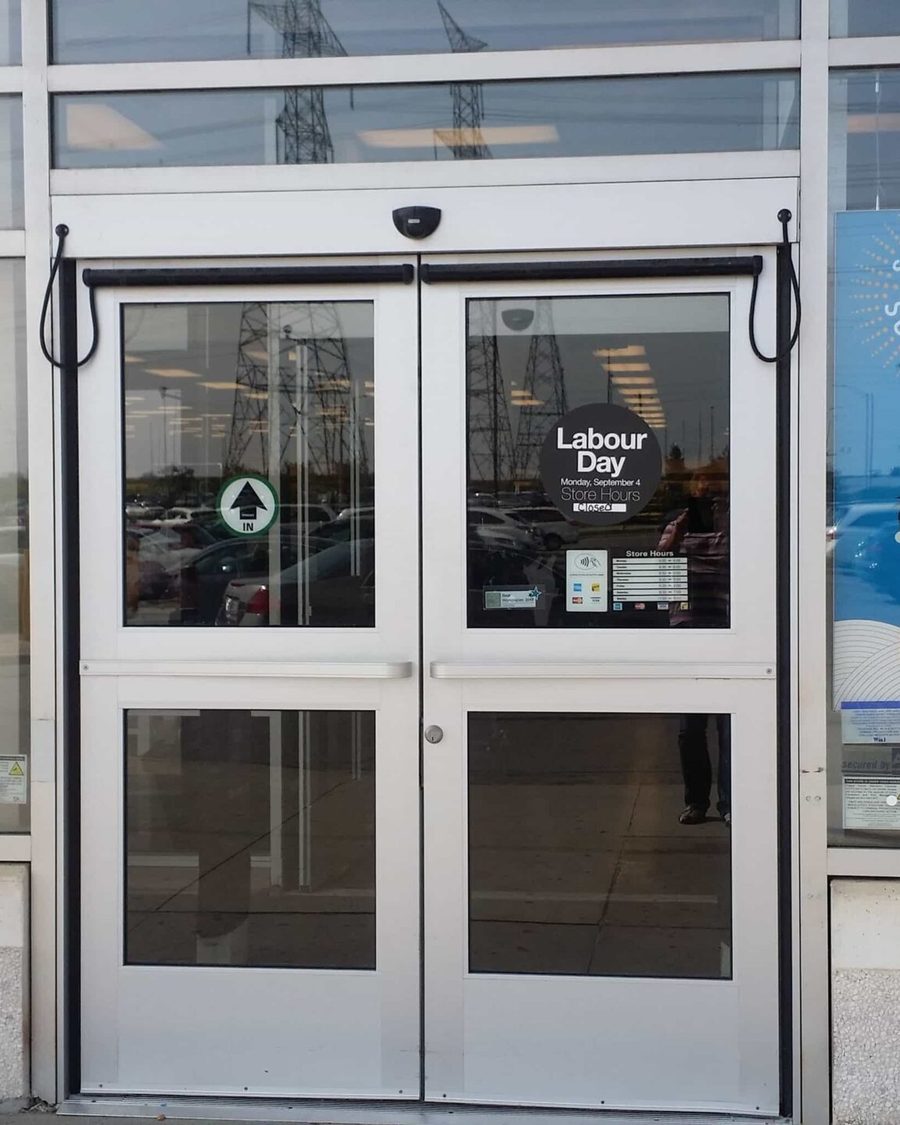
Common questions about commercial automatic doors
What is the difference between a door closer and a door operator?
A closer is a mechanical device that shuts a door you opened yourself — a spring and a hydraulic damper, no power. An operator opens the door for you, under electric or electro-hydraulic power, and then controls the closing as well. They look similar from the floor because both live in a box above the door, and enquiries mix them up constantly. If nobody has to pull the door, it is an operator. If the question is only "how fast and how hard does it close", it is a closer, and that is door hardware rather than automation.
How much does it cost to make an existing door automatic?
Adding a low-energy operator to a door that already hangs correctly is the least expensive way into automation, and the price is driven by three things rather than by the operator itself: whether there is power at the head of the opening, whether the frame and leaf can carry the load, and how many activation points you want. Running a new circuit to a header on an existing masonry wall routinely costs more than the operator does. That circuit is electrical work, so it has to be run by a certified electrical contractor, and it normally sits outside our scope. What we do is tell you exactly what the operator needs at the header before you order, so the electrician can be booked in alongside the door rather than chased afterwards.
Are automatic doors required by law in Ontario?
Not as a blanket rule. The requirement comes from the Ontario Building Code's barrier-free provisions, which apply when you build or renovate, and from the AODA's Design of Public Spaces standard, which covers certain new and redeveloped exterior paths and entrances. Existing buildings are not ordered to retrofit every door. In practice most of our operator work is triggered by a permit, a renovation, an accessibility complaint or a tenant requirement rather than by an inspector arriving unannounced — and where the code does apply, the entrance also has to meet clear-width and opening-force limits, not just open by itself.
How often do automatic doors need to be inspected?
The industry standard is a daily safety check by the building's own staff and a full inspection once a year by a certified inspector. Our technicians hold AAADM certification for exactly this — the annual inspection of automatic pedestrian doors — and the daily check takes about a minute: watch the door cycle, confirm it does not close on anything, confirm the signage and guide rails are still in place. Skipping the annual inspection is a liability question more than a maintenance one, because an automatic door is a powered machine that the public walks through.
What are the common problems with automatic doors?
In rough order of how often we are called for them: sensors that have drifted, been knocked or been blinded by sunlight or a new floor finish; dirty or worn rollers and tracks on a slider, which show up as a door that shudders or stalls; failed or misadjusted safety beams that leave the door stuck open or reversing at random; belts, motors and control boards at the end of their life; and damage from something that hit the door. The single most common underlying cause is not the operator at all — it is a building change nobody connected to the entrance, like a new mat, a new sign or a re-tiled floor.
Can you open an automatic door in a power failure?
Yes, and on an egress route it is a requirement rather than a nicety. Sliding doors on an exit route are built with break-out panels: push the leaf hard from inside and it swings out of its track to give a clear opening. Swing doors with a low-energy operator can simply be pushed open manually when the power is off — the operator declutches. What you should not assume is that a given door does this: break-out is a specified feature, and a slider bought without it stays shut. We confirm which behaviour an existing door has as part of an inspection.
How long does an automatic door take to supply and install?
Typically 4–6 weeks to produce the door once shop drawings are approved, then 1–2 weeks to schedule the job and install it — so around 5–8 weeks in total, depending on the size of the project. An automatic slider runs to the longer end because the operator, the framing and the glass all have to arrive together. A standard automatic door operator is a different matter entirely: those are stock items, so fitting one to a door that already hangs correctly is usually 2–3 days rather than weeks. Emergency repairs are a different clock again and are dispatched 24/7. On site, a single automatic entrance is usually installed in a day; a full package on a general contractor's build runs over several weeks.
Do automatic doors have to be tied into the fire alarm?
Often, and it is one of the details that gets missed on a retrofit quotation. Where a door is on an egress route or in a rated separation, its behaviour on alarm has to be specified — some doors are required to open and stay open, others to close and latch, and holding a rated door open on a magnet is only permitted where it releases on alarm. The rule follows the opening's role in the building, not the operator's brand, so it is decided with the door, not after it.
Entrance to automate, or an operator that has stopped?
Tell us what the opening is — slider or swing, new or existing, and whether there is power at the header — and we’ll tell you what it takes and quote it.