
Commercial & Industrial
Automatic Sliding Doors
Powered sliding entrances — single-slide, bi-parting and telescopic — with the operator, sensors, break-out and safety package that make them legal to walk through. Supplied, installed, inspected and repaired across Toronto and the GTA since 1979, as dealers for Record, Assa Abloy and Entrematic.
Request QuoteCall 800-522-6825
AAADM-certified inspection · 24/7 emergency service · we service sliders we did not install
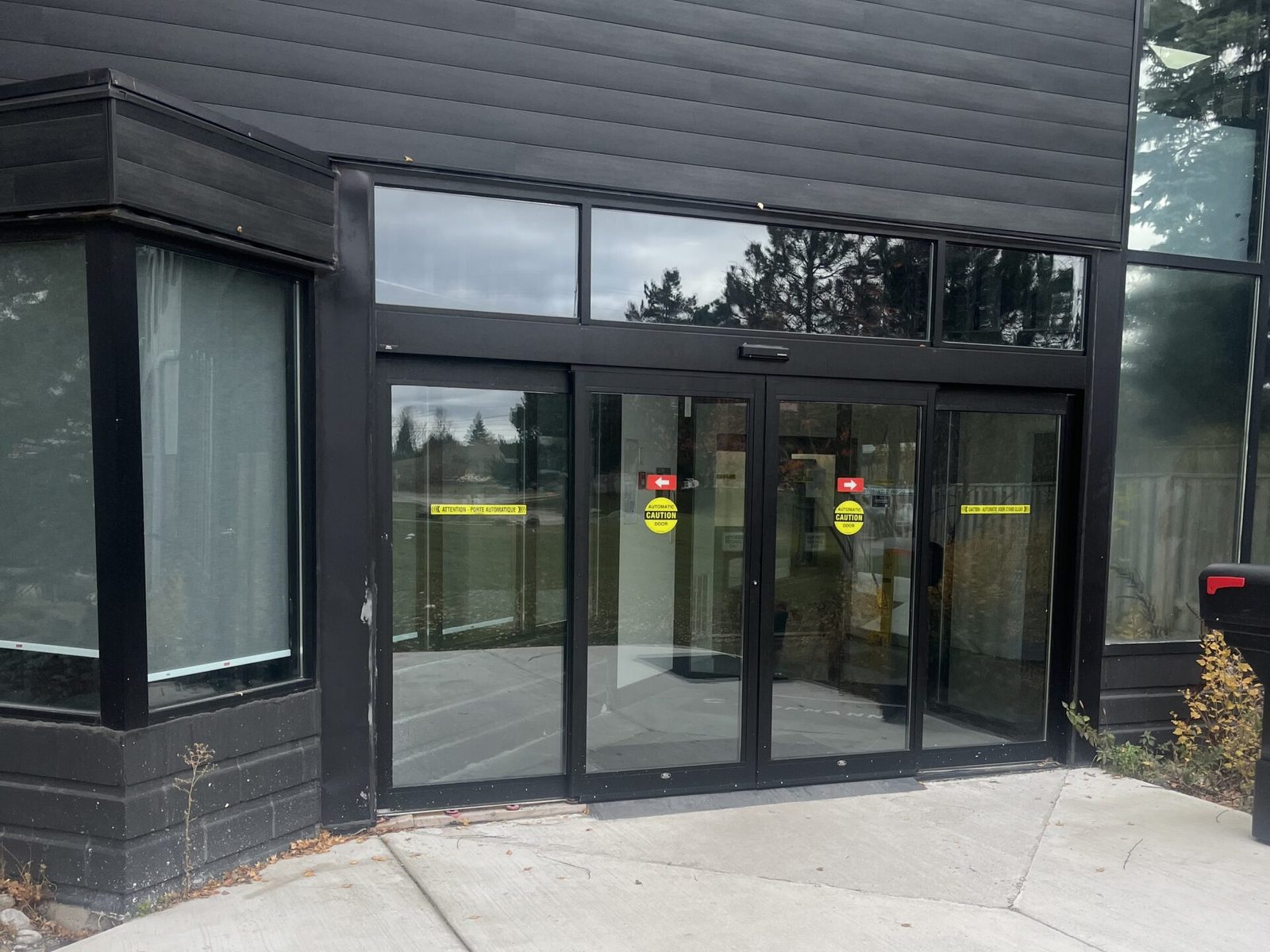
An automatic sliding door is two products in one opening: the glazed door itself, and the machine that moves it. This page is about the machine — the operator, the sensors, the safety devices and the standard they are all built to. If the question you are answering is about the framing, glass and finish, the commercial sliding glass doors page covers the same openings from the glazing side, and most projects need both.
Canuck Door Systems has been installing sliding entrances across the GTA since 1979. We are dealers for Record, Assa Abloy and Entrematic, our technicians hold AAADM certification for automatic pedestrian door inspection, and we service sliders regardless of who installed them.
Four decades of doors for names Ontario knows — Canada’s Wonderland, Tim Hortons, Canadian Tire, the LCBO, Metrolinx, Marriott & Hilton hotels, the University of Toronto — plus thousands of businesses across the GTA. Dependable people, quality products, since 1979.
The three configurations
Which one you need is decided almost entirely by arithmetic: how much clear width the opening must give when the door is fully open, against how much wall there is beside it to park the leaves in.
| Single-slide | Bi-parting | Telescopic | |
|---|---|---|---|
| Leaves | One, sliding one way | Two, meeting in the middle | Two per side, nesting as they slide |
| Side room needed | The full clear opening, on one side | Half the clear opening, each side | Roughly half again — the least of the three |
| Best for | Narrower openings, corridors, side entrances | Main entrances with wall either side | Wide openings with almost no wall beside them |
| Cost | Lowest | Middle | Highest — more carriers, more track, more synchronising |
| Typical use here | Clinics, plant openings, secondary entrances | Lobbies, retail, hospital vestibules | Retrofits into existing storefronts where the wall cannot move |
The mistake we are called to unpick most often is a single-slide specified for a wide barrier-free opening because it was the least expensive line on the quote. It works — but it needs a run of blank wall as wide as the door, and that wall usually turns out to be glass.
The operator and the sensor package
Everything visible above the glass is the operator. Everything that decides its behaviour is the sensors, and that is where service calls originate.
| Drive | Electric motor and belt in the header, driving carriers on a track |
|---|---|
| Motion sensor | Detects someone approaching and opens the door. Blind to a person standing still |
| Presence sensor | Detects someone in the door path and holds it open. This is the device that stops a slider closing on a stationary person |
| Hold-open time | Set at commissioning; longer for healthcare and long-term care than for retail |
| Speed and force | Specified by the standard, not by preference. Adjusting a door to "open faster" outside those limits is a liability |
| Break-out | Leaves swing out under hard pressure, for egress and power failure. Specified with the door |
| Emergency mode | Behaviour on fire alarm or power loss — open, closed or break-out — set by the opening's role in the building |
| Interfaces | Card access, intercom, fire alarm, building automation. Two trades, one control board, and the usual source of commissioning surprises |
| Standard | ANSI/BHMA A156.10 for full-energy sliders; A156.38 covers low-energy sliding and folding doors |
Where sliders are the right answer
Hospital & clinic entrances
Hands-free for beds, chairs and carts, with long hold-open times and presence detection through the whole opening.
Condominium & office lobbies
The building's front door: a bi-parting entrance, usually tied into an intercom or card reader, running all day every day.
Grocery & retail
Full-energy sliders where the door cycles thousands of times a day and a failure closes the store.
Food processing plants
Powered sliders between production zones, so product moves through without anyone touching a handle or a push plate.
Pharmaceutical & cleanroom
Sealed, smooth-faced sliders that hold a pressure differential and can be wiped down as part of the cleaning regime.
Long-term care & retirement
Slow, wide and predictable openings for residents on walkers and in chairs, where a swing door is a hazard.
Airports, transit & aviation buildings
Vestibule pairs handling crowds and luggage, with break-out for egress on every leaf.
Hotels & restaurants
Entrances used with luggage, strollers and trays, where the door has to be generous and quiet at the same time.
Sliding, or a swing operator?
Sliders are not automatically the better automatic door. The comparison that actually decides it:
| Automatic slider | Low-energy swing operator | |
|---|---|---|
| Floor space | None — the leaves stay in the wall line | Needs a clear swing arc, both sides |
| Traffic | Continuous, both directions, at volume | Intermittent; it opens slowly by design |
| Retrofit cost | Higher — new framing, glass and header work | Lower — often fits the door you already have |
| Weather sealing | Better on a purpose-built thermally broken frame | Depends entirely on the existing door |
| Egress | Break-out leaves, if specified | The door simply pushes open |
| Fails to | Stuck open, and the opening is unsecured | Manual operation, which is a nuisance rather than a crisis |
If the opening already has a serviceable door and the traffic is moderate, a low-energy swing operator does the same accessibility job for a fraction of the money. Sliders earn their cost where floor space is tight or the traffic is constant.
Installation, and what we need before quoting
- Measure — the rough opening, the headroom for the operator, the side room each way, and what the structure above the door actually is.
- Specify — configuration and clear width, glazing, finish, break-out, sensors and any interfaces. Shop drawings follow.
- Manufacture — 4–6 weeks once drawings are approved. Framing, glass and operator ship together.
- Install — 1–2 weeks to schedule, then usually a day or two per opening; entrance work is routinely done overnight.
- Commission — speeds, forces, hold-open times and sensor coverage set against the standard, then signage and an inspection.
Service, parts and inspection
Sliders are repaired far more often than they are replaced. Sensors, belts, carriers, rollers, guides, boards and motors are all serviceable items, and we stock parts for the lines we deal in. Two things are worth knowing before you have a problem: grit and salt in the floor track cause more winter faults than anything else, and the parts are brand-specific, which is why most contractors will not touch another maker's operator and why an obsolete board can decide the fate of an otherwise sound entrance.
Every slider should get a daily safety check by your own staff — one cycle, watched — and an annual inspection by an AAADM-certified technician, which is what our crews carry.
Automatic door work across the GTA
Documented automatic door jobs from our own project files — real clients, real buildings.
Canadian Millwork
Fox & Falcon Electric Inc
Alliance Corporation
Royalty General Construction
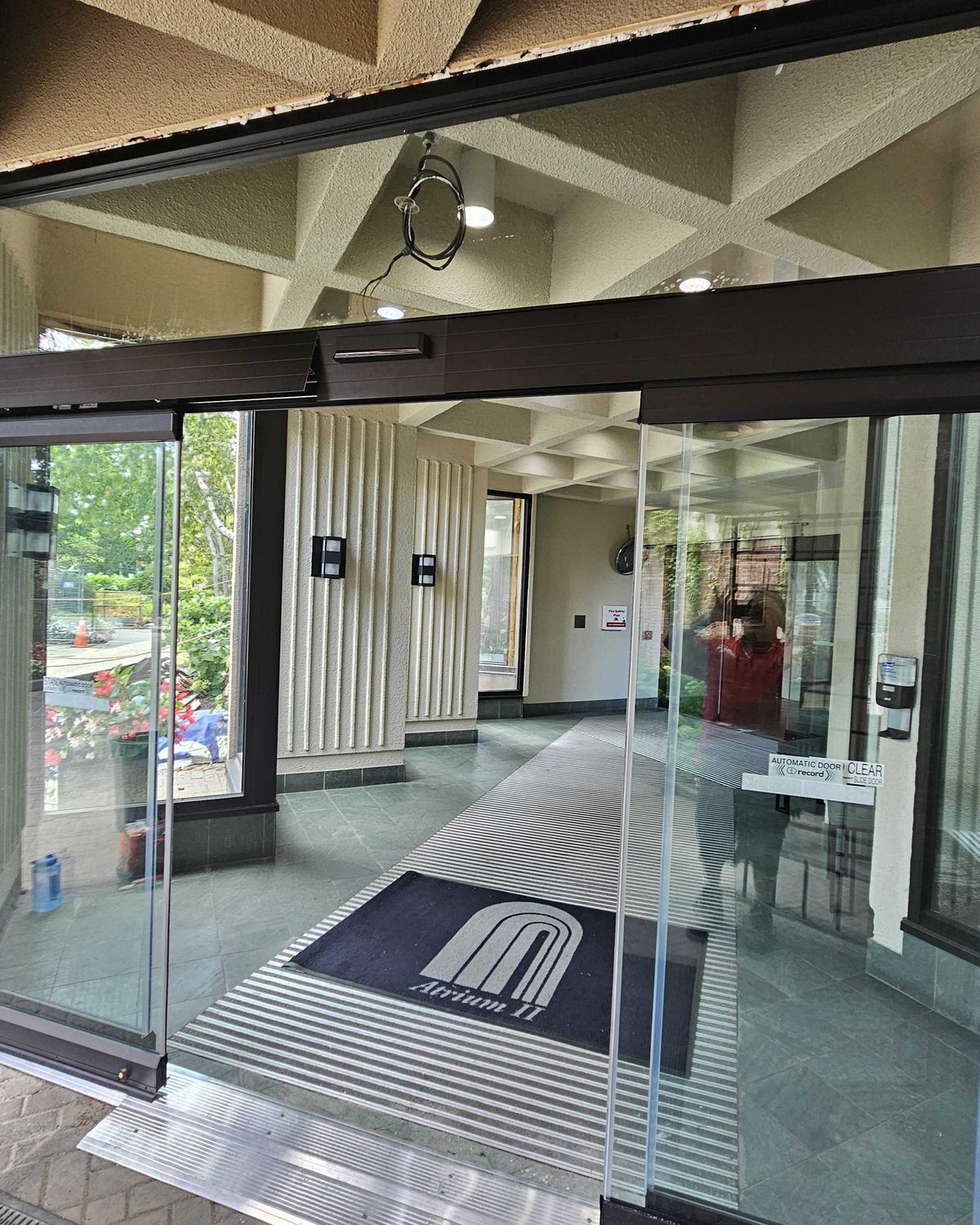
MTCC 650 - Atrium II
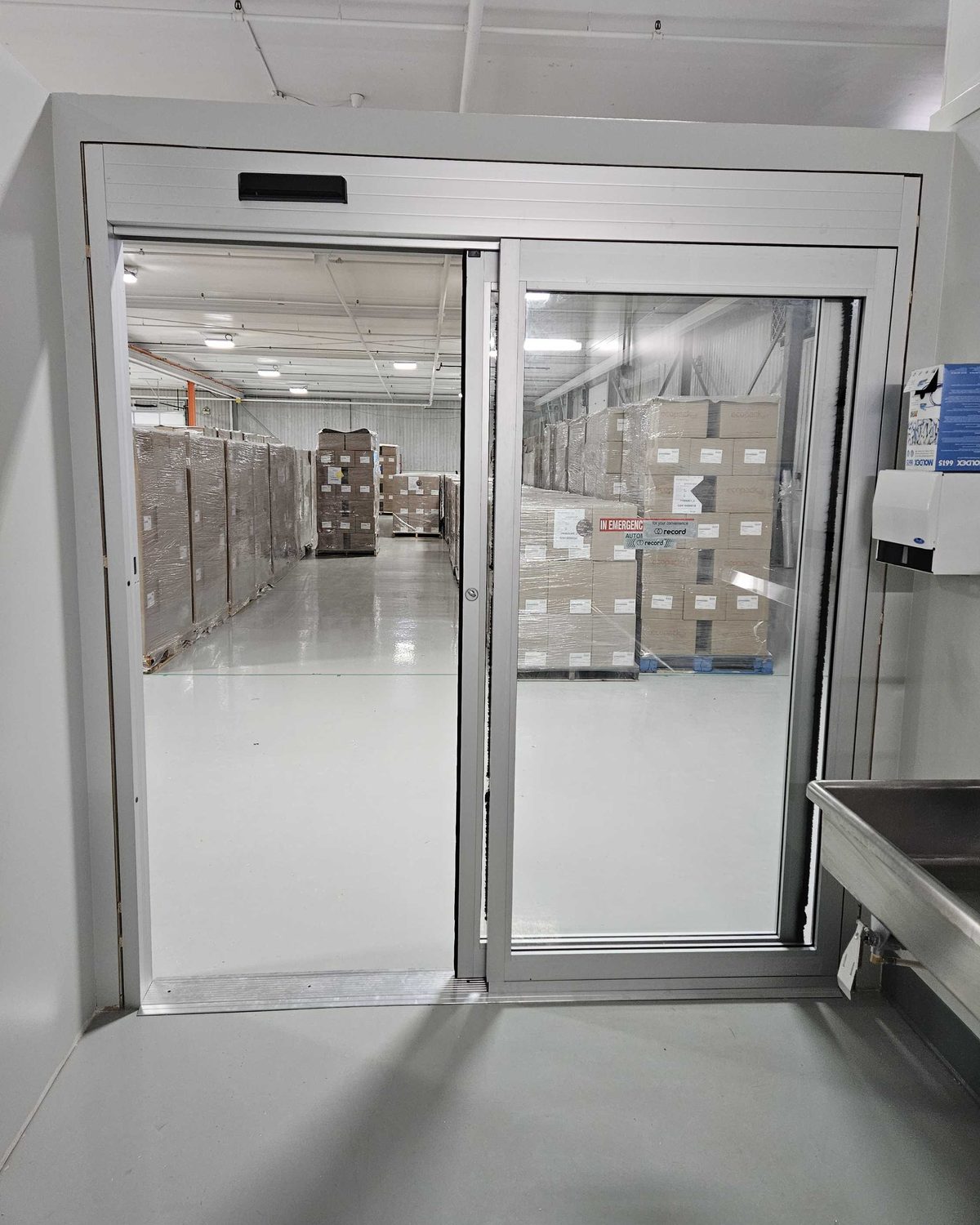
Ecopack Canada Inc
Two slider jobs are written up in full. Ditec bi-parting and telescopic sliders replacing swing doors, set into a new black anodized curtain wall — automatic sliding doors in Orangeville; and Record 5100 bi-parting and 5100T telescopic sliders in a new glass vestibule at an aviation facility, with the hardware adapted for airport security access — automatic sliding doors in Mississauga for Signature Aviation.
What our customers say
I hired them for installing a handicap door opener. They did a great job. I would definitely hire them again. If you have a tight deadline, I would definitely give Them a call. Thanks,
We own multiple commercial properties in Waterdown, and reaching out to a new contractor to fulfill a need is often stressful. Not so with Canuck Door Systems! From sales with Robert to dealing with Stanislav for measurements, communication was easy and open. …
Read the full review
I called Canuck Door systems regarding my security gate at our retail store, I cannot recommend them enough. Quick turn around, extremely fair pricing compared to competitors. Fixed the problem, called to make sure it was done to my expectations. This is the company to use.
Automatic slider work across Toronto & the GTA
We install and service automatic sliding entrances right across the core GTA and out into the Southern Ontario belt, from our shop in Mississauga. A main entrance that will not open closes the building, so slider faults are dispatched 24/7 — including on doors we did not install.
Core GTA
- Toronto
- Mississauga
- Brampton
- Vaughan
- Markham
- Scarborough
- North York
- Etobicoke
- Richmond Hill
- Oakville
- Burlington
- Milton
Southern Ontario belt
A slider is the one door type worth a long drive: the parts are brand-specific, most contractors will not touch another maker's operator, and a bi-parting entrance sitting open in February is costing more per hour than the call-out. See all service areas
What an automatic sliding door costs
There is no shelf price for these — the operator is a small part of the total, and the framing, glass and sensor package are the rest. What moves the number:
- Configuration — single-slide, bi-parting, or telescopic where side room is short
- Clear opening width required when the door is fully open, which decides all of the above
- Whether the framing and glass are new, or an existing opening is being automated
- Operator class and brand, and whether it must match systems already on site
- Glazing — tempered, laminated, low-E or tinted, and whether the frame is thermally broken
- Sensor package — motion, presence, and the safety devices the standard requires
- Break-out leaves, which are a specified feature and not a default
- Interfaces — fire alarm, card access, intercom, and the wiring each one needs
- Header construction and whether the structure above the opening can carry the operator
The two questions that change a quote most are the clear opening width you actually need and whether the door is on an egress route. The first decides single against bi-parting against telescopic; the second decides break-out, which cannot be added later without changing the leaves.
Common questions
How does an automatic sliding door work?
An electric motor in the header drives a belt, which moves carriers running on a track; the door leaves hang from those carriers and are guided at the floor. A control board decides when to move, taking its instructions from the sensors — a motion sensor to open, a presence sensor to hold the door open while somebody is in the opening. When the sensors go quiet the board waits a set hold-open time, then closes at a controlled speed. Everything that goes wrong with these doors is in that chain, which is why diagnosis starts with the sensors and not the motor.
What is a break-out slider, and do I need one?
Break-out means the sliding leaves swing outward when pushed hard from inside, giving a clear opening even with no power. On an exit route it is not optional, because the door has to release people during a power failure or an evacuation. It has to be specified with the door — the leaves, the hardware and the header are all different — so it cannot be added afterwards without replacing them. If you are not sure whether an existing slider breaks out, we check it as part of an inspection.
What is the difference between bi-parting and telescopic?
A bi-parting door has two leaves that meet in the middle and slide apart, each one stacking beside the opening. A telescopic door has two leaves per side that nest as they slide, so it clears a much wider opening from the same side room — the reason to pay for it is almost always that there is not enough wall beside the door to park a single leaf. Single-slide is one leaf moving one way, and it needs side room equal to the whole clear opening, which is why it suits narrower doors.
How much clear width does a sliding entrance give?
Less than the opening, always. The framing, the parked leaves and the guide rails all take space, so the clear width is a specified number rather than the width of the hole in the wall. It matters because the barrier-free requirement in the Ontario Building Code is written against clear width, not overall size, so an entrance can look generous and still fail. We work backwards from the clear width you need to the configuration and rough opening that produce it.
How long do automatic sliding doors take to install?
Typically 4–6 weeks to produce the door once shop drawings are approved, then 1–2 weeks to schedule the job and install it — about 5–8 weeks in total, depending on the size of the project. Sliders sit at the longer end of that range because the operator, the framing and the tempered glass all have to land together, and a missing lite holds the whole entrance. The install itself is usually a day or two per opening, and it is routinely scheduled overnight so the entrance is working when the building opens.
Can an automatic slider be repaired, or does it need replacing?
Almost always repaired. Sensors, belts, carriers, rollers, guides, control boards and motors are all replaceable in place, and we hold parts for the lines we deal in. Replacement becomes the honest answer in three cases: the framing is damaged or out of square beyond adjustment, the system is old enough that boards and carriers are no longer made, or the opening now has to do something it was never built for — usually become barrier-free or wider. We will tell you which of those you are looking at before quoting.
Do automatic sliding doors work in winter?
They do, but Ontario winters are what test them. Grit and salt in the floor track are the leading cause of slow and juddering doors from January onwards; water freezing at the threshold is the second; and the sensor package is affected by low sun and by the wet floor mats that appear at every entrance in November. A thermally broken frame and the right seals cut the condensation and drafts, and a winter service visit is worth more than a summer one on any exterior slider.
Can you service a sliding door another company installed?
Yes — most of the sliders we look after were installed by somebody else. We are dealers for Record, Assa Abloy and Entrematic, and we work on other makes as well; where a board or carrier is obsolete we say so rather than chase a part that no longer exists, and quote the operator replacement against the framing you already have. An AAADM inspection on an inherited door is usually the least expensive way to find out what condition it is really in.
Slider to install, or one that has stopped?
Send us the opening width, the headroom and the side room either way — and tell us whether it is an exit route. That is enough to specify the door and quote it.