
Commercial & Industrial
Handicap & Barrier-Free Door Operators
Low-energy power operators and push-plate activation that turn an ordinary swing door into a barrier-free entrance — supplied, installed, adjusted to the standard and inspected, across Toronto and the GTA since 1979. On existing doors as often as on new ones.
Request QuoteCall 800-522-6825
AAADM-certified inspection · retrofits to doors you already own · 24/7 service
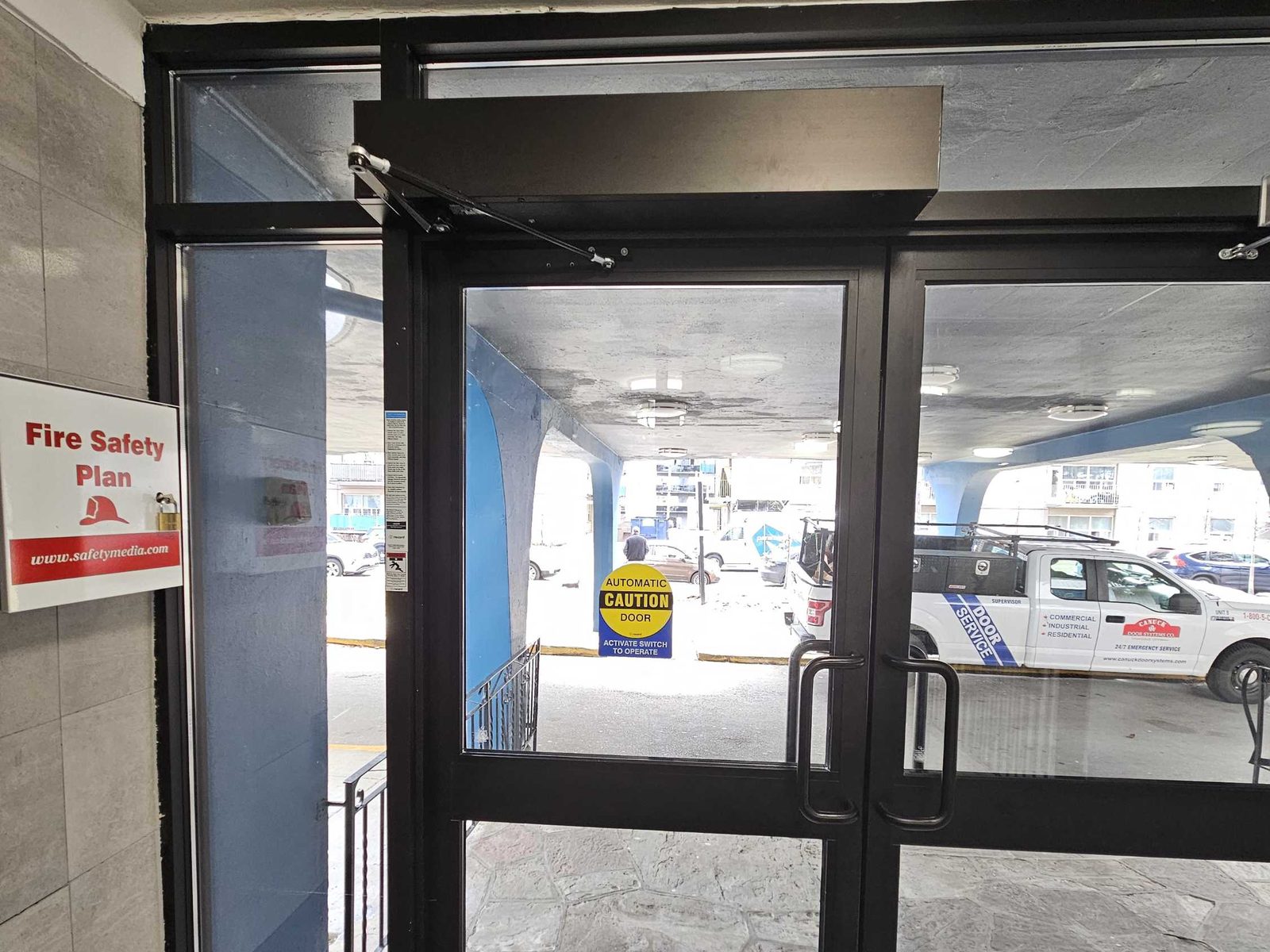
A barrier-free operator is the least expensive change most buildings can make to how people get in. It is a small electro-mechanical unit at the head of an existing swing door, a push plate or two on the wall, and a run of wire between them — and it converts a door that a person with a walker, a chair, a cart or an armful of files simply cannot open into one they can.
Canuck Door Systems has been fitting them across the GTA since 1979, on new entrances and on doors that have been hanging for thirty years. We are dealers for Record, Assa Abloy and Entrematic, and our technicians hold AAADM certification for the annual inspection these doors are supposed to get.
Four decades of doors for names Ontario knows — Canada’s Wonderland, Tim Hortons, Canadian Tire, the LCBO, Metrolinx, Marriott & Hilton hotels, the University of Toronto — plus thousands of businesses across the GTA. Dependable people, quality products, since 1979.
On a Hamilton retail plaza we fitted Ditec HA-8 operators to new storefront entrances: aluminum storefronts and automatic operators at 1379 Upper James.
What "barrier-free" actually requires
Three documents govern this work in Ontario, and it is worth knowing which one is talking to you.
- Ontario Building Code, Section 3.8 — barrier-free design. Applies when you build or renovate. It sets the clear width of a barrier-free doorway (850 mm in the 2024 edition), the manoeuvring space beside the latch, thresholds, and where power operators are required.
- The AODA's Design of Public Spaces standard. Covers exterior paths of travel, parking and certain new or redeveloped entrances — not every interior door.
- CSA B651, Accessible design for the built environment. The technical reference the other two draw on: reach ranges, control heights, and the force allowed to open a door on an accessible route — roughly 38 N at an exterior door and 22 N inside.
No Ontario rule orders an existing building to automate every door. What triggers this work in practice is a permit, a renovation, a tenant requirement, an accessibility complaint, or a decision that the front door should not be the reason somebody turns around.
Low energy, full energy and power assist
| Low-energy operator | Full-energy automatic | Power assist | |
|---|---|---|---|
| Opens when | Someone presses a plate or waves at a sensor | Someone approaches | You push the door |
| Speed | Deliberately slow — at least three seconds to open | Fast, and it must detect and stop for people | As fast as you push |
| Safety package | The slow speed is the safety package | Motion and presence sensors, guide rails, signage | None needed |
| Standard | ANSI/BHMA A156.19 | ANSI/BHMA A156.10 | ANSI/BHMA A156.19 |
| Cost | Lowest | Several times higher | Low |
| Right for | Barrier-free entrances, washrooms, accessible routes | Main public entrances with constant traffic | A heavy door with occasional users |
Nearly every "handicap door opener" enquiry we take is answered by a low-energy operator. Full-energy automation is a different product for a different problem — continuous public traffic — and quoting it for an accessible side entrance is how a $3,000 opening becomes a $12,000 one.
What a complete opening includes
The operator is one line on a list. A working barrier-free entrance is all of these:
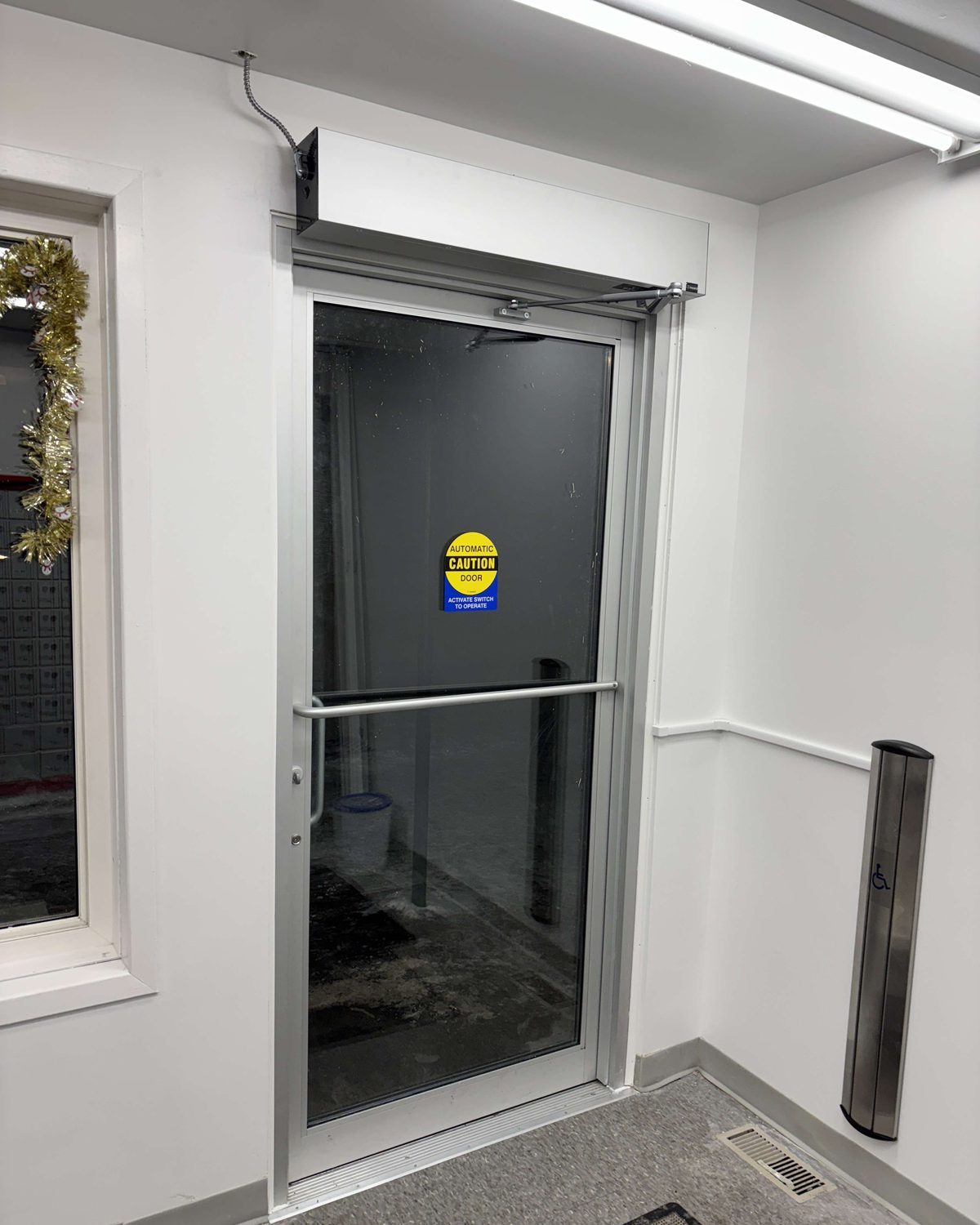
| Operator | Surface-mounted on the header, or concealed within it. Sized for the leaf width and weight |
|---|---|
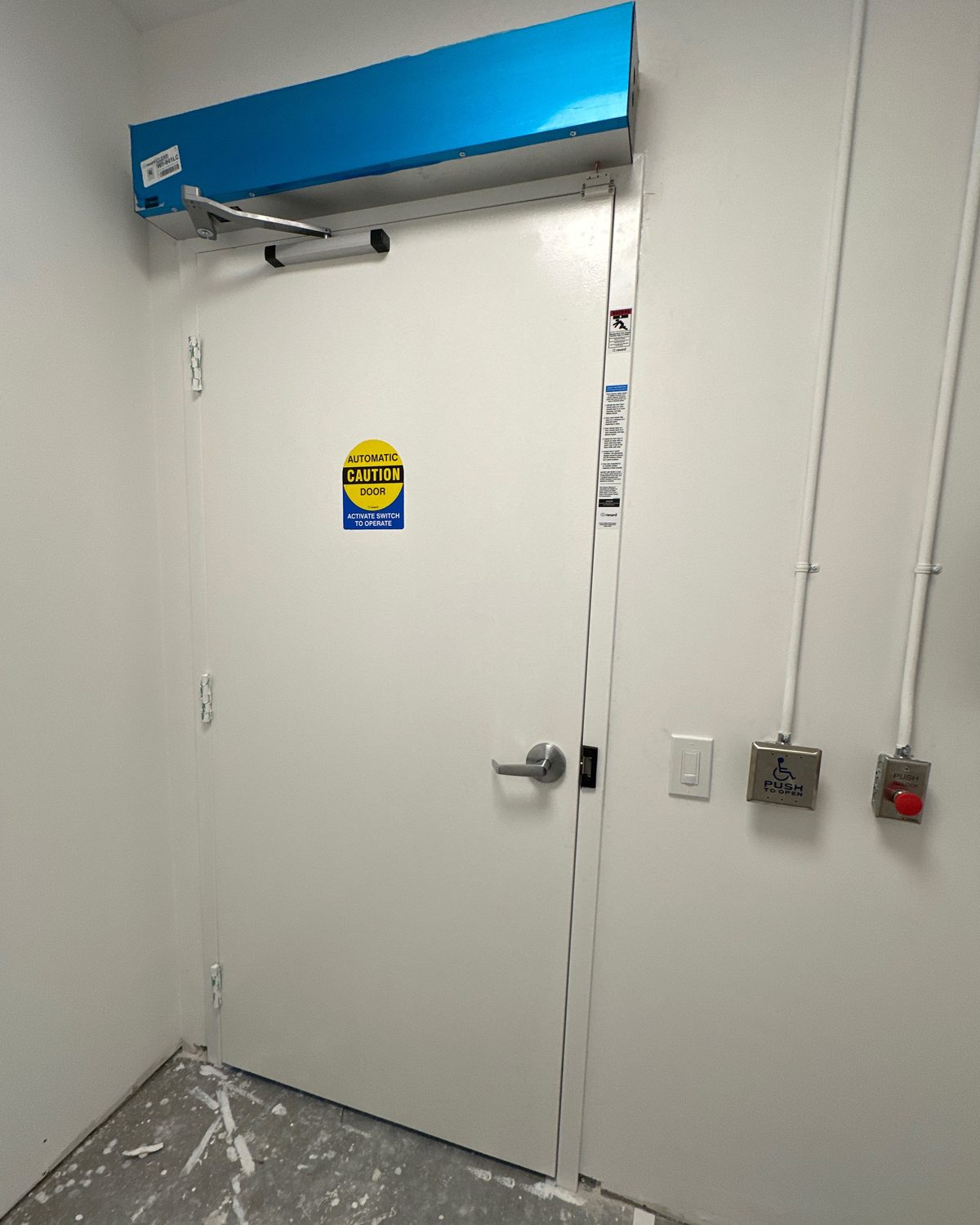
| Activation | Push plates, touchless wave actuators, or bollard-mounted posts — hard-wired or wireless |
| Placement | Outside the door's arc, typically 900–1,100 mm above the floor, reachable from a seated position |
| Vestibule sequencing | Where two doors follow each other, the second opens as you cross the vestibule |
| Electric lock interface | Electric strike or maglock released before the operator moves, on any locked door |
| Access control | Card reader, fob or intercom, tied into the same sequence |
| Closer function | The operator controls closing as well; on a rated door it must still latch every time |
| Fire alarm behaviour | Specified where the opening is on an egress route or in a rated separation |
| Signage | Activation and caution decals, per the standard the operator is built to |
Where these go
Hospitals & clinics
Department entrances and corridor doors where staff arrive pushing a bed, a chair or a trolley.
Long-term care & retirement homes
Residents using walkers and chairs all day, on doors that have to open slowly and predictably.
Schools & universities
Accessible entrances on the barrier-free route, usually installed over a summer shutdown.
Municipal buildings & libraries
Civic buildings where the accessibility standard is applied most visibly, and complained about fastest.
Medical & dental offices
Suite entrances in multi-tenant buildings, where the landlord's door and the tenant's fit-out meet.
Retail & franchise locations
Store entrances brought up to standard across a chain, one specification at a time.
Office towers & business parks
Lobby side entrances, amenity rooms and the washroom doors on the same accessible route.
Places of worship & community centres
Buildings with older, heavy doors and a congregation that needs them not to be.
Retrofitting an existing door — the real sequence
- Survey the opening, not the door. Clear width, approach space, threshold, floor finish, and the route either side.
- Fix the door first. Hinges, alignment, closer, latching. An operator makes a bad door worse.
- Find the power. This is the variable that decides the quote. Where a circuit is genuinely impractical, wireless actuators cut the wiring but not the operator's supply.
- Place the activation. Outside the swing, in reach, and on both sides where people approach from both sides.
- Install and adjust — opening and closing times, force, and hold-open, set to the standard rather than to taste.
- Inspect annually. Speeds and forces drift as the door and the building age, and an operator that has been "sped up" to stop complaints is outside its standard.
Service, adjustment and inspection
The commonest fault on these doors is not the operator failing — it is the door around it changing. A new closer, new floor covering, a swollen weather seal or a dropped hinge all change the force the operator has to work against, and it responds by struggling, stalling or slamming. Adjusting the operator alone treats the symptom.
Everything on this list is a service item rather than a replacement: control boards, motors and gearboxes, arms and linkages, push plates and their wiring, hinges and closers on the door itself. We service operators regardless of who installed them, and where a board is genuinely obsolete we say so and quote the replacement against the door you already have — see automatic door repair for how that call works.
Barrier-free and automatic door work across the GTA
Documented operator and automatic door jobs from our own project files — real clients, real buildings.
Canadian Millwork
Fox & Falcon Electric Inc
Alliance Corporation
Royalty General Construction
MTCC 650 - Atrium II
Ecopack Canada Inc
What our customers say
I hired them for installing a handicap door opener. They did a great job. I would definitely hire them again. If you have a tight deadline, I would definitely give Them a call. Thanks,
Great company! I had a broken industrial door and Canuck responded quickly to fix the problem! I was very impressed and now they will be doing more work for our company. Jay, the Sales Guru is amazing! He is friendly, knowledgeable, and well informed about all doors. Thanks Canuck Doors!
I Needed to replace the entire glass systems around my commercial building and got recommended by a friend to this place. They have walked me through the entire process from beginning to end. They did great Job in managing to keep me updated, finishing the job on time and did more than asked. …
Read the full review
Barrier-free operator work across Toronto & the GTA
We install and service barrier-free operators right across the core GTA and out into the Southern Ontario belt, from our shop in Mississauga. Most of this work is on doors that already exist, so it is scheduled around the building rather than around a construction programme.
Core GTA
- Toronto
- Mississauga
- Brampton
- Vaughan
- Markham
- Scarborough
- North York
- Etobicoke
- Richmond Hill
- Oakville
- Burlington
- Milton
Southern Ontario belt
Accessibility retrofits travel well because they are planned work — a school board, a municipality or a property manager with fifteen buildings gets one survey, one specification and one price per opening, wherever the buildings are. See all service areas
What a barrier-free door operator costs
An operator is one of the least expensive ways to change how a building is used, and the operator is rarely the biggest line on the quote. What moves the number:
- Single leaf or a pair, and whether both leaves have to be powered
- Whether there is power at the head of the opening — the largest single variable on a retrofit
- Surface-mounted or concealed-in-header operator
- Number and type of activation points — push plates, touchless actuators, or both sides
- Hard-wired against wireless actuators, and how far the wiring has to run
- Whether the door is locked, which brings an electric strike and an access-control interface with it
- Door condition — an operator will not rescue a leaf that is dropped, binding or badly hung
- Whether the opening also needs to be widened to meet clear-width requirements
- Fire-rated openings, where the operator, the closer and the label all have to agree
On an existing building the honest sequence is: fix the door, then automate it. An operator fitted to a door that already drags will drag harder, fail sooner, and be blamed for a problem it did not create.
Common questions
What is a handicap door opener actually called?
In the trade it is a low-energy power operator, or a barrier-free operator. "Handicap door opener" and "ADA door opener" are what people search for, and everyone in the industry knows what they mean, but the Ontario documents you will be held to say barrier-free — the Ontario Building Code's Section 3.8, the AODA, and CSA B651. The distinction is worth knowing when you are reading a specification or an inspection report, because the word "handicap" will not appear in either.
How much does a handicap door operator cost?
The operator is usually the smaller half of the job. What decides the price is whether there is power at the head of the opening, how many activation points you want and where they go, whether the door is locked, and whether the door itself needs work before it can be automated. Running a circuit to a header in an existing masonry wall can cost more than the operator. We quote the whole opening — operator, activation, electrical and any door repairs — rather than the box alone, because that is the number you actually have to budget.
What is a low-energy operator, and why does it matter?
A low-energy operator moves the door slowly enough to be safe without a sensor package. The standard behind it, ANSI/BHMA A156.19, requires the door to take at least three seconds to open and at least three seconds to swing from 90 degrees back to 10 degrees, and caps both the kinetic energy of the moving door and the force needed to stop it. That deliberate slowness is why a low-energy door can be activated by a push plate and needs no guide rails, and it is why it costs a fraction of a full-energy automatic entrance.
Where do the push plates go?
Outside the arc of the door, within easy reach, and at a height a seated user can hit — typically somewhere between 900 mm and 1,100 mm above the floor. Placement is the part most often got wrong: a plate mounted inside the swing means the user presses it and then has to back out of the way of the door they just opened, which is exactly the manoeuvre the operator exists to avoid. On a vestibule, the two sets of plates also have to be sequenced so the second door is opening while you cross.
Can any door be automated?
Most can, but not all should. The door has to hang square and swing freely, the frame has to be sound enough to carry the operator, and the header has to be able to take the fixings and the load. Fire-rated openings add a further constraint: the operator, the closer and the labelled assembly all have to be compatible, and the door must still latch on alarm. Where a leaf is dropped, binding or beyond adjustment, we fix or replace the door first — automating a bad door produces a worse door that costs more to run.
Does the door still work if the power goes out?
Yes. A low-energy operator declutches, so the door pushes open manually as an ordinary door does — with the closer doing what it always did. That is one of the practical advantages of a swing operator over a slider: a power failure is an inconvenience rather than a blocked opening. Where the door is electrically locked, what happens on power loss is a separate decision driven by the fire code and by security, and it is specified with the lock rather than the operator.
Does an operator make an entrance code-compliant on its own?
No, and this is the most expensive misunderstanding in accessibility work. The Ontario Building Code's barrier-free requirements cover the clear width of the doorway, the space beside the latch so a person in a chair can approach it, the force needed to open the door, thresholds and the route on both sides. An operator answers the force question and part of the approach one. If the doorway is too narrow or the landing is too tight, the opening still fails — which is why we survey the whole entrance rather than quoting a box on a header.
How long does it take to install a barrier-free operator?
Typically 1–2 weeks to supply and install the equipment once the opening is surveyed and the specification is approved. A retrofit that needs new electrical to the header takes longer to co-ordinate than the door work itself. Where a whole building or portfolio is being done at once, we survey and quote every opening together and then install them in one mobilisation. On site, one operator is usually installed in a day.
Making an entrance barrier-free?
Tell us what the door is, whether there is power near the header, and whether it is locked. That is usually enough for a firm price on the opening.