
Commercial & Industrial
Universal Washroom Door Packages (AODA)
The complete door package for a universal washroom — operator, interior and exterior actuators, electric lock with occupancy indication, emergency release and call station, wired and sequenced as one system. Supplied, installed and serviced across Toronto and the GTA since 1979.
Request QuoteCall 800-522-6825
Supplied as one sequenced package · AAADM-certified inspection · retrofits and new builds
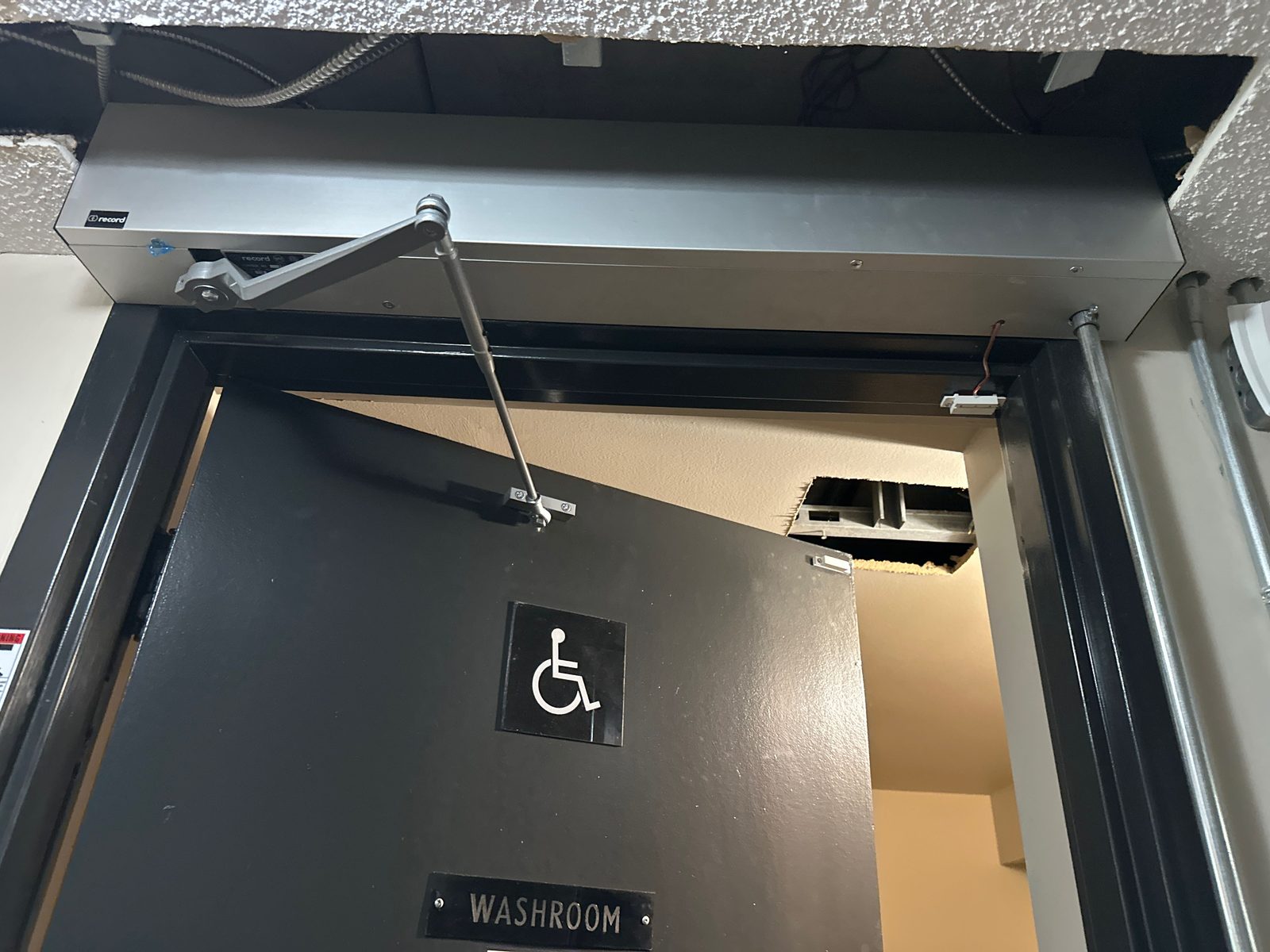
A universal washroom is a single, self-contained accessible washroom that anyone can use — including a person who needs an attendant with them, and where that attendant may be of a different gender. It is required in most new and substantially renovated buildings in Ontario, and the door is the part that makes it work or fail.
That door is not really a door. It is a package: a leaf that gives full clear width, a low-energy operator, an actuator inside and out, an electric lock that can be locked by a person with limited hand strength and released from outside in an emergency, an occupancy indicator, and an emergency call station within reach of the floor. Every one of those has to be wired into a single sequence. Canuck Door Systems supplies and installs them as one system, across the GTA, on new construction and on conversions of washrooms that were built before any of this existed.
Four decades of doors for names Ontario knows — Canada’s Wonderland, Tim Hortons, Canadian Tire, the LCBO, Metrolinx, Marriott & Hilton hotels, the University of Toronto — plus thousands of businesses across the GTA. Dependable people, quality products, since 1979.
A universal washroom kit with an automatic operator was part of our package for a new store in North York: steel doors, traffic doors and an accessible washroom for Toys “R” Us.
What is in the package
| Door and frame | Full barrier-free clear width — 850 mm at the doorway under the 2024 Ontario Building Code, Article 3.8.3.3 |
|---|---|
| Swing direction | Outward, or a sliding door. Never inward onto the floor space where somebody could have fallen |
| Operator | Low-energy, to ANSI/BHMA A156.19 — at least three seconds to open, and gentle enough to need no sensor package |
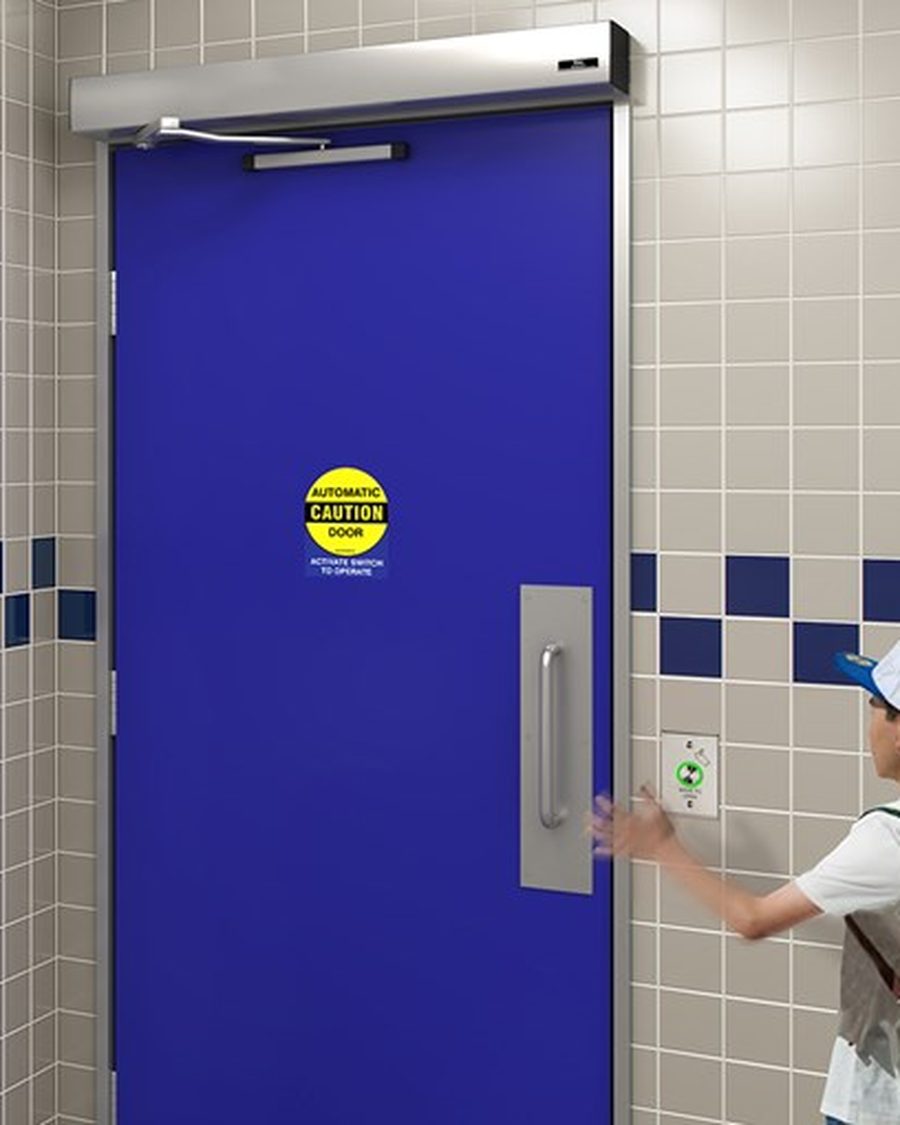
| Exterior actuator | Push plate or wave sensor, outside the door's arc and within the code's reach range |
| Interior actuator | The same, positioned to be reached from a chair once inside |
| Electric lock | Operable by a person with limited hand strength; no tight grasping, pinching or twisting |
| Emergency release | An override from outside so staff can enter a locked washroom. A privacy set alone does not satisfy this |
| Occupancy indication | Shows the room is in use, and stays honest about it |
| Emergency call station | Pull cord or button reachable from the floor, with its alarm reporting somewhere useful |
| Signage | The accessibility symbol and any wayfinding the project specifies |
The sequence — what should happen when someone uses it
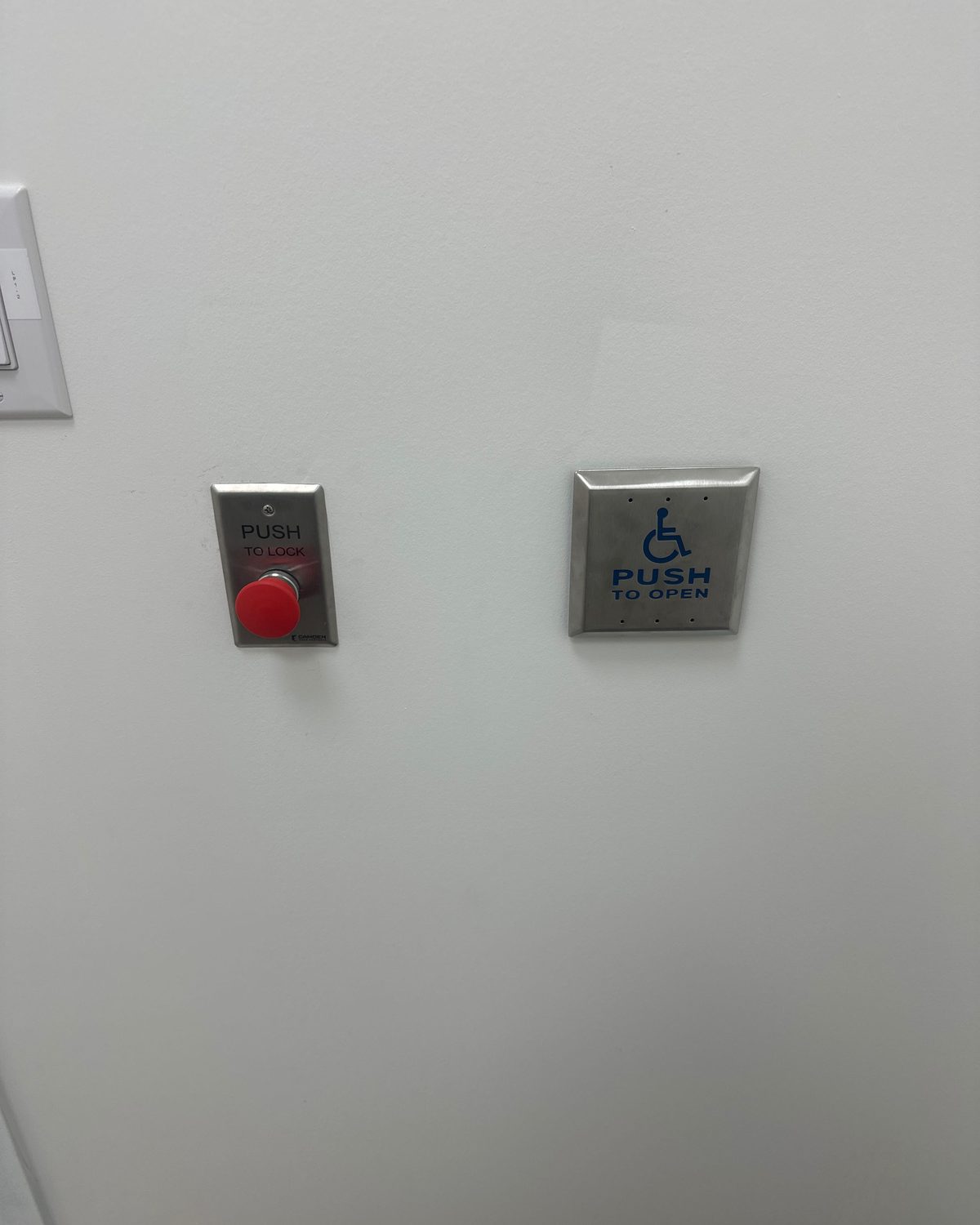
- Approach and press the exterior plate. The lock releases first, then the operator opens the door. In that order — the two fighting each other is the commonest fault on these systems.
- Enter. The door closes on the operator's own timing, not on a slam.
- Press the interior plate. The door locks and the occupancy indicator changes outside.
- Press it again to leave. The lock releases and the door opens.
- In an emergency, the call station raises the alarm from floor level, and staff release the lock from outside without a key to the whole building.
Every step above is one wiring sequence. It is the reason we quote these as a package: when the operator, the lock, the indicator and the call station arrive from four suppliers with four wiring diagrams, the commissioning becomes somebody's problem on a Friday afternoon — usually the general contractor's.
Swing or slide
| Outward-swinging door | Sliding door | |
|---|---|---|
| Floor space inside | Unaffected — the leaf swings out | Unaffected, and no swing arc outside either |
| Corridor space | Needs clear space for the leaf to swing into | None — the reason to choose it |
| Cost | Lower | Higher, and more parts to keep in sequence |
| Best where | Most washrooms, with a corridor wide enough | Tight corridors, and rooms where an outward swing would block the route |
| Locking | Electric strike or maglock on the frame | Integrated into the slider's own hardware |
| Watch for | The leaf swinging into passing traffic — position and signage matter | Floor track and threshold detail, especially in a wet room |
Where these are required
Schools & universities
Required in new and renovated buildings, and usually installed across a campus during a summer shutdown.
Hospitals & clinics
Where a patient may arrive with an attendant, and where the call station is tied into an existing nurse call system.
Long-term care & retirement
Residents with mobility devices and staff assistance — the setting the room was conceived for.
Municipal buildings & libraries
Civic buildings, arenas and community centres, where accessibility is applied most visibly.
Office buildings
Base-building washrooms on multi-tenant floors, most often added during a common-area renovation.
Retail & shopping centres
Customer washrooms where the universal room is the one families and mobility-device users head for.
Restaurants & hotels
Single-occupancy washrooms serving the public, where the room doubles as the accessible one.
Industrial & office-industrial
Plant and warehouse office areas, where the requirement arrives with the renovation permit.
New construction against retrofit
On new construction, this is a co-ordination job rather than a difficult one. Get the operator, lock, indicator and call station into the electrical drawings before the walls close, and the door work itself is a day. What causes trouble is a package specified after rough-in, when the conduit is already in the wrong place.
On a conversion, three things decide the price before the door does:
- The doorway width. If it is under the required clear width, the opening has to be widened — real construction in a block wall.
- The swing. An inward-swinging washroom door has to be reversed or replaced, because a person who has fallen inside can block it.
- The power. Getting a circuit to the head of an existing opening is routinely the largest line on the quote, and it is worth confirming before anything else is decided.
We survey all three before quoting, so what you get is a number for the finished washroom rather than a number for a door.
Service and inspection
These packages fail quietly rather than dramatically. The lock and the operator drift out of sequence and start working against each other; the occupancy indicator stops matching reality and the room reads as permanently in use; a call station is tested once at handover and never again. All three are adjustment and wiring issues, and all three are what an annual inspection catches — ours are carried out by AAADM-certified technicians, who also cover the operator's speeds and forces at the same visit.
Barrier-free work across the GTA
Documented washroom package and operator jobs from our own project files — real clients, real buildings.
Canadian Millwork
Fox & Falcon Electric Inc
Alliance Corporation
Royalty General Construction
MTCC 650 - Atrium II
Ecopack Canada Inc
What our customers say
I hired them for installing a handicap door opener. They did a great job. I would definitely hire them again. If you have a tight deadline, I would definitely give Them a call. Thanks,
As a small Landlord in the East end of Toronto I respond to my Tenants professionally in a timely cost effective way. This occurred over the Xmas holidays with a broken commercial door hinge. …
Read the full review
We own multiple commercial properties in Waterdown, and reaching out to a new contractor to fulfill a need is often stressful. Not so with Canuck Door Systems! From sales with Robert to dealing with Stanislav for measurements, communication was easy and open. …
Read the full review
Universal washroom work across Toronto & the GTA
We supply and install universal washroom door packages right across the core GTA and out into the Southern Ontario belt, from our shop in Mississauga. Most of this work lands inside a wider renovation, so it is co-ordinated with the general contractor and the electrician rather than dropped in at the end.
Core GTA
- Toronto
- Mississauga
- Brampton
- Vaughan
- Markham
- Scarborough
- North York
- Etobicoke
- Richmond Hill
- Oakville
- Burlington
- Milton
Southern Ontario belt
These packages travel well because they are planned work. A school board, a municipality or a developer with several sites gets one specification, one wiring diagram and one price per washroom, wherever the buildings are. See all service areas
What a universal washroom door package costs
This is a system, not a door, and the price follows the parts list plus the wiring that ties them together. What moves the number:
- Whether the door and frame are new, or an existing opening is being converted
- Swing or sliding door — a sliding package costs more and is sometimes the only option
- Operator size, set by the leaf width and weight
- Two activation points, inside and out, plus their mounting positions
- Electric lock and occupancy indication, and whether it fails locked or unlocked
- Emergency release from outside, which the code requires and which is not a standard privacy lock
- Emergency call station and where its annunciator has to report to
- Wiring runs and available power at the opening — routinely the biggest single line
- Whether the doorway has to be widened to give the required clear width
The least expensive version of this job is the one specified before the walls close. Retrofitting the wiring for an operator, a lock, an indicator and a call station into a finished washroom costs more than every component on the list put together.
Common questions
What is a universal washroom?
A single enclosed washroom, intended for use by one person at a time — including a person who needs an attendant, and where the attendant may be of a different gender. That is the distinction from an "accessible stall" inside a larger washroom: the universal washroom is its own room, with its own lockable door, and it serves people that a row of stalls cannot. In Ontario it appears in the Building Code's barrier-free section, and it is required in most new and substantially renovated buildings of any size.
What makes the door different from an ordinary washroom door?
Four things, and they have to work together. It gives the full barrier-free clear width. It can be locked from inside by someone with limited hand strength, and that lock can be released from outside in an emergency. It opens under power from both sides, so a person in a chair does not have to pull it. And it must not trap anybody — which is why these doors swing outward or slide rather than opening inward onto the floor space where a person could have fallen.
Does a universal washroom need a power door operator?
In practice, yes — and it is the reason this is a package rather than a door. The barrier-free requirement is that a person using the washroom can operate the door, and on a room that has to be closed, locked, unlocked and opened again by someone who may have one usable hand, a low-energy operator with actuators on both sides is the only arrangement that reliably does it. What varies between projects is the lock, the indication and the call station around it, not whether the door is powered.
How does the sequence actually work?
Press the plate outside: the lock releases and the operator opens the door. Once inside, press the interior plate: the door closes and locks, and an occupancy indicator on the outside changes to show the room is in use. Press it again to unlock and open. From outside, an emergency release — usually keyed or tool-operated — overrides the lock so staff can get in. All of that is one wiring sequence, which is exactly why it should be bought as one package from one supplier rather than assembled on site from four.
What does the emergency call station do?
It lets someone who has fallen or is in difficulty call for help without reaching the door — a pull cord or a button positioned low enough to be reached from the floor. Where its alarm reports to is a design decision: a light and sounder outside the washroom door, a front desk, a nurse call system, or a monitored panel. It is a separate system from the door, but it is installed at the same time and by the same trade sequence, which is why it belongs on this list.
Can an existing washroom be converted?
Often, and it is a large share of this work. The three things that decide whether it is straightforward are the doorway width, which way the door swings, and whether power can reach the head of the opening. Widening a doorway in a block wall or reversing a door that swings into the room are both real construction, not door work — so we survey first and tell you which of those you are facing before anything is ordered.
How long does a universal washroom package take?
Typically 4–6 weeks to supply the package once the specification is approved, then 1–2 weeks to schedule and install it — around 5–8 weeks in total, depending on the size of the project. The critical path is almost never the door: it is the electrical rough-in. On new construction, get the wiring for the operator, lock, indicator and call station into the drawings before the walls close and the installation itself becomes a day.
What goes wrong with these afterwards?
Two failures dominate. The lock and operator drift out of sequence, so the door opens before it has unlocked and the operator strains against its own lock — noisy, and destructive over months. And the occupancy indicator stops matching reality, which produces the complaint that the washroom is "always occupied". Both are adjustment and wiring faults rather than component failures, and both are what an annual inspection is for.
Building or retrofitting a universal washroom?
Send us the door size, whether it swings or slides, and whether the wiring is in yet. We’ll specify the package and quote it as one system.