
Commercial & Industrial · 24 hours a day, every day
Automatic Door Repair & Installation
An entrance that will not open is a building people cannot get into — and one stuck open is a building that is not secure. We repair automatic sliders and swing operators of every make, install new ones, and carry out the annual AAADM inspection. Across Toronto and the GTA since 1979.
Call 800-522-6825 — 24/7Request a Quote
Dispatched 24/7 from Mississauga · all makes, including doors we did not install · AAADM-certified
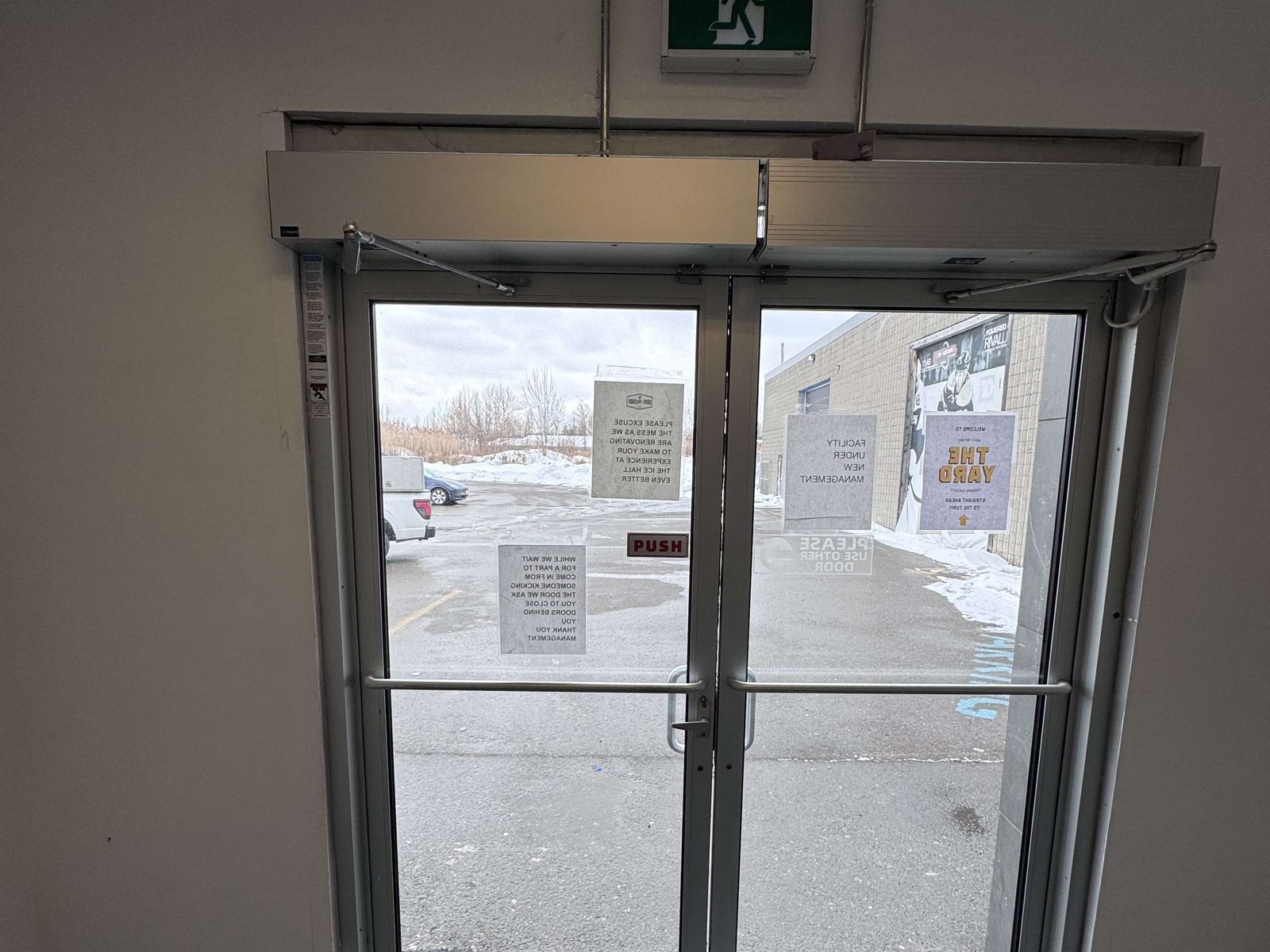
An automatic entrance fails in one of two directions, and both are urgent. Stuck shut, and the building is closed to anyone who cannot use another door — which, at a barrier-free entrance, is precisely the people it was installed for. Stuck open, and the building is unheated and unsecured until somebody stands in the doorway.
We repair automatic doors of every make across Toronto and the GTA, dispatch 24 hours a day from our shop in Mississauga, and hold AAADM certification for the annual inspection. We also install them — new entrances, operator retrofits to doors you already own, and straight replacements into existing framing.
Four decades of doors for names Ontario knows — Canada’s Wonderland, Tim Hortons, Canadian Tire, the LCBO, Metrolinx, Marriott & Hilton hotels, the University of Toronto — plus thousands of businesses across the GTA. Dependable people, quality products, since 1979.
What the symptom usually means
Diagnosis on these doors follows a fairly reliable pattern. This is what we expect to find before we have seen it — not a promise, but it is where a technician starts.
| Symptom | Usually | Sometimes |
|---|---|---|
| Door will not open at all | No power, tripped breaker, or a failed control board | Motion sensor dead or disconnected; operator switched to "off" or "manual" at the key switch |
| Door opens and stays open | A presence sensor seeing something that is not there — a mat, a sign, a display, sunlight | Safety device faulted, which fails the door open by design |
| Door opens on its own, at random | Sensor picking up traffic, weather or a moving object outside its intended field | Interference, or a sensor knocked out of aim |
| Door judders, stalls or is slow | Grit and salt in the track, dirty or worn rollers and carriers | Belt tension, or a motor drawing more than it should |
| Door closes too fast or too hard | Speed and force adjusted outside the standard, usually to answer a complaint | Failing closer on a swing door; the operator fighting a door that binds |
| Door will not lock or latch | The latch and lock hardware, not the operator | Sequencing between an electric strike and the operator gone out of step |
| Push plate does nothing | The plate, its battery, or its wiring | Receiver or board input, on a wireless actuator |
| Slider will not break out | Break-out hardware seized or damaged | The door never had break-out — it is a specified feature, not a default |
The single most common underlying cause of a "faulty" automatic door is a change in the building nobody linked to the entrance: a new mat, a new floor finish, a seasonal display, a re-tiled vestibule. All of them sit inside a sensor's field of view. All are minutes to fix once identified.
What we repair
Every part of these systems is a service item, and almost all of them are replaced in place.
- Sensors — motion, presence and safety beams: cleaned, re-aimed, re-commissioned or replaced.
- Control boards and motors — including where the fault is intermittent, which is the hardest kind to catch and the reason we check the door's history as well as its wiring.
- Belts, carriers, rollers, tracks and guides on sliders — the mechanical wear items, and the ones winter destroys.
- Arms, linkages and gearboxes on swing operators.
- Push plates, wave actuators and their wiring, including wireless transmitters and receivers.
- Break-out hardware, on the sliders that have it.
- The door and frame themselves — hinges, alignment, closers, glazing, weather seals. Often this is the actual fault.
- Interfaces — electric strikes, card access and fire alarm sequencing, where the operator is one part of a system.
Installation — new entrances and retrofits
The other half of this page. We install automatic doors as well as fix them, which for most buildings takes one of three forms.
- A new automatic entrance — framing, glass, operator and sensors as one package. 4–6 weeks to produce once shop drawings are approved, then 1–2 weeks to schedule and install: about 5–8 weeks in total.
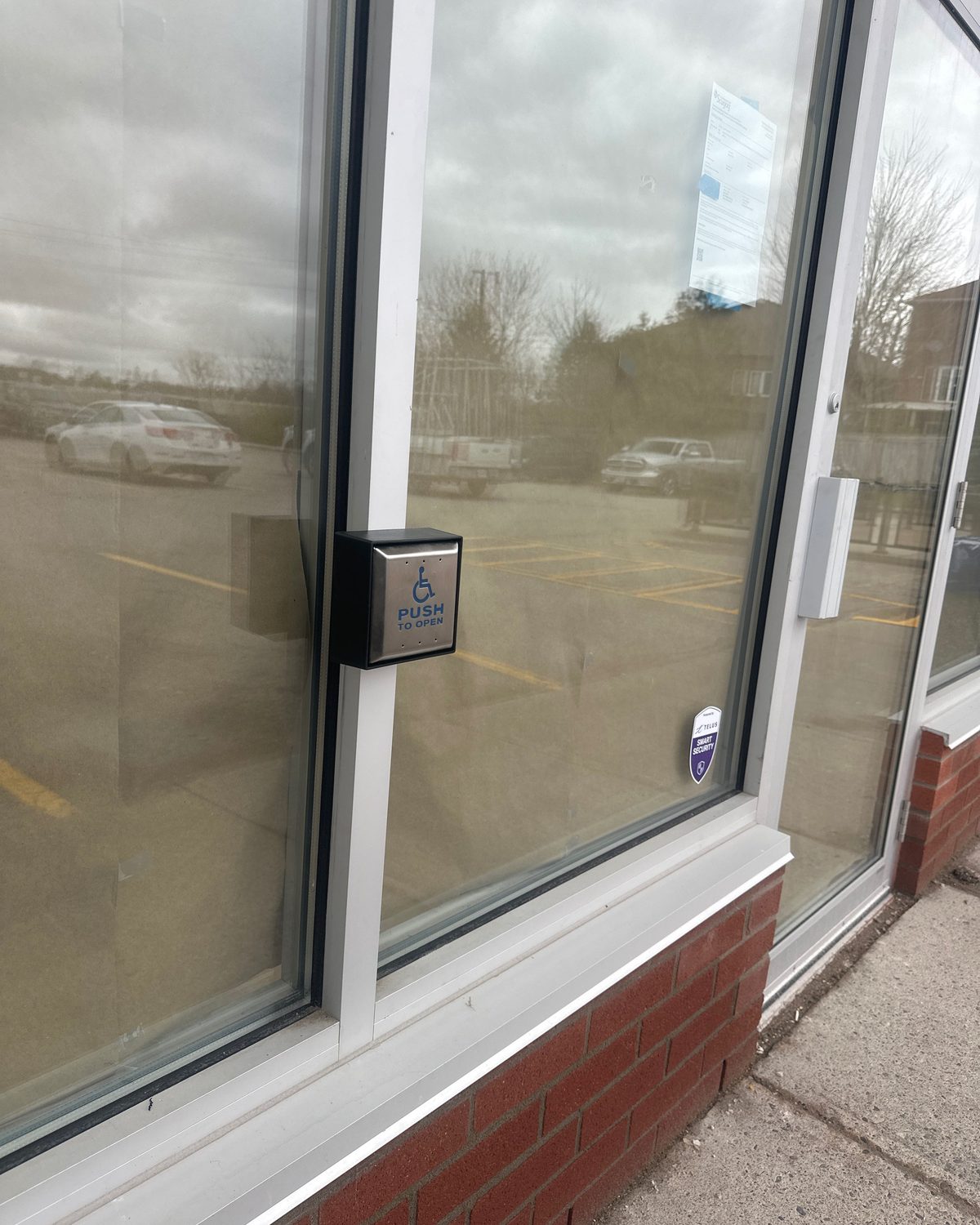
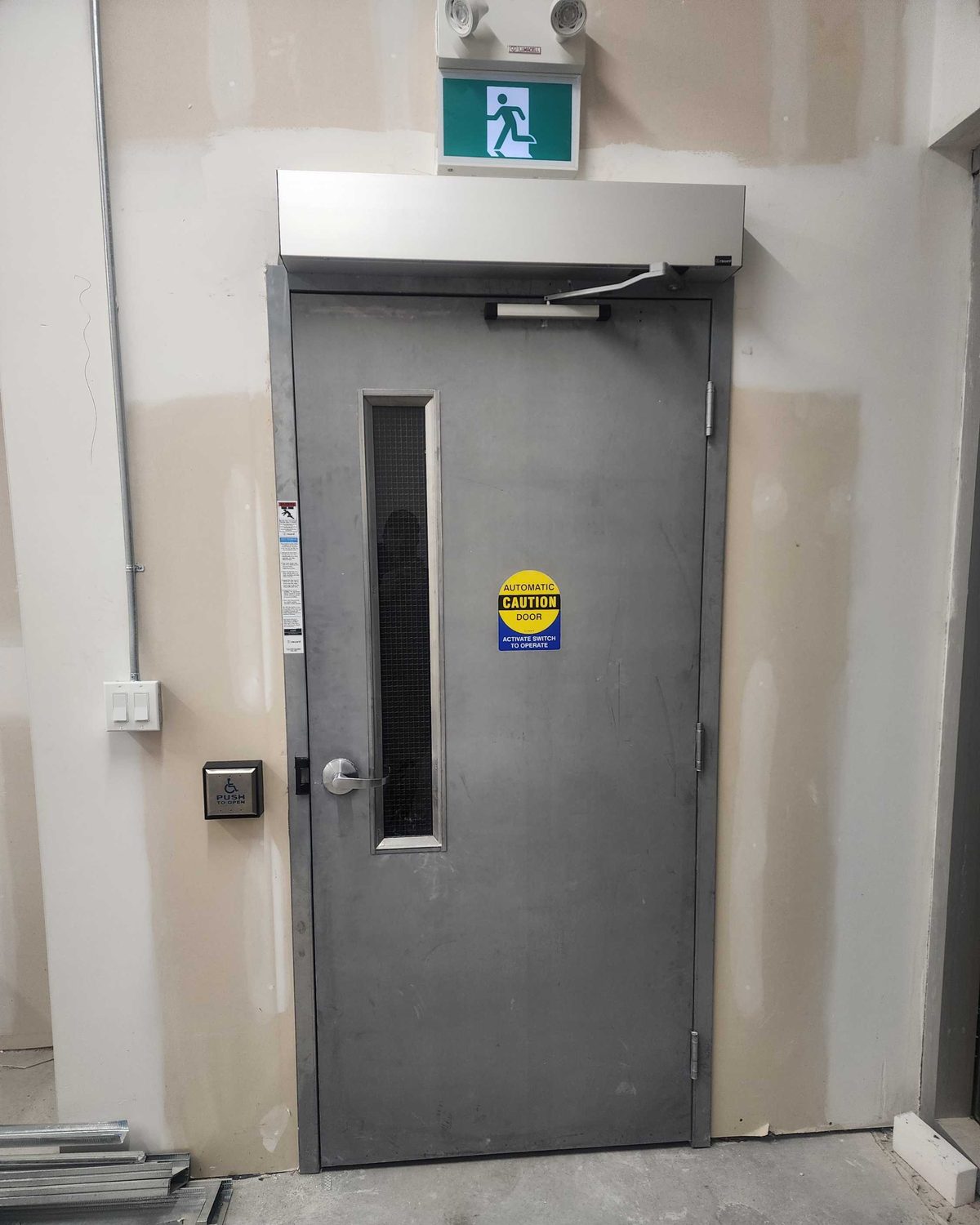
- An operator retrofit to a door you already own — the least expensive way to make an entrance barrier-free. Equipment in a few weeks, and usually a single day on site. See barrier-free door operators.
- An operator replacement into existing framing — when the old unit is obsolete but the entrance is sound. Far less expensive than a new door, and the commonest outcome of an inspection on an ageing slider.
Entrance work is routinely scheduled overnight or over a weekend so the building opens on time with a working door.
The annual inspection
An automatic door is a powered machine that the public walks through, which is why the industry standard is a daily safety check by your staff and a full annual inspection by a certified technician. Ours hold AAADM certification for it. The inspection covers sensor coverage and hold-open times, opening and closing speeds and forces, safety devices, break-out where fitted, guide rails, signage and the mechanical condition of the operator — and it produces a written record, which is the point of it if anything is ever disputed.
On an inherited door of unknown history, an inspection is also the least expensive way to find out what you actually own: which make it is, whether parts still exist for it, and whether it breaks out in an emergency.
Before you call
Four things make the first visit faster, and they are all visible from the floor:
- Slider or swing door, and how many leaves.
- What it is doing — stuck open, stuck shut, cycling on its own, or making a noise it did not make last week.
- Whether the opening can be secured if the door has to be left immobilised.
- Any name on the header or the decal — Record, Assa Abloy, Entrematic, Stanley, Horton, dormakaba. Parts are brand-specific, and knowing the make decides what goes on the truck.
Automatic door work across the GTA
Emergency calls are rarely photographed — these are documented installations and service visits from our own project files.
Canadian Millwork
Fox & Falcon Electric Inc
Alliance Corporation
Royalty General Construction
MTCC 650 - Atrium II
Ecopack Canada Inc
What our customers say
I hired them for installing a handicap door opener. They did a great job. I would definitely hire them again. If you have a tight deadline, I would definitely give Them a call. Thanks,
I had an old metal and class commercial door that was sagging. I opted for a re-hinging with new continuous hinge system. Process from quote to job done was very easy and competitive priced. Technicians were on time and did the job professionally. My door opens and closes beautifully.
It was a pleasure dealing with Canuck door systems. Moji was excellent to deal with. He responded extremely fast and a technician was here within 2 hours and did an excellent job on our commercial doot repair. I highly recommend them.
Automatic door repair across Toronto & the GTA
Crews dispatch from our shop at 1645 Bonhill Road in Mississauga — central to the region rather than at one end of it — and the emergency line is answered 24 hours a day, every day of the year, including holidays.
Core GTA
- Toronto
- Mississauga
- Brampton
- Vaughan
- Markham
- Scarborough
- North York
- Etobicoke
- Richmond Hill
- Oakville
- Burlington
- Milton
Southern Ontario belt
The belt is where we are straight about distance. A 3am call to Niagara is a long drive and we will say so on the phone rather than leave you waiting. Planned work — inspections, sensor replacements, operator swaps — travels much better than emergencies do. See all service areas
What an automatic door repair costs
A service call is priced on labour, parts and the hour. Which of those dominates depends on:
- What failed — a sensor, a belt, carriers and rollers, a control board, or the motor
- Whether the part is on the truck, orderable, or obsolete for that operator
- Make and model, since parts for these are brand-specific and not interchangeable
- Slider or swing — a bi-parting entrance is a bigger job than a single operator
- The hour: after-hours, weekend and holiday call-outs carry a labour premium
- Whether the opening can be secured, or has to be made safe and left until parts arrive
- Whether the real fault is the operator or the door and frame it is fitted to
We tell you what the call-out costs before a crew is on the road. Where an operator is genuinely obsolete — no boards, no carriers — we say so and quote a replacement against the framing you already have, rather than charging you to chase a part that no longer exists.
Common questions
What are the common problems with automatic doors?
In rough order of how often we are called: sensors that have drifted, been knocked, or been confused by sunlight, a new floor finish or a winter mat; grit and salt in the floor track of a slider, which shows up as juddering or stalling; safety beams and presence detectors that leave the door stuck open or reversing at random; worn rollers, carriers and belts; and control boards and motors at the end of their life. A surprising share of faults are not the door at all — something in the building changed in front of a sensor and nobody connected the two.
Can you manually open an automatic door?
Usually, and how depends on the type. A low-energy swing operator declutches, so the door simply pushes open like an ordinary door. A sliding entrance on an egress route has break-out leaves: push firmly from inside and the leaf swings out of its track. A slider without break-out — common on interior and industrial openings — has no manual mode and needs the operator released by a technician. If you do not know which you have, that is worth establishing before the day you need it.
How quickly can you get to a stuck door?
The line is answered 24 hours a day and crews dispatch from Mississauga, which is central to the GTA rather than at one end of it. What we will not do is quote you a headline response time we cannot hold at 3am in February — we tell you on the phone when a crew can be there, and if the honest answer is longer than you want, you get to make other arrangements instead of waiting.
Do you repair doors you did not install?
Yes — most of the automatic doors we service were installed by somebody else. We are dealers for Record, Assa Abloy and Entrematic and work on other makes besides. The limit is honest rather than commercial: parts for these systems are brand-specific, and on a genuinely obsolete operator there comes a point where no board or carrier exists at any price. We will tell you when you have reached it.
Is it worth repairing an old automatic door or replacing it?
Repair, in most cases. Sensors, belts, carriers, rollers, boards, motors, arms and linkages are all replaceable in place, and the framing usually outlives several generations of operator. Replacement becomes the right call in three situations: parts are no longer manufactured, the framing is damaged or out of square beyond adjustment, or the opening now has to do something it was never built for — most often become barrier-free or wider. An operator swap into sound existing framing is far less expensive than a new entrance.
How much does it cost to make a door automatic?
Adding a low-energy operator to a door that already hangs properly is the least expensive route into automation. The operator itself is rarely the biggest number — the variables are whether there is power at the head of the opening, how many activation points you want, whether the door is electrically locked, and whether the leaf needs work first. Running a new circuit to a header in an existing masonry wall can exceed the cost of the operator, so we quote the whole opening rather than the equipment.
How long does an automatic door installation take?
For a new automatic entrance, typically 4–6 weeks to produce the door once shop drawings are approved, then 1–2 weeks to schedule and install it — about 5–8 weeks in total, depending on the size of the project. An operator retrofitted to an existing door is much faster: equipment in a few weeks and usually a single day on site. Repairs are a different clock entirely — dispatched 24/7, with common sensors and parts carried on the trucks.
How often should an automatic door be inspected?
A daily safety check by your own staff, and a full inspection once a year by a certified technician. The daily check takes about a minute — watch one full cycle and confirm the door does not touch anyone, that the signage and guide rails are intact, and that nothing has been placed in the door path. The annual inspection is the one that matters legally: our technicians hold AAADM certification for it, and it covers sensor coverage, speeds, forces, hold-open times, safety devices, break-out and signage.
Door stuck open, stuck shut, or opening at random?
Call the 24/7 line — that is the fastest route to a crew. Tell us whether it is a slider or a swing door, what it is doing, and whether the opening can be secured, and we’ll tell you what happens next.