Commercial, Industrial & Residential · 24 hours a day, every day
24/7 Emergency Commercial Door Repair
A door that will not close, will not lock, or will not open — right now. We answer the line 24 hours a day, secure the opening first, and schedule the permanent repair after. Commercial, industrial and residential across Toronto and the GTA, dispatched from Mississauga since 1979.
Call 800-522-6825 — 24/7Request a Quote
Answered 24/7, including holidays · radio-dispatched service trucks · since 1979
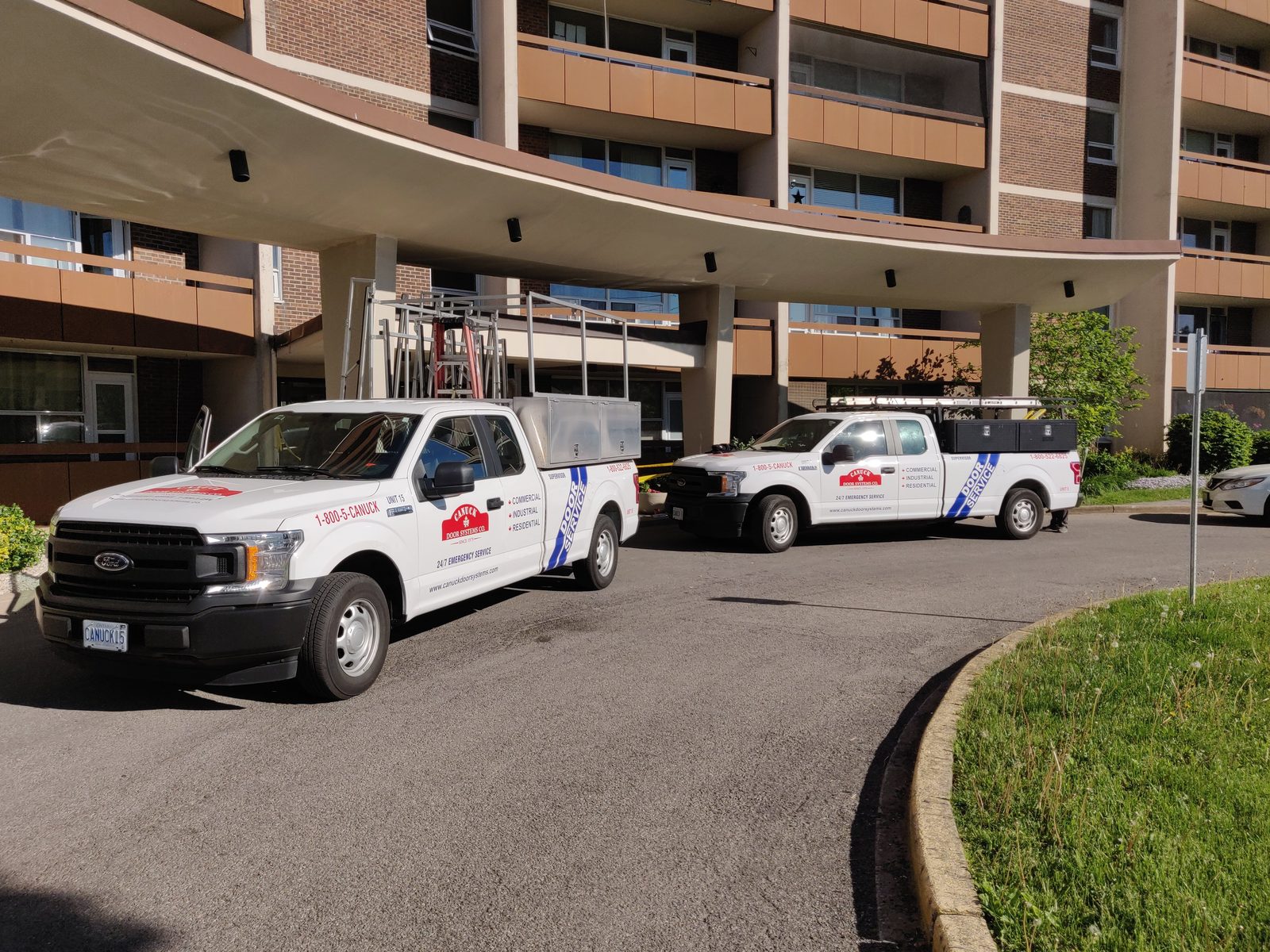
If a commercial door will not lock, will not close, or will not open and your building cannot wait, call 800-522-6825. The line is answered 24 hours a day, every day of the year. We secure the opening first — that is almost always the real job at 2am — and complete the permanent repair on a scheduled visit once any made-to-size part has been produced.
Canuck Door Systems has run emergency door calls across the GTA since 1979, on doors of every type and make: steel and glass entrances, overhead and rolling doors, dock equipment, automatic operators and security shutters.
Call, don't fill in a form
An emergency page whose main route is a contact form is a page that has never handled one. Phone the line. Four answers are enough to dispatch the right technician with the right parts:
- The address, and how to reach the door — gate codes, mall access, loading entrance, and who is on site with keys at 2am.
- What the door is — steel personnel door, glass entrance, overhead or dock door, automatic entrance, shutter or grille.
- What it is doing, and whether the building can be locked. This is the question that sets the priority.
- Whether an exit or a fire door is involved. That moves you to the front of the queue, ahead of everything cosmetic.
What we treat as an emergency
The building will not lock
A failed lock, a leaf that will not latch, a shutter that will not come down, a broken entrance. The premises cannot be closed and left.
An exit is compromised
A fire door jammed open or unable to latch, an exit device that will not release, a rated opening damaged. A life-safety fault, not a maintenance item.
A dock or overhead door is dead
The bay will not open and the trucks are queued, or it will not close and the building is open to the weather and to anyone.
Break-in or vehicle damage
Forced entry, a vehicle into a shopfront, a leaf or frame wrecked. Photographed on arrival, secured, then repaired.
Broken glass in an entrance
Glass down at street level, or any opening a person could step through. Cleared and boarded tonight, glazed when the unit is made — see emergency board-up.
A door stuck open in winter
An overhead or entrance door that will not close is a heating bill and a frozen sprinkler line as well as a security problem.
Automatic entrance failed
A powered door stuck open, closing on people, or with a failed safety sensor. It gets taken out of automatic operation the same night.
Production has stopped
A high-speed, cold-store or traffic door that a process depends on. Downtime is the cost, and it is usually larger than the repair.
The first job is the opening, not the door
At night, the useful question is not "can this be repaired" but "can this building be left". The order of preference on arrival:
- Repair it properly — the outcome on most calls, because the parts that fail most often are the parts on the truck.
- Make it lockable — a temporary cylinder or lock, a leaf re-hung so it latches, hardware swapped for what we carry.
- Physically close the opening — a shutter strapped down, a damaged leaf secured shut where no exit depends on it, or the opening boarded into its existing frame.
- Tell you the truth about the gap — where the permanent part has to be made, you get the expected date before we leave, and the temporary state is designed to hold until then.
The one thing we will not do is chain or screw shut an exit that people depend on. Where securing a building would block a required exit, the building needs a fire watch until the door is repaired — we will say so on site and put it in writing, even when it is not what anyone wants to hear at midnight.
What usually fails, and what happens on the night
| The call | What we usually find | Finished that night? |
|---|---|---|
| "It won't lock" | Lock or cylinder failed, latch not engaging, strike out of alignment | Usually — locks, cylinders and strikes are on the truck |
| "It won't close" | Closer failed or leaking, hinge dropped, frame pushed out of square | Usually; a twisted frame is secured and replaced later |
| "It won't open" | Operator, control or power fault; jammed hardware; frozen or seized track | Often — the door is at least released manually and made safe |
| "The overhead door came down / is too heavy" | Broken torsion spring, cable off the drum | Usually — spring sets and cables are stocked |
| "Someone drove into it" | Leaf and frame damaged, sometimes the surrounding structure | Secured that night; parts are made to size |
| "The glass is smashed" | Break-in or impact; frame often damaged too | Cleared and boarded; glass is fabricated to the opening |
| "The dock bay is stuck" | Leveler cylinder, spring or hold-down; door off its track | Often; pit and concrete work is scheduled |
| "The automatic door is closing on people" | Sensor, control board or carrier failure | Taken out of automatic operation immediately, then repaired |
After the night: the repair that stops it recurring
An emergency call is a symptom, not a diagnosis. Before the file closes, the technician records what actually failed and whether the opening will do it again — because the pattern is nearly always specific and fixable.
- Under-specified for its use. A door cycled far beyond its rating fails repeatedly. High-cycle springs or a different door type ends it. See springs & parts.
- Something keeps hitting it. Bollards, guide rails or dock bumpers cost less than the fourth repair.
- A repeatedly targeted opening. Laminated glass plus a shutter or grille costs less over two years than repeated board-ups and lost trading.
- No service interval. Most of what fails at night is visible in daylight weeks earlier. That is the entire argument for a maintenance plan, and it is the least expensive recommendation on this page.
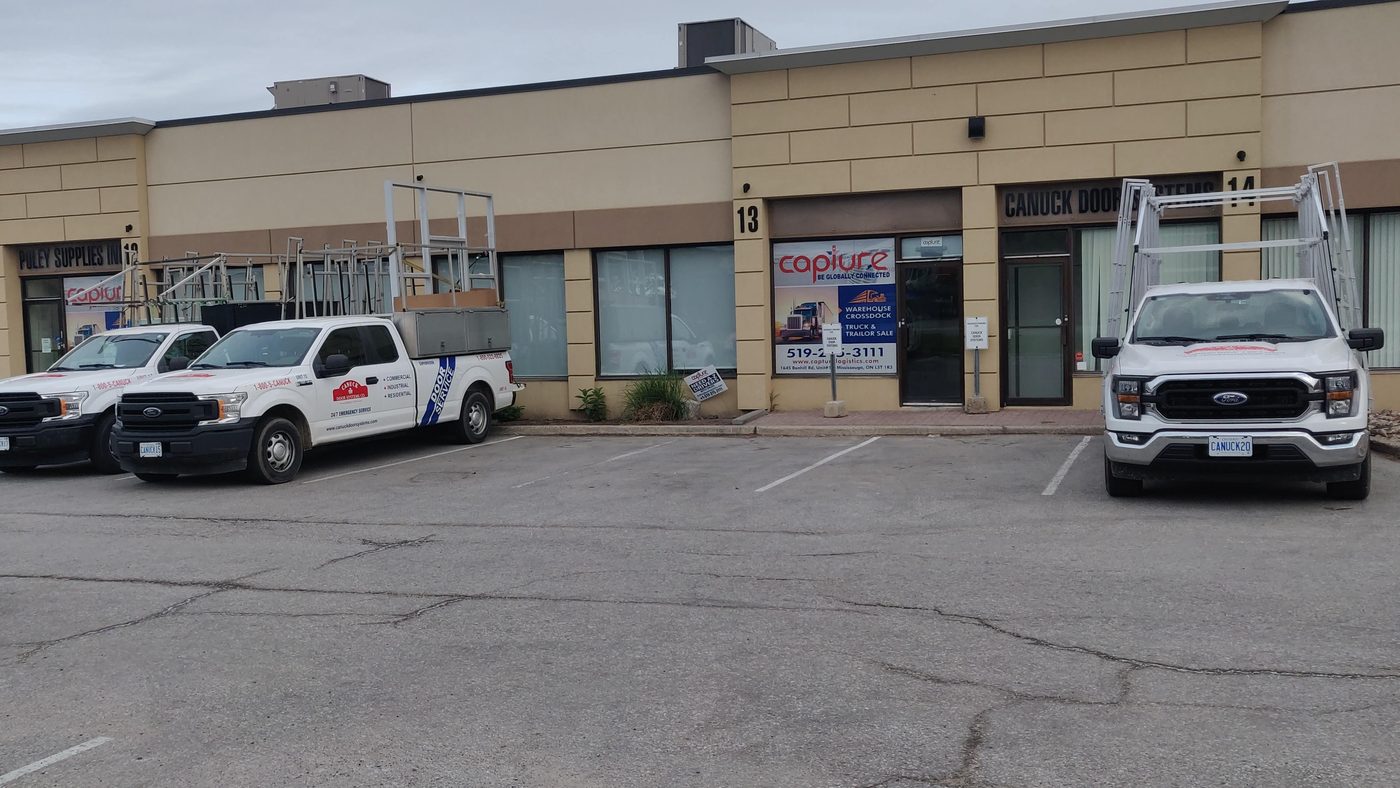
Four decades of after-hours calls for names Ontario knows — Canada’s Wonderland, Tim Hortons, Canadian Tire, the LCBO, Metrolinx, Marriott & Hilton hotels, the University of Toronto — plus thousands of businesses, warehouses, schools and hospitals across the GTA. Dependable people, quality products, since 1979.
Before you call — three things worth knowing
- You do not need to know what is wrong. Describe what the door is doing. Diagnosing it over the phone is our job, and the wrong guess only matters if it sends the wrong truck.
- Ask for the attendance cost. We quote it before dispatching, and any company that will not is a company you find out about on the invoice.
- Say if it can wait until morning. Plenty of faults honestly can, and the normal rate is materially less expensive than the after-hours one. We will tell you when we think yours is one of them, and book it for the next working day — see commercial door repair.
What our customers say
Called Canuck doors for one of our warehouse doors that was malfunctioning , the technician that came was very knowledgeable and efficient, it took him to time to find the issue and fix it. 5 stars
I called Canuck Door systems regarding my security gate at our retail store, I cannot recommend them enough. Quick turn around, extremely fair pricing compared to competitors. Fixed the problem, called to make sure it was done to my expectations. This is the company to use.
It was a pleasure dealing with Canuck door systems. Moji was excellent to deal with. He responded extremely fast and a technician was here within 2 hours and did an excellent job on our commercial doot repair. I highly recommend them.
Emergency dispatch across Toronto & the GTA
Crews dispatch from our shop at 1645 Bonhill Road in Mississauga — central to the region rather than at one end of it — and the line is answered 24 hours a day, every day of the year, including holidays.
Core GTA
- Toronto
- Mississauga
- Brampton
- Vaughan
- Markham
- Scarborough
- North York
- Etobicoke
- Richmond Hill
- Oakville
- Burlington
- Milton
Southern Ontario belt
The belt is where we are honest about distance. A 3am call to Niagara or Barrie is a long drive and we will say so on the phone rather than leave you waiting — and we will tell you what you can do to make the opening safe before we arrive. See all service areas
What an emergency call-out costs
Two numbers, and it is worth knowing which is which before you call anyone: making the opening safe tonight, and repairing it properly afterwards.
- The hour — after-hours, weekend and holiday attendance carries a labour premium
- How far the address is from Mississauga, since attendance is mostly travel
- What has to happen to secure the opening — boarding, strapping, chaining, or a temporary lock
- Whether the fault can be fixed on the night or only made safe
- The part — a closer or a lock is one order of magnitude, a spring set, an operator or a section another
- A second, scheduled visit to complete the permanent repair
We give you the attendance cost on the phone before a truck rolls, and the repair cost once the technician has seen the door. The parts are not priced differently because you called at midnight — the premium is on the labour, and it is disclosed.
Common questions
What counts as a door emergency?
Three things make a door call an emergency rather than a repair. The building can no longer be locked and left. An exit or a fire door is blocked, jammed open, or will not latch — a life-safety problem, not an inconvenience. Or the door is what your operation runs through, so a dead dock position or entrance is stopping trucks, production or trading. A door that is noisy, dragging or slow is not an emergency, and treating it as one costs you an after-hours premium for no gain.
How fast can you get here?
The line is answered 24 hours a day and trucks dispatch from Mississauga, central to the GTA rather than at one end of it. On the call we give you a real arrival window based on where a technician actually is at that moment — if the honest answer is three hours, we say three hours. What we will not do is publish a fixed response time we could not hold to for every address in Southern Ontario, because the promise would be worth nothing at 3am in Whitby.
Can you actually fix it at night, or just make it safe?
Both happen, and which one depends entirely on the part. Closers, locks, cylinders, hinges, strikes, sweeps, cables, rollers and common controls are on the trucks, so a large share of night calls end with the door working. What cannot be finished on the night is anything made to size — glass, a door leaf, a section, a curtain, a replacement operator, and overhead door springs, which are wound to the individual door and take 1–2 days. In those cases the job is to make the opening secure and weathertight tonight and return with the made part, and we will tell you which of the two you have while we are still on the phone.
What will you do to secure the opening?
Whatever the opening allows, in this order of preference: repair it, make it lockable, or physically close it. That can mean fitting a temporary lock or cylinder, re-hanging a leaf so it latches, strapping or chaining a shutter or overhead door down, screwing a damaged leaf shut where no exit depends on it, or boarding a broken opening into its existing frame. What we will not do is leave a rated exit chained or blocked — where that is the only way to secure a building, you need a fire watch, and we will say so.
How much does an emergency call-out cost?
It is attendance plus labour plus parts, with an after-hours premium on the labour. The attendance figure is quoted on the phone before a truck leaves, so the decision to call us out is made with the number in front of you. The parts cost the same at midnight as at midday. Where the job needs a second, scheduled visit to finish, that visit is quoted separately and at the normal rate — you are not paying an emergency premium twice for one fault.
Our alarm is going because a door will not close. Is that an emergency?
Yes, and it is one of the most common calls we get. A door held open by a failed closer, a broken latch or a dropped hinge sets off the alarm, breaks the building's security envelope and — if it is a fire door — defeats a compartment that is there to hold smoke back. Whether we can fix it on the night is usually a closer-or-frame question, and both are frequently a one-visit job.
Do you handle break-in damage?
Yes, and it is worth knowing what an adjuster will ask for. We photograph the opening on arrival before touching it, the call-out is timestamped, and making the premises safe is invoiced separately from the permanent repair, which is the format insurers expect. A forced entry very often damages the frame and hardware as well as the visible part, so the first visit is also when we work out whether the frame has to be replaced.
Do you take residential emergency calls?
Our emergency work is commercial, industrial and residential — storefronts, plants, warehouses, offices, schools, clinics, multi-residential common areas and houses. We attend every type of door on an emergency call.
The same door keeps failing at night. What should we do?
Stop buying call-outs and buy the cause. Repeated after-hours failures on one opening almost always trace to something specific: the door is cycled far beyond what it was specified for, something keeps hitting it, or a previous repair treated the symptom. Three emergency attendances typically cost more than the permanent fix — a heavier door, high-cycle springs, bollards or guide rails — and far more than a maintenance interval that would have caught it in daylight.
Building not secure right now?
Call the 24/7 line — that is the fastest route to a technician. Tell us whether the door can be locked and whether an exit is blocked; those two answers set the priority ahead of everything else in the queue.