
Commercial & Industrial · 24 hours a day, every day
Commercial Door Repair
Any commercial door, any make, whoever installed it. Closers, hardware, frames, glass, springs, tracks and dock equipment — repaired by our own technicians across Toronto and the GTA, with 24/7 dispatch from Mississauga since 1979.
Call 800-522-6825 — 24/7Request a Quote
All makes, including ones nobody builds any more · 24/7 dispatch · since 1979
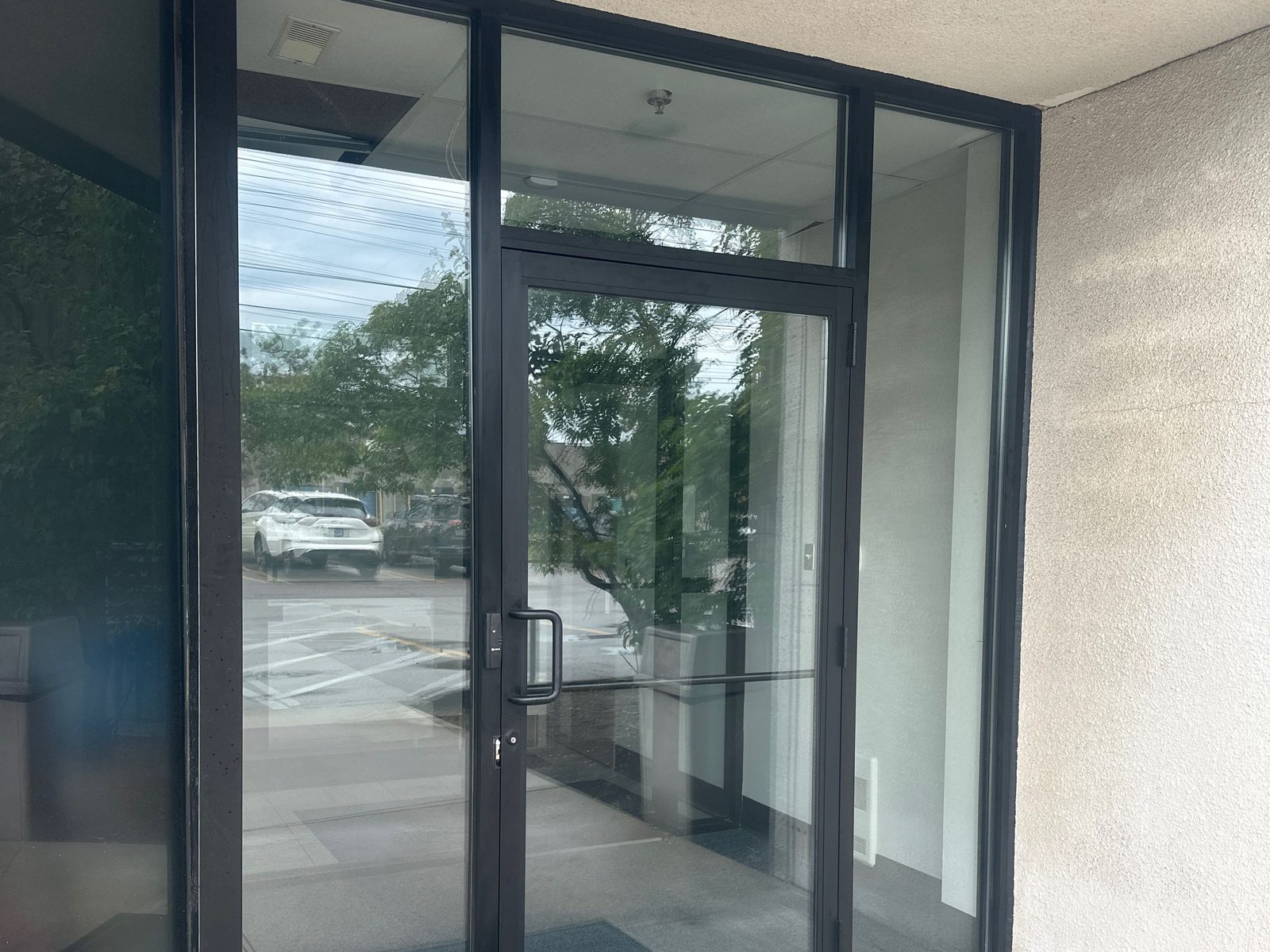
We repair commercial and industrial doors of every type across Toronto and the GTA — whoever made them and whoever installed them. Closers, hinges, locks and exit devices; steel doors and bent frames; glass doors, pivots and patch fittings; overhead springs, cables, tracks and sections; dock levelers, seals and shelters; automatic operators, sensors and controls. The line is answered 24 hours a day and technicians dispatch from our Mississauga shop.
Most of the doors we service, we did not sell. That is normal in this trade and it is the reason the trucks are stocked the way they are: a building has doors from four eras and five manufacturers, and the useful contractor is the one who can work on all of them.
Call, don't fill in a form
A door that has stopped working is a phone call, not a web form. Four pieces of information get the right technician there with the right parts:
- What the door is — steel personnel door, glass entrance, overhead, dock, automatic, shutter. If you are not sure, describe what it does when it works.
- What it is doing — will not latch, will not close, will not open, dragging, noisy, stuck open, glass broken, operator dead.
- Whether the building is secure and the exits are usable. This is the question that sets the priority, and it is the one people most often leave until last.
- Access — hours, gate codes, whether a lift is needed, and who holds the keys.
What the symptom usually means
Not a diagnosis, but the shortlist a technician runs through — and it will tell you roughly what kind of job you are looking at before anyone arrives.
| Symptom | Usually | Also worth checking | Typical fix |
|---|---|---|---|
| Door will not latch | Hinges worn, or the frame out of square | Strike position, closer force, latch bolt | New hinges into sound reinforcement, strike reset, frame straightened |
| Door slams or drifts shut too slowly | Closer out of adjustment or leaking | Arm geometry, backcheck, door weight | Closer adjusted or replaced, correct size for the leaf |
| Gap at the bottom, draught or water in | Sweep and threshold worn | Slab slope, leaf bottom rusting | Sweep, threshold and perimeter gasketing renewed |
| Exit device does not release cleanly | Device worn or misaligned with the strike | Rod adjustment on vertical rods | Device serviced or replaced; alignment corrected |
| Overhead door too heavy, or fell | Broken torsion spring | Cables, drums, brackets | Spring set replaced — both, on a pair |
| Overhead door binds or grinds | Rollers, hinges and track wear | Impact damage, track alignment | Rollers and hinges renewed, track re-aligned |
| Powered door stops mid-travel | Limits drifted, or a safety device tripping | Photo eyes, edges, obstruction | Limits reset, sensor or edge replaced, controls tested |
| Automatic entrance opens erratically | Sensor coverage or a failing carrier | Belt tension, board faults | Sensor re-aimed or replaced, carrier or board renewed |
| Dock leveler will not raise or hold | Cylinder, spring or hold-down | Lip keepers, pit debris, bumpers | Component replaced, leveler re-set and tested |
| Glass broken in a door or screen | — | Frame damage behind the glass | Opening secured first, unit made to size, glazed on a return visit |
What we repair, by door type
Every one of these has its own page with the detail; this is the routing list.
Steel & hollow metal doors
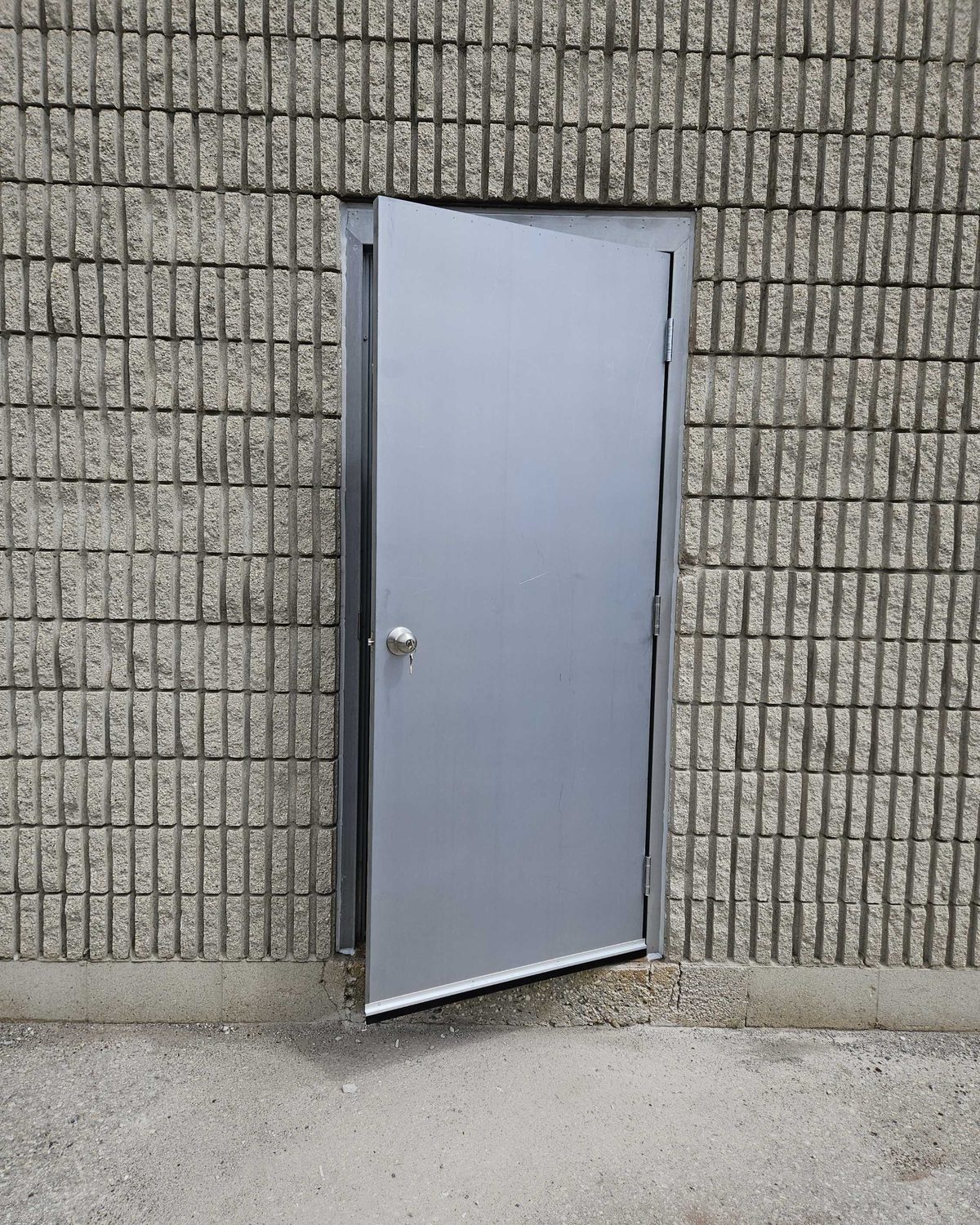
Hinges, closers, exit devices, locks, seals, and frames that have been hit. Rusted bottoms cut and repaired or the leaf replaced. Hollow metal & steel doors
Glass & aluminum entrances
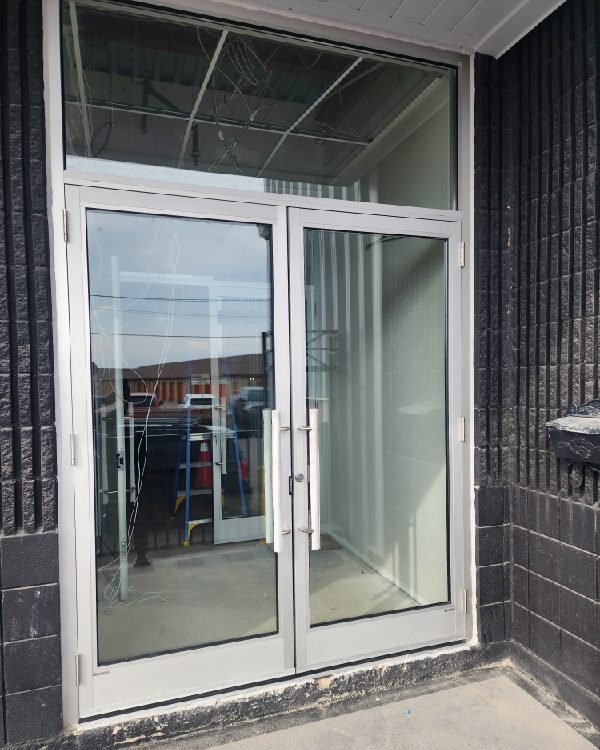
Closers and pivots, patch fittings, rollers, thresholds, locks and broken glass on aluminum and all-glass doors. Glass door repair
Overhead & rolling doors
Springs, cables, rollers, tracks, sections and curtains — all makes, including obsolete ones; operators replaced rather than rebuilt. Overhead door repair
Loading docks
Levelers, lips, seals, shelters and bumpers. A dead bay is a queue of trucks, so docks get treated as urgent. Loading dock repair
Automatic & barrier-free doors
Sensors, belts, carriers, boards and operators on every make, plus the annual safety inspection. Automatic door repair
Security shutters & grilles
Curtains, guides, barrels, locks and the motors and controls behind them. Security shutters & grilles
Fire-rated openings
Repairs that keep the assembly valid, plus the deficiency list from an annual inspection cleared properly. Fire door inspection
Glass & windows
Broken commercial glass, sealed units and shopfront bays, with same-night board-up where the opening is not secure. Commercial glass repair
Emergency, scheduled, or planned — three different prices
The same fault costs three different amounts depending on when you deal with it, and the gap between them is bigger than most maintenance budgets assume.
| Emergency call-out | Scheduled repair | Planned maintenance | |
|---|---|---|---|
| When | Now, including nights and weekends | The next working day or two | On a set interval, before it fails |
| What it costs | Attendance at an after-hours rate, plus parts | Normal rate, one attendance | One attendance covering every door on site |
| What triggers it | The building will not lock; an exit is blocked; production has stopped | It is annoying but the door still works | Nothing — the calendar |
| What we can finish | Whatever the truck carries; the rest is made safe | Almost everything, parts ordered in advance | Wear replaced before it strands anyone |
| Who ends up here | Buildings with no service interval | Most well-run buildings, most of the time | Buildings that have counted what the first column costs |
If the door cannot wait, go to 24/7 emergency door repair — same line, same technicians. If you keep ending up in the first column, the honest recommendation is the third: a maintenance plan costs less than the call-outs it prevents, and we will say so even though the call-outs are worth more to us.
One repair we will decline: making a fire-rated opening "work" by grinding the latch, wedging the closer or removing the coordinator. Those are the three most common site fixes on rated doors and every one of them invalidates the assembly. We will fix the actual fault or tell you the leaf has to be replaced.
When repair stops being the right answer
Repair is almost always the better value while the leaf and frame are sound, because everything that wears is replaceable. Four cases where it is not:
- The leaf has gone. Rusted through at the bottom, delaminated, or bent across its width. New hardware on a dead door is money spent twice.
- The frame is twisted. A frame out of square makes every subsequent repair temporary. It is a bigger job than a leaf, and doing it once ends a cycle of call-outs.
- The door is under-specified for what it does. A door failing every few months usually is not faulty — it is being cycled far beyond what it was bought for. The fix is a different door, or high-cycle components.
- Parts have become unobtainable. We adapt a great deal, but there is a point past which fabricating around an obsolete profile costs more than a new door.
In each case we give you both numbers — the repair and the replacement — and the honest expected life of the repair. Replacement and installation is the same crews and the same order.
Buildings we look after
Eight jobs from our own project files, across the door systems above and led by the property managers and building owners we are called back to. Service calls themselves are rarely photographed for a portfolio — this is the documented half of the work.
Intercity Properties Limited
PCI Pharma Services
The replacement of the exterior Glass Aluminum storefront door and…
BOLD Developments
Installation of glass aluminum doors and windows, and hollow metal doors.
Doodle All Daycare Inc
Replacement of exterior windows with all new black anodized aluminum windows and…
Eitz Chaim & Kollel School
The design, supply, and installation of a high-end operable wall system for a client.
Toys R US
Supply and installation of steel doors and frames , glass, and hardware.
Canadian Millwork
AVR Underground Co. LTD
The installation of new exterior Glass Aluminum storefronts with automatic door operators and hollow metal…
Four decades of doors for names Ontario knows — Canada’s Wonderland, Tim Hortons, Canadian Tire, the LCBO, Metrolinx, Marriott & Hilton hotels, the University of Toronto — plus thousands of businesses, warehouses, schools and hospitals across the GTA. Dependable people, quality products, since 1979.
What our customers say
I had an old metal and class commercial door that was sagging. I opted for a re-hinging with new continuous hinge system. Process from quote to job done was very easy and competitive priced. Technicians were on time and did the job professionally. My door opens and closes beautifully.
As a small Landlord in the East end of Toronto I respond to my Tenants professionally in a timely cost effective way. This occurred over the Xmas holidays with a broken commercial door hinge. …
Read the full review
Called Canuck doors for one of our warehouse doors that was malfunctioning , the technician that came was very knowledgeable and efficient, it took him to time to find the issue and fix it. 5 stars
Door repair across Toronto & the GTA
Service technicians dispatch from our shop at 1645 Bonhill Road in Mississauga — central to the region rather than at one end of it — and the line is answered 24 hours a day, every day of the year.
Core GTA
- Toronto
- Mississauga
- Brampton
- Vaughan
- Markham
- Scarborough
- North York
- Etobicoke
- Richmond Hill
- Oakville
- Burlington
- Milton
Southern Ontario belt
Distance shows up in repair work more than in anything else we do, because a service call is mostly travel and an hour of work. Out in the belt we will usually push to batch your call with other work in the area, or book it as a planned visit — it is the honest way to keep the invoice sensible. See all service areas
What a repair costs
A service call is priced on attendance, labour and parts, not on the door. The things that move it:
- The hour — after-hours, weekend and holiday call-outs carry a labour premium
- How long the fault takes to find, which is not always how long it takes to fix
- Whether the part is on the truck, in our shop, or has to be ordered in
- The part itself — a closer, a spring set, a section and a replacement operator are different orders of magnitude
- Access — lift work, height, or a door that has to be taken off to be worked on
- Whether the door can be made safe in one visit and finished in another
- How many doors we look at while we are on site
Batching matters more here than anywhere else on this site. Attendance is a fixed cost, so five doors seen on one visit cost far less than five call-outs — which is the whole argument for a maintenance plan rather than a repair habit.
Common questions
Do you repair doors you did not install?
Most of our service work is on doors somebody else installed, often decades ago. We hold parts for the makes common in Ontario buildings and can match or adapt hardware for doors whose manufacturer no longer exists — which is a large share of the stairwell and back-of-house doors in the GTA's older building stock. What matters is the door, not who sold it.
How much should it cost to fix a commercial door?
A service call is attendance plus labour plus parts, so the honest answer depends on which of those dominates. Adjusting or replacing a closer, a strike, a lock cylinder or a set of hinges is a short visit with an inexpensive part. A spring set, a bottom section, a replacement operator or a dock leveler cylinder is a parts-led job. What consistently makes repairs expensive is the hour they happen in and the number of separate visits — three faults on one attendance cost far less than three call-outs.
How can I fix a sagging commercial door?
A door that drags at the latch corner is almost never a door problem. In order of likelihood: the hinges are worn or their screws have pulled out of the frame reinforcement, the frame itself has been pushed out of square (usually by an impact or by a wall that has moved), or the door has been hung on hardware too light for its weight and cycle count. Packing the hinges is a temporary fix that buys weeks; the durable repair is new hinges into sound reinforcement, or the frame straightened or replaced. On a fire door it is not optional — a leaf that does not latch on its own is a deficiency.
How do you fix a misaligned metal door?
We start by working out whether the leaf, the frame or the building moved. A steel door that has stopped latching usually needs the strike relocated, the hinges renewed, or the frame pulled back to square and re-anchored; where a frame has been hit hard enough to twist, the frame is replaced. What we avoid is the common site fix of grinding the latch or the strike until it catches, because it defeats the closer, wrecks the seal and — on a rated opening — invalidates the assembly.
What causes commercial door damage in the first place?
Traffic and impact, overwhelmingly. Trolleys, pallet jacks and forklifts account for most damage to back-of-house and dock openings; entrances are wrecked by wind catching an unrestrained leaf and by closers that were never adjusted after installation. After that comes water at the bottom of exterior steel doors, and cycle wear on anything powered. Nearly all of it is visible before it becomes a failure, which is why doors respond so well to inspection.
What do you call someone who repairs doors?
In the commercial trade, a door technician or door systems technician — not a carpenter and not a locksmith, though the work overlaps both. A commercial door technician works on the assembly: leaf, frame, hinges, closer, exit device, lock, seals, and on powered doors the operator, controls and safety devices. Ours carry parts for all of that, which is why a first visit usually ends with the door working rather than with a quote.
Is it worth repairing an old door or should we replace it?
Repair is worth it while the leaf and the frame are sound, because everything else — hinges, closers, seals, hardware, glass, springs, rollers, operators — is replaceable, and a door with new moving parts is effectively renewed. It stops being sensible when the leaf itself has gone: rusted through at the bottom, repeatedly dented, delaminated, or bent across its width; or when the frame is twisted; or when an obsolete profile cannot be matched. We will tell you which of the two you have and give you the number for both.
How fast can someone get here?
The line is answered 24 hours a day and technicians dispatch from Mississauga, central to the GTA. On the call we give you a real arrival window based on where a technician actually is — if the honest answer is three hours, we say three hours. We do not publish a fixed response time we cannot hold to for every address in Southern Ontario. If the building cannot be locked or an exit is blocked, say so, because it changes the priority.
Can you fix it in one visit?
Usually, and that is what the trucks are stocked for — closers, hinges, cylinders, strikes, seals, cables, rollers and common controls. The cases that need two visits are made-to-size items (glass, a section, a curtain) and ordered equipment such as a replacement operator; overhead door springs, which are wound to the individual door over 1–2 days, and anything else that has to be manufactured. When it will be two visits, the first one ends with the opening safe and secure rather than open, and we tell you the date for the second before we leave.
Door not working right now?
Call the line — it is answered 24 hours a day. Tell us what the door is, what it is doing, and whether the building can be secured; that is enough for us to send the right technician with the right parts.