
Guide
Fire Door Ratings Explained: 20, 45, 60, 90 and 180 Minutes in Ontario
A fire door rating is how long the tested door assembly resists fire — 20, 45 minutes, or 1, 1.5, 2 or 3 hours. In Ontario the Building Code sets the minimum from the wall's rating: a 1-hour separation needs a 45-minute door, a 2-hour one a 1.5-hour door. The label proves it.
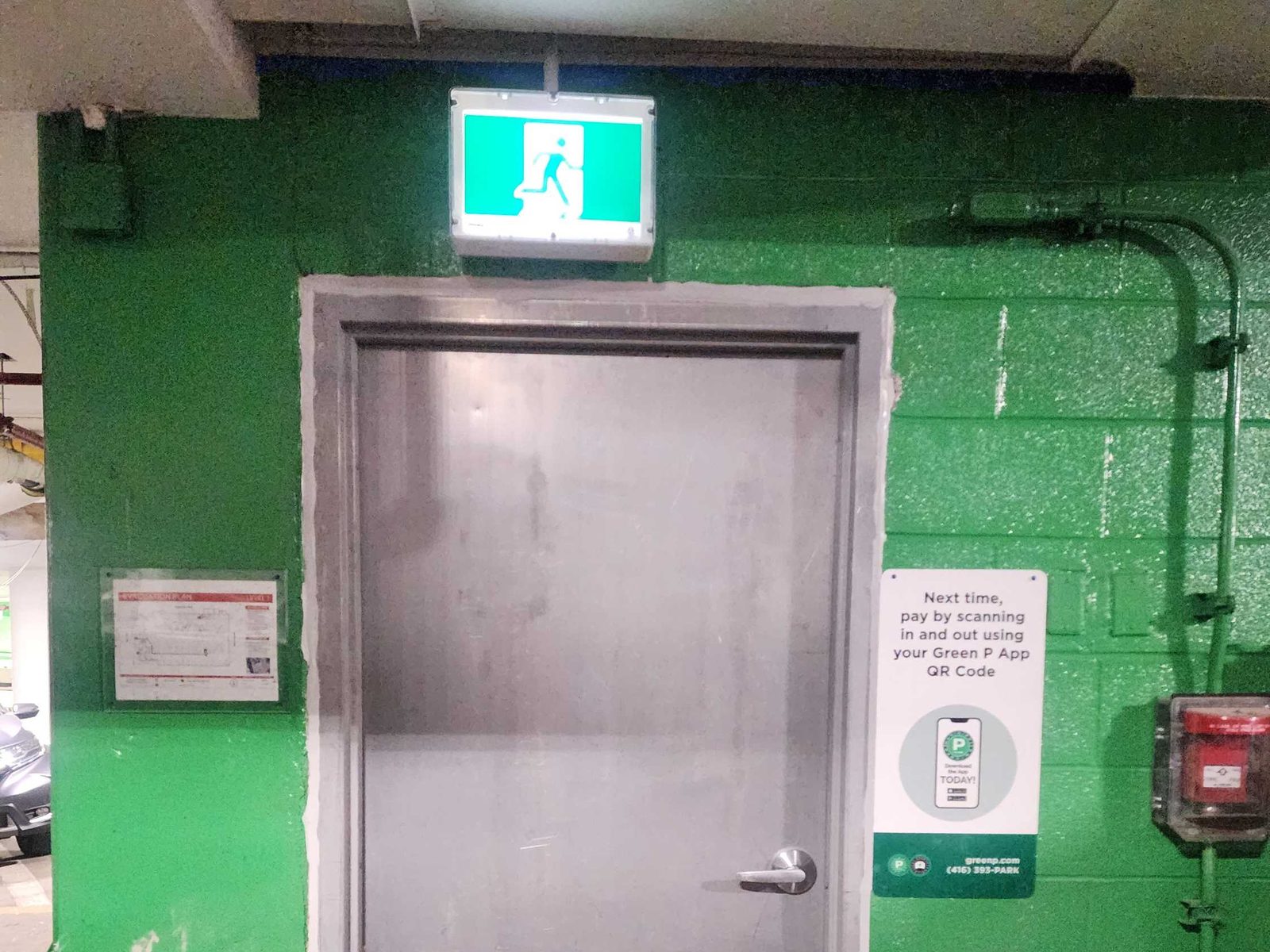
The rating on a fire door is not a property of the door on its own. It belongs to a tested assembly — leaf, frame, hinges, latch, closer and any glass — and it only holds while every part of that assembly stays as it was certified. That is why a new lock can void a rating, and why a door propped open with a wedge is rated for nothing.
This guide sets out what each rating means, how Ontario decides which one a wall needs, how to read the label, and what the codes allow in the way of glass. Every code figure below is taken from the Ontario Building Code, the Ontario Fire Code or NFPA 80 and linked to its source.
Four decades of doors for names Ontario knows — Canada’s Wonderland, Tim Hortons, Canadian Tire, the LCBO, Metrolinx, Marriott & Hilton hotels, the University of Toronto — plus thousands of businesses across the GTA. Dependable people, quality products, since 1979.
What is a fire door rating?
A fire door rating — the codes call it a fire-protection rating — is the time a door assembly resisted fire in a standard test: 20 or 45 minutes, or 1, 1.5, 2 or 3 hours. In Canada the rating of a door assembly is determined by the test standard CAN/ULC-S104; the Ontario Building Code requires it, and requires every fire door in a fire separation to be installed to NFPA 80 (2024 Ontario Building Code Compendium, Division B, Articles 3.1.8.4 and 3.1.8.5).
Two terms are worth keeping apart. A fire-resistance rating belongs to the wall or floor — the fire separation. A fire-protection rating belongs to the closure in it: the door, shutter or window. The two are set separately, and the door's required rating is usually lower than the wall's — which is why a 1-hour wall takes a 45-minute door.
How do you know which rating a door needs?
Start from the rating of the wall it sits in. The Ontario Building Code's Table 3.1.8.4 gives the minimum fire-protection rating of a closure for each fire-resistance rating of separation:
| Fire separation (wall) rating | Minimum fire door rating |
|---|---|
| 30 minutes | 20 minutes |
| 45 minutes | 45 minutes |
| 1 hour | 45 minutes |
| 1.5 hours | 1 hour |
| 2 hours | 1.5 hours (90 minutes) |
| 3 hours | 2 hours |
| 4 hours | 3 hours (180 minutes) |
So the everyday combinations are a 45-minute door in a 1-hour wall, a 90-minute door in a 2-hour wall, and a 3-hour door in a 4-hour firewall. The Code also allows two closures of the same rating installed on opposite sides of one opening to count as the sum of their ratings, which is occasionally the practical answer on a high-rated opening.
The rating the drawings call for is the architect's decision, made from the separation. Our job is to supply and install an assembly that is labelled for it — see fire-rated doors and assemblies.
What does a 20-minute fire door mean?
A 20-minute door is the lowest rating, and the Ontario Building Code only permits it in specific places. Article 3.1.8.12 allows it in fire separations of up to 1 hour between a public corridor and a suite, a corridor and sleeping rooms, or a corridor and classrooms, offices and libraries in Group A, Division 2 buildings — and in separations of up to 45 minutes in buildings of three storeys or less.
Those locations are the hotel-room door, the apartment suite door and the classroom door. The Code also sets tight clearances for them: no more than 6 mm under the door and 3 mm at the sides and top. For houses and small buildings, Part 9 of the Code accepts a 45 mm solid-core wood door built to CAN/ULC-S113 where a 20-minute door is permitted, which is where the difference covered in our
solid core vs hollow core doorsguide stops being a matter of taste.
How can you tell the rating of a fire door?
Read the label — there is one on the door and one on the frame. The Steel Door Institute places the door label either on the hinge edge between the top and middle hinges or on the top channel, and the frame label on the hinge jamb between the top and middle hinges; some frame labels are embossed into the steel rather than attached (SDI 122, installation and troubleshooting guide).
NFPA states that a fire door label must show the manufacturer's name, the certification body's mark, the rating, the fire test standard, and the temperature rise at 30 minutes where it is below 650°F (361°C) (NFPA, fire doors and NFPA 80 FAQs). Labels must stay legible. NFPA does not recommend painting them at all, and once a label has been removed or made unreadable, the rating has to be verified by other means acceptable to the authority having jurisdiction — in practice, often a replacement.
Labels cannot simply be re-applied, either. The SDI is explicit that nobody, including the manufacturer, may attach a label in the field unless the labelling agency's representative has inspected the product.
What is a temperature-rise rating?
A second limit, on how hot the unexposed face of the door gets, required on doors that people must pass while escaping a fire. Stair and exit-enclosure doors are the typical case: a door that stops flame but radiates heat into the stair would make the exit unusable.
The Ontario Building Code's Table 3.1.8.17 sets the limit at a 250°C rise on the opaque part of the door — after 30 minutes for a 45-minute door, and after 1 hour for 1.5-hour and 2-hour doors between an exit enclosure and the floor area. In buildings of three storeys or less, exit-enclosure doors have no temperature-rise limit. It is achieved with a temperature-rise core, and it is one of the specifications most often missed when a stair door is replaced like-for-like by eye.
Can a fire door have glass in it?
Yes, but the codes limit how much, and the glass must be listed for the door. The Ontario Building Code caps wired glass or safety glazing in a door at an aggregate 0.0645 m² — about 100 square inches — in the higher-risk locations:
| Exit-enclosure door, building of 3 storeys or less | Up to 0.8 m² of glazing, no temperature-rise limit |
|---|---|
| Exit-enclosure door, 45 min to 2 h, taller buildings | 0.0645 m² of glazing; 250°C rise limit |
| Firewall door, 45 min or 1.5 h | 0.0645 m² of glazing; 250°C rise limit |
| Firewall door, 3 h | No glazing permitted |
| Dead-end corridor door rated under 45 min | No limit |
Outside those locations, the glass allowed is whatever the door's own listing permits for the fire-rated glazing used. What cannot be done casually is cutting a vision lite into a labelled door on site: modifications to labelled doors are governed by NFPA 80, and in practice the lite belongs in the door when it is made. Fire-rated glass entrances are covered on our fire-rated doors page.
Wood or steel: which fire doors go up to which rating?
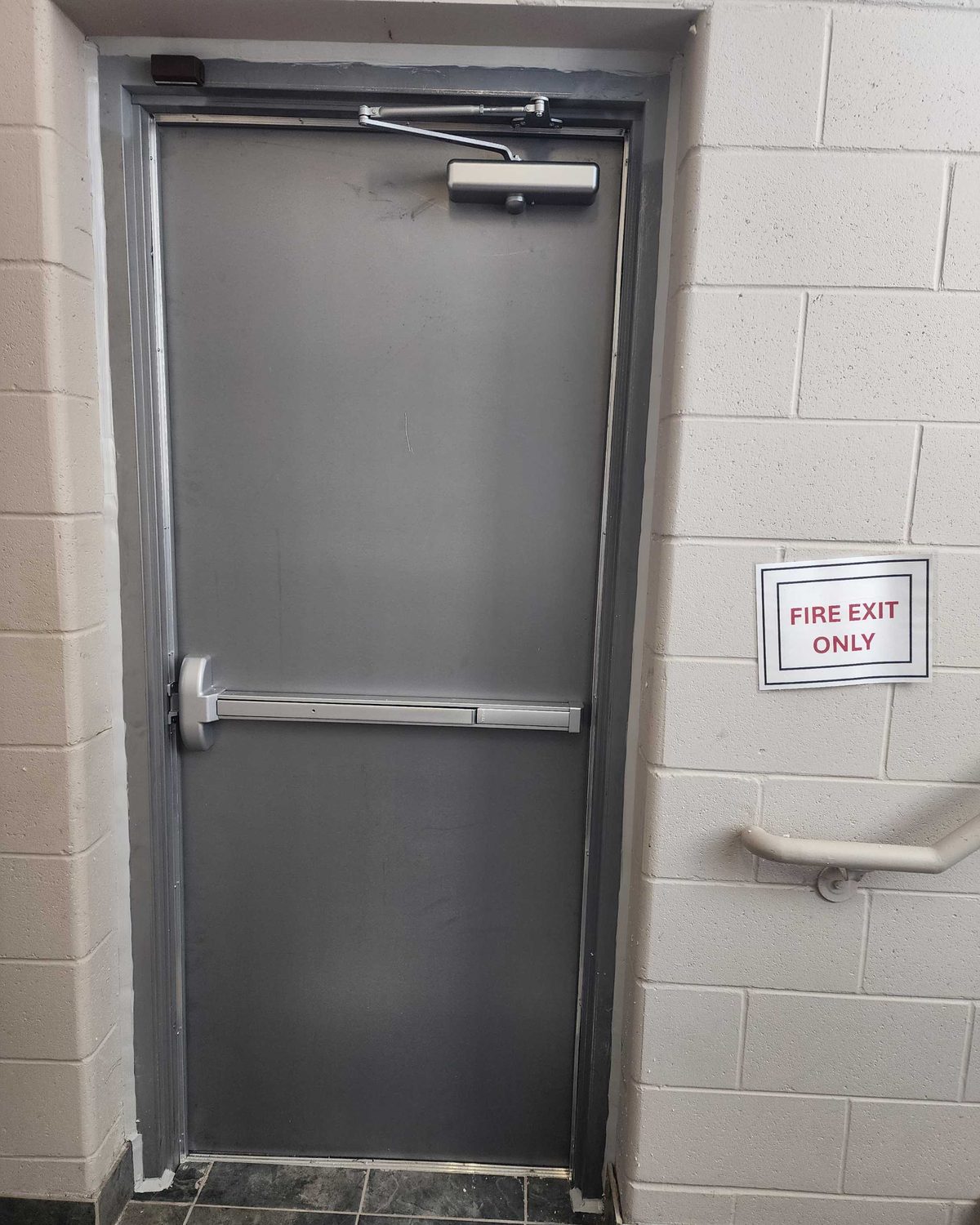
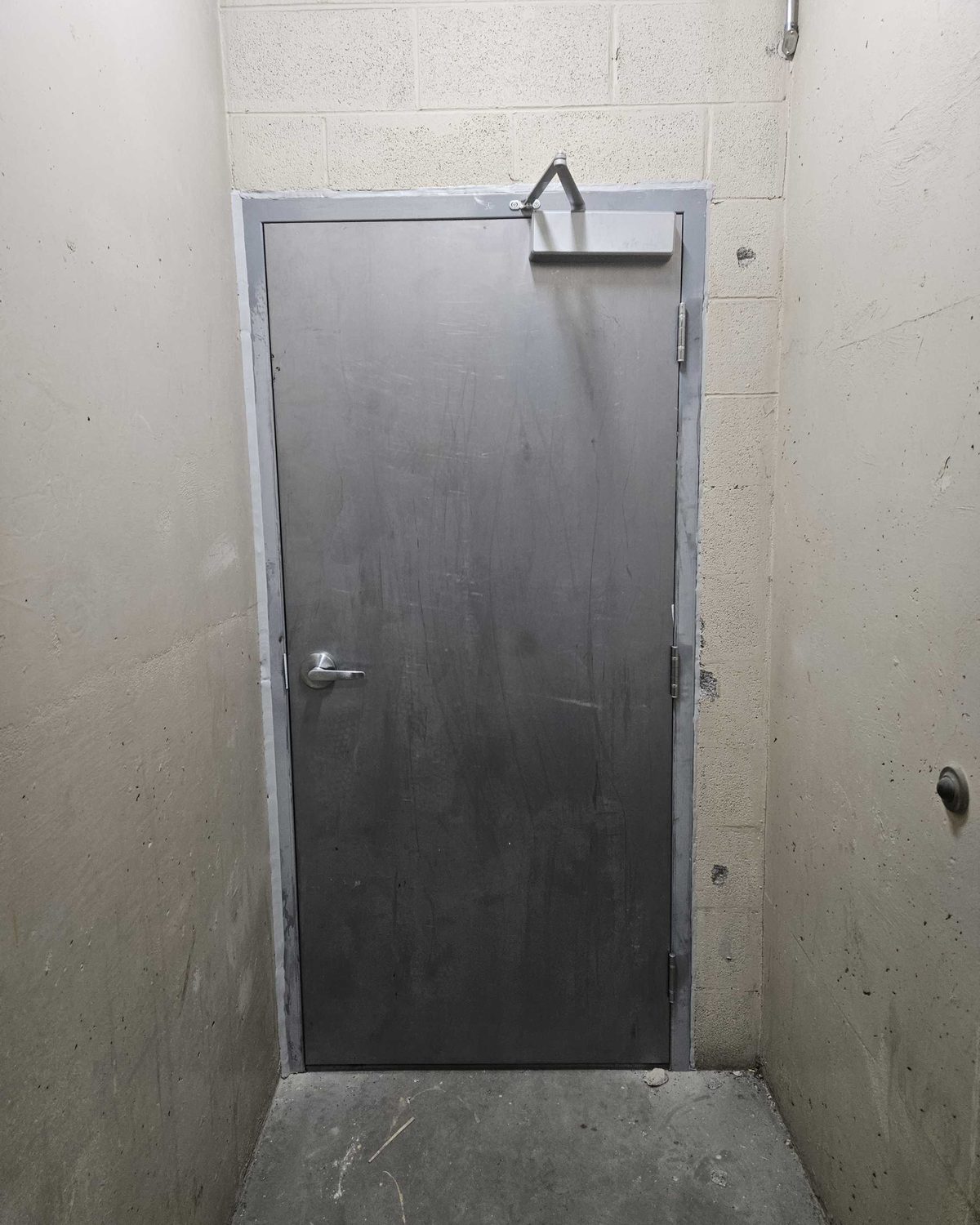
Steel covers every rating; wood covers the lower and middle ones. Mineral-core wood fire doors are made at 20, 45, 60 and 90 minutes (Haley Bros, fire-rated wood doors), which covers suite, classroom, office and most corridor doors. The 2- and 3-hour openings in shafts, service rooms and firewalls are steel.
On a North York condominium where we replaced all 123 stained wood suite doors, the hydro room doors went in as steel doors and frames with a 3-hour rating — the same building, two materials, chosen by the separation behind each door. See
metal and steel fire-rated doorsWhat keeps a fire door compliant after it is installed?
It has to close, latch and stay unaltered — and in Ontario it has to be checked every month. The Building Code requires, with limited exceptions, a self-closing device on doors in fire separations (Article 3.1.8.13), a positive latch on swing doors (3.1.8.15), and — in a building with a fire alarm system — any hold-open device to release on the alarm signal (3.1.8.14).
The Ontario Fire Code then governs the building in use: doors in fire separations are inspected monthly, closures must not be obstructed, blocked, wedged open or altered, and a damaged closure has to be repaired so the integrity of its rating is maintained (Ontario Fire Code, O. Reg. 213/07; see Windsor Fire & Rescue's owner checklist). NFPA 80 adds an inspection and operational test at least once a year, checking 13 items from label legibility and clearances to whether the door closes and latches on its own.
The failures we find most often are the ones people cause: a hole cut for a new lock or card reader, a door planed to clear new flooring, a closer removed because it was "too heavy", a wedge. Each can cost the opening its rating. A worn closer or latch can be replaced within the listing; a labelled leaf that has been cut cannot be un-cut.
Signs are allowed on fire doors within limits: NFPA 80 caps combustible signage at 5% of the door face and requires it to be glued or fixed with no more than four small screws. Our
fire door inspection servicewalks every opening, writes it up door by door, and repairs what can be repaired.
What does it cost to repair or replace a fire-rated door?
A common repair on a fire-rated entry assembly typically runs $250 to $750, and a replacement assembly $1,200 to $3,000 or more. Repairs are usually the closer, the latch, the hinges or the smoke seals, replaced with listed parts so the rating holds. Replacement is the answer when the leaf has been cut, drilled or has lost its label.
| Fire-rated entry assembly | Typical cost (CAD) |
|---|---|
| Hardware adjustment: closer, hinges, seals, latch | Under $400 |
| Common repair | $250 – $750 |
| Replacement assembly | $1,200 – $3,000+ |
| Replacement with the frame taken out | $1,500 – $3,500+ per opening |
These are typical ranges in Canadian dollars, not a quote: the number for your opening comes from your photos or drawings, or a site visit when needed. A new labelled steel door and frame is typically 4–6 weeks to produce once shop drawings are approved, then 1–2 weeks to schedule and install; a custom wood fire-rated door with specific hardware can take 8–12 weeks to produce.
Common questions
What does a 20 minute fire rated door mean?
A door assembly tested to resist fire for 20 minutes. In Ontario the Building Code allows a 20-minute door in limited places: fire separations of up to 1 hour between a public corridor and a suite, a corridor and sleeping rooms, or a corridor and classrooms, offices and libraries in some assembly buildings, and separations of up to 45 minutes in buildings of three storeys or less. The door must have no more than 6 mm clearance at the bottom and 3 mm at the sides and top.
What is a 45 minute fire rated door?
A door assembly tested to resist fire for 45 minutes. Under the Ontario Building Code it is the minimum closure for fire separations rated 45 minutes or 1 hour, and the usual door in a 1-hour corridor or room wall that is not a 20-minute location. It is available in both steel and mineral-core wood.
Is there a 2 hour fire rated door?
Yes. A 2-hour door is the minimum closure the Ontario Building Code requires in a 3-hour fire separation, and 3-hour doors exist for 4-hour separations such as firewalls. Doors at those ratings are steel; mineral-core wood fire doors are generally listed up to 90 minutes.
How can you tell the rating of a fire door?
Read the labels. A fire door carries a label, usually on the hinge edge between the top and middle hinges or on the top channel, and the frame carries its own on the hinge jamb between the same two hinges. The label names the manufacturer, the certification body, the rating, the test standard and any temperature-rise limit. A door with no legible label cannot be assumed to be rated.
How often must fire doors be inspected in Ontario?
The Ontario Fire Code requires doors in fire separations to be inspected monthly, and they must never be wedged, blocked or altered so that they cannot close. NFPA 80, the standard fire doors are installed to, also calls for an inspection and operational test at least once a year, covering labels, damage, clearances, hardware and whether the door closes and latches.
Pricing a job like this?
Not sure what rating your doors need, or whether they still have it?
Send us the drawings or a photo of the labels. We will tell you what the separation requires, whether the existing doors still comply, and what it takes to put right what does not.