
Commercial & Industrial
Dock Levelers & Dock Plates
The bridge between your dock floor and a trailer bed that is never quite the same height twice. Edge-of-dock, mechanical, hydraulic and air-powered levelers, plus dock plates and boards — supplied, installed, serviced and rebuilt across Toronto and the GTA since 1979.
Request QuoteCall 800-522-6825
Sized to your pit and your trailer range · installed one bay at a time · serviced 24/7
At a glance
| Types | Edge-of-dock · mechanical pit · hydraulic pit · air-powered |
|---|---|
| Common platform sizes | 6′ × 8′ · 6′ × 10′ · 7′ × 8′ · 7′ × 10′ |
| Typical capacities | 15,000–30,000 lb (edge-of-dock) · 25,000–45,000 lb (pit) |
| Typical dock height | 48″ nominal; 44–52″ in practice |
| Lead time | 4–6 weeks manufacture, 1–2 weeks to schedule installation |
| Service | All makes, including units no longer manufactured |
A dock leveler exists because a trailer bed is never level with your dock floor. Loaded trailers sit lower than empty ones, refrigerated units and drop-decks are different again, and the bed sinks further as a forklift drives onto it. The leveler absorbs all of that: its deck pivots to meet the trailer, its lip extends onto the trailer floor, and it keeps the ramp continuous while the load moves.
Canuck Door Systems supplies, installs, services and rebuilds levelers across the GTA, and has done since 1979. We came to dock equipment from the door trade, which is why one crew attends both the leveler and the sectional door above it — on most docks those two failures arrive together, because the same reversing trailer causes both.
The four types, and how to choose
Type is the decision. Capacity and size follow from your traffic and your opening, but the type follows from how much trailer variation you have to absorb and how many cycles a day the bay does.
| Type | Working range | Operation | Best for | Watch-outs |
|---|---|---|---|---|
| Edge-of-dock | ≈ ±5″ of dock height | Manual, lifted by handle | Consistent trailer fleets, light to moderate volumes | No pit needed and much less expensive — but a varied fleet will outgrow it |
| Mechanical pit | ≈ ±12″ | Spring-loaded, pull chain, walked down | General warehousing on a capital budget | Springs weaken over time; the pull chain is a recurring manual-handling complaint |
| Hydraulic pit | ≈ ±12″ | Push button | Multi-shift docks, high cycle counts, mixed fleets | Highest up-front cost, lowest cost over a decade; needs power at the pit |
| Air-powered | ≈ ±12″ | Push button, inflating bag | Food and pharmaceutical docks where hydraulic fluid is unwelcome | Fewer wear parts than hydraulic; the bag is the main replacement item |
The question to answer before anyone quotes you a leveler is not "what size?" but "what are the lowest and highest trailer beds you actually have to service?" Working range is what makes a dock usable, and it is the specification most often missing from an enquiry.
Sizing: the four numbers that decide it
| What it means | How to get it | |
|---|---|---|
| Dock height | Dock floor to the ground the trailer stands on | Tape measure; 48″ nominal, 44–52″ in practice |
| Trailer range | Lowest and highest bed height you serve | Ask your carriers, or measure over a week |
| Capacity | Heaviest forklift plus its load, with an allowance for dynamic forces | Truck data plate plus rated load |
| Platform | Width and length of the deck | Pit dimensions if one exists; opening width if not |
Capacity is about the forklift, not the pallet
The most common specification mistake on a leveler is rating it against what is being shipped. A pallet of goods may weigh 2,000 lb; the counterbalance truck carrying it can weigh three or four times that on its own, and the forces when it brakes or turns on the deck are higher again than its static weight.
Rate the leveler on the heaviest truck that will cross it, fully loaded, with margin. A leveler that is under-rated does not fail dramatically — it deflects, the deck deforms over months, and the failure looks like poor build quality when it was actually a specification error.
What a dock leveler is used for — the cases we quote most
Eight situations account for nearly every leveler enquiry we take. Which one you are in usually decides the type before anything else is discussed.
New distribution build
Levelers, seals, bumpers and doors specified together from drawings, with pits formed in the original concrete pour. The least expensive time to get it right.
End of life replacement
A mechanical unit twenty years old, springs gone, lip bent. Usually a like-for-like swap into the existing pit, one bay at a time.
Fleet has changed
A new carrier with lower beds, or a move into reefers. Nothing is broken — the dock has simply been outgrown, and the fix is range, not repair.
Upgrade from mechanical
Moving to hydraulic to remove the pull chain, cut cycle time and stop the manual-handling complaints on a multi-shift dock.
Adding a position
Cutting a new opening and forming a pit in an existing wall, most often when a tenant expands into adjoining units.
Food & pharma docks
Where hydraulic fluid above the threshold is unwelcome, and air-powered units with washable seals are specified instead.
Low-volume or occasional
A single bay taking a van a week, where an edge-of-dock leveler or even a dock plate is genuinely the right answer.
Post-impact repair
A trailer has hit the dock with the leveler up, or driven off with the lip down. Frame, lip and hinge damage, and usually a bumper problem behind it.
How long installation takes
Manufacture is the long pole on a new unit: plan on 4–6 weeks once the measure and any shop drawings are approved, then 1–2 weeks to schedule the crew — so roughly 5–8 weeks in total. The installation itself is short by comparison.
- Like-for-like into a sound pit — one day per position; the bay is out for a single shift.
- Edge-of-dock retrofit — often a few hours, since there is no pit work at all.
- New or rebuilt pit — concrete cure time sets the schedule, and the position is out for several days.
- Emergency repair — same day where the failed part is one we carry, which covers most spring, lip and hydraulic failures.
Maintenance: what it prevents
Levelers fail gradually and then suddenly. Springs weaken for months before a deck stops rising; a lip hinge seizes long before it snaps. A scheduled visit costs a fraction of the emergency call plus the lost bay, and on a distribution dock the lost bay is the bigger number.
- Cycle and hold — does the deck rise fully and hold position under load?
- Lip operation — full extension, clean return, no play in the hinge.
- Springs or hydraulics — tension and adjustment; leaks, pressure and pack condition.
- Structure — frame, welds, toe guards and the concrete beneath the frame.
- Bumpers — because worn bumpers are what destroy levelers, and they are checked on every visit.
If a leveler is failing repeatedly, the honest answer is often that the problem is not the leveler: check the dock bumpers first, since a trailer reaching the building face damages the lip every time it docks.
Dock work across the GTA
Documented dock jobs from our own project files.
Black & McDonald Limited
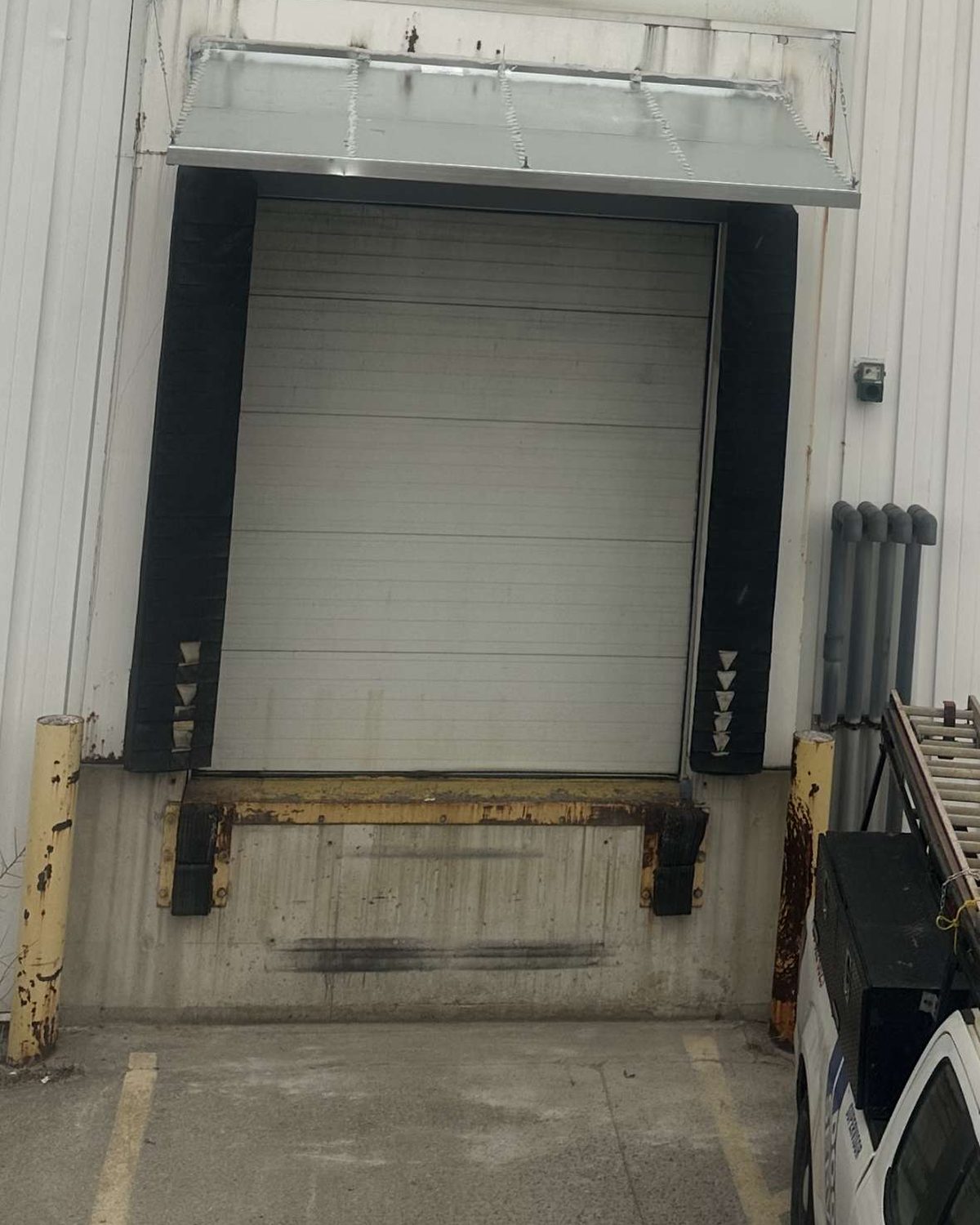
Dock seal, head canopy and leveler service on an existing dock position.
Synerex Construction Group Inc
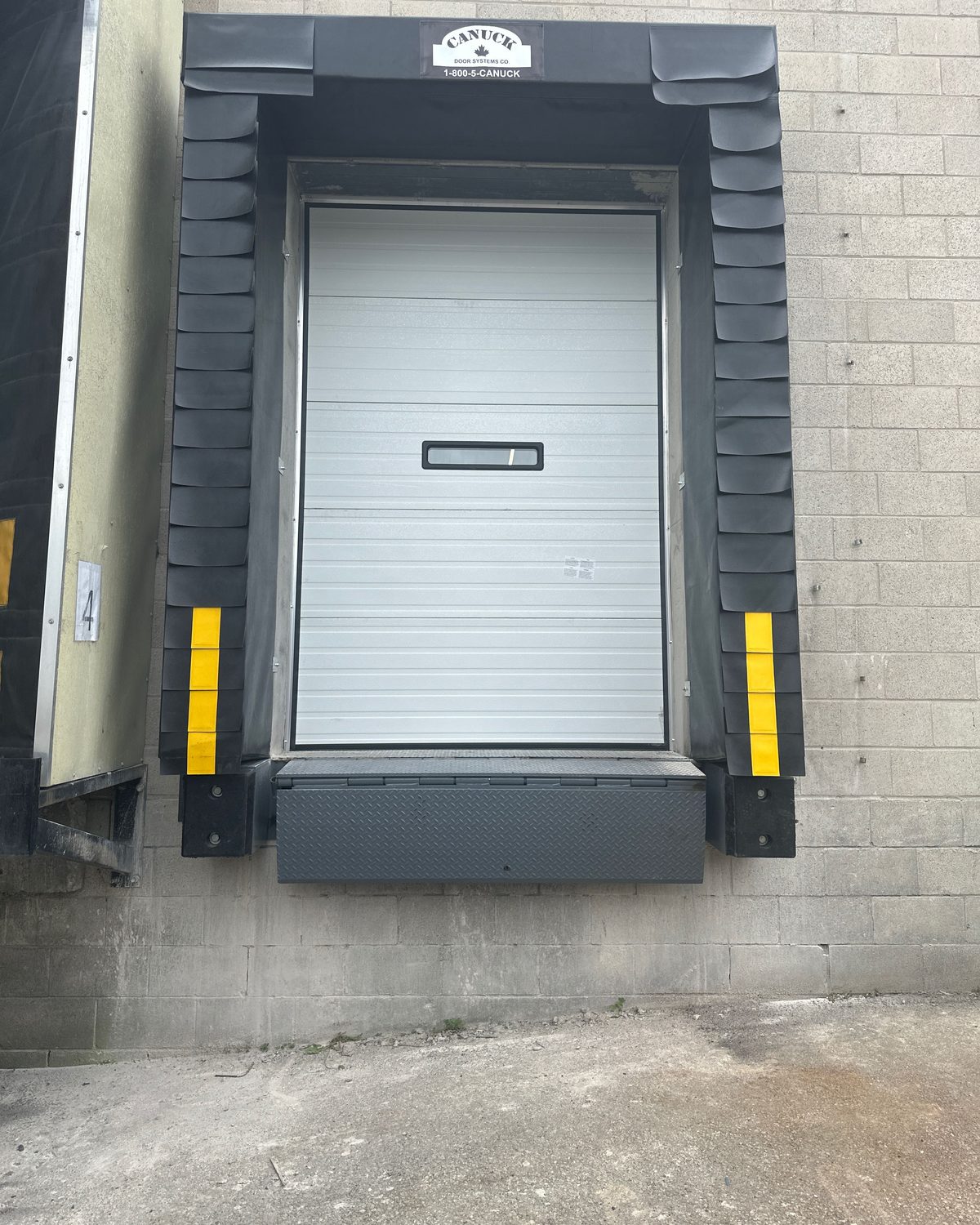
Edge-of-dock leveler, dock shelter and bumpers installed at a distribution bay, with the sectional door above it.
Four decades of doors and docks for names Ontario knows — Canada’s Wonderland, Tim Hortons, Canadian Tire, the LCBO, Metrolinx, Marriott & Hilton hotels, the University of Toronto — plus thousands of businesses across the GTA. Dependable people, quality products, since 1979.
What our customers say
Excellent service from Fred. Was kept posted by email on arrival of parts. We have had many years of service fixing our dock plates and door replacements.
We had the service a week ago and everything continues to work well on our dock ramp. Very professional front office and they even followed up with a call to see if we were happy. As a service company ourselves I am impressed so far and hope the great experience continues.
Great company! I had a broken industrial door and Canuck responded quickly to fix the problem! I was very impressed and now they will be doing more work for our company. Jay, the Sales Guru is amazing! He is friendly, knowledgeable, and well informed about all doors. Thanks Canuck Doors!
Dock levelers across Toronto & the GTA
We install and service levelers throughout the core GTA and out along the 401 and 407 distribution corridors, dispatched from Mississauga. Changeovers are scheduled around shift patterns, one bay at a time, so the rest of the dock keeps working.
Core GTA
- Toronto
- Mississauga
- Brampton
- Vaughan
- Markham
- Scarborough
- North York
- Etobicoke
- Richmond Hill
- Oakville
- Burlington
- Milton
Southern Ontario belt
Most of the region's warehousing sits in Milton, Brampton, Bolton and along the 401. If you operate several buildings we quote and maintain the levelers as one portfolio rather than site by site. See all service areas
What a dock leveler costs
Type drives the price far more than size does, and the concrete can cost more than the equipment. These are the factors that actually move a leveler quote:
- Type — edge-of-dock, mechanical pit, hydraulic pit or air-powered
- Rated capacity, set by your heaviest loaded forklift plus its load, not by the pallet weight
- Platform size — 6′ × 8′ and 7′ × 10′ are common; wider and longer cost more
- Whether the existing pit is sound, needs rebuilding, or has to be formed new
- Working range above and below dock level, which follows from your trailer mix
- Power and controls, and whether the leveler interlocks with the door or a vehicle restraint
- Weather seal and insulation, which matter more on a heated or refrigerated dock
- Out-of-hours labour, and how many positions can be out of service at once
We quote the equipment and the concrete work as separate lines, because they are separate decisions and one of them is often avoidable. If the pit is sound, a like-for-like swap is a much smaller number than a rebuild.
Common questions
What is a dock leveler used for?
It bridges the two gaps between your building and a trailer: the horizontal gap where the trailer stops short of the dock face, and the vertical difference between the dock floor and the trailer bed. Without one, a forklift cannot safely cross the threshold, because the trailer bed is almost never level with the dock. The leveler's deck pivots up or down and its lip extends onto the trailer floor, creating a continuous ramp that moves with the trailer as it is loaded and the suspension settles.
How much weight can a dock leveler hold?
Pit levelers are commonly rated between 25,000 and 45,000 lb, and edge-of-dock units between about 15,000 and 30,000 lb. The number that matters is not the weight of your pallets — it is the weight of your heaviest forklift with its load on it, plus a safety allowance for the dynamic forces of braking and turning on the deck. A loaded counterbalance truck is far heavier than most people assume, which is why under-rating a leveler is the most common specification error we see.
What is the difference between a pit leveler and an edge-of-dock leveler?
A pit leveler sits in a recess formed in the dock floor, so its deck is flush with the floor and it can serve trailer beds from low to high — typically around a foot above and below dock level. An edge-of-dock leveler bolts onto the face of the dock instead, needs no pit, costs considerably less and installs in a fraction of the time, but has a much smaller working range of roughly ±5 inches. If your trailers are consistent, edge-of-dock is good value. If they vary, it will frustrate everyone using it.
Is it "dock leveler" or "dock leveller"?
Both are correct and both are used in Canada. The industry, the manufacturers and most Ontario specifications write "leveler", which is why it is spelled that way throughout this page, even though Canadian spelling would normally double the L. If you are searching or writing a tender, expect to encounter both.
What is a dock plate, and how is it different from a leveler?
A dock plate or dock board is a portable ramp — a slab of aluminum or steel with curbs and lifting handles — that is set into place by hand and lifted out again. A leveler is fixed equipment built into the dock. Plates suit occasional use, low volumes and hand pallet trucks; they are limited in capacity, have to be positioned correctly every single time, and are a manual-handling and fall risk in their own right. Any dock doing regular forklift traffic should have levelers, not plates.
Can a dock leveler be repaired, or does it have to be replaced?
Most of a leveler is rebuildable in place. Springs, hydraulic packs, lip assemblies, hinges, control panels, toe guards and weather seals are all replaceable, and we carry the common failure parts. What is usually not economic to repair is the structural frame or the pit itself — badly corroded steel or spalled concrete under the frame. We will tell you which of the two you have before quoting, because the difference is a service call against a capital project.
Why does our leveler no longer reach the trailer?
Three usual causes. On a mechanical unit the springs have weakened, so the deck no longer rises to full height — this is gradual and easy to miss until it fails. On any unit, the lip hinge or lip may be bent or seized from being driven over out of position. Or the trailers have changed: a new carrier with lower beds can put you outside the unit's range even though nothing has broken. Diagnosis is quick, and only the third one means a different leveler.
How long does replacing a dock leveler take?
A like-for-like swap into a sound existing pit is normally a single day per position, so a bay is out of service for one shift. If the pit has to be rebuilt, the concrete cure time sets the schedule and the position is out for several days — we give you that number before the work starts, not after. Manufacturing lead time on a new unit is typically 4–6 weeks, with 1–2 weeks to schedule the crew.
Do you service levelers you did not install?
Yes, and that is the majority of our dock service work. Rite-Hite, Blue Giant, Serco, Kelley, Pentalift and equivalents are all common in GTA buildings, along with units whose manufacturer no longer exists. Parts for obsolete units can often be fabricated or substituted; where they genuinely cannot, we will say so rather than sell you a repair that will not last.
Leveler stuck, sagging or out of service?
Send us the dock height, the pit size and the trailer range and we’ll quote the right unit. If a bay is down right now, call — levelers are a 24/7 dispatch.