
Commercial & Industrial
Dock Seals & Shelters
The part of the dock that decides how much of your heating goes into the parking lot. Compression seals for uniform fleets, shelters for mixed ones — supplied, installed and re-covered across Toronto and the GTA, on docks of every age and make.
Request QuoteCall 800-522-6825
Sized to your trailer mix · curtains and pads replaced in sections · since 1979
At a glance
| Types | Compression seal · inflatable seal · fabric shelter · rigid-frame shelter |
|---|---|
| Best for | Seal — uniform fleets · Shelter — mixed trailer heights and widths |
| Wear parts | Head curtain, side curtains, foam pads, wear pleats — replaceable individually |
| Lead time | 4–6 weeks manufacture, 1–2 weeks to schedule installation |
| Service | Re-covering and section replacement on all makes |
A loading dock position with a trailer at it is a hole in your building. The trailer plugs most of the opening, but the gap around it — over the roof, down both sides, and at the corners where the seal never quite meets — stays open for as long as the bay is being worked. In January that gap is doing exactly what an open door would.
A seal or a shelter closes it. Which of the two you want is not a budget decision so much as a fleet decision, and getting it wrong is the reason many docks have a seal that has been replaced three times.
Seal or shelter
| Compression seal | Dock shelter | |
|---|---|---|
| How it closes | Trailer compresses foam pads on head and both sides | Head and side curtains drape around the trailer |
| Trailer mix it suits | Uniform — a consistent fleet | Varied — cube vans through 53-foot reefers |
| Closure quality | Tighter | Looser, far more tolerant |
| Trailer rear doors | Can obstruct the last few inches of the opening | Fully accessible |
| Main wear point | Foam compression and corner tearing | Head curtain abrasion; wear pleats down the edges |
| Repairability | Pads re-covered, faces replaced | Curtains replaced individually |
| Where it usually loses | A varied fleet: wrong for both ends of the range | A very uniform fleet: pays for tolerance it never uses |
The most useful thing you can send with an enquiry is not the opening size — it is a description of what actually backs into the bay. "Mostly 53-foot dry vans, occasional cube van" decides the specification faster than any measurement.
Why seals fail early, and what it is usually not
A dock seal that tears within a year has almost never failed on its own merits. Four causes account for most of it, and only one of them is the seal:
- Worn bumpers. The trailer comes far enough forward to crush the seal frame rather than compress the pads. Replace the seal without the bumpers and it fails again the same way.
- Angled approaches. Driveway geometry or a tight yard means trailers arrive off-square and load one side of the seal alone.
- Missing wear pleats. The sacrificial strips down the leading edges are inexpensive, and once gone the fabric behind them abrades directly.
- The wrong product. A compression seal on a site with a genuinely mixed fleet is being asked to do a shelter's job.
Where each one belongs
Distribution centres
High cycle counts and mixed carriers. Shelters almost always, with replaceable head curtains budgeted as a consumable.
Food & grocery
Temperature matters and inbound is varied. Shelters, with attention to closing the corner gaps a seal would otherwise leave.
Cold storage
Where the envelope is the product. Tight compression seals where the fleet allows, and often insulated doors behind them.
Manufacturing
Consistent inbound raw material on similar trailers — one of the few cases where a compression seal is clearly right.
Retail replenishment
Everything from a 53-foot trailer to a courier van at the same opening. Shelters, sized for the extremes rather than the average.
Parcel & courier
Small vehicles, very high cycle counts. Shelters with heavy wear pleats, because the wear is in the volume rather than the size.
Pharmaceutical
Controlled environments where the gap around a trailer is a compliance question as much as an energy one.
Older buildings
Set-back dock faces and non-standard openings, where the measure matters more than the product choice.
How long installation takes
Seals and shelters are made to your opening, so there is nothing to pull off a shelf:
- Measure — opening, dock face setback, bumper projection and available mounting steel.
- Manufacture — 4–6 weeks once the measure is approved.
- Install — 1–2 weeks to schedule the crew; a position is typically out of service for part of a day.
- Section replacement — head curtains, side curtains and pads are quicker to obtain and quicker to fit, which is why a sound frame is worth keeping.
Repair beats replacement more often than you would think
Nearly every wearing part of a seal or shelter is separately replaceable, and a frame in good condition will outlast several sets of curtains. On a service visit we will normally quote the smallest thing that fixes it — a head curtain, a pair of wear pleats, one side pad — and tell you plainly when the frame has reached the point where that stops being sensible.
Dock work across the GTA
Documented dock jobs from our own project files.
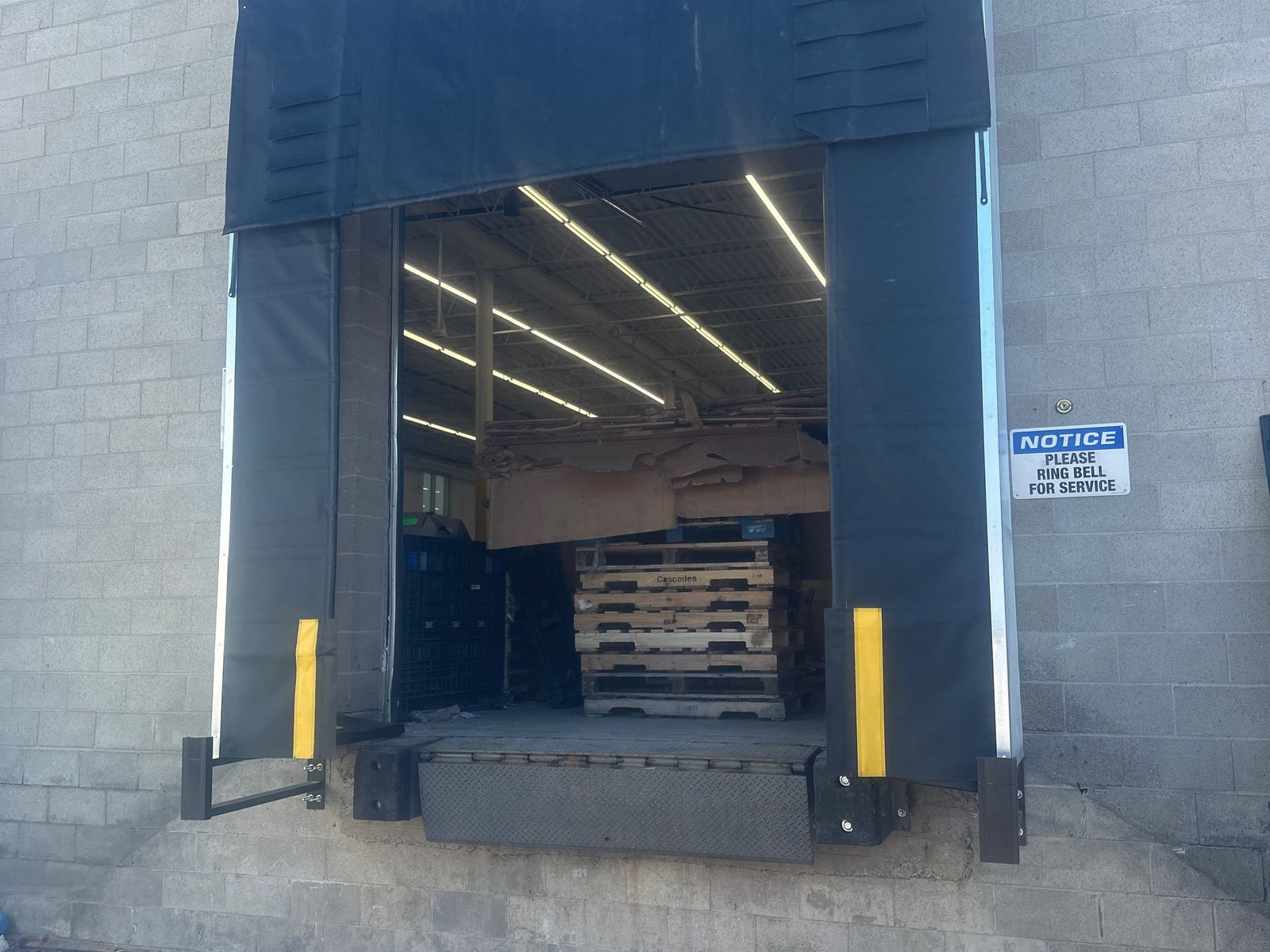
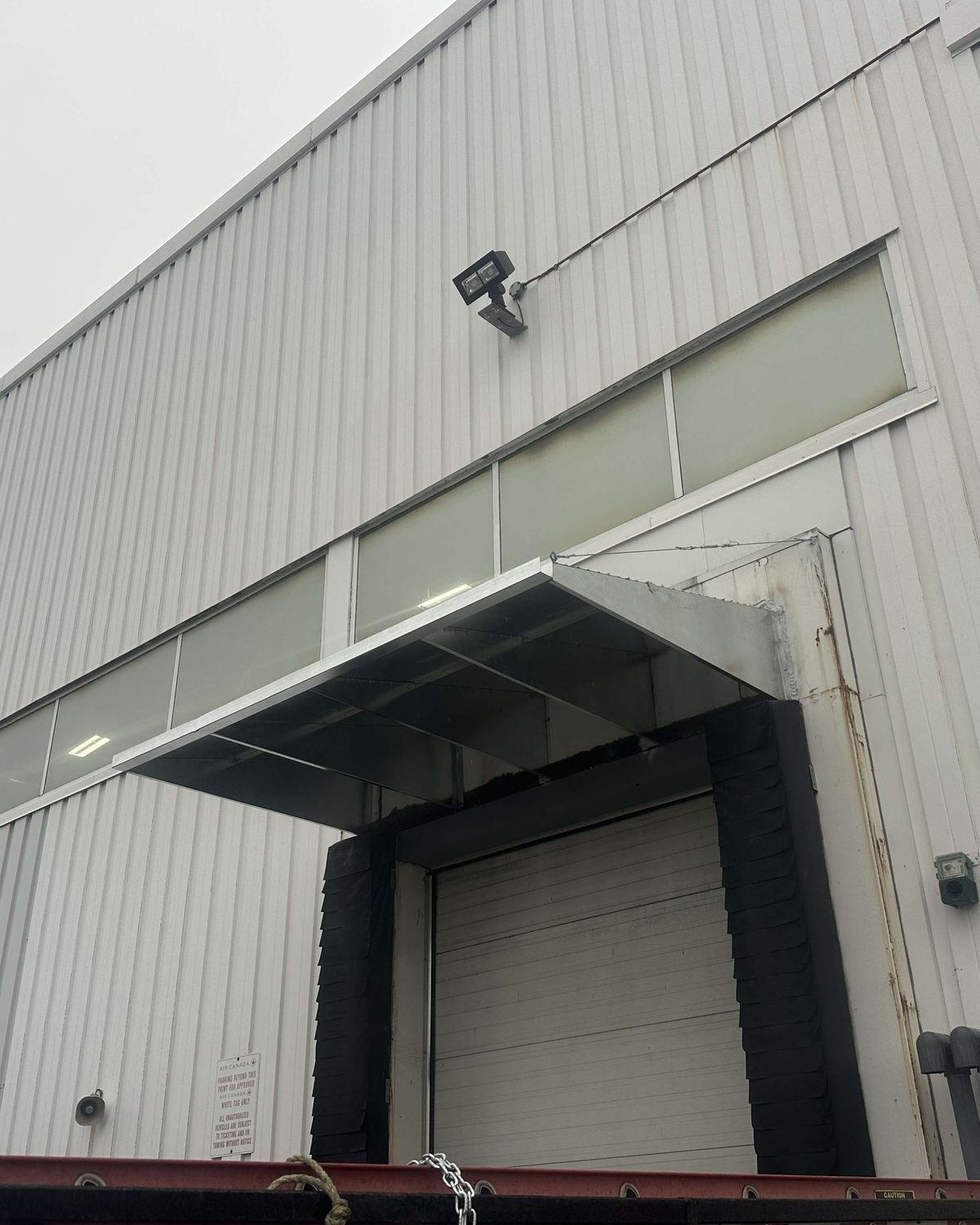
Black & McDonald Limited
Dock seal, head canopy and leveler service on an existing dock position.
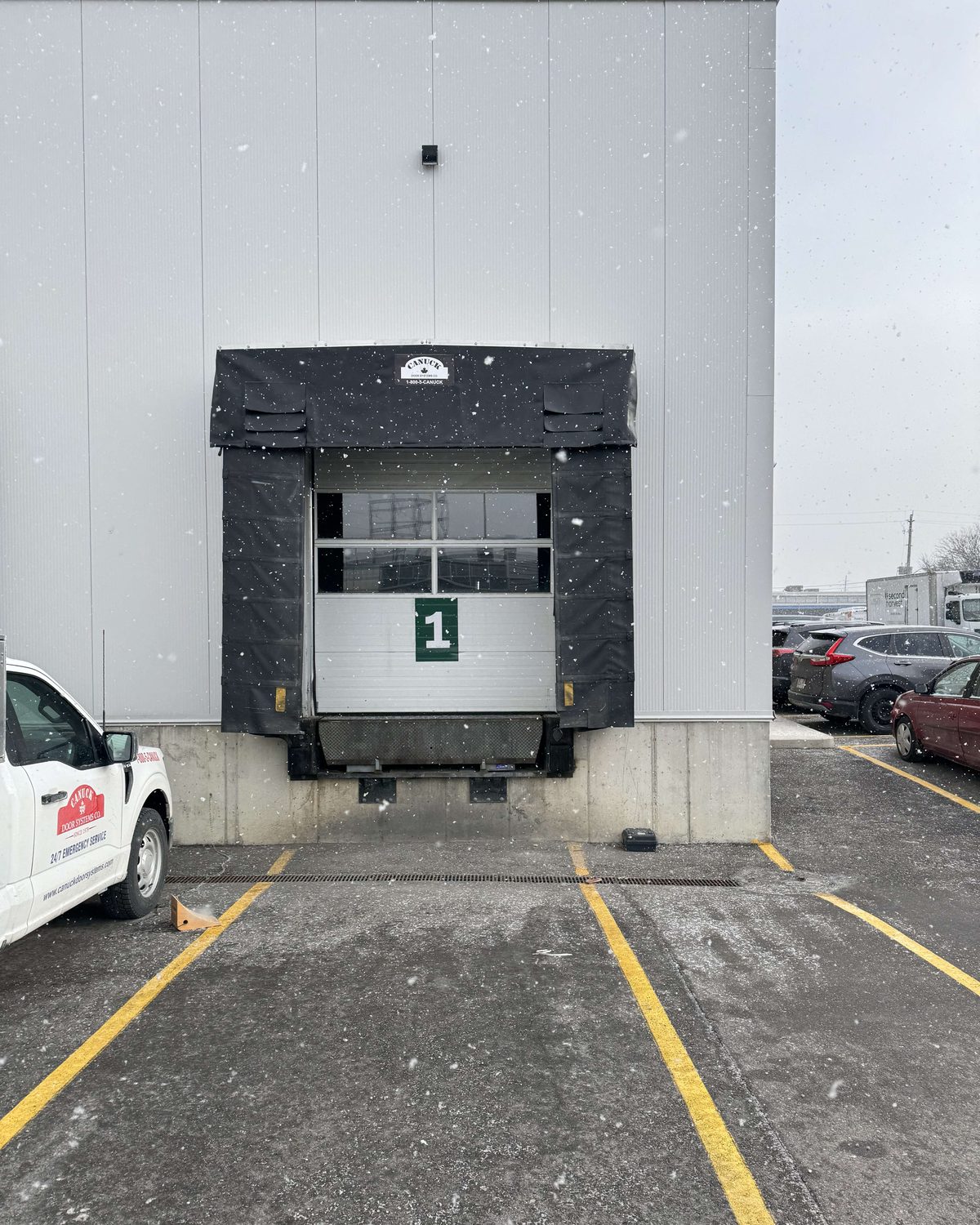
Synerex Construction Group Inc
Dock shelter with head and side curtains, plus bumpers and an edge-of-dock leveler, at a distribution bay.
Four decades of doors and docks for names Ontario knows — Canada’s Wonderland, Tim Hortons, Canadian Tire, the LCBO, Metrolinx, Marriott & Hilton hotels, the University of Toronto — plus thousands of businesses across the GTA. Dependable people, quality products, since 1979.
What our customers say
Excellent service from Fred. Was kept posted by email on arrival of parts. We have had many years of service fixing our dock plates and door replacements.
We had the service a week ago and everything continues to work well on our dock ramp. Very professional front office and they even followed up with a call to see if we were happy. As a service company ourselves I am impressed so far and hope the great experience continues.
I Needed to replace the entire glass systems around my commercial building and got recommended by a friend to this place. They have walked me through the entire process from beginning to end. They did great Job in managing to keep me updated, finishing the job on time and did more than asked. …
Read the full review
Dock seals & shelters across Toronto & the GTA
We measure, supply and fit seals and shelters throughout the core GTA and along the Southern Ontario distribution belt, from our shop in Mississauga. Fitting takes one bay out at a time, scheduled around your shift pattern.
Core GTA
- Toronto
- Mississauga
- Brampton
- Vaughan
- Markham
- Scarborough
- North York
- Etobicoke
- Richmond Hill
- Oakville
- Burlington
- Milton
Southern Ontario belt
Energy loss at the dock is worst in exactly the buildings that have most of them — the big distribution boxes along the 401 and 407. Multi-building portfolios are quoted per position. See all service areas
What dock seals and shelters cost
A seal is generally the less expensive purchase, a shelter the more tolerant one. What moves either number:
- Seal or shelter — and whether the trailer mix genuinely justifies a shelter
- Opening size, and how far the dock face is set back
- Fabric grade and backing — heavier weights for high-cycle and abrasive positions
- Foam density and pad projection on a compression seal
- Head curtain type, and whether a rigid canopy or frame is included
- Whether the existing frame and mounting steel are sound or need replacing
- Insulation and wear pleats, which extend life on busy positions
- Out-of-hours fitting, and how many positions can be out at once
Seals and shelters are made to your opening, so the site measure is where the accuracy has to be. We measure the opening, the dock face setback and the bumper projection together — the last of those is what decides whether the new seal lasts.
Common questions
What is the difference between a dock seal and a dock shelter?
A seal is made of compressible foam pads faced in heavy fabric: the trailer reverses into them and squashes them, which gives a tight seal but only works well when trailers are close to one size. A shelter is a framed assembly of curtains — a head curtain and two side curtains — that drape around the trailer instead of being compressed by it. A shelter tolerates a far wider range of trailer heights and widths and leaves the trailer's rear doors fully accessible; a seal closes tighter but is fussier about what backs into it.
Which one do we need?
Look at what actually arrives at your dock. If it is a consistent fleet of similar highway trailers, a compression seal is the tighter and usually less expensive answer. If your inbound mix runs from cube vans to 53-foot reefers — which is most third-party logistics, food distribution and retail replenishment — a shelter will serve you better despite the slightly looser closure, because a seal sized for the average trailer is wrong for both ends of the range.
Do dock seals actually save money?
They save conditioned air, which is the whole point of them. An open dock position with a trailer at it is a hole in the building envelope roughly the size of the gap around the trailer, and in a Canadian winter that gap runs for the entire time the bay is loaded. We would rather not publish a payback figure, because it depends on your heating cost, how many hours a day the position is occupied and how leaky the rest of the envelope is. What we can say plainly is that the gap is real, it is measurable, and closing it is the least expensive envelope work available on a distribution building.
Can a torn dock seal be repaired instead of replaced?
Very often, yes, and it is much the less expensive route. Head curtains and side curtains are separate components and are replaced individually; foam pads can be re-covered rather than scrapped; wear pleats — the sacrificial strips down the leading edge — are designed to be renewed. A whole-unit replacement is only necessary when the frame or mounting steel has failed, or when the fabric has degraded across the entire assembly rather than at the wear points.
Why does our dock seal keep tearing?
In our experience the most common cause is not the seal at all — it is the dock bumpers. Once bumpers are worn, trailers come far enough forward to crush the seal frame rather than compress the pads, and the new seal fails exactly like the last one. The other usual causes are angled approaches loading one side of the seal, missing wear pleats, and a seal specified for a narrower trailer range than the site actually receives.
What is a head curtain, and why does it wear first?
The head curtain is the piece that drapes over the top of the trailer. It wears first because it is dragged across the trailer roof on every arrival and departure, often over an edge that is neither smooth nor clean. That is normal and expected — which is why it is a separately replaceable component on any decent shelter. Replacing a head curtain on a sound frame is a small job and a fraction of the cost of the assembly.
Can seals or shelters be fitted to an existing dock?
Yes — retrofitting to existing openings is most of this work. What we measure is the opening size, how far the dock face is set back, the projection of your bumpers and the mounting steel available above and beside the opening. Occasionally the existing frame needs replacing, and occasionally the bumpers have to be changed first for the new seal to survive. We say which before quoting rather than after fitting.
How long do seals and shelters take to arrive?
Plan on roughly 4–6 weeks for manufacture once the measure is approved, then 1–2 weeks to schedule the crew — about 5–8 weeks in total. They are made to your opening, so there is no stock unit to pull off a shelf. Individual replacement curtains and pads are usually quicker, which is another reason section replacement beats whole-unit replacement when the frame is sound. Installing a seal or shelter at one position is usually a day.
Seal shredded, or heating the parking lot?
Send us the opening size and what backs into it and we’ll tell you whether you want a seal or a shelter, and quote it. Torn curtains can usually be replaced in sections rather than whole.