
Commercial & Industrial
Traffic & Impact Doors
Double-acting doors for openings that get pushed through hundreds of times a day — by staff, carts, pallet jacks and forklifts. Impact, traffic and flexible doors supplied, installed and repaired across Toronto and the GTA since 1979.
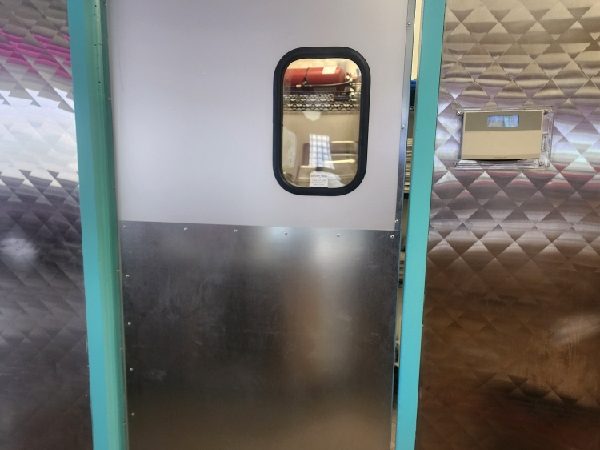
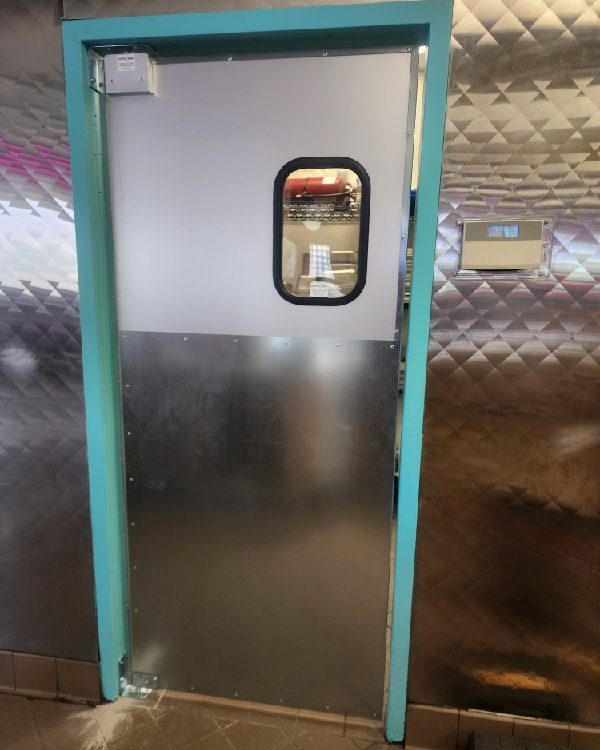
A traffic door has one job: let people and equipment through an opening without anyone stopping to open anything, then close itself again. No latch, no handle, no closer arm — just a leaf that swings both ways on hinges that return it to centre. Everything distinctive about the product follows from that, because a door with no handle is a door that gets hit, and it gets hit every single time it is used.
Canuck Door Systems supplies, installs and repairs traffic and impact doors across the GTA. It is a small part of what we do compared with steel and glass, and we would rather say that plainly than pretend otherwise — but it is a category where specification errors are common and expensive, and where a door contractor that also serves the kitchen's fire-rated openings, the plant's dock and the warehouse's overhead doors can put right in one visit what would otherwise be three.
Traffic doors we supply, install and service
By setting
The same double-acting principle, specified very differently depending on what comes through the opening.
Industrial Impact & Traffic Doors
Reinforced double-acting doors for openings that get driven through — pallet jacks, powered trucks and forklifts.
Kitchen & Restaurant Traffic Doors
The door between the kitchen and the customers: washable, quiet, and with a window low enough to see a loaded tray.
What decides the specification
Four questions, in this order. Answer them and the door is largely specified; skip them and you will be replacing the leaf within a year.
- What hits it? Staff on foot, carts and hand pallet trucks, or counterbalance forklifts. This sets panel thickness and material more than anything else.
- How wet is it? A washdown kitchen or a food plant rules out materials that a dry warehouse aisle would accept without complaint.
- How cold is it? A cooler or freezer opening needs an insulated, gasketed, sometimes heated door — a different product, not a variant.
- How fast is the traffic? Speed is what turns a bump into damage, and it is why a warehouse door needs reinforced edges where a kitchen door does not.
Traffic, impact and flexible
Three families that get used interchangeably in enquiries and are not interchangeable in practice.
| Traffic door | Impact door | Flexible / strip door | |
|---|---|---|---|
| Built for | People, carts, light trolleys | Pallet jacks and forklifts | Constant vehicle traffic where a rigid leaf would be destroyed |
| Construction | Light rigid panel, ¾″–1″ typical | Heavier rigid panel, ≈1½″–2″, reinforced edges | Hanging PVC curtain, or a flexible vinyl leaf |
| Vision | Window, sized for the traffic | Large window, positioned for a seated driver | Transparent or partly transparent throughout |
| Recovers from impact | Poorly — dents and cracks show | Designed to absorb and keep working | Completely — it simply deflects |
| Where it fails | Warehouse aisles | Very high-speed traffic; genuine cold rooms | Where a real seal, security or fire separation is required |
The most common mistake we are called to fix is a light kitchen-grade traffic door fitted in a warehouse aisle because the openings looked the same on a drawing. It will be cracked within months, and the replacement is charged twice.
Where they belong
Restaurant kitchens
Between kitchen and service floor. Washable, quiet, with a window low enough to see a person carrying a tray.
Grocery & retail stockrooms
Back-of-house to sales floor, taking carts and cages all day, in full view of customers — so appearance matters too.
Food processing
Washdown environments where the panel material has to tolerate hosing, detergents and inspection.
Warehouse aisles
Zone separation for forklift traffic, where the door is struck at speed and reinforced edges earn their cost.
Cold rooms & freezers
Insulated and gasketed, sometimes with frame heaters — a different product from an ambient traffic door.
Hospital service corridors
Bed, trolley and cart traffic, with hygiene and cleanability driving the material choice.
Manufacturing
Separating dusty, noisy or fume-producing processes from the rest of the floor while keeping movement easy.
Loading areas
Between the dock and the warehouse, usually paired with the dock equipment on the other side of the wall.
Safety: the vision panel is not optional
A door that swings both ways, is pushed without pausing, and has no window is a collision waiting to happen. The usual victim is someone carrying something with both hands, and the usual cause is that the window was value-engineered smaller or placed at the wrong height.
- Sight lines follow the traffic. A seated forklift driver and a person carrying a tray need the window in different places.
- Bigger is better in almost every case, limited only by panel strength around the opening.
- Two-way visibility matters: both sides of the door need to see through it, which sounds obvious and is regularly got wrong on pairs.
- Keep it clean and clear. A scratched, filmed-over or poster-covered window is the same as no window, and it is the single easiest thing to put right on a maintenance visit.
How long installation takes
Panels are made to your opening, so manufacturing is the long pole:
- Manufacture — 4–6 weeks once sizes and materials are confirmed.
- Install — 1–2 weeks to schedule; a single opening is usually a matter of hours.
- Replacement parts — hinge cassettes, gaskets, vision glazing and edge protection are much quicker, and worth stocking if you run a lot of these doors.
- Repairs — most hinge and vision-panel failures are put right on a single visit.
Kitchens and food plants are normally worked around production, which in practice means overnight or between shifts — say so at the quote stage and the schedule is built around it.
One traffic door job is written up in full: double traffic doors in stainless steel frames for the back of a new retail store, alongside its steel doors and frames — steel doors, frames and traffic doors for Toys “R” Us in North York.
Four decades of doors for names Ontario knows — Canada’s Wonderland, Tim Hortons, Canadian Tire, the LCBO, Metrolinx, Marriott & Hilton hotels, the University of Toronto — plus thousands of businesses across the GTA. Dependable people, quality products, since 1979.
Traffic door work across Toronto & the GTA
We supply, install and repair traffic and impact doors right across the core GTA and out into the Southern Ontario belt, from our shop in Mississauga. Kitchens and food plants are usually worked around production, which routinely means nights and weekends.
Core GTA
- Toronto
- Mississauga
- Brampton
- Vaughan
- Markham
- Scarborough
- North York
- Etobicoke
- Richmond Hill
- Oakville
- Burlington
- Milton
Southern Ontario belt
Restaurant groups, grocery chains and food processors rarely have one site. We quote and maintain traffic doors across a portfolio on one specification, so every location gets the same leaf and the same spare parts. See all service areas
What our customers say
The wind blew my commercial glass door open and it broke. Canuck Door systems came fast and board it up. They then replaced the glass door and everything is perfect now.
We own multiple commercial properties in Waterdown, and reaching out to a new contractor to fulfill a need is often stressful. Not so with Canuck Door Systems! From sales with Robert to dealing with Stanislav for measurements, communication was easy and open. …
Read the full review
Great company! I had a broken industrial door and Canuck responded quickly to fix the problem! I was very impressed and now they will be doing more work for our company. Jay, the Sales Guru is amazing! He is friendly, knowledgeable, and well informed about all doors. Thanks Canuck Doors!
What traffic and impact doors cost
These are among the least expensive doors in a commercial building, and the variables are few. What moves the number:
- Single leaf or pair, and the size of the opening
- Panel material — ABS or polyethylene, laminated fibreglass, stainless-clad, or flexible PVC
- Traffic type — staff on foot, carts and pallet jacks, or counterbalance forklifts
- Vision panel size and glazing, which is a safety requirement rather than an option
- Hinge type — gravity, spring cassette, or full double-acting hardware
- Frame condition, and whether jamb protection or a new frame is needed
- Temperature — a cooler or freezer opening is a different door entirely
- Washdown and food-contact requirements, which rule out some materials
The honest advice on this page is that the least expensive traffic door is rarely the least expensive over five years. These openings are hit thousands of times a year, and panel material and hinge quality are what decide whether you are replacing the leaf annually.
Common questions about traffic & impact doors
What is a traffic door?
A double-acting door that swings both ways and closes itself, fitted in an opening people and equipment pass through constantly — a kitchen service opening, a stockroom entrance, an aisle between warehouse zones. There is no latch and usually no handle: you push through it, and it swings back to closed on its own hinges. That is the whole design brief, and everything else about the door follows from being hit thousands of times a year.
What is an impact door, and how is it different?
An impact door is a traffic door built for vehicle traffic rather than foot traffic — thicker panels, a much tougher facing material, reinforced edges and hardware sized to survive being struck by a pallet jack or a forklift rather than a shoulder. In practice the terms overlap: every impact door is a traffic door, but a light kitchen traffic door will not survive a warehouse aisle. The distinction that matters when specifying is what hits the door, and how fast.
How can you tell if a door is impact rated?
Be careful with this phrase, because it means two different things. In the door industry an "impact door" is a double-acting door designed for vehicle traffic, and there is no single rating stamp for it — you specify panel material, thickness and hardware. In hurricane-region building codes "impact rated" is a formal wind-borne-debris certification, which is not relevant to Ontario commercial interiors and is not what these doors are. If a specification asks for an impact rating, it is worth confirming which of the two it means before anyone prices it.
For a traffic door, is aluminum or fibreglass better?
For an interior traffic opening, neither is the usual answer. Most of these doors are ABS or polyethylene panels, sometimes over a solid core, with a metal or laminated facing where the abuse is heavier. Aluminum frames are common; aluminum leaves are not, because aluminum dents and stays dented. Laminated fibreglass is genuinely good in wet and washdown environments because it does not corrode or absorb. The choice should follow the environment — dry warehouse, wet kitchen, cold room — rather than a material preference.
How thick are traffic and impact doors?
Light kitchen and service doors are commonly in the ¾″ to 1″ range, and heavier industrial impact doors around 1½″ to 2″, with reinforcement at the edges and around the vision panel. Flexible PVC doors are a different product altogether — a curtain rather than a panel — and are measured in millimetres of vinyl thickness instead. The right figure follows from what hits the door, which is why we ask about traffic before quoting.
Do traffic doors need a vision panel?
Yes, and it should be treated as a requirement rather than an option. A door that swings both ways, is pushed without stopping and has no window is a collision waiting to happen — most often between a person carrying something and a person on the other side. Window size and position should suit the traffic: low enough to see a child or a cart in a retail or restaurant setting, and large enough to see a pedestrian from a forklift seat in a warehouse.
Can traffic doors be used on a cooler or freezer?
Only if they are made for it. A standard traffic door on a cold opening will sweat, ice up around the edges and eventually fail, because it is not insulated and its gasketing is not designed for the temperature difference. Cold-room openings need insulated panels, gasketing rated for the temperature, and often heaters in the frame. It is a different product at a different price, and substituting a standard door is a false economy that shows up within a winter.
How long do traffic doors take to arrive?
Plan on roughly 4–6 weeks for manufacture once sizes are confirmed, then 1–2 weeks to schedule installation — about 5–8 weeks in total, since panels are made to your opening. Replacement parts are much quicker: hinge cassettes, gaskets, vision-panel glazing and bumper strips are the items that wear, and keeping a small stock of them on site is worth doing if you run a lot of these doors. Fitting the doors at one opening is usually done in a day, often overnight or between shifts.
Can you repair a traffic door rather than replace it?
Usually, and it is normally the better value. Hinges and spring cassettes are the most common failure and are replaceable in place. Vision panels, gaskets, sweep strips and edge protection all renew individually. What is not worth repairing is a panel that has delaminated or cracked right through, or a frame that has been struck out of square — a door hung in a twisted frame will keep failing whatever you fit to it.
Traffic door failing, or specifying a new one?
Send us the opening size and what goes through it — people, carts or forklifts — and we’ll tell you what the door should be, and quote it.