
Commercial & Industrial
Industrial Impact & Traffic Doors
Double-acting doors built to be driven through. Reinforced impact panels for warehouse aisles, food plants and cold rooms, where the door is struck by a pallet jack or a forklift rather than a shoulder — supplied, installed and repaired across Toronto and the GTA.
Request QuoteCall 800-522-6825
Specified by what hits it · hinges and panels replaced in place · since 1979
At a glance
| Typical panel thickness | ≈1½″–2″, reinforced at edges and around the vision panel |
|---|---|
| Panel materials | ABS · polyethylene · laminated fibreglass · metal-faced |
| Traffic | Pallet jacks, powered trucks and counterbalance forklifts |
| Vision panel | Sized and positioned for a seated driver's eye line |
| Lead time | 4–6 weeks manufacture, 1–2 weeks to schedule installation |
| Service | Hinges, panels, gaskets and vision glazing replaced in place, all makes |
An industrial impact door is a door you are meant to drive through. Nobody stops, nobody opens anything, and the leaf takes the hit — from a pallet jack, a powered truck, or a counterbalance forklift carrying a load. It swings both ways, returns to closed on its own hinges, and its entire specification is a response to being struck thousands of times a year.
That is why the inexpensive version fails so predictably. A light traffic door and an impact door look nearly identical in a photograph and on a drawing; the difference is panel thickness, edge reinforcement and hinge duty, none of which show until the first forklift clips a corner.
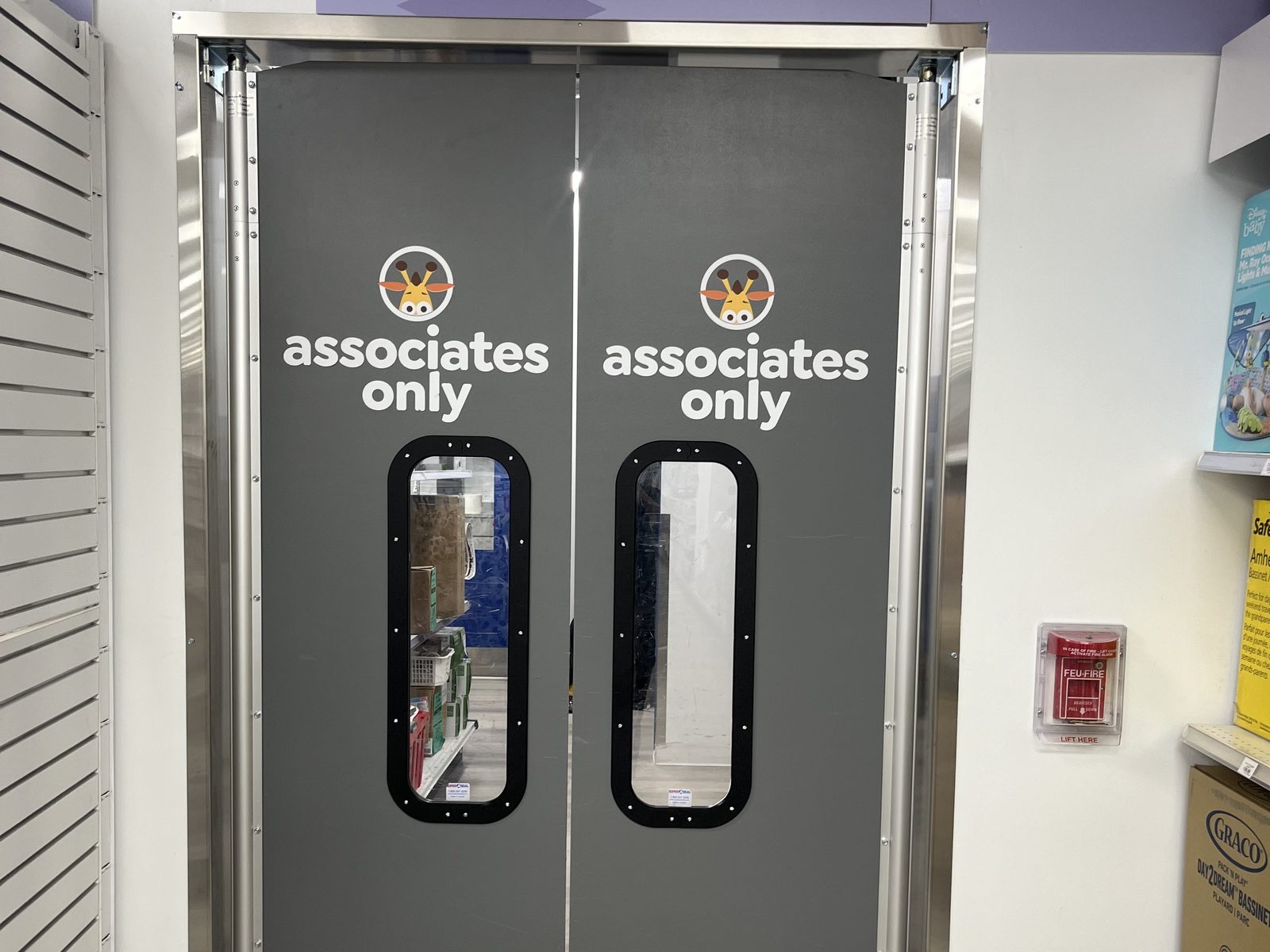
Double traffic doors in stainless steel frames were part of our package for a new Toys “R” Us store in North York.
Specify by what hits it
| Traffic | Panel | Edges | Vision panel | Typical setting |
|---|---|---|---|---|
| Foot and light carts | ¾″–1″ light rigid | Standard | Sized for a standing person | Kitchens, service corridors |
| Hand pallet trucks | ≈1½″ rigid | Reinforced corners | Larger, lower | Stockrooms, back-of-house |
| Powered pallet trucks | ≈1½″–2″ impact | Reinforced edges and corners | Large, positioned for a seated operator | Warehouse aisles |
| Counterbalance forklifts | 2″ impact, often faced | Full edge reinforcement plus jamb guards | Large; two-way sight lines | Distribution, manufacturing |
| Any of the above, wet | Laminated fibreglass or polyethylene | Sealed edges | Gasketed glazing | Food processing, washdown |
| Any of the above, cold | Insulated, gasketed, sometimes heated frame | Thermal break at edges | Double glazed | Coolers and freezers |
Before replacing a door that keeps cracking, measure the opening against the widest load that passes through it. A large share of "bad doors" are actually openings 6 inches too narrow, and drivers have been clipping the edges since the building opened.
Where impact doors earn their cost
Warehouse aisles
Zone separation where forklifts pass constantly and stopping to open anything would be unworkable.
Distribution centres
Between the dock area and the pick floor, taking powered trucks all shift, every shift.
Food processing
Washdown-tolerant panels between processing areas, where hygiene and inspection drive the material.
Cold rooms & freezers
Insulated, gasketed and frequently heated at the frame — a different product from an ambient door.
Manufacturing cells
Separating dust, noise or fumes without impeding the movement of material between processes.
Auto & parts
Heavy trolley and cart traffic in an environment that is hard on finishes and hardware alike.
Hospital service routes
Bed, cart and trolley traffic where cleanability and quiet operation matter as much as strength.
Waste & recycling
Some of the roughest traffic in any building, where edge protection and jamb guards are essential rather than optional.
How long installation takes
Panels are made to your opening, so manufacture sets the schedule:
- Manufacture — 4–6 weeks once sizes, materials and hardware are confirmed.
- Install — 1–2 weeks to schedule; a single opening is normally a few hours, worked between shifts.
- Repairs — hinge, gasket and vision-panel failures are usually put right on one visit.
- Wear parts — hinge cassettes and gaskets are quick to obtain, and worth stocking on site if you run a number of these doors.
What actually wears out
Impact doors fail in a predictable order, and knowing it makes maintenance inexpensive:
- Hinges and spring cassettes — the most common failure by a wide margin, and replaceable in place.
- Vision-panel glazing — scratched, crazed or knocked out; a safety item, not cosmetic.
- Edge and corner protection — sacrificial by design, which is the point of it.
- Gaskets and sweeps — first thing to go on chilled and washdown openings.
- The frame — struck out of square by traffic. A leaf hung in a twisted frame will keep failing whatever you fit.
If the same opening keeps eating doors, the honest answer is usually the opening rather than the door — width, approach angle, or unprotected jambs. We will say so rather than sell you another leaf.
Four decades of doors for names Ontario knows — Canada’s Wonderland, Tim Hortons, Canadian Tire, the LCBO, Metrolinx, Marriott & Hilton hotels, the University of Toronto — plus thousands of businesses across the GTA. Dependable people, quality products, since 1979.
What our customers say
I had an old metal and class commercial door that was sagging. I opted for a re-hinging with new continuous hinge system. Process from quote to job done was very easy and competitive priced. Technicians were on time and did the job professionally. My door opens and closes beautifully.
Called Canuck doors for one of our warehouse doors that was malfunctioning , the technician that came was very knowledgeable and efficient, it took him to time to find the issue and fix it. 5 stars
We own multiple commercial properties in Waterdown, and reaching out to a new contractor to fulfill a need is often stressful. Not so with Canuck Door Systems! From sales with Robert to dealing with Stanislav for measurements, communication was easy and open. …
Read the full review
Industrial door work across Toronto & the GTA
We supply, install and service impact doors throughout the core GTA and along the Southern Ontario distribution belt, from our shop in Mississauga. Plant work is scheduled around production — usually between shifts or at a weekend.
Core GTA
- Toronto
- Mississauga
- Brampton
- Vaughan
- Markham
- Scarborough
- North York
- Etobicoke
- Richmond Hill
- Oakville
- Burlington
- Milton
Southern Ontario belt
Most of the region's warehousing and food processing sits in Milton, Brampton, Bolton and along the 401. Multi-site operators are quoted on one specification so spares fit every building. See all service areas
What an industrial impact door costs
Impact doors cost more than kitchen traffic doors and far less than the equipment that goes through them. What moves the number:
- Opening size, and single leaf against a pair
- Panel construction and thickness — ABS, polyethylene, laminated or metal-faced
- Edge and corner reinforcement, which is what survives forklift strikes
- Vision panel size and position, set by the driver's eye line
- Hinge type and duty — gravity, cassette, or heavy double-acting hardware
- Whether the opening is ambient, chilled or freezer
- Frame and jamb protection, including bollards or guards where trucks turn tightly
- Washdown or food-contact requirements
The least expensive impact door is rarely least expensive over five years. These openings take thousands of strikes a year, and panel construction and hinge duty are what decide whether you are buying another leaf next spring.
Common questions
What is an impact door?
A double-acting door built to be driven through rather than walked through. It swings both ways, closes itself, and is constructed to survive being struck by a pallet jack or forklift many times a day — thicker panels than a standard traffic door, reinforced edges and corners, and hardware sized for the abuse. It carries no latch and usually no handle, because anything that has to be operated by hand defeats the purpose of the opening.
Which type of impact door is better, aluminum or fibreglass?
Neither is the usual answer for an interior industrial opening, and the question is worth reframing. Aluminum leaves dent and stay dented, so aluminum tends to appear in the frame rather than the panel. Laminated fibreglass is genuinely strong and does not corrode or absorb moisture, which makes it a good choice in wet and washdown environments. Most impact doors in Ontario plants are ABS or polyethylene panels, sometimes over a solid core, with a metal or laminated face where the traffic is heaviest. Pick by environment first — wet, dry or cold — then by traffic weight.
How can you tell if a door is impact rated?
Two different things share that phrase. In this trade an "impact door" is a double-acting door designed for vehicle traffic; there is no single certification stamp, and what you specify is panel construction, thickness, reinforcement and hardware duty. In hurricane-region building codes, "impact rated" means a formal wind-borne-debris certification for exterior openings, which is not relevant to Ontario interior traffic doors. If a drawing asks for an impact rating, confirm which meaning is intended before pricing it — they are not the same product.
How thick are impact doors?
Industrial impact doors are commonly around 1½″ to 2″ thick, with additional reinforcement at the edges, corners and around the vision panel — the places that fail first. Lighter traffic doors for foot and cart traffic are typically ¾″ to 1″. Flexible PVC doors are not measured this way at all, being a curtain rather than a panel. The right figure follows from what strikes the door and how fast, which is why we ask about the traffic before quoting.
Impact door or high-speed door — which do we need?
Different problems. An impact door is a passive, unpowered leaf that absorbs strikes and costs relatively little; it is right where traffic is frequent but the opening does not need to seal or open quickly. A high-speed door is powered, opens and closes in seconds, and is right where you are separating temperatures or contamination zones and the cycle time matters. Many plants use both — impact doors on internal aisles, high-speed doors between climate zones.
Will a standard impact door work on a freezer opening?
No. A standard door on a cold opening will sweat, ice up at the edges and fail, because it is neither insulated nor gasketed for the temperature difference. Cold-room and freezer openings need insulated panels, gasketing rated for the temperature and frequently heaters in the frame. It is a different product at a different price, and substituting a standard door is an economy that shows up within one winter.
Our impact doors keep cracking. What are we doing wrong?
Usually one of three things. The door is under-specified — a kitchen-grade traffic door in a forklift aisle will crack within months whatever you do. The opening is too narrow for the traffic, so drivers clip the edges instead of passing through cleanly. Or the frame has been struck out of square, and a door hung in a twisted frame binds and fails no matter how good the leaf is. Widening the opening or protecting the jambs often costs less than the doors you are replacing.
Can impact doors be repaired?
Most of the time, and it is usually the better value. Hinges and spring cassettes are the most common failure and replace in place. Vision panels, gaskets, sweep strips and edge protection all renew individually. What is not worth repairing is a panel cracked right through or delaminated, or a frame knocked out of square — that needs straightening or replacing before any new leaf will last.
How long do industrial impact doors take to arrive?
Plan on roughly 4–6 weeks to manufacture once sizes and materials are confirmed, then 1–2 weeks to schedule installation — about 5–8 weeks in total, because panels are made to your opening. Common wear parts are far quicker, and if you run a number of these doors it is worth holding a small stock of hinge cassettes and gaskets so a failure does not close an aisle. Fitting one opening is usually a day, scheduled between shifts so the aisle stays open.
Door cracked, sagging, or hit once too often?
Tell us the opening size and what drives through it, and we’ll specify and quote the right door. Hinges and panels can usually be replaced without changing the frame.