
Guides & FAQ · Traffic & impact doors
Double-Acting, Traffic & Impact Doors: Questions Answered
A double-acting door swings both ways through its frame and returns to centre on its own, with no latch and usually no handle, so people, carts and forklifts can push straight through. Traffic doors and impact doors are both double-acting. Below are the questions restaurant, retail, warehouse and plant managers ask us most, answered briefly.
These answers come from the traffic and impact doors we supply, install and repair in kitchens, stores, warehouses and plants across the GTA. Where a question needs more room, it links to the page that covers it in full.
Four decades of doors for names Ontario knows — Canada’s Wonderland, Tim Hortons, Canadian Tire, the LCBO, Metrolinx, Marriott & Hilton hotels, the University of Toronto — plus thousands of businesses across the GTA. Dependable people, quality products, since 1979.
What a double-acting door is
The name describes the swing, not the material. Everything else about these doors follows from it.
What is a double-acting door?
A door that swings both ways through its frame, into and out of the room, and returns to the closed, centred position by itself. There is no door stop in the frame, no latch and usually no handle, so anyone can push through from either side without stopping. That makes it the standard door wherever hands are full: kitchen service openings, stockrooms, food plants and warehouse aisles.
What do you call a door that swings both ways?
Its trade name is a double-acting or double-swing door. In commercial buildings it is usually called a traffic door, or an impact door when it is built for vehicles. In restaurants people just say "kitchen doors", and the short louvred versions in bars and homes are café or saloon doors. They all work on the same principle.
What is the difference between single-acting and double-acting doors?
A single-acting door swings one way only: it closes against a stop in the frame and is held shut by a latch, which is what lets it lock, seal and, if it is labelled, serve as a fire door. A double-acting door has no stop and no latch, so it can open in either direction but cannot lock or seal the same way. The choice comes down to whether the opening needs to be secured or just passed through.
How does a double-acting door hinge work?
It returns the leaf to centre from either side. Gravity hinges do it with a cam: the leaf rises slightly as it opens, and its own weight brings it back down to closed. Spring hinges and spring cassettes do it with a spring in each direction. On heavier or glass doors the same job is done by a floor pivot or concealed closer that holds the leaf at centre. Traffic doors mostly use gravity or spring-cassette hinges, and they are the part that wears first.
Is a double door the same as a double-acting door?
No. A double door is a pair of leaves in one frame. Double-acting describes how a leaf swings. A pair can be either: most kitchen and stockroom traffic doors are double-acting pairs, while a double-egress pair, common across hospital and school corridors, is two single-acting leaves that open in opposite directions so people can exit either way.
Traffic doors or impact doors
The same principle, built for very different traffic. What goes through the opening decides which one you need.
What is a traffic door?
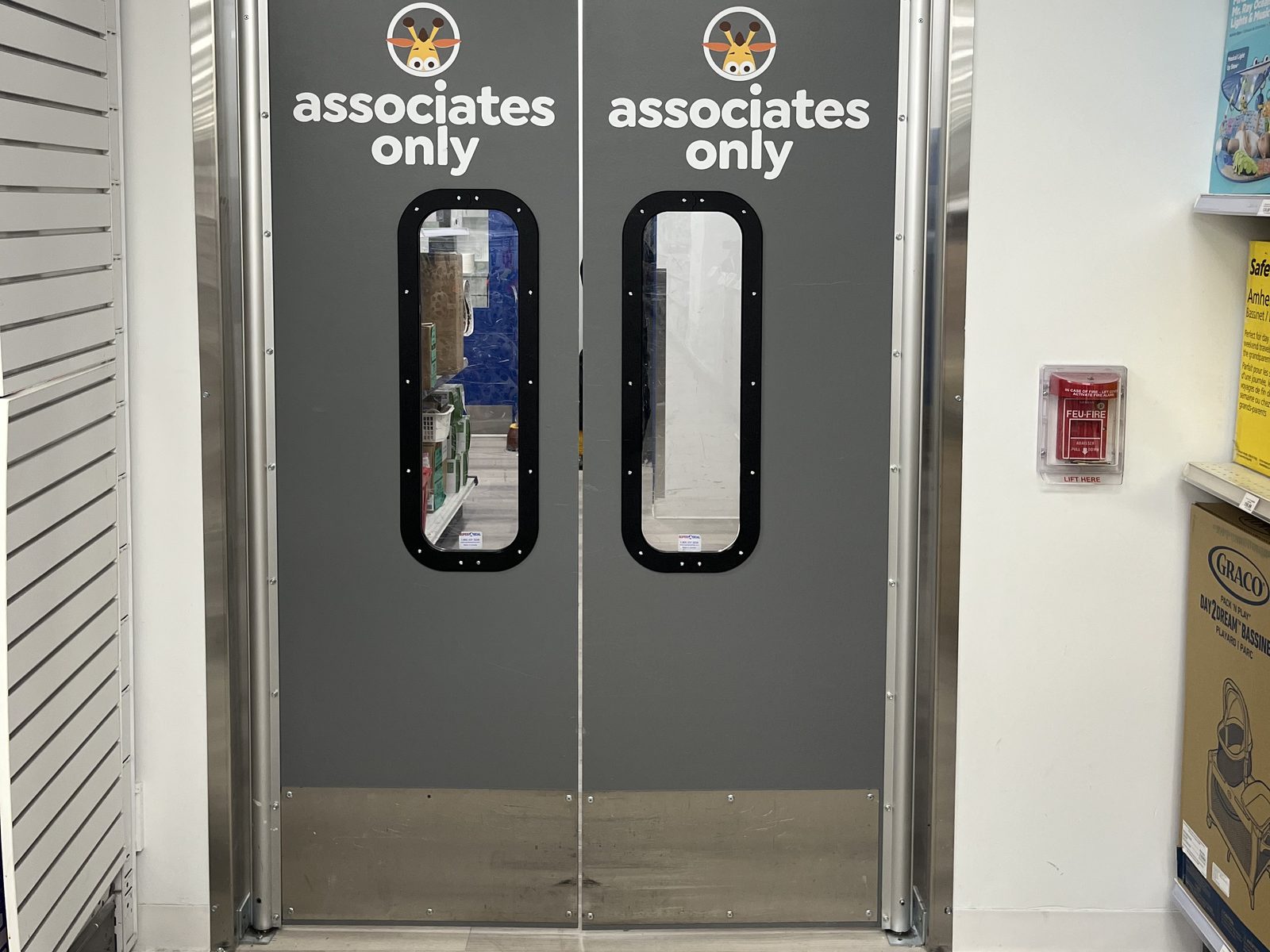
A double-acting door for an opening people and light equipment pass through all day: staff on foot, trolleys, carts and cages. It is light, quiet and self-closing, with a vision panel so people see each other before they push. Typical places are the opening between a kitchen and its dining room, and between a store's back room and its sales floor.
What is an impact door, and what makes a door one?
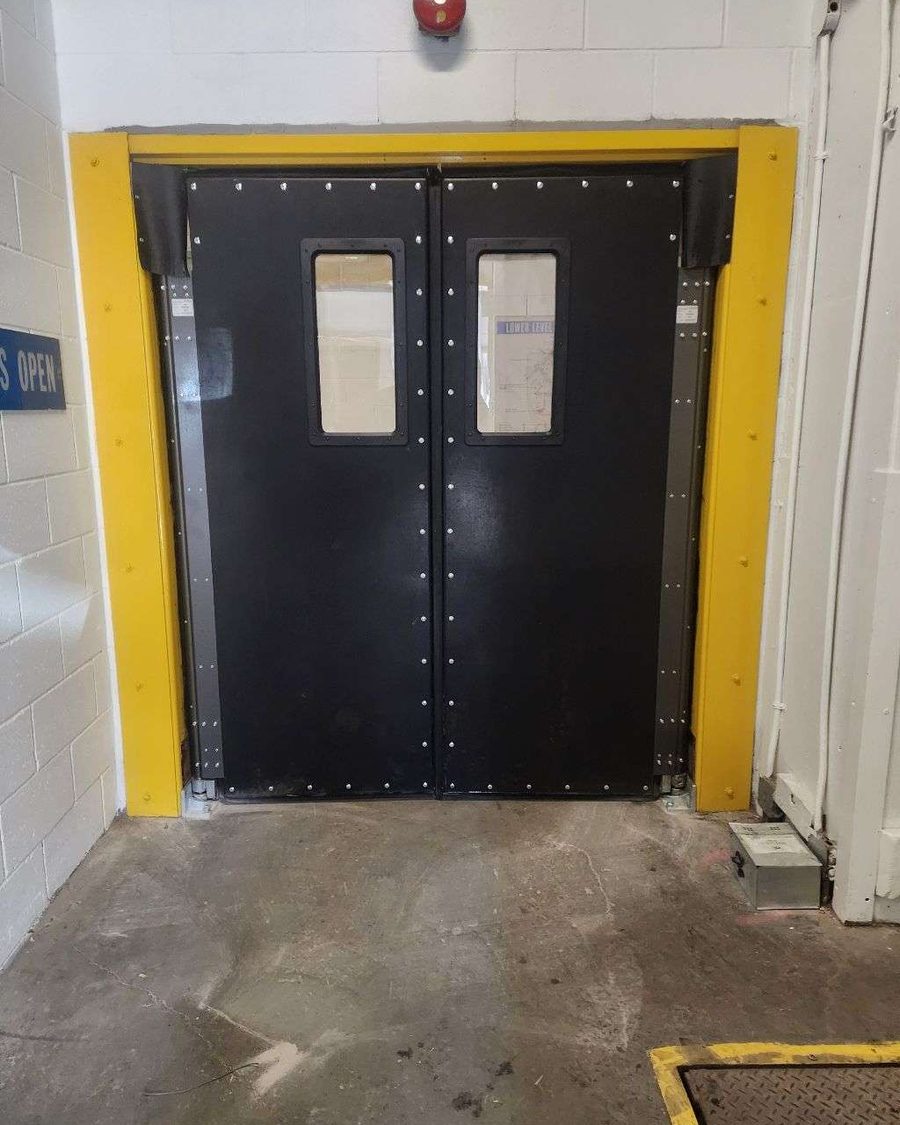
A traffic door built to be struck by vehicles: pallet jacks, powered trucks and forklifts. What makes it one is construction, not a label: thicker panels (around 1½ to 2 inches against ¾ to 1 inch for a light traffic door), tougher facing, reinforced edges and corners, heavier-duty hinges and a large vision panel placed for a seated driver.
How can you tell if a door is impact rated?
For a traffic door you mostly can't, because there is no single impact rating stamp. You check what it is built from: panel material and thickness, edge reinforcement and hinge duty, all of which the manufacturer's data sheet states. "Impact rated" in building codes usually means something else, a hurricane-zone certification against wind-borne debris, which does not apply to an interior door in Ontario. If a specification asks for an impact rating, confirm which meaning it has before pricing.
Traffic door or impact door for a retail back of house?
It depends on what the staff push. Foot traffic, rolling racks and hand carts suit a heavier retail-grade traffic door with a kick plate and stainless jamb guards. Once pallet jacks come through from the receiving area, move up to an impact door, or the light panels will crack and the frame will take the hits. In both cases the vision panels should sit where someone pushing a load can see through them.
Traffic door or impact door for a warehouse aisle?
An impact door, sized for the widest load and positioned for the driver. A kitchen-grade traffic door in a forklift aisle is one of the most common mistakes we are called to fix: it looks the same on a drawing and is cracked within months. Where forklifts pass constantly, or the opening separates temperatures, a high-speed door that rolls up out of the way can be the better answer than any swinging leaf.
Are impact doors worth it?
Where vehicles pass through, yes. An impact door costs more than a light traffic door, but a light door in a vehicle opening is replaced again and again, and each strike risks the frame and the load. Where only people pass through, an impact door is money spent on strength the opening never uses.
Safety, fire and exit rules
A door with no latch cannot do everything a latched door can. These are the limits.
Do traffic doors need a vision panel?
In practice, yes. Two people pushing the same double-acting door from opposite sides, one of them carrying something, is how most traffic-door injuries happen. The window should be as large as the panel allows and placed for the traffic: low enough to see a child or a cart in a store, high and wide enough to see a pedestrian from a forklift seat.
Can a swing door be fire rated?
A single-acting swing door can, if it is a labelled assembly. A double-acting traffic door cannot stand in for one: a fire door has to close and latch, and a traffic door has no latch. Where a fire separation needs an opening people can pass through both ways, the usual answer is a pair of labelled fire doors, often held open on alarm-released devices, with the traffic door elsewhere.
Do commercial doors have to swing outward?
Doors in exits generally have to open in the direction people leave the building, and the Ontario Building Code sets which doors that covers. Traffic doors belong between work areas, such as kitchen to dining room or stockroom to sales floor, not in the exit path. If a plan shows one on an exit route, check it with the building's designer before ordering.
Materials and specification
Four questions settle most of the specification: what hits the door, how wet it is, how cold it is and how fast the traffic moves.
What are traffic doors made of?
Most leaves are ABS or polyethylene panels, sometimes over a solid core, which flex under a knock and go back into shape. Where the abuse is heavier or the room is washed down, laminated fibreglass or stainless-clad panels are used. Frames are commonly aluminum or stainless, and stainless jamb guards and kick plates protect the places carts hit most.
Can a traffic door go on a cooler or freezer?
Only one built for it. A standard traffic door on a cold opening sweats, ices at the edges and fails within a season, because it is not insulated and its gaskets are not made for the temperature difference. A cold-room door needs insulated panels, low-temperature gasketing and often heated edges: a different product at a different price.
Problems, repairs and lead times
Most traffic doors fail at the same few points, and most of those parts replace in place.
What are common problems with swing doors?
On a double-acting door: the leaf no longer returns to centre or swings past it, the leaf sags and drags on the floor, panels crack or delaminate after one hit too many, and vision panels get so scratched or covered that nobody can see through them. The first two are nearly always worn hinges or cassettes. A frame knocked out of square by a vehicle is the other usual cause, and it will defeat any new hinge.
Can a traffic door be repaired, or does it need replacing?
Usually repaired. Hinges and spring cassettes, gaskets, vision glazing, kick plates and edge guards all replace individually, with the leaf left in place. Replacement is the better value when the panel has cracked right through or delaminated, or when the door is simply the wrong grade for the traffic it now gets.
How long does it take to get a new traffic or impact door?
Leaves are made to the opening, so plan on 4–6 weeks of manufacture once sizes and materials are confirmed, then 1–2 weeks to schedule installation. Fitting a single opening usually takes hours, and in kitchens and plants we work around service or production, which often means nights or between shifts. Repair parts come much faster.
In-depth guides
How to Choose Commercial Doors for an Ontario Building
Door type by opening, material, fire rating, swing, accessibility, hardware and lead time — and exactly what to send so a quote comes back right the first time.
Get traffic doors replaced or repaired
Traffic door sagging, cracked or the wrong grade?
Tell us the opening size and what goes through it: people, carts or forklifts. We will tell you whether new hinges will do or what the door should be, and quote it.