
Commercial & Industrial
High-Speed & Rolling Fabric Doors
Powered fabric and rubber doors that open and close in seconds. Where an opening cycles constantly, the time the door spends open costs more than its insulation value — supplied, installed and serviced across Toronto and the GTA.
Request QuoteCall 800-522-6825
Cycle time over R-value · self-repairing curtains · serviced on all makes
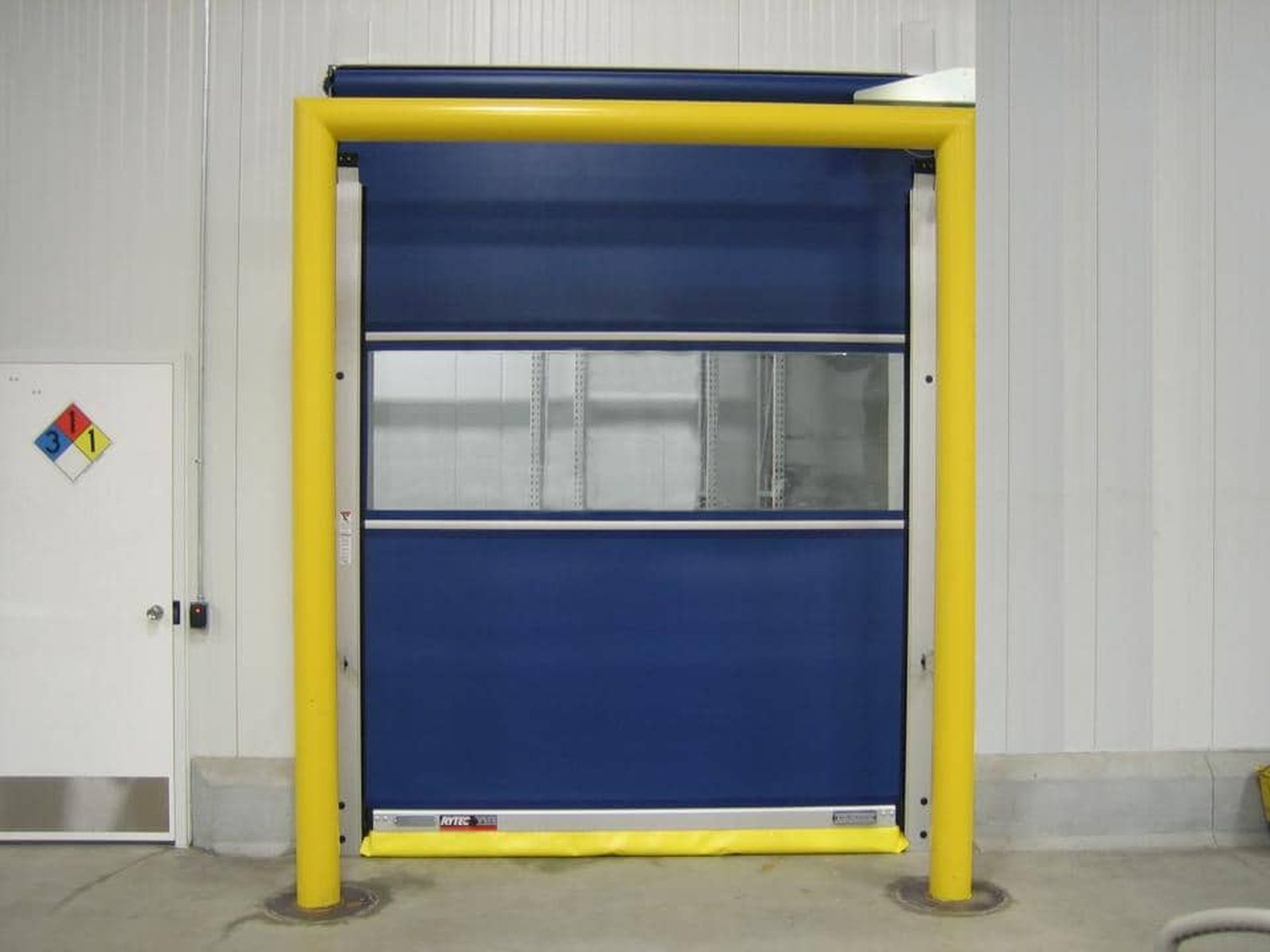
At a glance
| Construction | Powered fabric or rubber curtain on a driven roller |
|---|---|
| Curtain materials | PVC fabric · reinforced fabric · rubber for exterior and heavy duty |
| Best for | High cycle counts, temperature separation, dust and contamination control |
| Self-repairing | Available — the curtain re-seats after an impact instead of needing repair |
| Lead time | 2–4 weeks manufacture, 1–2 weeks to schedule installation |
| Service | Curtains, drives, controls and sensors on all makes |
A high-speed door is a powered curtain of fabric or rubber that opens in seconds. It exists for one reason: on an opening that cycles constantly, the time the door spends open costs more than anything about the door itself.
The arithmetic is worth doing before anyone quotes you one. An opening that cycles a hundred times a day, with a conventional door taking fifteen seconds each way, is open for well over half an hour a day — every day — with your heating, cooling, humidity and dust control crossing it freely. Cut that to three seconds and most of it goes away. Cycle a door five times a day and none of that applies, and we will tell you so rather than sell you one.
High-speed against conventional
| High-speed door | Insulated sectional | Air curtain | |
|---|---|---|---|
| Barrier | Physical, briefly open | Physical, slowly open | None — a stream of air |
| Cycle time | Seconds | Tens of seconds | n/a, the opening stays open |
| R-value while closed | Modest, even insulated | Best | n/a |
| Stops dust and insects | Yes | Yes | Partially |
| Impact tolerance | High, especially self-repairing | Panel damage needs replacing | n/a |
| Purchase cost | Highest | Middle | Lowest |
| Wins when | The opening is busy | The opening is mostly closed | The opening cannot be closed at all |
The single question that decides this purchase is "how many cycles a day?" Below a certain frequency a high-speed door cannot repay itself, and a good insulated sectional is the better buy. Above it, the sums are not close.
Where they pay for themselves
Cold storage & freezers
The clearest case in the list. Every second the opening stands open is refrigeration you have already paid for, leaving.
Food processing
Temperature and contamination zones, with washable curtains and specifications that tolerate inspection.
Pharmaceutical & cleanroom
Pressure and particulate separation, where the door is part of the environment rather than just the wall.
Distribution centres
Internal openings cycling hundreds of times a shift, where cycle time is throughput as well as energy.
Paint & finishing
Keeping overspray and dust in one place — and keeping dust out of a finish that has to be right first time.
Manufacturing cells
Separating noisy, dusty or fume-producing processes without slowing the movement of material.
Car washes & wet areas
Constant cycling in a hostile environment, where rubber curtains outlast fabric considerably.
Exterior dock and yard
Wind-rated curtains and guides, usually alongside an insulated sectional for when the bay is idle.
How long it takes
- Measure and check power — the opening, the mounting structure, and the electrical supply at the door.
- Manufacture — 2–4 weeks, once activation and any plant interlocks are decided.
- Install — 1–2 weeks to schedule; normally a day per opening, plus coordination where the door interlocks with plant or ventilation.
- Repairs — curtains, drives, sensors and activation devices; curtain replacement is routine rather than exceptional.
What wears, and the early warnings
These are powered machines cycling all day, so they need more maintenance than a passive door — and they give more warning:
- Curtain and edge wear — the consumable. Plan for replacement rather than being surprised by it.
- Drive, gearbox and brake — a cycle time that is quietly slowing is the first symptom.
- Activation devices — a loop or sensor that needs two passes is failing, not fussy.
- Safety sensors — checked every visit; never bypassed to keep production running.
- Curtain tracking — a curtain drifting off-centre will eventually pull out of the guides, and it announces itself first.
Service on all makes, including curtain replacement, is on overhead door repair (24/7).
Overhead door work across the GTA
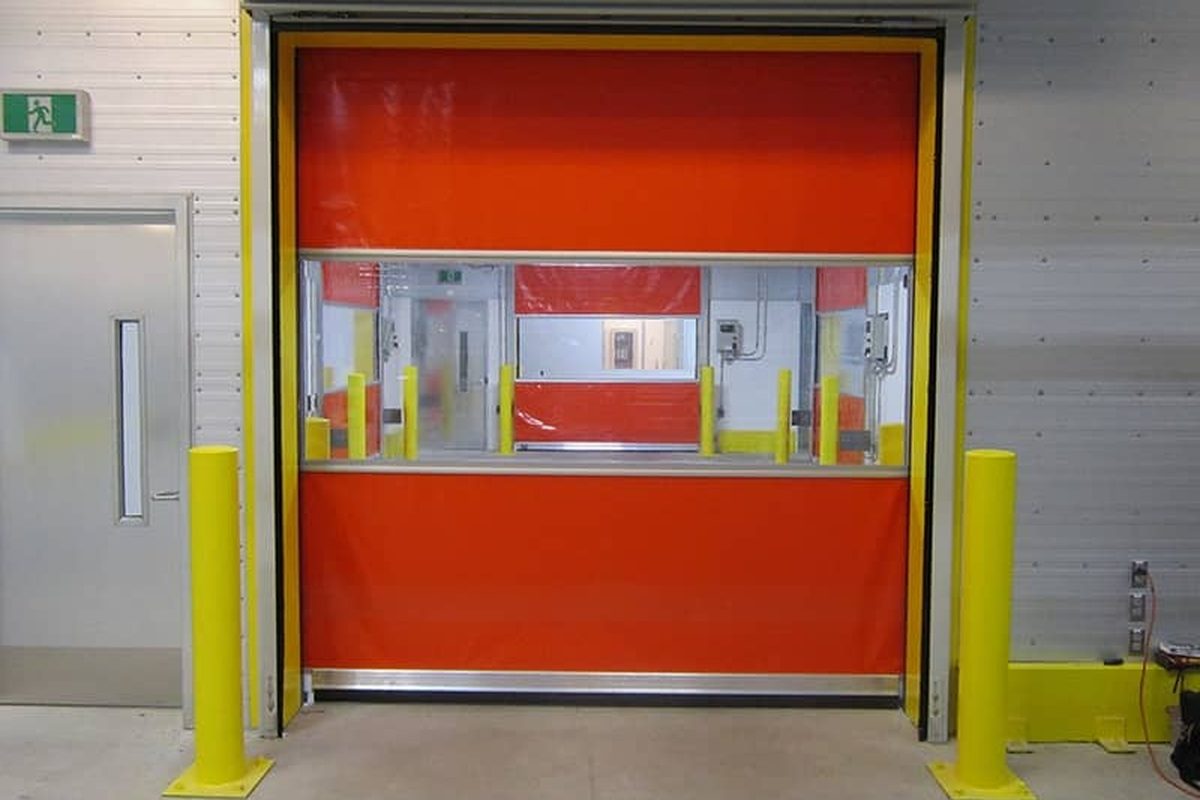
Documented overhead and rolling door jobs from our own project files.
Golden Gate Contracting Inc
Newlink Construction
Formtek Structures Inc
Stallion Construction Inc
Winmarm
Ultra-Form Manufacturing Co Ltd
Four decades of doors for names Ontario knows — Canada’s Wonderland, Tim Hortons, Canadian Tire, the LCBO, Metrolinx, Marriott & Hilton hotels, the University of Toronto — plus thousands of businesses across the GTA. Dependable people, quality products, since 1979.
What our customers say
Called Canuck doors for one of our warehouse doors that was malfunctioning , the technician that came was very knowledgeable and efficient, it took him to time to find the issue and fix it. 5 stars
We have a company. We had the garage door installed by Canuck. From beginning to end they did a great job. We love the doors, the functionality and how great it looks. The price was great as well. Thanks so much Tracey
Hats off to Canuck Doors for finding a quick solution to my dilemma of finding a 16 foot door in under 16 weeks for my new garage build. …
Read the full review
High-speed door work across Toronto & the GTA
We supply, install and service high-speed doors throughout the core GTA and out along the Southern Ontario industrial belt, from our shop in Mississauga. These are the doors that stop production when they fail, so they get 24/7 cover.
Core GTA
- Toronto
- Mississauga
- Brampton
- Vaughan
- Markham
- Scarborough
- North York
- Etobicoke
- Richmond Hill
- Oakville
- Burlington
- Milton
Southern Ontario belt
Food, pharmaceutical and distribution plants across the belt are where most of these doors sit. Multi-door sites go on one maintenance schedule, since curtain and drive wear runs at similar rates across a building. See all service areas
What a high-speed door costs
High-speed doors cost more than any other door in this silo per opening, and are justified by cycle time rather than by purchase price. What moves the number:
- Opening size, and the structure available to mount the frame and drive
- Curtain material — PVC fabric, reinforced fabric, or rubber for exterior and heavy duty
- Opening speed, and the drive and controls needed to achieve it
- Interior or exterior, since wind load and weather change the specification entirely
- Insulated or non-insulated curtain, and whether it separates temperature zones
- Self-repairing design, which costs more and pays for itself where impacts happen
- Activation — pull cords, loops, motion sensors, radio, or plant control integration
- Safety package, and any interlock with the process behind the door
- Cleanroom, washdown or food-contact requirements
The case for a high-speed door is almost never the door. It is the cycle time: how long the opening stands open, multiplied by how often, multiplied by what is crossing the threshold in both directions.
Common questions
What is a high-speed door?
A powered door with a flexible curtain — usually PVC fabric or rubber — that opens and closes in seconds rather than in the ten to twenty a conventional overhead door takes. The curtain winds onto a driven roller above the opening. Because it is soft and light it can be moved very quickly and safely, and because it moves quickly the opening spends far less time open, which is the entire point of the product.
Why would we pay more for a faster door?
Because on a busy opening, the cost is the time the door is open, not the door. Consider a doorway that cycles a hundred times a day: a conventional door standing open for fifteen seconds a cycle leaves that opening open for well over half an hour a day, every day, with your heating, your cooling, your dust control and your humidity crossing it. A door that does the same job in three seconds cuts that dramatically. If the opening cycles rarely, the sums do not work and we will say so.
What is the difference between a high-speed door and an air curtain?
They solve overlapping problems in opposite ways. A high-speed door closes the opening quickly, so the barrier is physical and the gap is brief. An air curtain leaves the opening open and blows a stream of air across it to resist the exchange. High-speed doors give better separation and also stop dust, insects and noise; air curtains suit openings that genuinely cannot be closed at all. Some buildings use both at different doorways.
What is a self-repairing high-speed door?
A design where the curtain is held in the guides by a system that lets it pull free on impact instead of tearing, and then re-seat itself — usually automatically on the next cycle. On an opening with forklift traffic that difference is significant: a conventional curtain that is struck needs a service call, and a self-repairing one is often back in operation within a cycle. It costs more, and on any opening where impacts are a matter of when rather than if, it is the less expensive choice.
Can high-speed doors be used outside?
Yes, but it is a different specification. An exterior high-speed door has to deal with wind load, which a light interior curtain will not tolerate — that usually means reinforced or rubber curtains, stronger guides, and wind ratings appropriate to the elevation. Weather sealing and cold-weather operation matter too. An interior-grade door fitted to an exterior opening is one of the more predictable failures in this category.
Do high-speed doors insulate?
Some have insulated curtains, but insulation is not really the argument for them. A conventional insulated sectional door has better R-value while closed; the high-speed door wins by being closed far more of the time. Where both matter — a cold store with heavy traffic — the usual answer is both doors: an insulated sectional or a cold-room door for when the opening is idle, and a high-speed door for the traffic.
What maintenance do they need?
More than a passive door, because they are powered machines cycling constantly. Curtain condition and edge wear, drive and gearbox, brake, controls, activation devices, and the safety sensors all need periodic checking, and the intervals should follow cycle counts rather than the calendar. The upside is that these doors give plenty of warning — a slowing cycle time, a curtain tracking off-centre, or an activation device that needs two passes are all early symptoms.
How long does a high-speed door take to install?
Plan on roughly 2–4 weeks for manufacture once the opening is measured and the electrical supply confirmed, then 1–2 weeks to schedule — about 3–6 weeks in total. The installation itself is normally a day per opening, but it needs power at the door and, where the door is interlocked with plant or ventilation, coordination with whoever owns those controls.
Do you service high-speed doors you did not install?
Yes. Curtains, drives, controls, sensors and activation devices are serviceable across the common makes, and curtain replacement in particular is routine — it is the wearing part. Where a control board or drive is proprietary and no longer supported, we will tell you that plainly, because that is the case where continuing to repair costs more than replacing.
Opening cycling all day?
Tell us the opening size, roughly how many cycles a day it does, and what is on each side of it — temperature, dust, or just traffic. That is what decides whether a high-speed door pays for itself here.