
Commercial & Industrial
Commercial Door Operators & Motors
The motor that runs the door, the controls that tell it what to do, and the safety devices that make it legal to stand under. Trolley, jackshaft and hoist operators supplied, installed, replaced and serviced across Toronto and the GTA.
Request QuoteCall 800-522-6825
Commercial-duty, not residential openers · safety devices never bypassed · all makes
At a glance
| Types | Trolley (ceiling rail) · jackshaft (wall, on the shaft) · hoist |
|---|---|
| Duty ratings | Light · medium · heavy · continuous, chosen by cycles per day |
| Controls | Open/close/stop · constant pressure · automatic with activation devices |
| Safety | Entrapment protection — photo eyes and/or reversing edge, tested every visit |
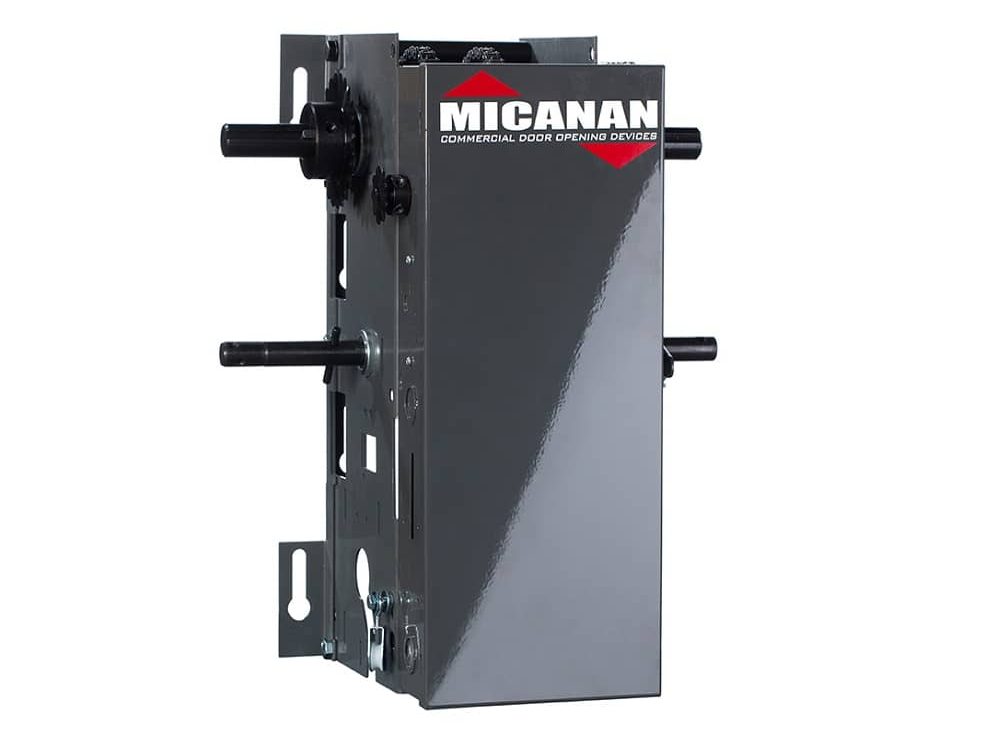
| Brands installed | LiftMaster · Chamberlain · Micanan · Manaras, and equivalents |
| Service | All makes, including replacement of obsolete units |
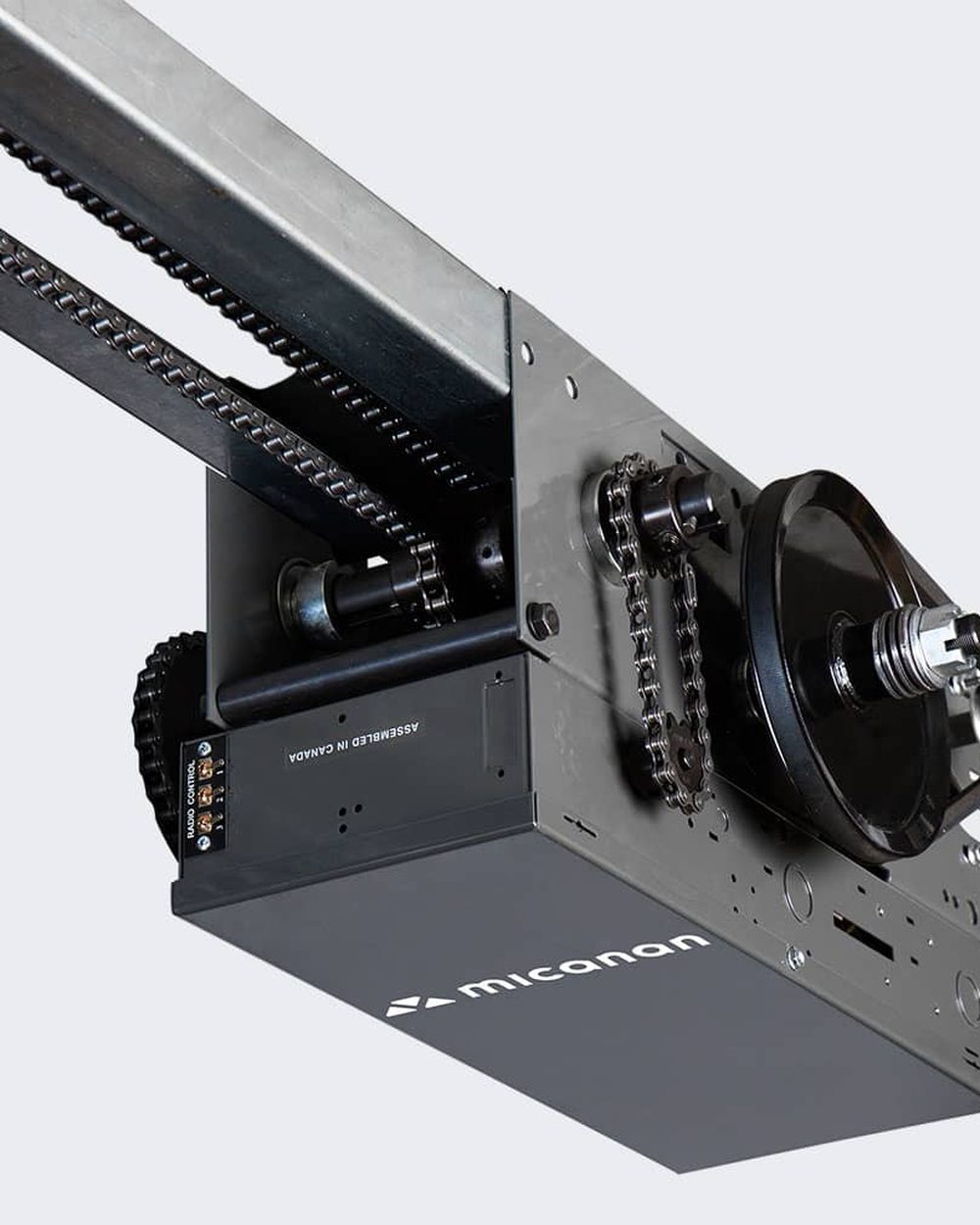
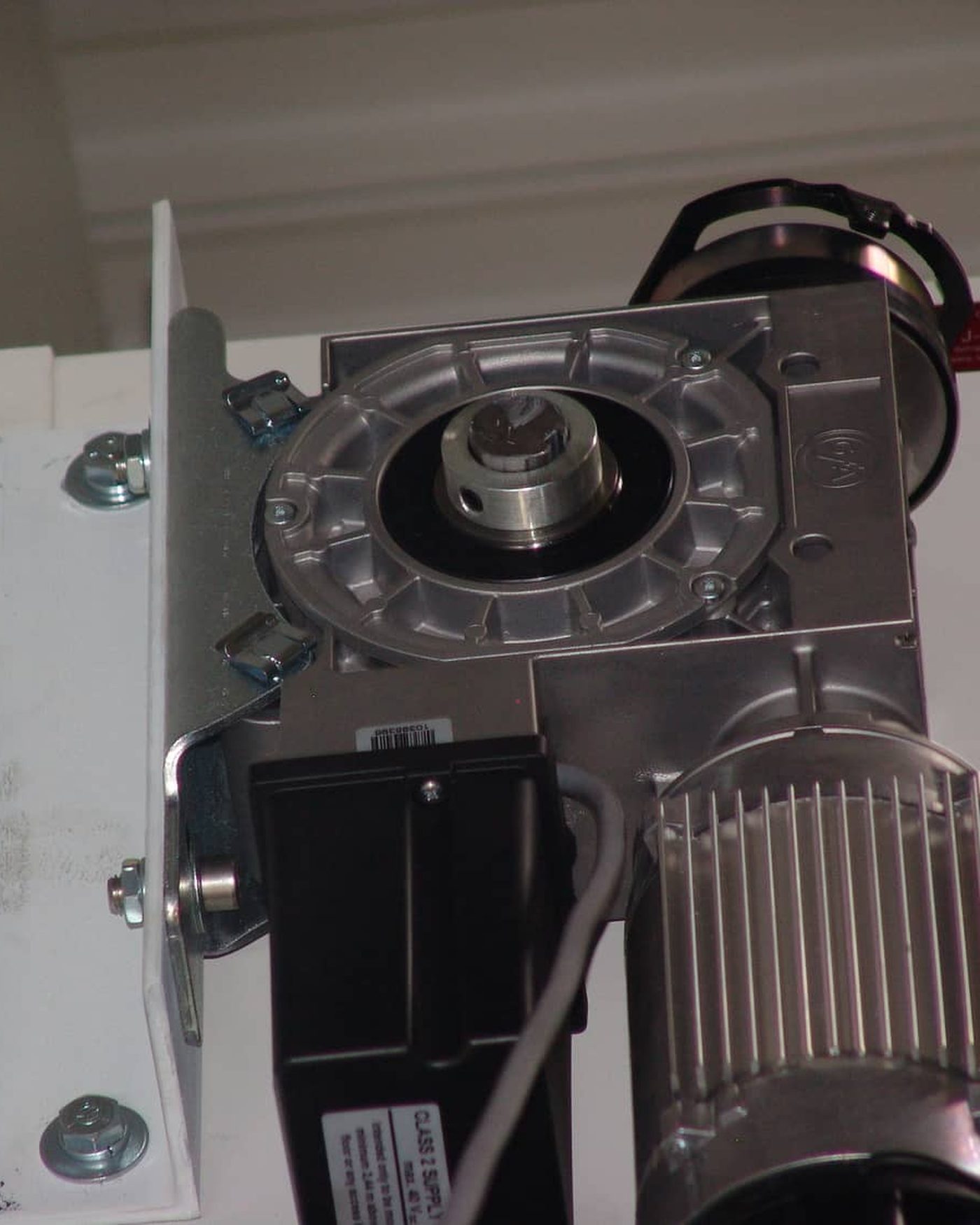
An operator is the motor that runs an overhead door, but the purchase is really three things: the motor, the controls that tell it what to do, and the safety devices that make it legal to stand underneath. Getting the first right and the third wrong is the common failure, and it is the one with consequences beyond downtime.
Canuck Door Systems installs, replaces and services commercial operators across the GTA — LiftMaster, Micanan, Manaras and equivalents. We are not a single-brand dealer, so the recommendation follows the opening rather than a supply agreement.
Three types, and the opening usually decides
| Type | Where it mounts | Choose it when | Watch-outs |
|---|---|---|---|
| Trolley | On a rail running back from the opening under the ceiling | There is clear ceiling space behind the door | The rail occupies exactly the space a hoist, crane or high-lift track wants |
| Jackshaft | On the wall beside the door, driving the torsion shaft | Ceiling space is spoken for, or the door is high-lift or vertical-lift | Needs a sound, correctly balanced door and a proper shaft |
| Hoist | On the wall, driving through a chain reduction | Rolling steel and large industrial doors | Slower; usually with a manual chain fallback, which is a feature not a fault |
Duty rating is chosen by cycles per day, not by door size. A small door cycling two hundred times needs a heavier-duty operator than a large door cycling five times, and the small opening is the one people under-specify.
Safety is not an accessory
Photo eyes
An infrared beam across the opening. The door reverses if it is broken. Alignment and cleanliness are most of their maintenance.
Reversing edge
A pressure-sensitive strip on the bottom bar that reverses the door on contact. Essential where the beam cannot see everything.
Control siting
Whoever operates the door has to be able to see it. A button around a corner is a design fault, not a convenience.
Constant pressure
Where full automation is unsafe, the door only moves while the button is held. Simple, and appropriate more often than it is used.
Monitored circuits
Better operators refuse to run automatically if a safety device is disconnected — which is exactly the behaviour you want.
Manual disconnect
Lets the door be moved by hand in a power failure. It is also the reason half of "the operator runs but nothing moves" calls exist.
Interlocks
With ventilation, plant controls, alarms or a dock restraint, so the door and the process cannot disagree dangerously.
Testing
On every service visit. Never bypassed — including when the reason offered is that a device keeps stopping production.
Activation: how the door knows to open
- Push-button stations — open, close and stop. The default, and the right answer more often than people expect.
- Pull cords — simple, inexpensive, and workable where a driver cannot reach a button.
- Floor loops — a vehicle in the loop opens or holds the door. Standard on parking entrances.
- Radio remotes — for fleet vehicles; keep the fob population managed or it becomes a security question.
- Motion and presence sensors — hands-free, and worth their cost on high-traffic openings.
- Card and fob access — where the door is also the building's security boundary.
- Plant integration — the door as part of a process rather than a standalone machine.
How long it takes
- Like-for-like replacement — usually a few hours on existing mounting and wiring; the opening reopens the same day.
- New activation or loops — longer, especially where the floor has to be cut.
- New electrical supply — occasionally the largest line on the quote, and the one to confirm early.
- Ordered units — larger and three-phase operators can carry a lead time; we will leave the door manually usable where possible.
The thing that kills operators early
An operator moves a door that its springs are supposed to be holding in balance. When the springs weaken, the motor quietly starts doing their job — and it will, right up until it fails, usually months later and apparently without cause.
That is why we check door balance before quoting a replacement operator. Fitting a new motor to an unbalanced door replaces the symptom and keeps the disease. See overhead door springs & parts.
Overhead door work across the GTA
Documented overhead and rolling door jobs from our own project files.
Golden Gate Contracting Inc
Newlink Construction
Formtek Structures Inc
Stallion Construction Inc
Winmarm
Ultra-Form Manufacturing Co Ltd
Four decades of doors for names Ontario knows — Canada’s Wonderland, Tim Hortons, Canadian Tire, the LCBO, Metrolinx, Marriott & Hilton hotels, the University of Toronto — plus thousands of businesses across the GTA. Dependable people, quality products, since 1979.
What our customers say
Called Canuck doors for one of our warehouse doors that was malfunctioning , the technician that came was very knowledgeable and efficient, it took him to time to find the issue and fix it. 5 stars
We have a company. We had the garage door installed by Canuck. From beginning to end they did a great job. We love the doors, the functionality and how great it looks. The price was great as well. Thanks so much Tracey
Hats off to Canuck Doors for finding a quick solution to my dilemma of finding a 16 foot door in under 16 weeks for my new garage build. …
Read the full review
Operator work across Toronto & the GTA
We install, replace and service commercial door operators throughout the core GTA and along the Southern Ontario belt, from our shop in Mississauga. An operator failure usually stops an opening entirely, so it is a 24/7 call.
Core GTA
- Toronto
- Mississauga
- Brampton
- Vaughan
- Markham
- Scarborough
- North York
- Etobicoke
- Richmond Hill
- Oakville
- Burlington
- Milton
Southern Ontario belt
Buildings with many powered doors are worth standardising on one operator type and one control scheme — it makes spares, training and fault-finding dramatically simpler across a portfolio. See all service areas
What a commercial door operator costs
Operators span a wide range, and the type is usually dictated by the opening rather than chosen. What moves the number:
- Operator type — trolley, jackshaft, or hoist
- Door size and weight, and how well the door is balanced
- Duty cycle — light, medium, heavy or continuous
- Control scheme — open/close/stop, constant pressure, or fully automatic
- Activation — push button, pull cord, loops, radio, motion sensors, card access
- Safety package — photo eyes, reversing edges, and monitored circuits
- Electrical supply available at the door, including single or three phase
- Interlocks with alarms, ventilation, plant controls or a vehicle restraint
- Whether an existing operator's mounting and wiring can be reused
An operator is sized against the door it moves. Fitting one to a door that is out of balance means the motor is doing the springs' job, which is how operators die young — we check balance before quoting a replacement, not after fitting one.
Common questions
What is the difference between a residential and a commercial garage door opener?
Duty cycle, controls and safety. A residential opener is designed for a few cycles a day and will overheat and fail quickly on a commercial opening. A commercial operator is rated by duty — light through continuous — and is built for the number of cycles the door actually does. The control scheme is different too: commercial operators use open/close/stop stations, constant pressure or automatic activation rather than a single button, and they are installed with entrapment protection appropriate to a workplace.
How much does a commercial door operator cost?
It depends most on type and duty rating, then on the control and safety package. A light-duty jackshaft on a small door and a continuous-duty operator with automatic activation, loops and monitored safety devices are not the same purchase. Two things are worth knowing: an operator fitted to an unbalanced door will fail early whatever you pay, and the electrical supply at the opening sometimes costs more than the operator itself if three-phase power has to be brought to it.
What is a jackshaft operator, and when do we need one?
A jackshaft operator mounts on the wall beside the door and drives the torsion shaft directly, instead of pulling the door along a ceiling-mounted rail. You need one when there is no room for a trolley rail — a low ceiling, a crane, a vehicle hoist, ductwork, or high-lift track already occupying the space. They are also the usual choice on high-lift and vertical-lift doors, and they leave the ceiling clear, which plenty of facilities managers value on its own.
How many amps does a commercial garage door opener use?
There is no single figure — it depends on the motor size, the voltage and whether the supply is single or three phase, and the correct number for your door comes off the operator's data plate rather than off a web page. What is worth planning for is that commercial operators frequently need more than a standard convenience circuit, and larger ones are often three phase. Confirm what is available at the opening early: bringing power to a door is occasionally the largest line on the quote.
What is the best heavy-duty operator?
There is no single best one, and we would be suspicious of anyone who names a model without asking about the door. The right operator follows from the door's weight and balance, the cycles per day, the room available for mounting, the power at the opening, and how the door has to be activated. We install LiftMaster, Micanan, Manaras and equivalents, and the recommendation follows the opening rather than a supply agreement — which is the point of not being a single-brand dealer.
Do powered doors legally need safety devices?
A powered door in a workplace has to be safe to be under, and that means entrapment protection: photo eyes across the opening, a reversing edge on the bottom bar, or both, with controls sited so whoever operates the door can see it. Ontario's Occupational Health and Safety Act requires equipment to be maintained and capable of its job, and a powered door with defeated safety devices meets neither test. We test them on every visit, and we will not leave a door in service with them bypassed — including when the reason given is that they keep stopping production.
Our operator runs but the door does not move. What is wrong?
Usually the connection between the two rather than either one. On a trolley operator the most common cause is that the manual disconnect has been pulled and never re-engaged. Otherwise: a broken chain or coupling, a sheared drive key, or a failed gearbox. On a jackshaft, check whether the door is being held by a broken spring — the operator will happily run against a door it cannot lift, and doing so repeatedly is how you turn a spring failure into an operator failure as well.
Can an operator be added to a manual door?
Frequently, yes, and it is a common upgrade on openings that have got busier than they used to be. What has to be checked first is that the door is sound and correctly balanced, that its springs are rated for the cycle count you are about to give it, and that there is somewhere to mount the operator and power to run it. Automating a tired door is a good way to destroy it faster; we will say so if that is what we find.
How long does an operator replacement take?
A like-for-like replacement onto existing mounting and wiring is usually a few hours, and the opening is back in service the same day. New activation devices, loops in the floor, or a new electrical supply extend that. Where an operator has to be ordered — larger or three-phase units in particular — allow a lead time, and we will make the opening usable manually in the meantime where the door allows it.
Operator failed, or door still being lifted by hand?
Tell us the door type and size, what power is available at the opening, and how often it runs. If the operator has stopped and the opening is out of use, call — that is a 24/7 dispatch.