
Commercial & Industrial
Roll-Up Doors
A curtain of slats that coils into a barrel above the opening — the door for openings with no headroom to give. Commercial and industrial roll-up doors supplied, installed and repaired across Toronto and the GTA since 1979.
Request QuoteCall 800-522-6825
Commercial and industrial only · all makes serviced · 24/7 emergency call-out
At a glance
| Construction | Interlocking steel slats coiling onto a barrel above the opening |
|---|---|
| Headroom needed | Much less than a sectional — the barrel, not a horizontal track |
| Insulation | Available as insulated slat; standard curtains are uninsulated |
| Operation | Push-up, chain hoist, or powered operator |
| Lead time | 2–4 weeks manufacture, 1–2 weeks to schedule installation |
| Service | All makes — curtains, guides, barrels, springs and operators |
A roll-up door solves one problem better than anything else: an opening with nothing above it. Instead of a horizontal track running back under the ceiling, the curtain coils into a barrel directly over the opening, so a door can go where a sectional physically cannot — under a mezzanine, beneath ductwork, in a wall with a low lintel, or in a multi-unit building where every inch of height is already spoken for.
They are also simple and inexpensive, which is why they dominate self-storage, service buildings, industrial condominium units and back-of-house openings. The trade-offs are real and worth knowing before you specify one, and they are set out honestly below.
Roll-up, rolling steel, or sectional
| Roll-up | Rolling steel | Sectional | |
|---|---|---|---|
| Headroom needed | Little — just the barrel | Little — just the barrel | Substantial, for the horizontal track |
| Typical duty | Light to moderate | Heavy commercial and industrial | Light to heavy |
| Insulation | Available, limited | Available, limited | Best — sandwich panel |
| Security | Good | Best | Moderate |
| Impact damage | A struck slat stays dented and can stop the curtain coiling | As roll-up, but heavier gauge resists more | One section replaces; the rest of the door is unaffected |
| Vision panels & pass doors | Difficult | Difficult | Straightforward |
| Cost per opening | Lowest | Middle | Highest |
The measurement people forget on a roll-up is side room. The guides need space either side of the opening and the barrel needs bearing plates. Less than a sectional needs overhead, but not nothing — and on a tight industrial-condo opening it is occasionally the constraint that decides the door.
Where roll-up doors belong
Industrial condo units
Multi-unit buildings where every unit has one opening and headroom was never generous. Quoted per door across the site.
Self-storage
Volume installations of identical small doors, specified for economy and easy parts availability years later.
Restaurant & retail service
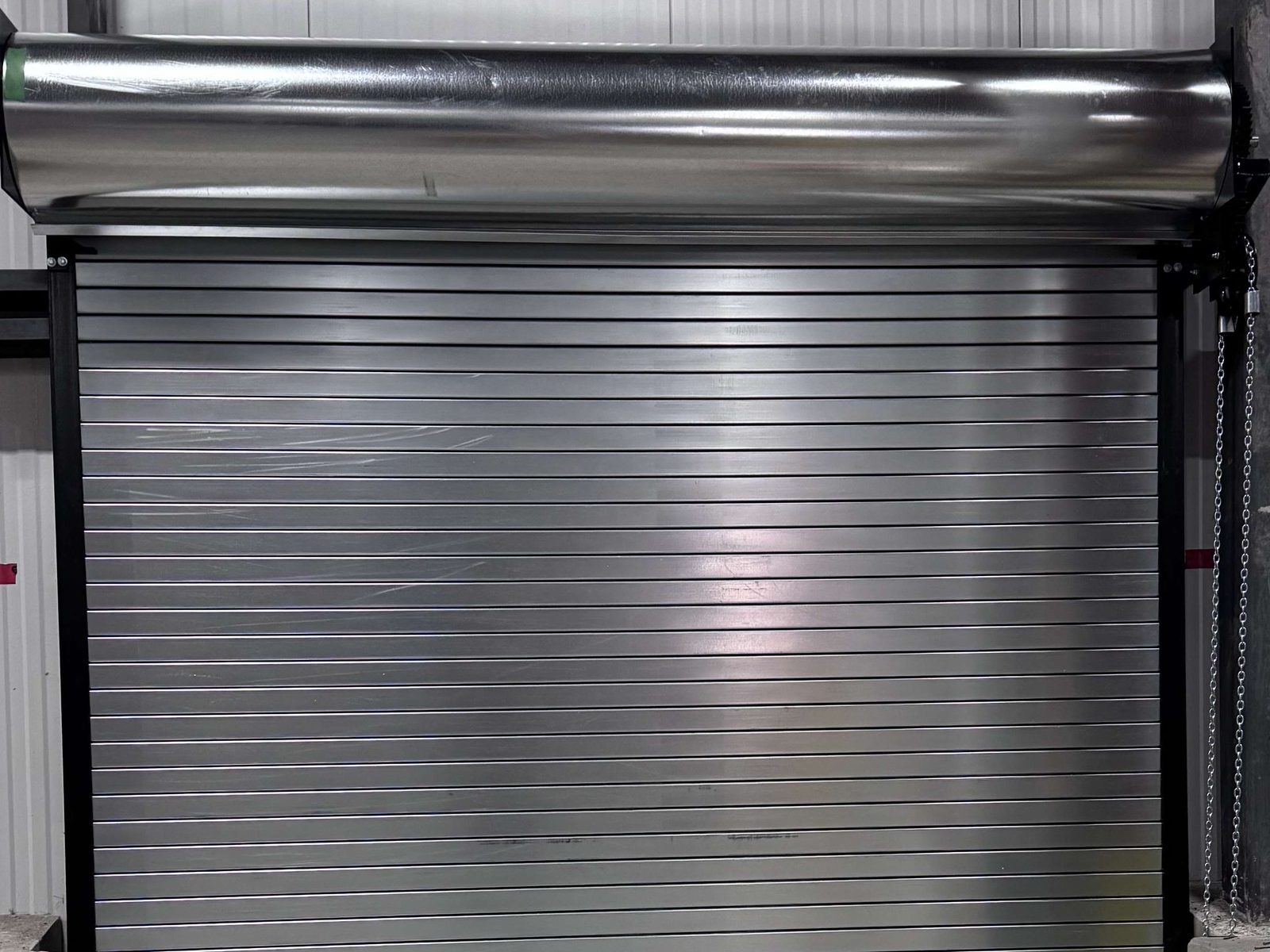
A small opening in a back wall for deliveries and waste — the case in the photo at the top of this page.
Warehouse interiors
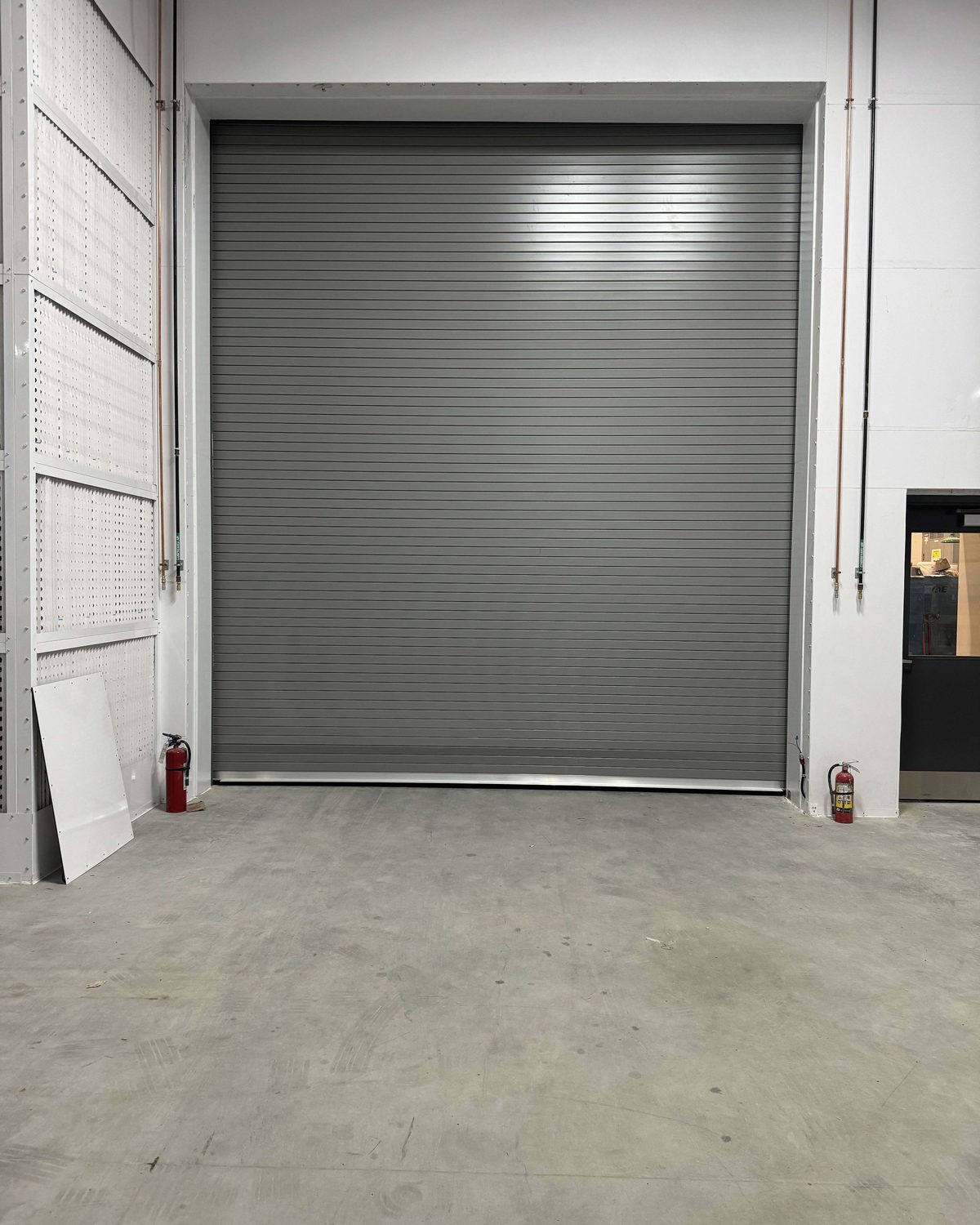
Separating zones inside a building, where there is structure above the opening and no room for track.
Under mezzanines
Openings with a floor directly overhead, which rules out a sectional's horizontal track entirely.
Yards & covered storage
Unheated buildings where an uninsulated curtain is genuinely the right specification, not a compromise.
Utility & mechanical
Pump houses, transformer rooms and equipment enclosures needing a secure, simple, low-maintenance closure.
Municipal & institutional
Works yards, garages and depots, where durability and simple parts matter more than appearance.
How long it takes
- Measure — opening size, headroom, side room, and the condition of the jambs and lintel.
- Manufacture — 2–4 weeks; the curtain is cut to your opening.
- Install — 1–2 weeks to schedule, then usually under a day per opening.
- Repairs — guides, bottom bars and door hardware are carried, so most faults are fixed on the visit. A failed operator is replaced rather than rebuilt. Springs are wound to the door and take 1–2 days, so those are two visits.
What goes wrong, and what it costs to put right
Roll-up doors fail in a small number of predictable ways, and catching them early is the difference between a service call and a new curtain:
- Barrel spring loses tension — the door gets heavy, stalls part-way, and starts wearing the operator. Re-tensioning or replacement.
- A slat is struck — dents stay, and a bad one stops the curtain entering the guides. Individual slats can often be replaced.
- Guides bent or fouled — impact, ice or debris. Straightening or replacement, and it is inexpensive early.
- Bottom bar damage — usually from something driving into it; often bent rather than broken.
- Operator limits drift — the door stops short or runs on. An adjustment, not a repair.
Never force a jammed curtain. Each attempt deforms more slats, and a door that needed three replacement slats becomes a door that needs a new curtain.
Repairs across all makes, including obsolete profiles, are on overhead door repair (24/7).
Overhead door work across the GTA
Documented overhead and rolling door jobs from our own project files.
Golden Gate Contracting Inc
Newlink Construction
Formtek Structures Inc
Stallion Construction Inc
Winmarm
Ultra-Form Manufacturing Co Ltd
Four decades of doors for names Ontario knows — Canada’s Wonderland, Tim Hortons, Canadian Tire, the LCBO, Metrolinx, Marriott & Hilton hotels, the University of Toronto — plus thousands of businesses across the GTA. Dependable people, quality products, since 1979.
What our customers say
Called Canuck doors for one of our warehouse doors that was malfunctioning , the technician that came was very knowledgeable and efficient, it took him to time to find the issue and fix it. 5 stars
We have a company. We had the garage door installed by Canuck. From beginning to end they did a great job. We love the doors, the functionality and how great it looks. The price was great as well. Thanks so much Tracey
Hats off to Canuck Doors for finding a quick solution to my dilemma of finding a 16 foot door in under 16 weeks for my new garage build. …
Read the full review
Roll-up doors across Toronto & the GTA
We supply, install and service roll-up doors throughout the core GTA and out along the Southern Ontario industrial belt, from our shop in Mississauga. Openings come out of service one at a time, scheduled around your shifts.
Core GTA
- Toronto
- Mississauga
- Brampton
- Vaughan
- Markham
- Scarborough
- North York
- Etobicoke
- Richmond Hill
- Oakville
- Burlington
- Milton
Southern Ontario belt
Multi-unit industrial condos and self-storage sites often have dozens of identical openings. Those are quoted per door across the site rather than one at a time, which materially changes the number. See all service areas
What a roll-up door costs
Roll-up doors are among the least expensive overhead doors per opening, which is much of their appeal. What moves the number:
- Opening size, and how much side room the barrel and guides need
- Slat gauge and profile, and whether the curtain is insulated
- Manual push-up, chain hoist, or a powered operator
- Wind load and exposure, which the Ontario Building Code drives on exterior openings
- Finish — mill galvanized, or a factory colour
- Locking, and whether the door has to resist attack as well as weather
- Number of openings, since crew time dominates on a single door
- Whether the existing jambs, header and lintel are sound
Side room is the measurement people forget. A roll-up door needs room beside the opening for its guides, and above it for the coiled barrel — less headroom than a sectional, but not none. We measure all three before quoting.
Common questions
What is the point of a roll-up door?
Headroom. A sectional door needs a horizontal track running back under the ceiling, and plenty of buildings simply do not have that space — a low lintel, a mezzanine, ductwork, or structure right above the opening. A roll-up door coils its curtain into a barrel directly above the opening instead, so it needs a fraction of the room. It is also simple, tough and inexpensive, which is why it dominates storage, service buildings and multi-unit industrial.
What is the difference between a roll-up door and a rolling steel door?
They work identically; the difference is duty. "Roll-up" generally means the lighter end — thinner slats, smaller openings, service buildings, storage units. "Rolling steel" means the heavier commercial and industrial end: thicker interlocking slats, larger spans, higher wind loads, security duty, and the fire-rated versions that drop on alarm. The vocabulary is used loosely across the trade, so what matters in an enquiry is the opening size, the exposure and what the door has to resist.
What are the disadvantages of roll-up doors?
Three worth knowing before you specify one. Insulation is limited — an insulated slat exists but does not match a sandwich-panel sectional, so on a heated building the sectional is usually the better envelope. The curtain shows damage: a struck slat dents and stays dented, and because slats interlock, a bad dent can stop the door coiling. And a full-height curtain is harder to fit with a pass door or vision panels than a sectional. Against that, they need almost no headroom and cost less, which is why they are everywhere.
How much does a commercial roll-up door cost?
The range depends most on opening size, slat gauge, insulation, wind rating and whether it is powered. A small uninsulated push-up door in a shop wall and a large wind-rated insulated door with an operator are different orders of number, so a "from" price would mislead more than it helped. What we can say is that per opening these are usually the least expensive overhead door, and that ordering several for one site changes the per-door price considerably.
Can a roll-up door be insulated?
Yes, with an insulated slat — a foam-filled slat with an inner and outer skin. It is a genuine improvement over a single-skin curtain and worth specifying on a heated building. Be realistic about it, though: an insulated roll-up does not match an insulated sectional for thermal performance, because the slat is thinner and there are more joints. If the envelope is the priority and you have the headroom, a sectional is the better answer.
Our roll-up door has jammed part-way. What is wrong?
Usually one of four things. A slat has been struck and deformed, so the curtain will not pass into the guides. The guides themselves are bent or packed with debris and ice. The spring inside the barrel has lost tension, so the door is too heavy to lift and stalls. Or, on a powered door, the operator's limits have drifted or the chain has jumped. Do not force a jammed curtain — it distorts more slats and turns an inexpensive repair into a new door.
Can individual slats be replaced?
Often, yes, and it is far less expensive than a new curtain. A small number of damaged slats can usually be swapped out, provided the profile is still available and the rest of the curtain is sound. Where it stops being sensible is when many slats are deformed, when the curtain has been bent across its width, or when an obsolete profile cannot be matched. We will tell you which of those you have before quoting.
How long does a roll-up door take to install?
Manufacture is the long part: plan on 2–4 weeks once the opening is measured, then 1–2 weeks to schedule the crew — roughly 3–6 weeks in total, since the door is made to your opening. The installation itself is normally under a day per opening, and openings are done one at a time so the building keeps operating.
Do you service roll-up doors you did not install?
Yes, and it is most of what we do on these. Springs, barrels, guides, bottom bars, slats and locks are all serviceable, and an operator of any make can be replaced, regardless of make, including on doors whose manufacturer no longer exists. On very old doors we will say plainly when parts are costing more than a replacement would.
Roll-up door stuck, jammed or damaged?
Send us the opening size, the headroom and the side room and we’ll quote the right door. If one is stuck open and the building will not secure, call — that is a 24/7 dispatch.