
Commercial & Industrial
Rolling Security Grilles
Aluminum grilles that coil above the opening and let you see straight through them — the closure shopping malls ask for, drawn across a glazed shopfront when the unit shuts. Supplied, installed and serviced across Toronto and the GTA since 1979.
Request QuoteCall 800-522-6825
Aluminum link and rod patterns · made to the opening · we service other makes
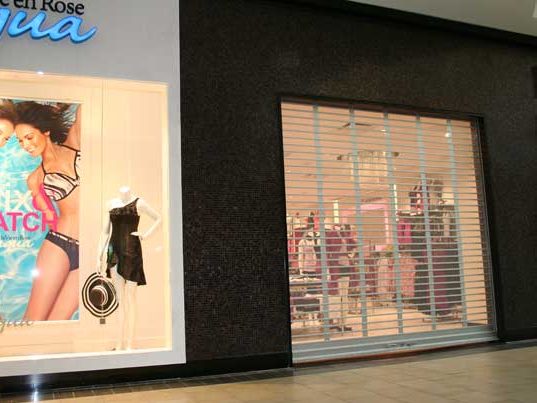
A rolling security grille closes an opening without hiding what is behind it. Aluminum links or rods run in a guide each side and coil onto a barrel above the head, exactly as a slat shutter does — but with gaps between them, so the shop floor stays visible when the unit is shut.
That is why this is the shopping-mall product. Along a concourse, a closed unit still has to be lit, still has to advertise, and still has to be visible to the centre's own patrols and cameras. A slat shutter would blank all three. Canuck Door Systems fits grilles across GTA centres and glazed shopfronts, and services them on every make.
Four decades of doors and closures for names Ontario knows — Canada’s Wonderland, Tim Hortons, Canadian Tire, the LCBO, Metrolinx, Marriott & Hilton hotels, the University of Toronto — plus thousands of businesses across the GTA. Dependable people, quality products, since 1979.
Rolling grille, folding grille, or a slat shutter
| Rolling grille | Folding grille | Slat shutter | |
|---|---|---|---|
| How it opens | Coils onto a barrel above the head | Stacks sideways against a jamb | Coils onto a barrel |
| Headroom needed | Yes, for the barrel | None | Yes |
| Stacking room at the sides | None | Yes, at one or both jambs | None |
| See through it | Yes | Yes | No |
| Where it usually goes | Inside malls, over glazed shopfronts | Inside malls, where headroom is gone | Outside, over the entrance |
| Weather barrier | None | None | Yes |
| When it is open | Invisible — the whole curtain is in the coil | A visible stack at the jamb | Invisible |
Both grilles do the same job and the opening picks between them. Headroom above the head means a rolling grille and a cleaner look when open; no headroom means a folding one. The pattern, the finish and the security are the same either way.
Pattern, material and drive
| Curtain | Aluminum links or rods on horizontal tubes. Brick pattern, straight vertical, or tighter lattice |
|---|---|
| Spacing | Sets how much can be reached through — the one specification decision with a security consequence |
| Material | Aluminum as standard: light enough to coil a wide span and motorize it, and it will not corrode |
| Finish | Mill, anodized, or powder-coated to the centre's or the brand's specified colour |
| Guides | Surface-mounted, recessed into the jamb, or built into the shopfront framing at fit-out |
| Barrel | Above the head, usually in a pocket formed during the fit-out |
| Drive | Manual chain or crank on narrow openings; tube motor with key switch on mall spans |
| Infill | Solid or polycarbonate panels can be mixed into a run where one bay must be blanked |
| Locking | Bottom-bar cylinder or floor bolts, keyed to the tenant's or the centre's system |
Systems we supply: MobilFlex rolling grilles and closures, and equivalents. Where a centre's fit-out manual names a product or a finish, we build to that; where it does not, we specify to the opening.
What "security" actually buys you
A grille is called a security grille, and it is worth being straight about what that means. It does not make a unit burglar-proof. Anything with gaps in it can be reached through, and a determined attack with the right tools gets past any closure eventually.
Inside a shopping centre, that matters less than it sounds — because the grille is not doing the job alone. A mall unit already sits inside a building with 24-hour surveillance and staffed patrols, in a space nobody can reach outside opening hours without passing something that records them. What the grille adds is a visible physical barrier and a clear line: the unit is shut, the stock is not casually reachable, and anyone working on it is doing something obvious in a monitored space.
That is a genuine and useful layer. It is not a safe, and it is not an alarm.
A rolling grille supplements a shopping centre's own surveillance rather than replacing it. On any opening that faces outside rather than a monitored concourse, it should be specified alongside 24-hour cameras and a monitored alarm, and never as a business's only security measure.
Where rolling grilles go
Shopping mall units
The core use: a glazed shopfront closed to the concourse while the display stays lit and visible.
Food courts & kiosks
Counters and open-fronted units shut between services, where a solid curtain would be wrong.
Airports & transit retail
Concessions closed between flights or runs, in buildings that never really shut.
Pharmacies & clinics
Dispensaries and treatment areas closed off inside a building that stays open around them.
Hotels & conference centres
Gift shops, bars and business centres secured overnight without blanking off the lobby.
Hospitals & universities
Cafés, bookshops and equipment stores in circulation space that has to stay visible.
Parking garages & storage
Lobby, stair and cage access where a see-through barrier is safer than a solid one.
Warehouses & tool cribs
Parts counters and secure storage inside a building, closed off from the floor.
How a grille job runs
- Read the fit-out manual first, if the unit is in a centre. Closure type, pattern and finish are often already specified, and quoting against the wrong one wastes everybody's time.
- Measure the opening — width, height, and the head detail, because the barrel and its pocket are what decide whether a rolling grille fits at all.
- Coordinate with the fit-out. The pocket and the structure above the head go in before the ceiling closes; retrofitting is where the cost is.
- Manufacture — 4–6 weeks once measured and the finish is approved.
- Install — 1–2 weeks to schedule, usually a day per opening, after concourse hours.
- Service — guides cleaned, curtain and links checked, bottom bar and lock adjusted, motor limits reset. Annually on a unit cycled every trading day.
Service and repair
Grilles fail in a short and predictable list, and nearly all of it is put right in place:
- Forced while locked — the commonest fault by a distance. Links bend, the bottom bar distorts, the curtain jumps its guide.
- Grit in the guides — a grille that suddenly needs two hands is usually telling you the guide needs cleaning, not that it is failing.
- Worn carriers and tube bearings, which is normal wear on an opening cycled every trading day.
- Motor limits drifting, so the curtain stops short or runs on into the floor.
We service grilles whoever installed them, links can be matched into an existing curtain, and where a curtain is genuinely finished the guides and barrel can usually be reused.
Grille work across the GTA
Documented security grille jobs from our own project files — real clients, real shopfronts.
Silver Bridge Vapes
Formtek Structures Inc
22 Ontario Inc
Wellesley Home Centre
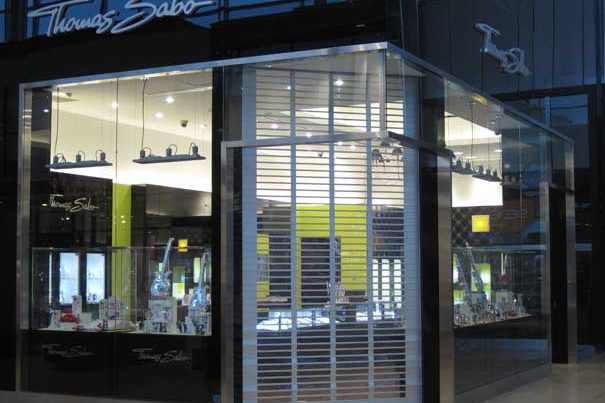
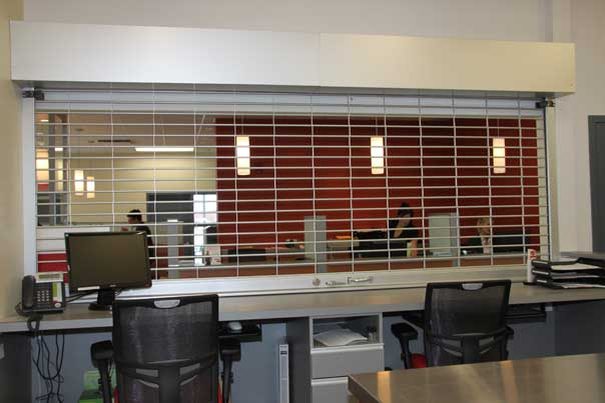
What our customers say
I called Canuck Door systems regarding my security gate at our retail store, I cannot recommend them enough. Quick turn around, extremely fair pricing compared to competitors. Fixed the problem, called to make sure it was done to my expectations. This is the company to use.
Called Canuck doors for one of our warehouse doors that was malfunctioning , the technician that came was very knowledgeable and efficient, it took him to time to find the issue and fix it. 5 stars
canuck door systems has provided our company with spectacular service and we have enjoyed working with them. a really good team, honest and reliable. mike hussein was our rep and he is a gentleman and honourable man and great person to work with
Rolling grille work across Toronto & the GTA
We install and service rolling grilles right across the core GTA and out into the Southern Ontario belt, from our shop in Mississauga. Mall work is done to the centre's own rules — after concourse hours, with the landlord's specified finish, and usually inside a fit-out programme.
Core GTA
- Toronto
- Mississauga
- Brampton
- Vaughan
- Markham
- Scarborough
- North York
- Etobicoke
- Richmond Hill
- Oakville
- Burlington
- Milton
Southern Ontario belt
Malls are portfolio work. A retailer opening four units in four centres wants one specification, one finish and one key across all of them, and the centres each have their own view on what may be fitted — sorting that once is most of what we do on this product. See all service areas
What a rolling grille costs
A grille is priced by the span, the pattern and where the coil goes. Every one is made to the measured opening. What moves the number:
- Opening width and height, and the headroom available above it for the barrel
- Pattern and spacing — brick, straight rod, or a tighter lattice
- Aluminum against steel, and the finish the centre or the brand specifies
- Manual chain or crank against a tube motor, on a wide mall opening
- Whether the run is straight, or turns a corner around a display bay
- Guides — surface-mounted, recessed into the jamb, or built into the shopfront framing
- Locking, and whether it keys into the centre's system or the tenant's own
- Fit-out coordination, since the grille pocket is built before the ceiling closes
- Site access and after-hours working, which most centres require
The least expensive time to fit a grille is while the unit is being built, because the pocket and the structure above the head can be designed in. Retrofitting one into a finished shopfront is where the cost goes, and occasionally where the answer turns out to be a folding grille instead.
Common questions
What is a rolling security grille?
A closure built from aluminum links or rods with deliberate gaps between them, running in a guide each side of the opening and coiling onto a barrel above it. Mechanically it works exactly like a slat shutter; the difference is that you can see straight through it. That is the whole point — the unit is secured and the display behind it stays lit and visible, which is what a shopping centre wants along its concourse after hours.
Why do shopping malls specify grilles rather than shutters?
Because a mall concourse lined with blank metal curtains looks derelict, and because the centre's own security depends on being able to see into every unit. A grille keeps the sightline: the centre's staff and cameras can see the shop floor on a night patrol, and the display keeps working as advertising to anyone walking past. Most centres write the closure type, the pattern and sometimes the finish into the tenant fit-out manual, so the choice is often made before you are involved.
What is the difference between a rolling grille and a folding grille?
Only how it gets out of the way. A rolling grille coils onto a barrel above the opening, so it needs headroom and leaves the jambs clear. A folding grille stacks sideways against a jamb, so it needs no headroom but does need wall to park against. Both are see-through, both suit mall units, and the opening usually decides: if there is room above the head, the rolling version is tidier and disappears completely when open.
What patterns are available, and does it matter?
Brick pattern, straight vertical rod and tighter lattice are the common three, and the difference is how much can be reached through. A wide brick pattern is the most open and the most common on mall units, because visibility is the reason it was chosen. Tighter spacing reduces what an arm can reach and suits a jewellery or electronics unit. Solid or polycarbonate infill panels can be mixed into a run where one bay needs to be blanked.
Can a rolling grille be fitted across an exit?
Only with care, and sometimes not at all. Any opening on an exit route has to be openable from inside without a key, a tool or special knowledge, and a locked grille across it defeats that. In practice grilles close units that are empty, with the egress handled by a separate door with the hardware the code requires. We work that out at the survey, not after the grille is made.
Should it be motorized?
On a mall unit, usually yes. These openings are wide, they are cycled every trading day, and they are operated by whichever member of staff is closing up — the three conditions that between them account for nearly all the damage we repair on manual units. A tube motor with a key switch, plus a manual override for a power failure, removes the technique from the job. A narrow single-door grille cycled once a day is fine on a chain hoist.
How long does it take to supply and install?
Typically 4–6 weeks to produce once the opening is measured and the pattern and finish are confirmed, then 1–2 weeks to schedule and install — around 5–8 weeks in total, depending on the size of the project. Installation itself is usually a day per opening. In a mall it is done after concourse hours, and where the unit is still being fitted out, the grille pocket has to be coordinated before the ceiling closes.
Do you install MobilFlex grilles and closures?
Yes. MobilFlex build most of the see-through closures on mall units, bank lobbies and school serveries — rolling ones such as Roll-Flex and Roll-Vision, and side-folding ones such as the tempered-glass Royal and the open S-126 grille. We supply, install and repair them, including existing MobilFlex closures somebody else fitted.
Can you repair a grille another company installed?
Yes, and most of the ones we look after came from somebody else. The failures are predictable: the grille forced while still locked, a guide full of grit so it will not coil evenly, worn carriers, a bent bottom bar, a failed motor limit. All of it is replaceable, and links can be matched into an existing curtain rather than replacing the whole thing. Where a curtain is genuinely finished, the guides and barrel can often be reused.
Mall unit to close, or a grille that has stopped coiling?
Send the opening width and height, a photo of the head detail, and the centre's specification if you have been given one. That is enough to say whether a rolling grille fits the opening — and to quote it.