
Commercial & Industrial
Folding Security Grilles & Gates
Closures that stack sideways instead of coiling — the answer when there is no headroom for a barrel. Aluminum folding grilles for mall units, and hollow-tube folding gates behind street-facing windows and doors. Fitted across Toronto and the GTA since 1979.
Request QuoteCall 800-522-6825
No headroom required · made to the opening · 24/7 emergency service
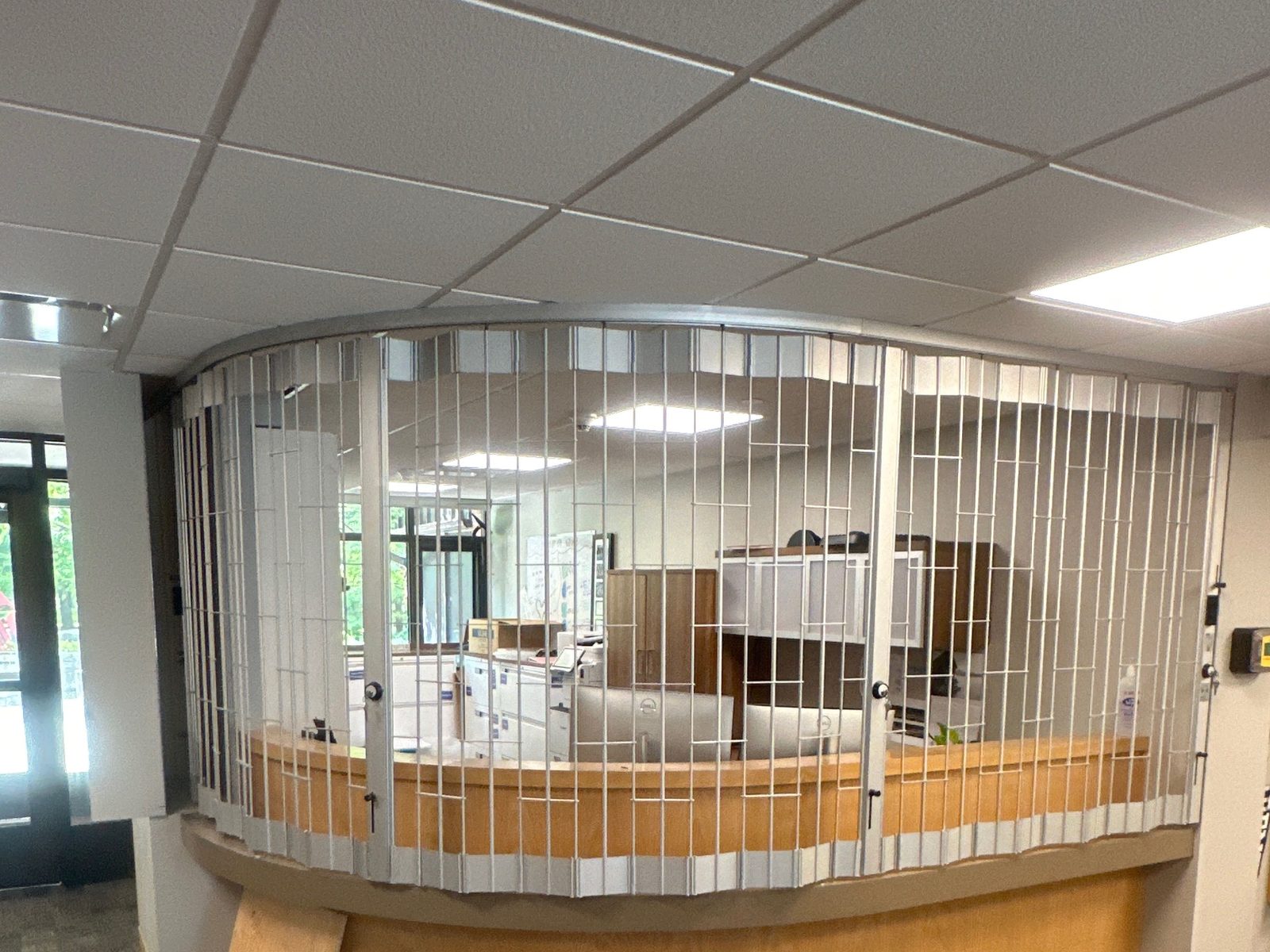
A folding closure gets out of the way sideways. The leaves are hinged or pinned together so the whole thing concertinas against a jamb, and nothing goes above the head — which is the entire reason the product exists. Where a fit-out has already filled the space above an opening with ductwork or a bulkhead, a folding grille is not a compromise on a rolling grille; it is the only one of the two that fits.
There are two of them, and they are not interchangeable. Folding security grilles are aluminum, and they go inside shopping malls across glazed shopfronts. Folding security gates are hollow metal tube, and they go behind windows and doors on storefronts facing the street. Canuck Door Systems fits and services both across the GTA, on every make, including gates forced open the night before.
Four decades of doors and closures for names Ontario knows — Canada’s Wonderland, Tim Hortons, Canadian Tire, the LCBO, Metrolinx, Marriott & Hilton hotels, the University of Toronto — plus thousands of businesses across the GTA. Dependable people, quality products, since 1979.
Folding grille or folding gate
| Folding security grille | Folding security gate | |
|---|---|---|
| Made from | Aluminum, in a lattice or brick pattern | Hollow metal tube, pinned into a scissor lattice |
| Where it goes | Inside shopping malls, across glazed shopfronts | Behind street-facing windows and doors |
| What it faces | A monitored concourse | The street, unwatched, overnight |
| Weight and finish | Lighter, more finished, takes a specified colour | Heavier and plainer — built to be forced against |
| See through it | Yes | Yes |
| Headroom needed | None | None |
| Stacking room | Yes, at one or both jambs | Yes |
| Usual objection | Takes wall space at the side | It looks like what it is |
The constraint that decides between a folding closure and a rolling one is almost never budget — it is what the opening physically offers. Headroom above it, wall to stack against beside it, and whether that wall happens to be glass. We measure all three before recommending anything.
Inside or outside
This is the question we are asked most, and the answer has a default.
- Inside is the default. Out of the weather, out of reach of graffiti and casual damage, invisible from the street during trading hours, and generally free of the landlord, BIA or heritage approvals that an exterior installation attracts. It also protects what is behind the glass, which is what the goods actually need.
- Outside when the glass itself is the thing at risk — a repeatedly smashed display bay, a ground-floor window in a rough spot — or when there is genuinely no interior room to stack.
- Exterior means a different specification, not just a different position: corrosion-resistant finish, tracks that shed water and grit, and a maintenance interval that matches an Ontario winter.
Pattern, material and locking
| Folding grille | Aluminum lattice or brick pattern on a head track. The mall product, and the more finished of the two |
|---|---|
| Folding gate | Hollow metal tube pinned into a scissor lattice. The street-facing product |
| Pattern | Diamond/lattice, straight vertical rods, or a brick pattern. Tighter spacing means less can be reached through |
| Finish | Mill, anodized, or powder-coated — including a landlord's or franchise's specified colour |
| Track | At the head, with a floor guide or floor track on wider spans |
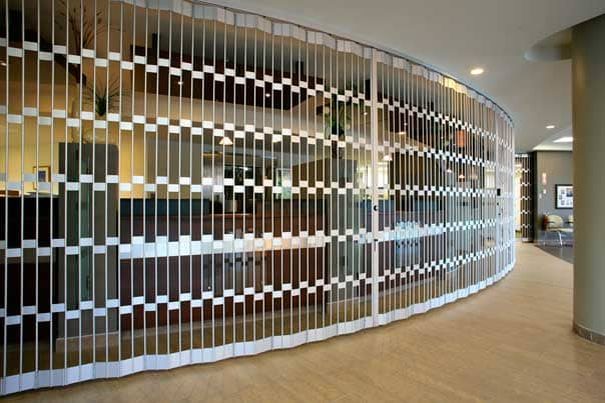
| Stacking | Against one jamb, or split to both. Curved shopfronts are made to a template |
| Locking | Cylinder locks, floor bolts, or padlock provision — keyed alike or into the building's system |
| Egress | Any opening on an exit route constrains what may be fitted and how it may be locked |
| Fixed guards | Fixed bars and grilles: quoted on request, not promoted. See below |
Systems we supply: MobilFlex folding grilles and closures for the mall side, and Emart folding gates for street-facing work. We service both, and other makes with no name on them at all.
About fixed bars and fixed grilles
People ask for these constantly, usually because they are the least expensive thing on the list, and the honest answer is a qualified one.
We will quote a fixed guard on request, and for an opening nobody ever looks through — a mechanical room, a basement light well, a back-of-house window — a properly made one is still the least expensive permanent barrier there is, with nothing to maintain. What we stopped doing is fitting the light imported bars we used to supply: they were flimsy enough that we were not comfortable putting our name on them, and a barrier that bends is worse than none because it sells a feeling of safety that isn't there.
Where a fixed guard is simply the wrong product, we say so rather than take the order:
- Anywhere with a view or a display. A permanent grid across a shopfront is a visual write-off, and a folding grille does the same job and disappears every morning.
- Any opening that might serve as an escape from a room. A fixed bar cannot be opened, and that is the whole objection.
- Anywhere the requirement is really "deter people at night". That is a folding gate or a shutter, and the difference in cost buys a barrier that actually resists being levered.
What "security" actually buys you
Both of these products have "security" in the name, and neither makes a business burglar-proof. Anything with gaps in it can be reached through, and a determined attack with the right tools eventually gets past any closure. What they buy is different depending on which side of the wall the opening faces.
Inside a shopping centre, a folding grille is an added layer on top of protection that already exists. The unit sits in a building with 24-hour surveillance and staffed patrols, in a concourse nobody reaches after hours without passing something that records them. The grille adds a visible physical barrier and a clear line — the unit is shut, the stock is not casually reachable, and anyone working on it is doing something conspicuous in a monitored space.
On a street-facing opening, there is no concourse and nobody watching. What a folding gate buys there is time: it turns a ten-second smash-and-grab into a job that needs tools, makes noise, and takes long enough for a response to arrive. That is genuinely valuable — but it is only valuable if a response is actually coming.
On any opening facing the street, a folding gate is a hurdle that wins time until police arrive — nothing more. It should be specified alongside 24-hour camera surveillance and an alarm monitored by a security company or connected to police, and it should never be a business's only security measure.
Where folding grilles and gates go
Mall & plaza retail units
Closing the unit while the concourse stays lit — usually a landlord-specified grille rather than a solid shutter.
Street-facing shops
Windows and doors on a high street, where the gate sits inside the glass and comes across at closing.
Pharmacies & convenience stores
Doorways and display windows, where staff and passing police both need to see in.
Jewellery & electronics
High-value stock behind glass, where the gate is one layer of a plan that includes alarms and cameras.
Restaurants & bars
Patio bars, walk-up windows and interior servery openings closed between services.
Schools & community centres
Corridors, canteens, equipment stores and computer rooms closed off inside a building that stays open.
Warehouses & industrial
Tool cribs, parts cages, mezzanine access and secure storage inside the building.
Parking garages & storage
Lobby and stair access, storage cages and lockers, where a see-through barrier is safer than a solid one.
The exit-route constraint, plainly
A door on an exit route must be openable from the inside without a key, a tool or special knowledge. A padlocked gate across it is not a code technicality — it is the failure mode that turns a fire into a headline.
In practice that means these belong on non-exit openings, or on openings that are only locked when the building is empty and there is nobody left to evacuate. Where a client needs both security and egress on the same opening, the answer is usually a different arrangement altogether: a grille inside the display window, and an exit door beside it with the hardware the code actually asks for. We work that out at the survey, not after the gate is made.
Service and repair
Folding closures fail in predictable ways, and almost all of it is fixable in place:
- Forced while locked — the single commonest fault. Links bend, carriers jump the track, floor bolts tear. Repairable, and less expensive than the break-in it survived.
- Grit and salt in the track — a gate that suddenly needs two hands is usually telling you the track needs cleaning, not that it is failing.
- Worn carriers and hangers, which is normal wear on a busy retail opening.
- Locks and cylinders — the part most often changed, usually because staff turnover has outrun the keys.
We service grilles and gates whoever installed them, and where one is genuinely finished, the track and structure can usually be reused.
Folding grille and gate work across the GTA
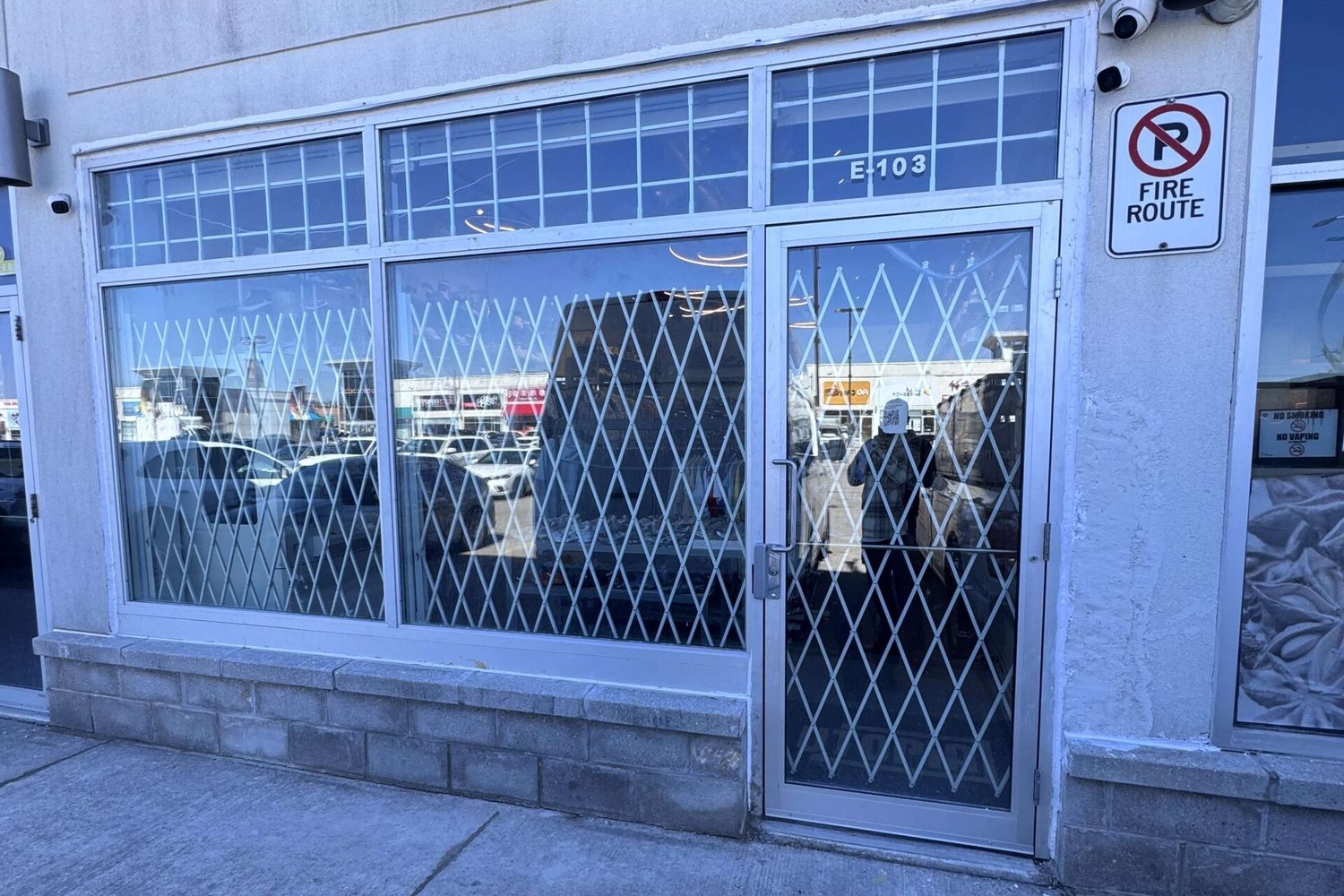
Documented grille and gate jobs from our own project files — real clients, real storefronts.
Silver Bridge Vapes
Formtek Structures Inc
22 Ontario Inc
Wellesley Home Centre
What our customers say
I called Canuck Door systems regarding my security gate at our retail store, I cannot recommend them enough. Quick turn around, extremely fair pricing compared to competitors. Fixed the problem, called to make sure it was done to my expectations. This is the company to use.
The wind blew my commercial glass door open and it broke. Canuck Door systems came fast and board it up. They then replaced the glass door and everything is perfect now.
We have a company. We had the garage door installed by Canuck. From beginning to end they did a great job. We love the doors, the functionality and how great it looks. The price was great as well. Thanks so much Tracey
Folding grille and gate work across Toronto & the GTA
We install and service folding grilles and gates right across the core GTA and out into the Southern Ontario belt, from our shop in Mississauga. Retail work is scheduled around trading hours, which usually means evenings or before opening.
Core GTA
- Toronto
- Mississauga
- Brampton
- Vaughan
- Markham
- Scarborough
- North York
- Etobicoke
- Richmond Hill
- Oakville
- Burlington
- Milton
Southern Ontario belt
Break-ins cluster, and so do our calls. When a plaza or a strip has had one, we are usually quoting three units on the same street within a fortnight — and doing them together is less expensive for everybody than three separate mobilisations. See all service areas
What folding grilles and gates cost
These are priced by the span and by where the leaves park when the opening is clear. What moves the number:
- Opening width and height, and whether one leaf covers it or it needs a pair
- Type — an aluminum folding grille, or a hollow-tube folding gate
- Pattern and spacing, which set both the look and how much can be reached through
- Stacking room, and which jamb the leaves park against — the detail retrofits get wrong
- Interior or exterior mounting, which changes the track, the finish and often the approvals
- Track at the head, and whether the span also needs a floor track or guide
- Locking — cylinder, floor bolts, padlock provision, or keyed into the building's system
- Whether the opening is an exit route, which constrains what may be fitted and how it locks
- Curved, sloped or non-rectangular openings, which are made to a template rather than a size
The question that changes a quote most is where the leaves live when the gate is open. A folding closure stacks against a jamb and needs wall to stack against — if that wall is glass, the design changes before the price does.
Common questions
What is a folding security gate?
A closure that opens by stacking sideways rather than rolling up. The leaves are hinged or pinned together so the whole thing concertinas against one jamb — which is why it is also called a scissor gate, an accordion gate or a side-folding closure. It exists for openings with no headroom: where a rolling shutter or grille would need a barrel above the head and there is nowhere to put one, a folding closure needs none at all.
What is the difference between a folding grille and a folding gate?
What they are made of, and where they belong. A folding grille is built from aluminum in a lattice or brick pattern — lighter, more finished, and the version shopping centres accept across a glazed shopfront. A folding gate is built from hollow metal tube, and it is the heavier, plainer, street-facing product: fitted behind windows and doors on storefronts that face outside, where nobody is judging how it looks at three in the morning. Both stack sideways; the material and the setting decide which one you want.
Should it be fitted on the inside or the outside?
Inside, whenever the opening allows it. An interior closure is out of the weather, out of reach of graffiti and casual damage, does not change how the shopfront looks during trading hours, and rarely needs landlord, BIA or heritage approval for appearance. It also protects what is behind the glass, which is what the stock actually needs. Mount outside when there is genuinely no interior room to stack, or when the glass itself is what keeps being broken rather than the goods behind it.
Do you install fixed window bars and fixed grilles?
We will quote them on request, but we do not promote them and we no longer fit the light imported bars we used to — they were too flimsy to be worth the money once they were on the wall. For an opening nobody looks through, a properly made fixed guard is still the least expensive permanent barrier there is. For anything with a view, a display, or any chance of being used as an escape route from a room, a fixed bar is the wrong product: it cannot be opened. On those openings we steer people to a folding gate or a rolling shutter, which cost more and are worth it.
Can a gate be fitted across an exit door?
Only with care, and sometimes not at all. A door on an exit route has to be openable from inside without a key, a tool or special knowledge, and a padlocked gate across it defeats that — a life-safety issue, not a technicality. In practice these go on non-exit openings, or they are arranged so they are only locked when the building is empty and there is nobody left inside to evacuate. We will tell you which case you are in before quoting rather than after.
How much room do the leaves take when it is open?
More than people expect, and it is the detail retrofits get wrong. A folding closure compresses into a stack against one jamb — narrower than a panel wall, but real, and it grows with the span. On a wide opening the stack can be split to both jambs instead. What it cannot do is park against glass, so on a fully glazed shopfront the stacking position has to be designed rather than assumed. We show it on the drawing before anything is made.
How long does it take to supply and install?
Typically 4–6 weeks to produce once the opening is measured, then 1–2 weeks to schedule and install — around 5–8 weeks in total, depending on the size of the project. Everything here is made to the opening, and curved or sloped spans are made to a template, which adds time at the measuring end rather than in the shop. Installation is usually a day per opening and is normally done outside trading hours.
Do you supply Emart expandable security gates?
Yes. Emart Factory, based on Magnetic Drive in Toronto, supply expandable steel folding gates for storefronts, pharmacies, warehouse doors and house patio doors, and we measure, fit and repair them. They need no box above the opening and no power, which is why they go where a rolling shutter will not fit.
Can you repair a gate that is off its track?
Usually on the visit. The commonest fault by a distance is a gate forced while it is still locked, or a track full of grit that stops it stacking — both put right in place. After that it is worn carriers, damaged links, bent bottom guides and failed locks, all of which are replaceable. Where a gate is genuinely beyond repair we can often reuse the track and structure, which is a fraction of the cost of a new installation.
Storefront to secure, or a gate that will not close?
Send a photo of the opening from inside, with the width and height, and say whether it faces a mall concourse or the street. That is enough to say whether it takes a folding grille, a folding gate or a shutter — and to quote it.