
Commercial & Industrial
Stainless Steel Doors
Type 304 and 316 stainless doors and frames for the openings where a painted steel door does not survive — washdown areas, food and pharmaceutical production, kitchens, labs and cleanrooms. Same hollow metal construction, different metal, and specified for the cleaning regime rather than the traffic.
Request QuoteCall 800-522-6825
304 & 316, #4 brushed or as specified · since 1979 · washdown, food-grade and lab openings
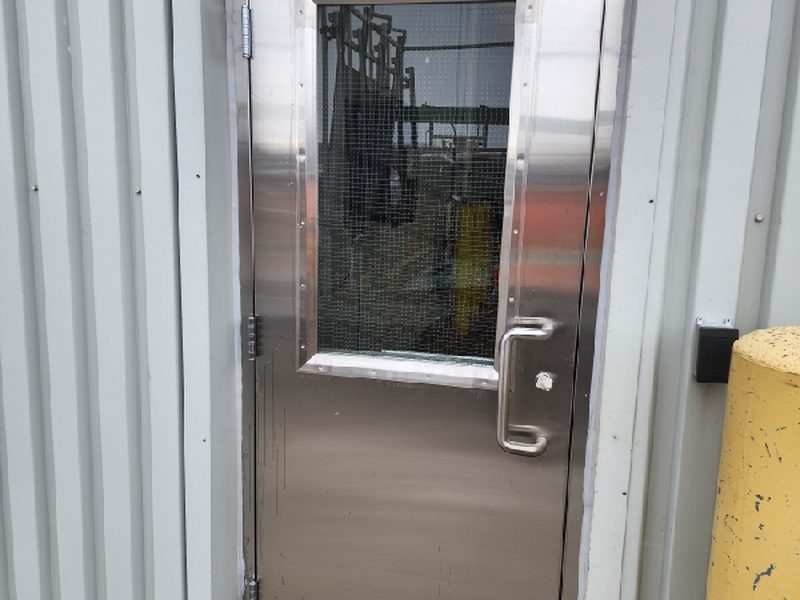
Everything a hollow metal door is good at, stainless does in a room that would eat a painted door. The construction is the same — formed face sheets around a core, hung in a steel frame — but the metal is chosen for what the room is cleaned with rather than for what walks through it.
That distinction decides where this door belongs. In a dry corridor a painted steel door will last decades. In a room washed down with hot water and caustics every night, paint is a consumable: it fails at the edges first, rust starts at the first scratch, and the opening looks tired years before the steel behind it is done. Canuck Door Systems specifies and installs stainless doors and frames across the GTA for exactly those rooms.
Where stainless earns its price
Food & beverage production
Washdown areas where the nightly clean is hot water, caustics and pressure.
Commercial kitchens
Grease, steam and constant cleaning — plus the traffic of a service corridor.
Pharmaceutical & lab space
Rooms where the surface finish and the seams are part of the specification.
Cleanrooms & controlled areas
Flush, sealed assemblies that can be wiped down and will not shed.
Cold rooms & coolers
Condensation and constant humidity, where painted steel corrodes from the edges.
Pool & chemical rooms
Chlorides in the air, which is where grade 316 stops being optional.
Hospital service areas
Sanitation, cleaning chemistry and heavy carts in the same opening.
Loading and exterior openings
Coastal-grade humidity and road salt at grade, on buildings that cannot repaint yearly.
304 or 316 — decided by the chemistry, not the budget
| Type 304 | Type 316 | |
|---|---|---|
| Composition | Chromium-nickel | Chromium-nickel plus molybdenum |
| Resists | General moisture, most cleaning agents, food acids | The above, plus chlorides — bleach, brine, pool chemistry, salt |
| Where it goes | Most kitchens, labs, processing and service areas | Chloride-heavy processes, pool rooms, salt exposure, coastal air |
| Fails when | Chlorides sit on the surface and pit it | Rarely, in the environments a door sees |
| Cost | The stainless baseline | Above 304, and worth it exactly where chlorides live |
The question we ask before quoting is not "what is the room?" but "what is it washed with?". Chloride-based sanitisers in a food plant put a 304 door in the wrong grade, and the pitting shows up in a year.
Sanitary detailing: what makes a door food-grade
Stainless alone does not make an opening cleanable. The details do.
- Welded and ground seams — no crevice at the edge for water or product to sit in.
- Flush faces — no applied trim or fasteners on the wet side to trap soil.
- Sloped or sealed top caps — so the top of the leaf is not a shelf that holds standing water.
- Sealed frame profiles — grouted or sealed to the wall, with no open throat behind the jamb.
- Stainless hardware throughout — including hinges, strikes and kick plates, so nothing plated corrodes onto the door.
- Continuous hinges — fewer joints, and the leaf stays aligned under constant cleaning and heavy traffic.
Stainless, or one of the alternatives?
Stainless is not the only answer to a wet or abusive opening, and it is not always the least expensive one that works.
| Option | Good at | Weak at |
|---|---|---|
| Stainless hollow metal | Washdown, sanitation, corrosion, fire rating available | Cost, and it will show a scratch |
| Painted hollow metal | Cost, availability, easy repainting | Any regular washdown regime — the paint is the weak point |
| FRP (fibreglass) doors | Chemical resistance, no corrosion, light | Impact damage, and it will not carry most fire labels |
| Traffic / impact doors | Constant cart and pallet traffic, self-closing | Security, sealing and rating — they are not a locked opening |
Where the traffic is the problem rather than the chemistry, the honest answer is often a traffic or impact door in front of a stainless or painted opening, taking the hits so the rated door does not.
Stainless and plant openings from our files
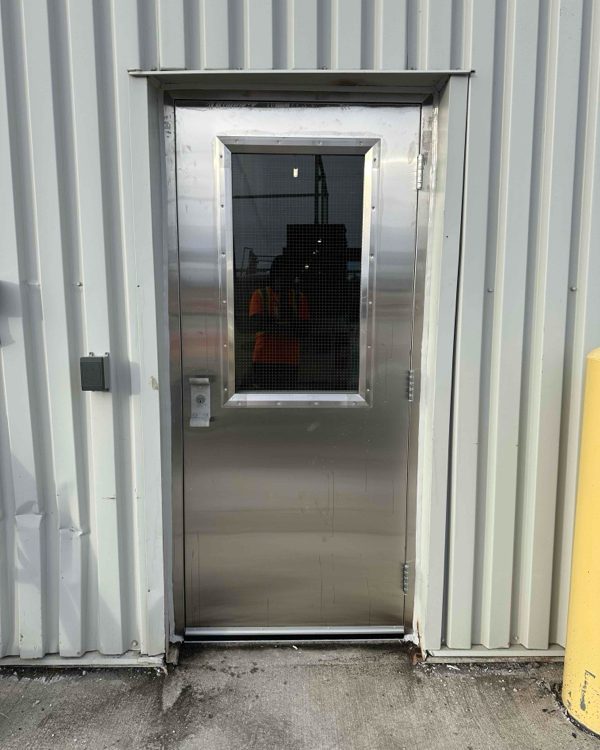
Recent work from our own records, listed as client and date — documented as dated job folders in the company photo library rather than as written project briefs.
- Stracor Inc.February 2025
- Frost Products LtdFebruary 2025
- Plas Tech Extrusions Ltd.December 2025
- VINS PlasticsDecember 2025
- Felton Brushes Ltd.August 2025
- 4M Manufacturing Inc.October 2025
Four decades of doors for names Ontario knows — Canada’s Wonderland, Tim Hortons, Canadian Tire, the LCBO, Metrolinx, Marriott & Hilton hotels, the University of Toronto — plus thousands of businesses across the GTA. Dependable people, quality products, since 1979.
What our customers say
I had an old metal and class commercial door that was sagging. I opted for a re-hinging with new continuous hinge system. Process from quote to job done was very easy and competitive priced. Technicians were on time and did the job professionally. My door opens and closes beautifully.
Canuck doors is a pleasure to work with. From the initial conversation to the job being completed was a stress free period. Charles was very great to work with. They completed an outside steel door / new frame and door, and installed 2 beautiful windows. …
Read the full review
As a small Landlord in the East end of Toronto I respond to my Tenants professionally in a timely cost effective way. This occurred over the Xmas holidays with a broken commercial door hinge. …
Read the full review
Stainless door supply & installation across the GTA
We measure, supply and install stainless doors and frames across the core GTA and the Southern Ontario belt from our shop in Mississauga — plants, kitchens, labs and processing floors, worked around production wherever we can.
Core GTA
- Toronto
- Mississauga
- Brampton
- Vaughan
- Markham
- Scarborough
- North York
- Etobicoke
- Richmond Hill
- Oakville
- Burlington
- Milton
Southern Ontario belt
Not on the list? Processing plants are where they are — we travel for this work anywhere from Niagara to Barrie. Call and ask. See all service areas
What a stainless door costs
Stainless is a material decision, and it prices above painted steel every time — the sheet costs more and it is slower to fabricate. What moves the number:
- Grade — 304 for most interiors, 316 where chlorides or harsh chemicals are present
- Whether the frame is stainless too, or a painted frame in a dry-side wall
- Finish —
- Gauge and construction, including flush-seam welded and ground edges
- Core — insulated, honeycomb, or steel-stiffened for abuse
- Fire rating, where the opening also has to carry a label
- Hardware in matching stainless, and whether it has to be washdown-rated
- Sanitary details — coved seams, sloped tops, sealed edges for food-grade areas
Stainless costs more up front and less over the life of the opening. Where the cleaning regime strips paint annually, that maths turns quickly.
Common questions
When is a stainless steel door worth the money?
When the room is cleaned aggressively, when what is in the air is corrosive, or when the opening has to be sanitary. Food and beverage production, pharmaceutical and lab space, commercial kitchens, pool and chemical rooms, and washdown areas all destroy paint on a schedule — every wash cycle takes a little more, rust starts at the first scratch, and the door is repainted or replaced years before it should be. In a dry corridor, stainless is money spent on appearance rather than performance.
What is the difference between 304 and 316 stainless?
316 contains molybdenum, which makes it far more resistant to chlorides — salt, bleach, brine, pool chemicals and coastal air. 304 is the general workhorse grade and is right for most kitchens, labs and processing areas. Where the cleaning chemistry is chloride-based or the process itself is salty, 316 is what stops pitting. We ask what the room is washed with before we specify the grade.
Are stainless steel doors the same as hollow metal doors?
They are built the same way — two formed face sheets around a core in a steel frame — but in stainless sheet rather than carbon steel, usually with welded and ground seams so there is nothing to trap water or product. So a stainless door is a hollow metal door in a different metal, and it hangs, latches and is repaired the same way. The differences are the grade, the finish, and the sanitary detailing.
What finish do stainless doors come in?
A #4 brushed finish is the commercial standard — a directional satin grain that hides handling marks and cleans easily. Mirror (#8) is available where appearance leads, and bead-blast finishes where a uniform matte surface is wanted. The grain direction matters on a door: vertical grain on the leaf is normal, and it should run consistently across a pair.
Can a stainless door be fire-rated?
Yes. Labelled stainless assemblies are made in the same ratings as painted hollow metal — 20 to 180 minutes — with the core the rating requires. The whole assembly has to be labelled and compatible, so the frame, hinges, closer and latch are specified with the door. It is a common requirement where a rated corridor runs into a kitchen or a processing area.
Do stainless doors rust?
They can, and the usual cause is contamination rather than the stainless itself — carbon-steel dust from grinding nearby, steel wool used to clean, or chlorides left standing on the surface. That is surface rust on embedded iron, not the door failing, and it is prevented by keeping carbon steel away from the finish and cleaning with the grain using non-chloride cleaners. Genuine pitting means the grade was wrong for the chemistry.
Can you match stainless hardware to the door?
Yes, and in a washdown area you should. Hinges, locks, exit devices, pulls, kick plates and thresholds are all available in stainless, and mixing plated carbon-steel hardware onto a stainless door reintroduces the corrosion the door was specified to avoid. Continuous stainless hinges are common on washdown openings, because there are fewer joints to hold water.
How long does it take to get stainless steel doors?
Typically 4–6 weeks to produce a stainless door and frame once the shop drawings are approved, then 1–2 weeks to schedule the job and install it, depending on the size of the project. Stainless is a made-to-order product in almost every case — grade, finish, gauge, core and hardware prep are all specified per opening, and there is no stock equivalent to pull from. Once delivered, one stainless door and frame is usually a day's work on site.
An opening the cleaning is destroying?
Tell us what is in the room and what it gets washed with, and we'll specify the grade, the finish and the frame — then quote the assembly.