
Commercial & Industrial
Commercial Windows & Aluminum Window Systems
New and replacement windows for commercial buildings — thermally broken aluminum framing, fixed and operable units, made to your openings rather than bought in a size. Supplied, installed and serviced across Toronto and the GTA since 1979.
Request a Window QuoteCall 800-522-6825
Dispatched from our Mississauga shop · since 1979 · we service windows we did not install
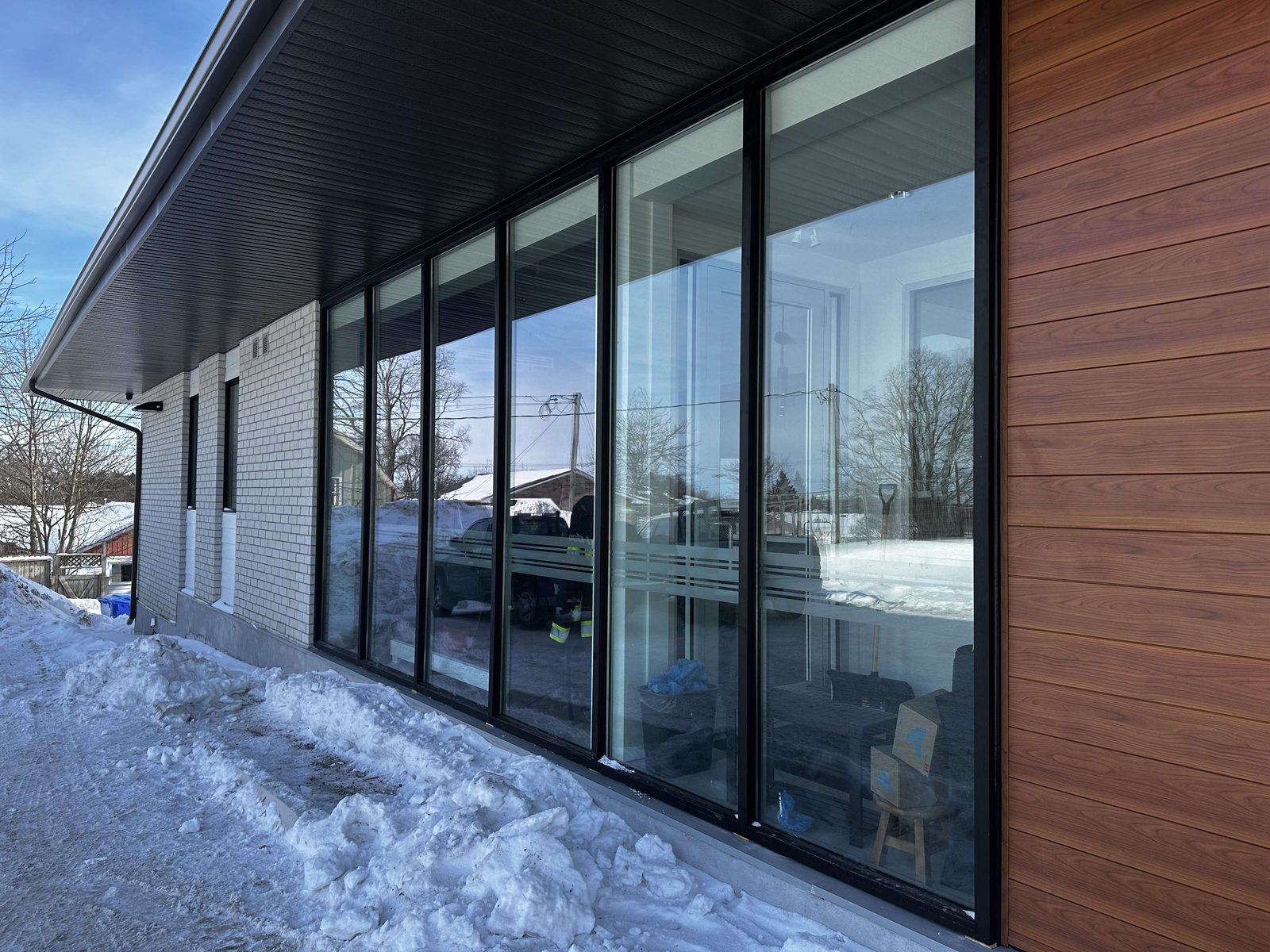
A commercial window is fabricated to your opening rather than bought in a size. That single fact drives everything else about it: the framing is extruded aluminum cut to your dimensions, the glass make-up is chosen per opening to meet the Ontario Building Code, and the whole assembly is quoted from a site measure instead of a catalogue. It is the same trade as the storefront below it, and usually the same elevation.
Canuck Door Systems supplies, installs and services commercial windows across the GTA — new build, whole-elevation retrofit, or a handful of units that have failed. We are the contractor, not the extruder: we do the measure, the shop drawings, the removal, the install and the service afterwards, which is why we can tell you when the honest answer is to keep your frames and change only the glass.
Where commercial windows go
Offices & business parks
Punched openings and ribbon glazing across single- and multi-storey office elevations, usually replaced a floor at a time.
Clinics & healthcare
Fixed and operable units for medical, dental and long-term-care buildings, where daylight matters and the space stays occupied.
Schools & institutions
Classroom and corridor glazing replaced inside a summer shutdown, with safety glazing where the code requires it.
Manufacturing & warehousing
Clerestory and wall glazing on plant elevations — daylight over the floor without losing the wall.
Retail & restaurants
The windows either side of the storefront, matched to the storefront framing so the elevation reads as one system.
Hotels & multi-residential
Suite windows replaced or reglazed floor by floor, phased so rooms come back into service the same week.
Auto dealers & showrooms
Large fixed units carrying the display glazing, in framing slim enough to keep sightlines open.
Places of worship & community halls
Replacing aging single-glazed elevations with thermally broken units, usually in phases as budget allows.
Window types we supply
Two decisions cover most of a window schedule: does the opening need to ventilate, and if so, which way should the vent swing. Everything else follows from the size of the lite and the elevation it sits on.
| Type | How it works | Specified for |
|---|---|---|
| Fixed lite | Does not open; glass sealed into the framing | Daylight and view where ventilation is handled mechanically |
| Awning | Hinged at the top, opens outward at the bottom | Ventilating in the rain — the standard commercial vent |
| Hopper | Hinged at the bottom, opens inward at the top | Below-grade and high-level openings, common in schools |
| Casement | Side-hinged, swings out like a door | Maximum opening area where the sash can project outside |
| Horizontal slider | One sash slides past the other | Where nothing may project into or out of the opening |
| Window wall | Slab-to-slab framed glazing, one storey at a time | Condo and office elevations, installed from inside |
| Spandrel panel | Opaque glass — fritted or back-painted | Concealing slab edges and mechanical space between floors |
Commercial windows against residential ones
The comparison matters because the least expensive quote on an aging elevation is often a residential window company pricing house windows into a commercial building. They will fit, and they will fail early — the hardware is not built for the cycles and the frames are not built for the spans.
| Commercial | Residential | |
|---|---|---|
| Sizing | Made to the measured opening | Stock sizes, or made to a limited range |
| Framing | Extruded aluminum, thermally broken outside | Vinyl, wood or clad wood |
| Glass | Specified per opening — tempered, laminated, low-E, spandrel | Standard package, safety glazing where required |
| Hardware | Commercial-grade, built for constant use | Domestic-duty |
| Governed by | OBC, CAN/CGSB-12.1, and the project specification | OBC, and the manufacturer's package |
| Replaced | Elevation by elevation, phased around occupancy | Unit by unit |
The thermal break, and why it is not optional outside
Aluminum conducts heat. An exterior aluminum frame with no thermal break runs close to the outdoor temperature at its interior face, which in a Toronto January means condensation, then water on the sill, then staining and eventually damage to the finishes below. A thermally broken frame separates the interior and exterior aluminum with a polyamide strut or a poured-and-debridged resin channel, and the interior face stays close to room temperature.
This is also the single most common difference between two window quotes for the same building. If one is materially less expensive, look for the thermal break before you look at anything else.
Glass in the openings
| Make-up | Typical thickness | Where it goes |
|---|---|---|
| Sealed insulating unit | 25 mm overall — 6 mm / 12.7 mm cavity / 6 mm | Every exterior opening; cavity is air or argon |
| Low-E coating | On an inner surface of the unit | Standard on new exterior work — cuts heat loss and solar gain |
| Tempered | 6 mm | Where the code requires safety glazing, including low sills |
| Laminated | 6.38 mm and up | Security, sound reduction, and fragment retention |
| Tinted or reflective | 6 mm | Glare and solar control on exposed south and west elevations |
| Monolithic annealed | 6 mm | Interior lites and non-safety locations only |
Keeping the frames and changing only the glass? That is reglazing, and it is a different — usually much less expensive — project: see commercial window glass replacement & reglazing. This page is for new window units, frames included.
How a window project runs
- Survey. Every opening measured, plus frame type, pocket depth, thermal break and how many units have already failed. This is where we tell you whether you are buying windows or glass.
- Shop drawings. Approved by you before anything is cut — unit schedule, framing sections, glass make-up and finish.
- Fabrication. 4–6 weeks. Framing and glass are both made to your dimensions and neither can be recut.
- Installation. 1–2 weeks to schedule and fit, phased by floor or elevation, each opening made good the same day it is opened.
- Service. Hardware, gaskets and glass afterwards — including the units we did not supply.
Systems we install
We install the aluminum systems common to Ontario commercial work rather than one manufacturer's line, so the specification follows the opening instead of a supply agreement.
- Windspec — including the 655 and 5500 HTP series named in our own project records (windspec.com).
- Commdoor aluminum entrance, storefront and window systems (commdooraluminum.com).
- Herd aluminum framing (herdaluminum.com), and equivalents.
- Whatever is already in the building — we service and reglaze existing aluminum windows whoever supplied them, including systems no longer made.
Commercial window work from our own files
Named clients, real elevations — window replacement is a large share of our glass and aluminum work.
Sable Metal Fabrication
Replaced outdated glass-and-aluminum windows with modern, energy-efficient units at their Markham plant.
Canada's Wonderland
Clear-anodized aluminum storefront and window systems for the Operations Building — awning and fixed units with a glazed entrance.
Shelburne Dental
Replaced the exterior glass-and-aluminum storefront doors and windows, plus interior glass-aluminum frames and wood doors.
EFCO Corp
Glass-and-aluminum window replacement at 30 Todd Road in Georgetown, as subcontractor to MIRODAN Contracting.
Two of these jobs are written up in full, and they are the two halves of this work. The replacement: nineteen black anodized units across four elevations of a two-storey Toronto brick building, through an asbestos hold and a sidewalk permit — commercial window replacement in Toronto for Doodle All Daycare. The new build: eleven aluminum windows and doors on a new two-storey office front, curtain wall over a storefront entrance, ordered in November for openings that were not ready until April — commercial window installation in Hamilton.
Three more window jobs are written up: fifty-five worn wood windows replaced in aluminum on a restaurant that stayed open, worked in winter mornings — commercial windows replacement in Mississauga for Tandoori Flame; a clear anodized entrance and a run of awning and fixed windows finished before a theme park opened — aluminum window systems at Canada's Wonderland; and a Scarborough retrofit glazed one opening at a time around the siding crews, for a grand opening — commercial windows in Scarborough.
Two straightforward replacements are written up too, both in Commdoor 2500 framing: a pharmaceutical building kept in use, window by window — commercial windows in Mississauga for PCI Pharma Services; and a panel-clad building worked around parked cars and a manufacturer's backlog — glass aluminum windows at 30 Todd Road, Georgetown.
And one client who came back: eight windows on a Markham metal fabrication plant, then eleven more on the other side of the building later the same year — commercial windows in Markham for Sable Metal Fabrication.
Two more show the range: custom Duranar-finished windows and vents for a public building, made to the architectural schedule — glass aluminum doors and windows for the MTO patrol yard; and every storefront and window on 20+ commercial units across three buildings — glass aluminum windows at Kelfield Street, Etobicoke.
Two longer guides sit alongside this page: what commercial window replacement costs in Ontario, with the published market ranges and what actually moves a quote, and commercial window brands and manufacturers, on which systems get specified here and why.
Four decades of windows for names Ontario knows — Canada’s Wonderland, Tim Hortons, Canadian Tire, the LCBO, Metrolinx, Marriott & Hilton hotels, the University of Toronto — plus thousands of businesses across the GTA. Dependable people, quality products, since 1979.
What our customers say
Canuck Doors provided outstanding service for our new flagship store in Cambridge. Their competitive pricing and superior quality were evident in the flawless installation of our 12-foot oversized glass panels for the storefront system and a side door, a challenging task that nearly all other …
Read the full review
I Needed to replace the entire glass systems around my commercial building and got recommended by a friend to this place. They have walked me through the entire process from beginning to end. They did great Job in managing to keep me updated, finishing the job on time and did more than asked. …
Read the full review
The wind blew my commercial glass door open and it broke. Canuck Door systems came fast and board it up. They then replaced the glass door and everything is perfect now.
Commercial window installation across Toronto & the GTA
We measure, supply and install commercial windows right across the core GTA and out into the Southern Ontario belt, dispatched from our shop in Mississauga. Occupied buildings are phased floor by floor or elevation by elevation so the space stays in use.
Core GTA
- Toronto
- Mississauga
- Brampton
- Vaughan
- Markham
- Scarborough
- North York
- Etobicoke
- Richmond Hill
- Oakville
- Burlington
- Milton
Southern Ontario belt
Not on the list? A whole-elevation window replacement is a project rather than a call-out, and projects travel — we have installed well past the belt. Ask. See all service areas
What commercial windows cost
Commercial windows are priced per unit, not per square foot, because two openings of the same area can be a fixed lite and a four-vent operable assembly. The variables that actually move a window quote:
- Unit size and count — the price per unit falls as the quantity rises
- Fixed or operable, and which vent type (awning, hopper, casement, slider)
- Whether the framing is thermally broken — it should be, on anything exterior
- Glass make-up — sealed insulating unit, low-E, argon, tempered or laminated
- Finish — stock anodized against a custom powder-coat colour
- Removing the old frames and making good inside and out, versus a new opening
- Access — ground floor, a boom lift, or a swing stage above the third floor
- Working around occupancy — after hours, phased by floor, one tenant at a time
Beware any "per square foot" number quoted without seeing the building — it ignores the removal, the making good and the access, which on a retrofit are routinely a third of the job. We measure and itemise instead.
Common questions
What does "commercial window" actually mean?
It describes how the window is built and specified, not where it happens to be installed. A commercial window is fabricated to the measured opening rather than bought in a stock size, framed in extruded aluminum rather than vinyl or wood, glazed to a make-up chosen per opening, and fitted with hardware rated for far more cycles than a house window sees. The same building can hold commercial windows and residential ones — the difference is the product, not the address.
What type of windows do commercial buildings use?
Overwhelmingly aluminum-framed units — fixed lites where the space does not need to ventilate, and awning, hopper, casement or slider vents where it does. Aluminum is used because it carries large areas of glass on slim sightlines, does not rust or warp, takes any anodized or powder-coat finish, and survives commercial use. On anything exterior the framing should also be thermally broken, which is what stops a Canadian winter condensing on the inside face.
What is the difference between commercial and residential windows?
Four things. Commercial windows are made to the opening rather than to a stock size; they are framed in aluminum rather than vinyl; their glass make-up is specified per opening to meet the Ontario Building Code rather than supplied as a standard package; and their hardware is built for constant use. The trade-off is that aluminum conducts heat, which is why residential construction moved to vinyl and commercial construction did not — the fix is a thermal break, not a different material.
How much do commercial windows cost per square foot?
Per-square-foot numbers mislead on commercial work and we do not quote them. Two openings of the same area can be a single fixed lite and a four-vent operable assembly, at very different prices, and on a retrofit the removal, the making good and the access routinely come to a third of the job — none of which scales with glass area. We price per unit from a site measure and itemise the removal and access separately, so you can see what is glass and what is labour.
What is the life expectancy of a commercial window?
The frame and the glass have different lives, and that is the useful distinction. Properly finished aluminum framing with an intact thermal break can run 30 to 40 years and often outlasts two sets of glass. Sealed insulating units are the wearing part: most commercial units start failing somewhere between 15 and 25 years, usually in batches on the elevation that takes the most sun. So the first question on an aging elevation is which part has actually reached the end of its life.
Should we replace the windows or just the glass?
If the frames are straight, thermally broken and the glazing pocket will take a modern sealed unit, replacing the glass gets most of the energy benefit for a fraction of the cost — that is reglazing, and it is covered on our window glass replacement page. Replace the windows when the frames are bent or corroded, the thermal break has failed and the frames sweat every winter, the frames are single-glazed with a pocket too shallow for a sealed unit, or the opening itself has to change size or become operable. We check the pocket depth and the frame condition on the first visit and tell you which of the two projects you are looking at.
Are you a commercial window manufacturer?
No, and it is worth being clear about it. We are the contractor: we measure the openings, produce the shop drawings, order the framing and the glass to those dimensions, install with our own crews and service the result. The extrusions come from Ontario aluminum systems — Windspec, Commdoor, Herd and equivalents — and the glass from Canadian fabricators. What that means in practice is that the recommendation follows your opening rather than one manufacturer's catalogue, and there is one company responsible from the measure to the service call.
How long does it take to install commercial windows?
Typically 4–6 weeks to produce the windows once the shop drawings are approved, then 1–2 weeks to schedule the job and install them — depending on the size of the project. What sets the schedule on windows specifically is the glass: sealed insulating and laminated units take longer to fabricate than plain tempered, and none of them can be recut once made, so the measure has to be right before anything is ordered. A few window replacements are usually a day on site; a whole elevation or a new building for a general contractor runs over several weeks.
Can you replace windows while the building stays occupied?
Yes — most of our window work is on occupied buildings. The elevation is phased floor by floor or bay by bay, openings are made good the same day they are opened, and the work is scheduled around the tenants, including evenings and weekends. What that requires is a sequence agreed before we start: which suites, in what order, and what happens if the weather turns. We build that into the quote rather than discovering it on site.
Replacing the windows, or specifying them for a new build?
Send us the building — a rough count of openings and a photograph of the elevation is enough to start — and we’ll measure and quote it.