
Guide
Types of Automatic Doors: Which One Suits Your Building?
There are five types of automatic door: sliding, swing, folding, revolving, and the low-energy or power-assist operator fitted to an ordinary swing door. Sliders suit busy main entrances, a low-energy operator suits most barrier-free doors, and folding and revolving doors solve narrower problems.
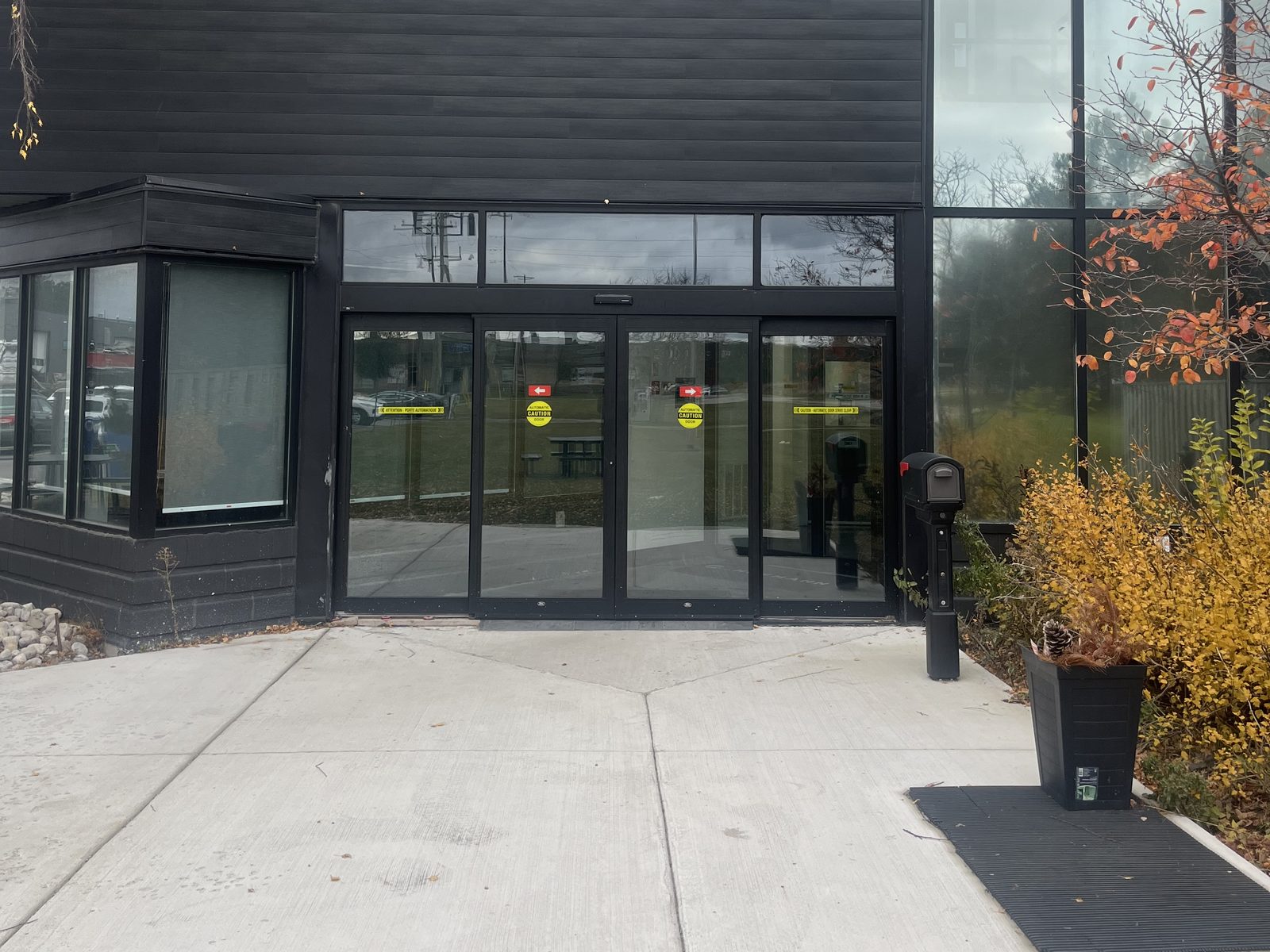
"Automatic door" covers several quite different machines. A bi-parting slider at a supermarket, a push-plate operator on a clinic's side door and a revolving door in an office tower all open by themselves, but they are built to different standards, suit different openings and cost very different amounts to install and keep running.
This guide sets out the types, where each one belongs, and what the Ontario code actually asks for, so you can go into a quote knowing which one you need.
Four decades of doors for names Ontario knows — Canada’s Wonderland, Tim Hortons, Canadian Tire, the LCBO, Metrolinx, Marriott & Hilton hotels, the University of Toronto — plus thousands of businesses across the GTA. Dependable people, quality products, since 1979.
What are the main types of automatic doors?
There are five types of automatic door in commercial use: sliding, swing, folding, revolving, and the low-energy or power-assist operator fitted to an ordinary hinged door. In Ontario commercial buildings, nearly all of them are sliders or swing operators. Folding and revolving doors are specialist answers to narrower problems.
Each type is covered by its own ANSI/BHMA standard. The standard decides how fast the door may move and what safety equipment it must carry.
| How it opens | Best for | Standard | |
|---|---|---|---|
| Sliding (full-energy) | Leaves slide sideways in the wall line, triggered by sensors | Busy main entrances, lobbies, grocery, hospitals | ANSI/BHMA A156.10 |
| Swing (full-energy) | A hinged leaf swings open on approach, with guide rails and sensors | One-way traffic lanes where a slider will not fit | ANSI/BHMA A156.10 |
| Low-energy swing | A hinged leaf opens slowly after a push plate, wave sensor or card | Barrier-free entrances, washrooms, interior doors | ANSI/BHMA A156.19 |
| Power-assist swing | You push; the operator takes most of the weight | Heavy doors with occasional users | ANSI/BHMA A156.19 |
| Folding | Two or more panels fold back as the door opens | Wide openings with little side wall and little swing space | A156.10, or A156.38 at low energy |
| Revolving | Wings rotate around a central post | High-traffic towers where draught control matters most | ANSI/BHMA A156.27 |
The standards are published by the Builders Hardware Manufacturers Association. A156.19 covers power-assist and low-energy swing operators, and every door under it must open only on a "knowing act" such as pressing a plate (BHMA, A156.19). Low-energy sliding and folding doors have their own standard, A156.38.
What are the types of automatic sliding doors?
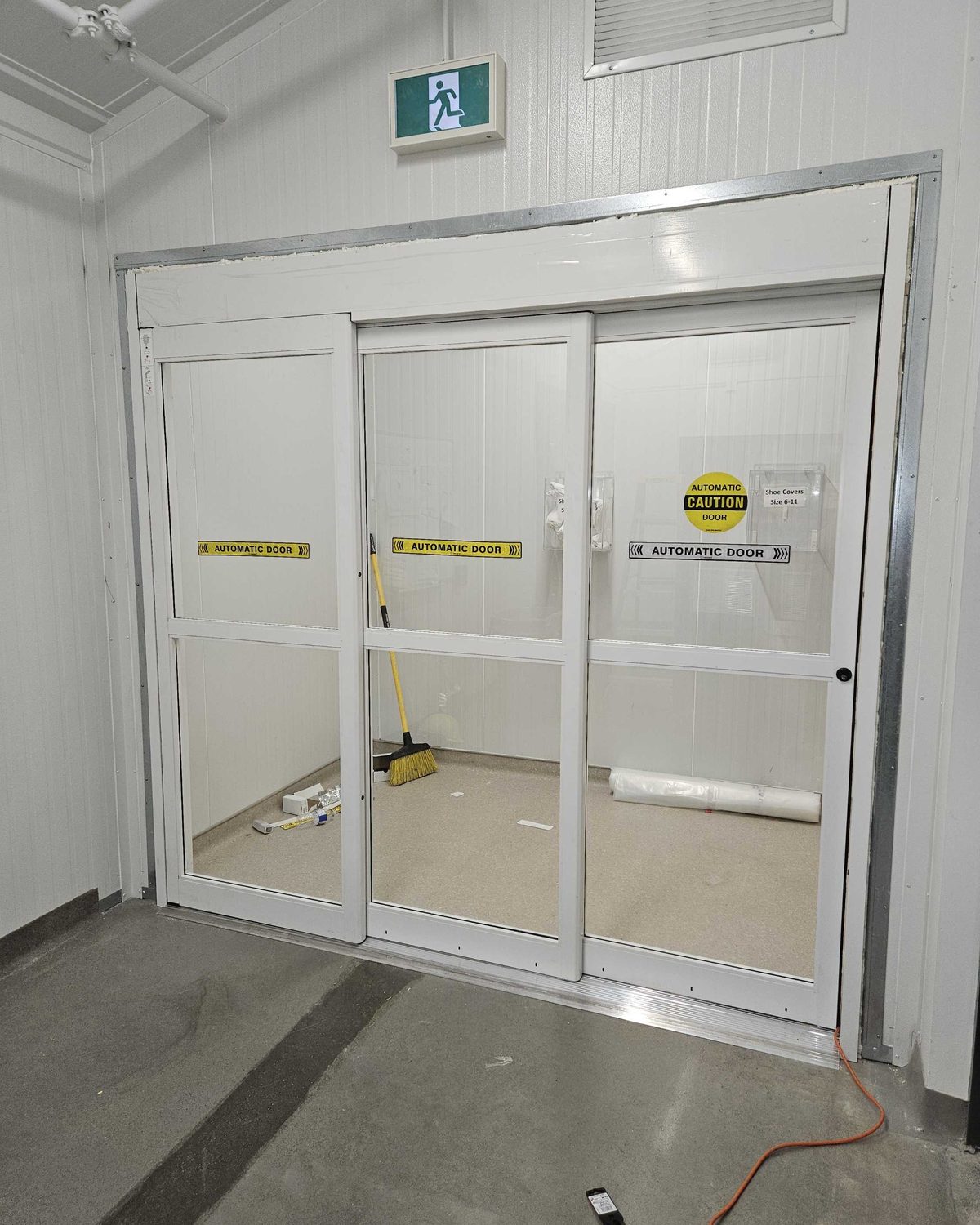
An automatic sliding door comes in three configurations: single-slide, bi-parting and telescopic. The choice comes down to how wide the clear opening must be and how much wall there is beside it for the leaves to slide into.
- Single-slide. One leaf slides past a fixed panel. It is the simplest and least expensive option, and suits narrower openings, corridors and secondary entrances used by one person at a time.
- Bi-parting. Two leaves slide apart from the middle, so each side only needs half the opening in wall space. This is the standard main entrance for lobbies, grocery stores and hospital vestibules, where people pass in both directions at once or push carts and beds through.
- Telescopic. The leaves nest behind each other as they slide, so more of the frame width becomes clear opening for the same amount of side wall. It costs more, because there are more carriers and more track to keep in step. It is often the answer when an existing storefront wall cannot move.
Any of the three can be framed in aluminum or built as an all-glass entrance with minimal rails. On an exit route, the leaves should have break-out: pushed hard from inside, they swing out of the track to give a clear escape path. Break-out is specified with the door. A slider bought without it stays shut when the power goes.
Automatic sliding doorscovers the operator, the sensor package and the side-room arithmetic in more detail.
How do automatic swing doors and low-energy operators differ?
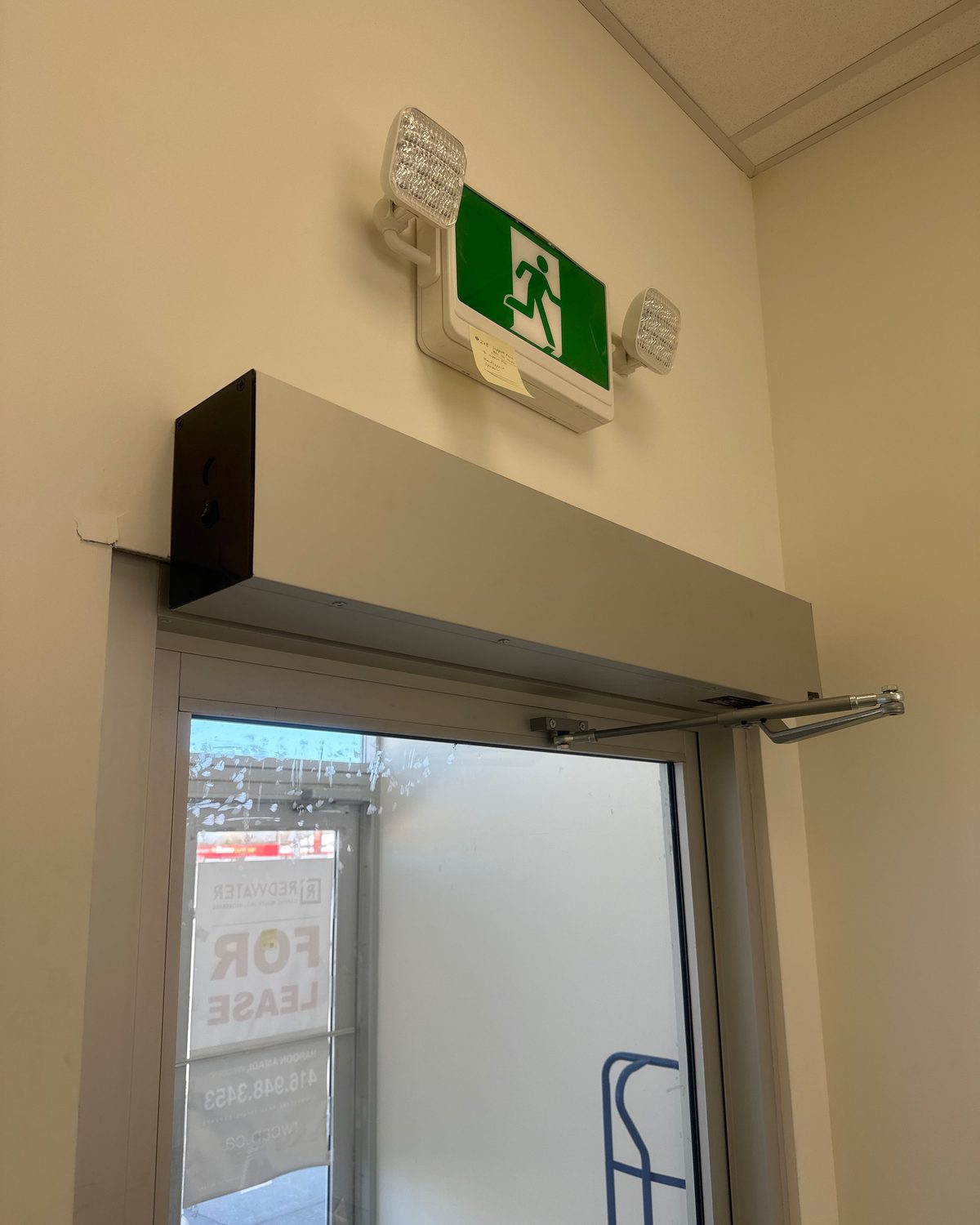
An automatic swing door is a hinged door with an operator at its head. It comes in three kinds. A full-energy swing door opens quickly on approach, so it needs sensors, guide rails and signage. A low-energy operator opens slowly after a knowing act, so the slow speed is its main safety feature. A power-assist door still needs a push, but a much lighter one.
For most buildings, the low-energy operator is the one that matters. It is a small unit on the head of a door you already own, plus a push plate or wave sensor on each side, and it turns a door that a person on a walker cannot open into one they can. It is the usual way to make an entrance barrier-free. It is also usually far less expensive than a new slider, because the door, frame and opening stay as they are.
Full-energy swing doors are less common. They make sense in one-way traffic lanes, such as a supermarket's in and out doors, where there is room for guide rails and a slider will not fit. Swing doors are also the natural choice when the operator has to be fitted to a door that is already there, whether it is steel or aluminum.
Handicap and barrier-free door operatorssets out what a complete low-energy opening includes, from actuators to electric strikes.
When does a folding or revolving automatic door make sense?
A folding automatic door makes sense when an opening needs to be wide but there is neither wall beside it for a slider nor floor in front of it for a swing door. Its panels fold back on themselves, so it opens wider than a slider of the same width. It also sweeps much less floor than a pair of swing doors. It works inside and outside, but it has more hinges and moving parts to maintain than either alternative.
A revolving door makes sense on a high-traffic tower entrance where keeping wind and cold outside matters most, because the building is never open straight through to the street. It is never the whole answer, though. Under the 2024 Ontario Building Code, a revolving door used as an exit must be collapsible and have hinged doors of equivalent exit capacity beside it (OBC Article 3.4.6.15). In practice, the barrier-free entrance is always that adjacent swing or sliding door, usually with its own power operator.
How do automatic doors know when to open?
Automatic doors open on a sensor or a deliberate act. Full-energy doors use motion sensors to see people approaching and presence sensors to hold the door while someone is in it. Low-energy doors open when somebody presses a plate, waves at an actuator, or presents a card.
| Motion sensor | Microwave or radar detection of someone approaching, mounted on the header. Opens the door, but cannot see a person standing still |
|---|---|
| Presence sensor | Infrared detection of someone in the door path. Holds the door open and stops it closing on a person who has stopped |
| Safety beam | A break-beam across the opening, used mainly on swing doors and as a back-up |
| Push plate or wave actuator | Hard-wired or wireless, mounted within reach from a seated position. The standard activation for low-energy doors |
| Access control or intercom | Card reader, fob or video intercom releasing the lock and then the operator, for after-hours or secured entrances |
| Pressure mat | The older trigger, a mat that switches when stepped on. Rarely installed on new entrances, where sensors have replaced it |
Most service calls start with the sensors, not the motor. A mat, display or sign placed in a sensor's field is enough to make a door open at random or refuse to close. Our
automatic door sensor troubleshooting guidewalks through what a building can safely check itself.
Which automatic doors does the Ontario code require?
In Ontario, the requirement comes from the Building Code, not from any rule telling owners to automate their doors. The 2024 Code requires a power door operator on every door providing the barrier-free path of travel through a barrier-free entrance. It also requires one on doors serving a public washroom that must be barrier-free (OBC Article 3.8.3.3).
The same article sets a clear width of at least 850 mm for doorways on a barrier-free path of travel. It also limits the force needed to open a door without an operator, to 38 N at an exterior door and 22 N inside. An operator bolted onto an opening that is too narrow does not make it compliant.
The AODA's Design of Public Spaces standard, part of the Integrated Accessibility Standards regulation (O. Reg. 191/11), adds requirements for exterior paths of travel and some service areas. Like the Code, it applies when a space is newly built or redeveloped, not to every existing door. In practice, automation is triggered by a permit, a renovation, a tenant requirement or an accessibility complaint. The washroom requirement is why universal washrooms arrive as a universal washroom door package, with operator, lock, actuators and emergency call wired as one sequence.
A low-energy operator and a barrier-free entrance are not the same thing. The clear width, the manoeuvring space beside the latch, the threshold and the height of the push plate are all part of the same test. We survey the opening, not just the door, before quoting.
How do you choose the right automatic door?
Start with the opening and the people using it, not with the product. Five questions settle most choices:
- How heavy is the traffic, at normal times and at peak? Continuous two-way traffic points to a bi-parting slider. Occasional users point to a low-energy swing operator.
- Will wide things come through? Carts, beds, pallets and luggage need a bi-parting or telescopic slider, or a pair of swing doors.
- What is beside and in front of the opening? No side wall rules out a single-slide. No floor space rules out a swing door. Neither leaves telescopic or folding.
- Does it need security or monitoring? Card access, intercom, after-hours locking and fire alarm behaviour all have to be designed into the controls. They are hard to add later.
- What happens in a power cut? On an exit route, sliders need break-out. Low-energy swing doors can simply be pushed open.
Two practical points apply to every type. A new automatic entrance typically takes 4–6 weeks to produce once shop drawings are approved, then 1–2 weeks to schedule and install. Every automatic door should also get a daily safety check by staff and an annual inspection by a certified technician. Our technicians hold AAADM certification for that inspection. The commercial automatic doors hub covers the brands we deal in (Record, Assa Abloy and Entrematic) and the service side.
Common questions
What are the different types of automatic door openers?
There are two families. Sliding operators sit in a header above the opening and move one or more leaves sideways, in single-slide, bi-parting or telescopic form. Swing operators sit on or in the head of a hinged door and push it open, either at full energy with sensors and guide rails, or at low energy, slowly, after someone presses a plate. Folding and revolving doors have their own operators, but they are far less common in Ontario commercial buildings.
What is the difference between a power-assisted door and an automatic door?
A power-assisted door still needs you to push it: the operator takes most of the effort out, so a heavy door feels light. An automatic door opens without anyone touching it, triggered by a sensor, a push plate or a card reader. Power-assist and low-energy swing operators are covered by one standard, ANSI/BHMA A156.19; full-energy automatic doors by another, A156.10.
Which automatic door is best for a store entrance?
For a busy main entrance, usually a bi-parting sliding door. It handles two-way traffic at volume, needs no swing space and does not open into people. Where wall space beside the opening is short, a telescopic slider gives a wide clear opening in less room. A low-energy swing operator suits a secondary or barrier-free entrance with lighter traffic.
Are automatic doors required in Ontario?
For a building permit, often yes. The 2024 Ontario Building Code requires a power door operator on doors that provide the barrier-free path through a barrier-free entrance, and on public washrooms that must be barrier-free. It does not order existing buildings to automate every door; the requirement usually arrives with new construction or a renovation.
Can a revolving door be the only accessible entrance?
No. Under the Ontario Building Code a revolving door used as an exit must be collapsible and have hinged doors with equivalent exit capacity beside it, and a person using a wheelchair or walker needs a swing or sliding door anyway. Where a building has a revolving door, a barrier-free door with a power operator sits next to it.
Pricing a job like this?
Not sure which automatic door fits the opening?
Send us a photograph of the entrance, a rough width and height, and whether there is wall beside it and power above it. That is enough to tell you which type fits and what it takes.