
Comparison
Automatic Sliding Door Repair vs Replacement: Which Saves More?
Repair an automatic sliding door when the framing is sound, the fault is a single component and parts still exist. That covers most calls. Replace the operator when its parts are discontinued or faults keep coming back. Replace the whole entrance only when the framing is damaged or the opening must change.
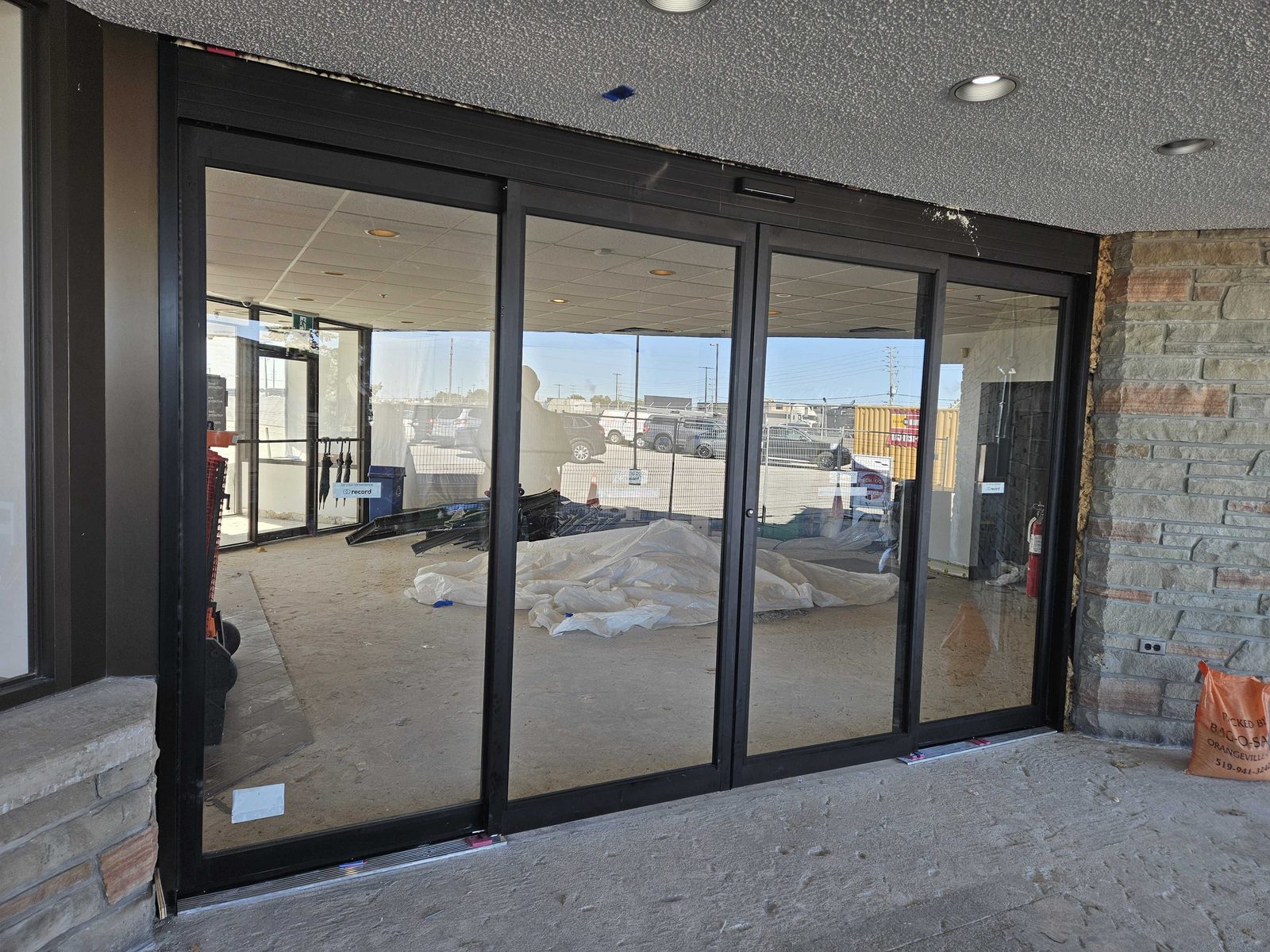
When an automatic sliding door fails, the building has to decide quickly whether to fix it or replace it. The door may be the only way into the building, or the only barrier-free one. A repair is less expensive that day. A replacement can be less expensive over the next few years. Which is true depends on the age of the operator, the state of the framing and whether parts still exist.
This guide sets out how to tell the difference. It also covers the middle option many buildings never get offered: a new operator in the framing you already have.
Four decades of doors for names Ontario knows — Canada’s Wonderland, Tim Hortons, Canadian Tire, the LCBO, Metrolinx, Marriott & Hilton hotels, the University of Toronto — plus thousands of businesses across the GTA. Dependable people, quality products, since 1979.
Is it better to repair or replace an automatic sliding door?
In most cases, repair. Almost every part of an automatic slider is replaced in place, including sensors, belts, carriers, rollers, guides, control boards and motors, without touching the framing or the glass. Replacement becomes the better value when faults keep coming back, when the operator's parts are discontinued, or when the framing itself is damaged.
Before deciding, look at five things:
- Repair history: one fault in several years, or several in one season?
- Parts: does the manufacturer still make boards and carriers for this operator?
- Framing: is it square, sound and still sealing?
- Standards: does the door still meet the safety standard it was built to, and the accessibility the opening now needs?
- Downtime: what does another failure cost the building?
What are the common automatic sliding door problems?
Most automatic sliding door problems are single components wearing out or something in the building upsetting the sensors. Neither means the door needs replacing. The faults we see most often:
- Sensors that have drifted, been knocked, or are seeing a mat, sign or display
- Grit and salt in the floor track, which make the door judder or stall
- Worn rollers, carriers and belts, the mechanical wear parts in the header
- Presence and safety sensors that leave the door stuck open or reversing
- Misaligned leaves that drag on the floor guide or meet badly
- Broken glass, usually from an impact
- Control boards and motors at the end of their life, sometimes with intermittent faults
- Power supply problems, including tripped breakers and loose connections
The first two are covered in our automatic door sensor troubleshooting guide, which lists the checks building staff can make before calling anyone.
When does repairing an automatic sliding door make more sense?
Repair makes sense when the door is otherwise sound and the fault is isolated. A single component, sound framing and an operator whose parts are still made point to repair. Repair also keeps downtime short: common sensors and parts are carried on our trucks, so a repair is often finished in one visit.
- The operator is still supported. If the manufacturer still makes boards, motors and carriers for it, repairs stay practical and the door can keep running for years.
- The damage is minor. Sensors, tracks, belts and rollers are routine repairs, not reasons to replace.
- The framing and glass are in good condition. If the entrance is square and sealing, a component repair gives the best value.
- Repairs are infrequent. Occasional service calls are normal for a busy entrance. One fault is not a pattern.
- You need the door working now. A repair call is dispatched 24/7. A replacement typically takes 4–6 weeks to produce once shop drawings are approved, then 1–2 weeks to schedule and install.
When does replacement save more money?
Replacement saves money when repair spending has become open-ended. That usually means frequent and varied faults, discontinued parts, damaged framing, or a door that no longer suits the opening. In any of those cases, each repair buys less time than the one before, and the downtime between repairs costs the building too.
- Repairs are becoming frequent. Several service calls a year, each for a different fault, is the pattern of an operator wearing out as a whole.
- Parts are obsolete. This decides more replacements than anything else. Parts for automatic operators are brand-specific, and once a board or carrier is no longer made, no amount of money can buy it.
- The door no longer meets the standard. An older door that cannot be set to current speed, force and sensor-coverage requirements, or an opening that now has to be barrier-free, may need more than a repair.
- The building is losing heat. Worn seals and leaves that no longer close fully let heat out through a Canadian winter.
- The entrance is hurting the business. A main entrance that fails regularly frustrates customers, tenants and staff.
- The framing is damaged. Impact damage, corrosion or frames out of square beyond adjustment mean the door cannot seal or run true, whatever operator is on it.
Discontinued parts are a real risk, not a theoretical one. The Ditec DS20 sliders we installed in Orangeville in 2023 have since been discontinued by the manufacturer, so their owner needs a plan for parts and service. It is why "which operator is it?" is the first question on any repair-or-replace call.
That job is written up in automatic sliding doors in Orangeville.
The middle option: replace the operator, keep the framing
Between repairing a failing operator and replacing the whole entrance is a third option: install a new operator in the existing framing. The header drive, control board and sensors are replaced; the aluminum framing, glass and threshold stay. This is the usual outcome when an inspection finds an obsolete operator on an otherwise sound entrance.
It works because the framing and glass usually outlive the machinery, often by more than one operator. An operator swap costs far less than a new entrance and is less disruptive. Like other entrance work, it can often be done overnight or at a weekend so the building opens with a working door. It is not the answer if the framing is damaged, out of square or too narrow for what the opening now has to do.
How do repair and replacement compare?
| Repair a component | Replace the operator | Replace the entrance | |
|---|---|---|---|
| Upfront cost | Lowest — typically $350–$1,200 | Between the two | Highest — typically $3,500–$8,500+ |
| Downtime | Often one visit | Usually a day or two per opening, once the operator arrives | Planned around a 4–6 week production period plus installation |
| What stays | Everything except the failed part | Framing, glass and threshold | Nothing, and the opening can change size or configuration |
| Parts supply | Depends on the old operator | A current, supported operator | A current, supported operator |
| Standards | Adjusted within what the old door can do | New sensors and controls set to the current standard | Everything to the current standard |
| Energy performance | Unchanged, unless seals are replaced | Unchanged framing, with new seals and tighter closing | New framing, glass and seals |
| Right when | The door is sound and the fault is isolated | The machinery is obsolete but the entrance is sound | The framing is damaged or the opening must change |
What does automatic sliding door repair and replacement cost?
A common automatic sliding door repair typically runs $350 to $1,200, and a replacement $3,500 to $8,500 or more — the widest replacement range of any commercial door we handle, since a new entrance brings its own operator, sensors and controls. The table puts it beside the other commercial doors we repair and replace, in Canadian dollars.
| Door type | Common repair cost range | Replacement cost range |
|---|---|---|
| Glass and aluminum storefront | $250 – $800 | $1,200 – $3,500+ |
| Hollow metal / steel door | $200 – $600 | $900 – $2,500+ |
| Automatic sliding door | $350 – $1,200 | $3,500 – $8,500+ |
| Commercial overhead door | $300 – $900 | $3,500 – $7,200+ |
| Fire-rated entry assembly | $250 – $750 | $1,200 – $3,000+ |
Minor hardware adjustments, such as closers, hinges, seals or latches, typically stay under $400. Structural replacement that means taking the frame out quickly exceeds $1,500 to $3,500 or more per opening. These are typical ranges, not a quote: the number for your door comes from your photos or drawings, or a site visit when needed, and the factors below are what move it.
What decides the cost of each option?
Nobody can price an automatic sliding door repair or replacement without knowing the door. We quote from photos first, with a site visit when the door needs one. For a repair, the cost depends on:
- what failed: a sensor, a belt, carriers and rollers, a control board or the motor;
- whether the part is on the truck, orderable or obsolete for that operator;
- the make and model, since parts are brand-specific;
- the configuration, as a bi-parting or telescopic door has more parts than a single-slide;
- the time of the call, as after-hours, weekend and holiday call-outs carry a labour premium.
For a replacement, the cost depends on:
- operator only or the whole entrance, the biggest difference of all;
- configuration and size, single-slide, bi-parting or telescopic, and the clear opening;
- glazing and framing finish, if new framing is included;
- break-out, required on an exit route;
- interfaces with card access, intercom and fire alarm;
- the work around the opening, such as the header, floor and any rebuilding of the opening itself.
How long do automatic sliding doors last?
No honest single number exists. It depends on how many times a day the door cycles, how well it has been maintained, the conditions it works in, and, above all, whether its maker still supports it. The framing and glass usually last longest. The operator's electronics usually fail first, or become unrepairable when parts run out.
Two habits extend the life of the whole system. Staff should run the daily safety check, and a certified technician should inspect the door once a year. The American Association of Automatic Door Manufacturers recommends that every automatic door be checked annually by an inspector it has certified (AAADM FAQ). Our technicians hold AAADM certification for that inspection.
How does preventive maintenance change the decision?
Preventive maintenance moves the repair-or-replace decision from a crisis to a plan. A door that is inspected and serviced on a schedule has its worn rollers and belts replaced before they fail. Its sensors are kept in adjustment, and an operator heading for obsolescence is spotted early. That gives time to budget a replacement instead of paying for an emergency.
Maintenance helps in several ways:
- it catches wear parts before they fail at the busiest time of day;
- it keeps speeds, forces and sensor coverage within the standard;
- it builds a service record that shows whether faults are isolated or a pattern;
- it flags operators whose parts are being discontinued;
- it reduces after-hours emergency calls.
A preventative maintenance plan covers the entrance alongside the building's other doors and docks. When a door does fail, automatic door repair is dispatched 24/7 from our Mississauga shop, for every make, including doors we did not install. If the answer is a new entrance,
automatic sliding doorscovers the configurations and what we need to quote one.
Common questions
Is it less expensive to repair or replace an automatic sliding door?
Repair is almost always less expensive at the time. Sensors, belts, rollers, carriers, boards and motors are all replaced in place without touching the framing or the glass. Replacement becomes the better value when faults keep returning, when the operator's parts are no longer made, or when the framing itself is damaged. Even then, replacing only the operator in sound framing costs far less than a new entrance.
What is the typical lifespan of an automatic door?
There is no single number. The life of an automatic sliding door depends on how many cycles it runs, how it has been maintained and, above all, whether its manufacturer still makes parts for it. Framing and glass usually outlive the operator, often by more than one generation of operator, which is why an operator replacement is so common.
What are common problems with automatic sliding doors?
Sensors that have drifted or are seeing a mat or display; grit and salt in the floor track; worn rollers, carriers and belts; presence and safety sensors that leave the door stuck open or reversing; misaligned leaves; broken glass; and control boards or motors at the end of their life. Most are single-component repairs.
What does it cost to replace an automatic sliding door?
Typically $3,500 to $8,500 or more in Canadian dollars, against $350 to $1,200 for a common repair. Where a job lands in that range turns on whether it is a new operator in existing framing or a complete bi-parting or telescopic entrance with new framing, glass and sensors, plus the size of the opening, break-out and interface requirements, and the work around it. We confirm the number from your photos or drawings, or a site visit when needed.
When should a business replace its automatic sliding doors?
When repairs have become frequent and varied rather than occasional, when parts for the operator are discontinued, when the framing is damaged or out of square beyond adjustment, or when the opening must now do something it was not built for, such as become wider or barrier-free.
Pricing a job like this?
Repair it, or replace it?
Tell us the make on the header, roughly how old the door is and what it has been doing. We will say honestly whether it is worth fixing, and quote the repair or the replacement.