
Maintenance guide
How to Maintain, Adjust and Paint a Hollow Metal Door
Hollow metal door maintenance is mostly hardware: tighten hinges, closers, strikes and exit devices, keep the gasketing sealing and the paint unbroken. Check the frame is plumb before adjusting anything, repaint over sanded, solvent-cleaned primer in warm weather, and never paint over a fire label.
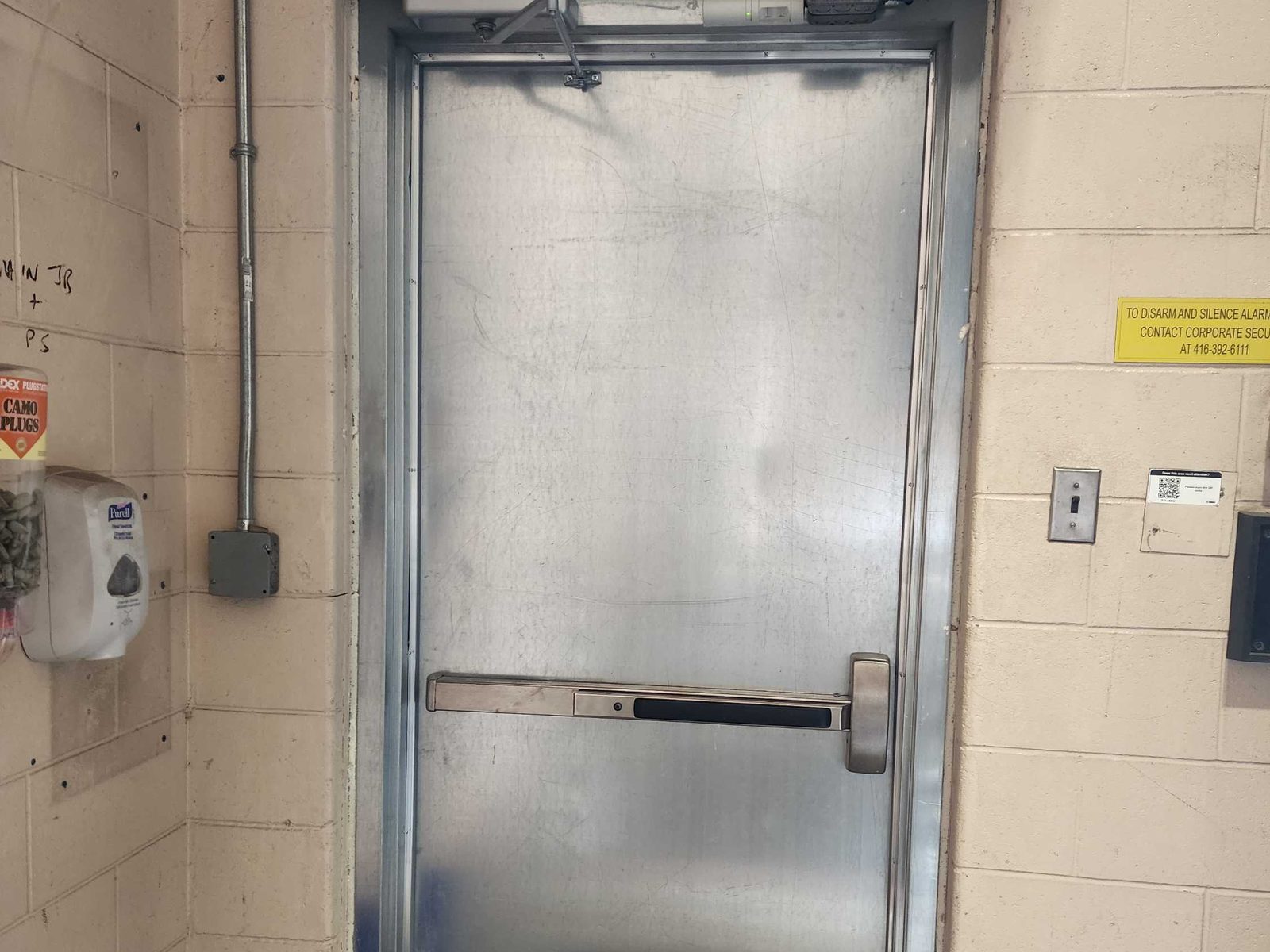
A steel door and frame will outlast almost everything bolted to them. The failures we are called to are nearly always the hardware — a closer leaking oil, a latch that no longer catches, a hinge worn on its pin — or corrosion that started at a chip nobody touched up. Both are inexpensive to prevent and expensive to ignore.
This is the maintenance routine the Steel Door Institute recommends, the adjustments that fix most binding doors, and how to repaint a hollow metal door so the paint stays on.
Four decades of doors for names Ontario knows — Canada’s Wonderland, Tim Hortons, Canadian Tire, the LCBO, Metrolinx, Marriott & Hilton hotels, the University of Toronto — plus thousands of businesses across the GTA. Dependable people, quality products, since 1979.
What does hollow metal door maintenance involve?
Checking the hardware, the seals and the finish on a schedule, and fixing small faults before they become failures. The Steel Door Institute's maintenance guide is blunt that maintenance is "for the most part, associated with the accessories and hardware attached to the door and frame", not the steel itself (SDI 124, maintenance of steel door and frame assemblies).
| Check | What to look for | What fixes it |
|---|---|---|
| Hinges | Loose screws, worn pins; door not swinging freely | Tighten or replace; re-shim if the door has dropped |
| Locksets and exit devices | Loose screws, latch wear; extra force needed to latch | Service or replace worn parts; replace worn silencers |
| Strike plate | Loose on the frame; latch dragging on its edge | Re-fix; adjust the strike opening |
| Closer | Loose arm, worn pins, oil leaking | Adjust sweep and latch speed; replace a leaking closer |
| Flush bolts | Rods not engaging their keepers | Adjust rods and keepers |
| Glass lites | Cracks, missing glazing, loose stops | Reglaze with safety glass, or fire-rated glass in a fire door |
| Finish | Chips and scratches to bare metal; rust | Sand, prime and repaint before rust spreads |
| Gasketing and weatherstripping | Splits, cracks, gaps along the perimeter | Replace; test the seal with a sheet of paper |
The paper test is the SDI's own: close the door on a sheet of paper at points all round the perimeter. Wherever the paper pulls out freely, the seal is not doing its job — which on an exterior door in January means heat loss and drafts, and on a smoke-rated door means the seal has failed. Replacement seals are covered on our commercial weatherstripping page.
How often should hollow metal doors be inspected?
For ordinary doors, as often as their traffic demands; for fire doors, on a fixed legal schedule. The SDI leaves the frequency to the owner, the insurer and the maintenance provider, because a loading-dock man door and a storage room door wear at different rates.
Fire-rated doors are not left to judgement. The Ontario Fire Code requires doors in fire separations to be inspected monthly (Ontario Fire Code, O. Reg. 213/07; summarised in Windsor Fire & Rescue's owner checklist), and NFPA 80 requires fire doors to be inspected and tested after installation and at least annually after that (NFPA, fire doors and NFPA 80 FAQs). What that inspection covers is set out in our guide to fire door ratings and labels.
Why is my steel door binding or not latching?
Usually because the frame has moved, not the door. Standard steel doors and frames are made to a nominal 1/8-inch clearance between door and frame; once that gap closes on one side, the door rubs, the latch misses its strike, and the hardware wears fast.
The SDI's troubleshooting guide is emphatic on the order of work: check that the frame is square and plumb before adjusting any hardware, because a frame out of plumb causes lockset trouble and bolt binding that no hinge adjustment will cure (SDI 122, installation and troubleshooting guide).
- Hinge-side bind. Shimming behind a hinge leaf moves the door toward the strike jamb or away from the stop. Worn hinges are replaced, not shimmed.
- Twisted door. If the frame is true and the door still stands proud of the frame face at one corner, the door itself can often be sprung back with blocking and pressure.
- Latch misses the strike. Once the frame is confirmed true, the strike opening can be enlarged — on a non-rated frame — rather than forcing the door shut.
- Seasonal trouble. A door that binds only on hot sunny afternoons, or on the coldest mornings, may be thermal bow, a temporary bow caused by the difference in temperature between its two faces. Dark colours in direct sun make it worse; a lighter colour on the exposed face helps.
On a fire-rated door, none of this is do-it-yourself work. Modifications to labelled doors and frames have to comply with NFPA 80 — a strike opening enlarged, a hole drilled for new hardware or a door planed to clear the floor can void the label, and a door that has lost its label is a replacement, not a repair.
What goes wrong at installation?
Most problems we are called to on new steel doors were built in on the day they were hung. Three habits prevent nearly all of them.
- Measure the opening before ordering the package. Size, handing, frame depth and hardware preparations are made to order; a door bought to a drawing instead of a site measure arrives wrong. The SDI recommends a rough opening at least 3/16 inch larger than the frame on all three sides, so the installer can shim and align it (SDI 111, recommended details).
- Set the frame plumb and square before the door goes in. It is the final step of every frame installation, and the one that decides whether the hardware ever works properly.
- Seal exterior frames. Most seams in a hollow metal frame are neither welded nor sealed unless someone does it, so on an exterior opening the frame is not watertight until the joints and perimeter are caulked.
For exterior doors, the steel itself matters. The SDI recommends galvannealed A40 or A60 steel for exterior doors and frames — A60 resists rust better — and advises against ordinary galvanized sheet because paint does not bond to it well (Steel Door Institute FAQ). A new door is typically 4–6 weeks to produce once shop drawings are approved, then 1–2 weeks to schedule and install; see
hollow metal and commercial steel doorsfor what we supply.
How do you paint a steel door?
Sand it, clean it with the right solvent, prime any bare metal, lightly sand the primer, and apply a compatible topcoat in suitable weather. Paint that peels to bare metal almost always means poor surface preparation or a topcoat that reacted with the primer, and the SDI's fix for both is to start again from bare, clean steel.
The SDI sequence, for a door that is failing or being repainted:
- Remove or mask the hardware. Paint in a latch or on a hinge knuckle causes the next fault.
- Sand the whole surface. Sand damaged or rusted areas to bare metal and feather them into the sound paint around them.
- Clean with solvent. Use the same solvent that will thin the topcoat, over every surface to be painted.
- Prime the bare metal with a metal primer. Benjamin Moore, for example, recommends its acrylic metal primer on metal doors and at least 24 hours of drying before the finish coat (Benjamin Moore, how to paint a front door).
- Lightly sand the primer, wipe it, and topcoat with a finish paint compatible with that primer, allowing full drying time between coats.
- Leave the labels alone. The SDI states that certification labels are not to be painted over during repainting, and NFPA advises against painting fire door labels at all.
When is it too cold to paint?
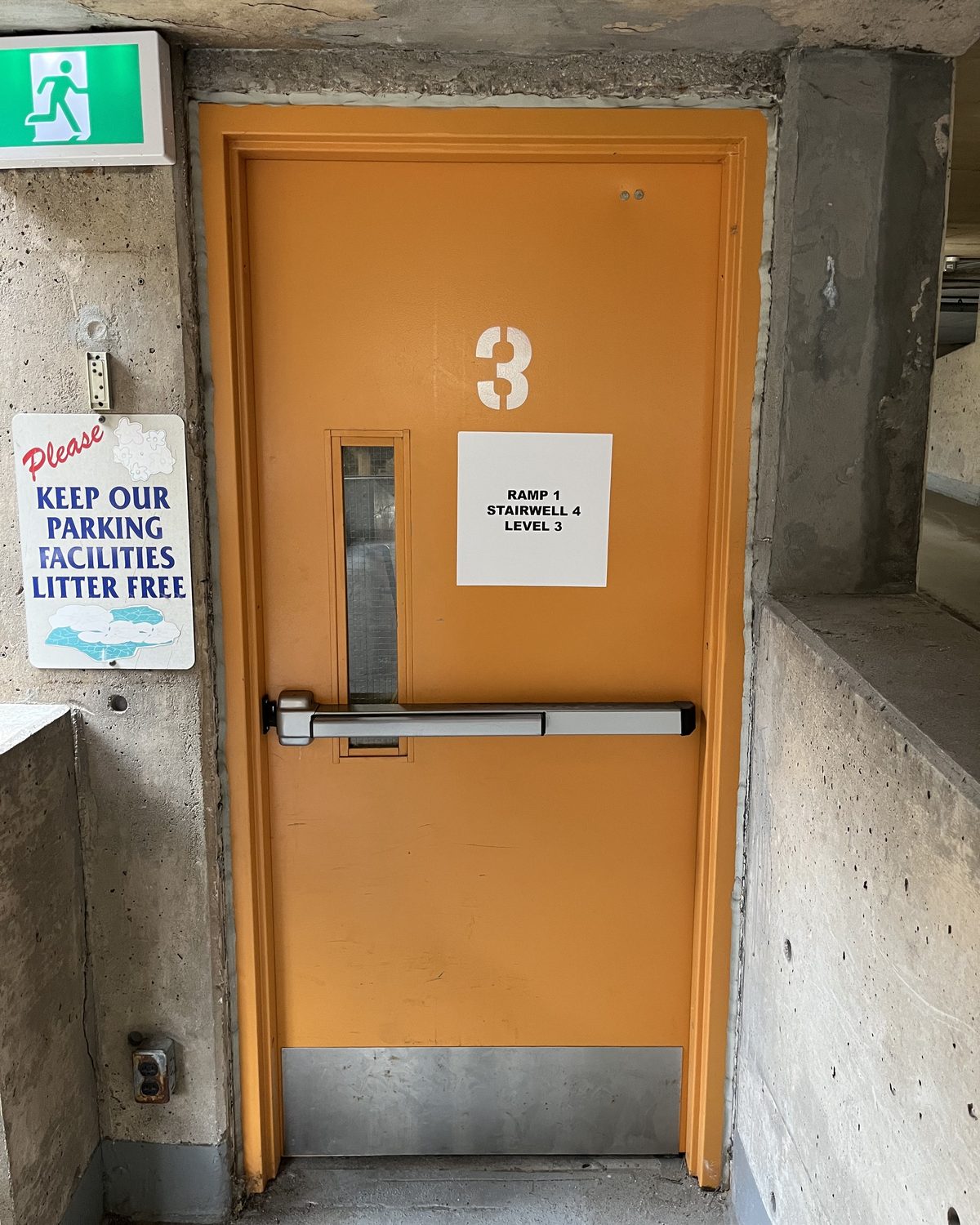
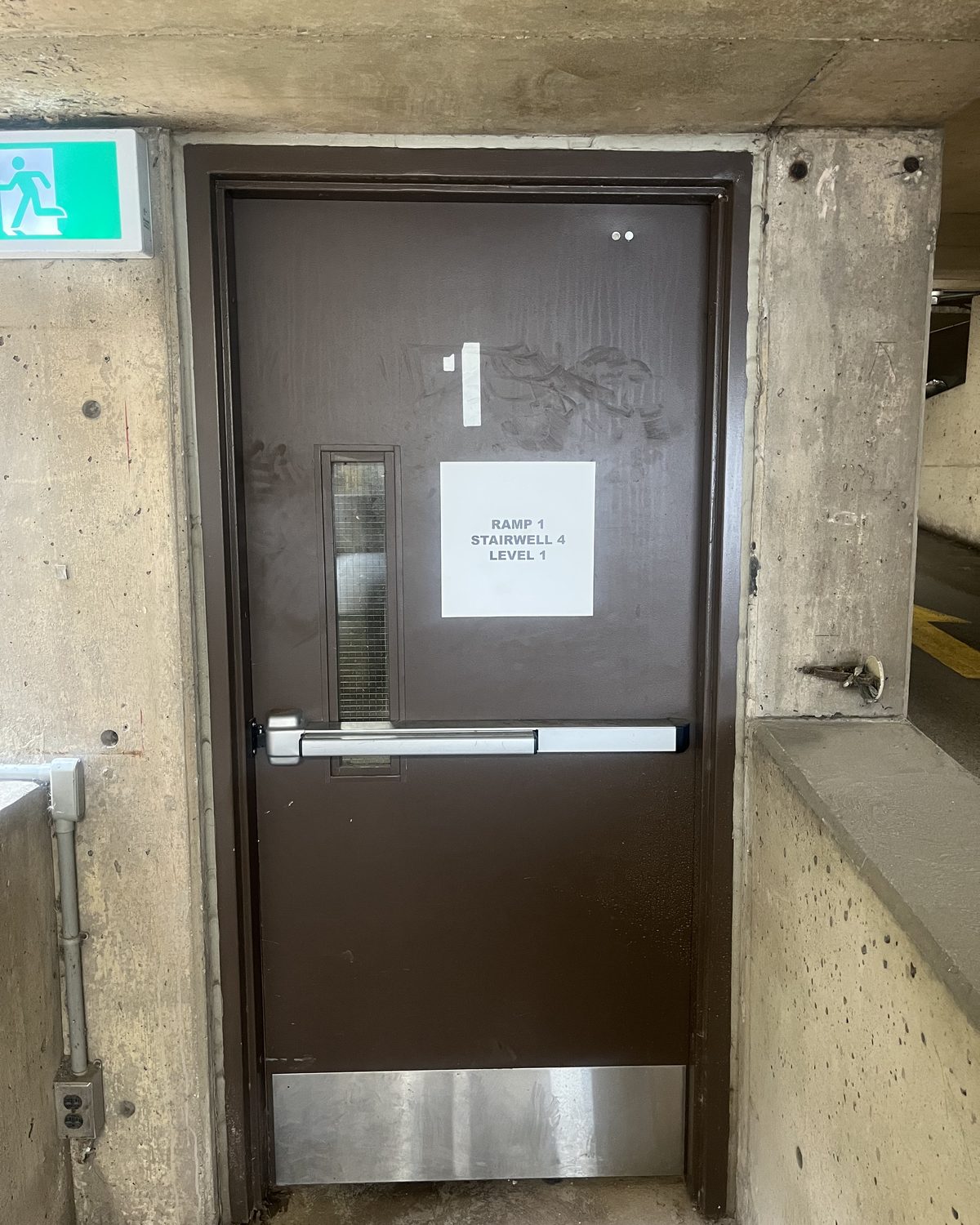
When the paint maker says so — and in Ontario that rules out much of the winter for outdoor work. On the Hamilton garage above, the doors and frames were painted on site, so the schedule was built around paint weather: two ramps were painted and installed before winter, and the third ramp's doors waited for spring. If a door has to go in during January, plan for the finish coat to follow when the temperature allows, and keep the primer protected until then.
A lighter colour is worth considering on any exterior steel door that faces the sun, for the thermal-bow reason above. The colour-per-level scheme in Hamilton was chosen for wayfinding, not looks — a painted steel door can do a job beyond keeping the weather out.
Repair or replace?
Repair the hardware and the finish; replace the door when the steel itself has failed. A dent can be filled and repainted, a worn closer or hinge swapped, and a latch problem is usually an adjustment. Rust that has eaten through the bottom of an exterior door, a door twisted past springing back, or a fire door that has been drilled, cut or has lost its label are replacements.
| Work on a hollow metal door | Typical cost (CAD) |
|---|---|
| Hardware adjustment: closer, hinges, seals, latch | Under $400 |
| Common repair | $200 – $600 |
| Replacement door | $900 – $2,500+ |
| Replacement with the frame taken out | $1,500 – $3,500+ per opening |
The gap between the last two rows is why a sound frame matters: a new leaf hung in the existing frame costs far less than cutting a frame out of a block wall. These are typical ranges in Canadian dollars, not a quote: the number for your opening comes from your photos or drawings, or a site visit when needed.
We repair and replace steel doors and frames across the GTA — see commercial door repair and commercial door hardware — and a door that will not lock after a break-in is a 24/7 emergency call. For a building with dozens of doors, a
preventative maintenance plancatches the leaking closer before it becomes the unlocked door.
Common questions
What material is a hollow metal door?
Steel. A hollow metal door is two steel face sheets over a core, with steel edges, hung in a steel frame. The name is historical: most are not hollow at all, but filled with a honeycomb, polystyrene, polyurethane, steel-stiffened or fire-rated core.
What is the best product to clean metal doors?
Mild soap and water on a soft cloth, rinsed and dried. Avoid abrasive pads and harsh solvents on a finished door, because anything that cuts through the paint to bare steel creates the spot where rust starts. Keep cleaners away from fire door labels.
How do I refinish a metal door?
Sand the whole surface, feathering any bare-metal spots, clean it with the solvent the topcoat will be thinned with, re-prime any bare steel, lightly sand the primer, then apply a compatible topcoat. Do it in suitable weather, remove or mask the hardware, and leave fire labels unpainted.
Do I need to prime a steel door before painting?
Only where the primer is gone. A factory-primed door, or a painted door in sound condition, needs sanding and cleaning rather than a new prime coat. Anywhere that has been sanded or chipped to bare metal must be primed with a metal primer before the topcoat, or the paint will lift and the steel will rust.
How often should hollow metal doors be inspected?
The Steel Door Institute leaves the interval to the building owner and the traffic each door sees. Fire-rated doors are different: in Ontario, doors in fire separations must be inspected monthly under the Fire Code, and NFPA 80 calls for a full inspection and test at least once a year.
Pricing a job like this?
Steel doors dragging, not latching or rusting through?
Tell us how many doors there are and what they are doing. We adjust, repair or replace them — and for a door that will not lock tonight, call us 24/7.