
Guide
How to Prevent Break-Ins at a Commercial Property
To prevent break-ins at a business, make every opening slow and conspicuous to attack: a grille, shutter or bars over the glass, solid doors and frames with proper locks, good lighting and clear sightlines, and cameras plus a monitored alarm so the time you buy ends in a response.
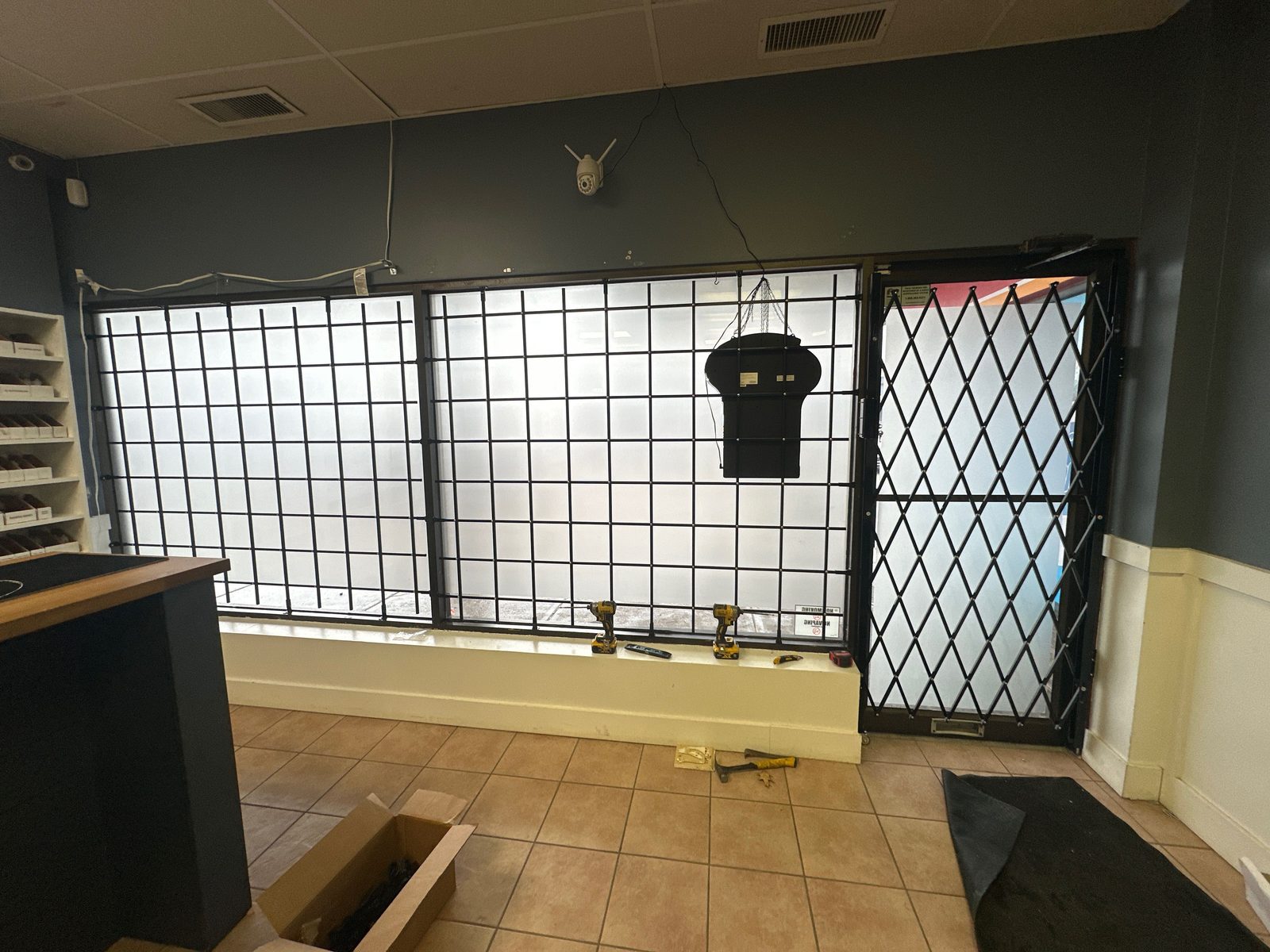
Almost every guide that ranks for this question is written for a house. A business is a different problem: it sits empty and dark for twelve hours a night, it often has a wall of glass facing the street, and its back door opens onto a laneway nobody watches.
This guide is about the building itself — the doors, frames, glass and closures that decide how long an opening takes to beat. It sits alongside, not instead of, the lighting, cameras and alarm monitoring every police service recommends.
Four decades of security closures and commercial doors for names Ontario knows — Canada’s Wonderland, Tim Hortons, Canadian Tire, the LCBO, Metrolinx, Marriott & Hilton hotels, the University of Toronto — plus thousands of businesses across the GTA. Dependable people, quality products, since 1979.
How do you prevent break-ins at a business?
You prevent break-ins by making every opening slow and conspicuous to attack, and by making sure the time you buy ends in someone responding. In practice that means a barrier over the glass, solid doors and frames with locks that actually latch, lighting and clear sightlines, and cameras with a monitored alarm.
Crime-prevention people summarise it as four Ds: deter (look like a poor target), detect (be seen and recorded), delay (make it take time) and deny (keep them out of where they want to be). Doors, grilles and glass do most of the delaying and denying. They are only worth what the detection behind them is worth.
Where do intruders actually get into commercial buildings?
Through the easiest opening, which is rarely the front door. Walk the building at night and look at it the way a stranger would: which opening is dark, out of sight of the street and slow for anyone to notice?
- Storefront glass — the fastest way into a shop is through the display, not the lock.
- Back and side doors — a steel door on a laneway with a worn lock or a frame that has moved is the classic entry point, especially where it cannot be seen from any street.
- Loading and service openings — overhead doors left on a manual lock, dock doors, and man doors beside them.
- Ground-floor windows on the sides and back, particularly anything hidden by landscaping or bins.
Waterloo Regional Police's
business security checklistasks exactly these questions: whether views of the property are obscured from the street, whether there are hiding spots by windows and doors, and whether entrances are well lit. A professional walk-through catches the ones staff stop seeing.
Which physical security measures work, and what does each one buy?
Each measure buys a different thing, and the right one depends on the opening. The table sets them side by side; the sections after it cover the ones people ask about most.
| What it does | Best on | Limitation | |
|---|---|---|---|
| Rolling grille | See-through curtain coiled above the opening | Storefronts and mall units that want the display visible at night | Needs headroom; can be reached through |
| Folding grille or gate | Concertinas sideways and stacks at the jamb | Openings with no headroom for a coil | Takes wall space at the side |
| Rolling shutter | Solid slats; blocks view, weather and impact | Street-facing entrances and windows | A closed frontage looks closed |
| Fixed security bars | Permanent steel bars anchored over the glass | Side and rear windows that never need to open | Never on a required exit |
| Laminated glass | Glass that stays in the frame when broken | Display glass and door lites | Delays entry; does not prevent it |
| Security film | Film applied to existing glass to hold fragments | Glass you are not ready to replace | Only as good as how it is anchored to the frame |
| Solid door, frame and lock | Steel door in a sound frame with proper hardware | Back, side and service doors | The weakest part sets the result |
Security grilles and shutters
A grille or shutter turns a ten-second smash-and-grab into a job that needs tools, makes noise and takes long enough for a response to arrive. A
rolling security grillekeeps a storefront visible after hours; a
rolling security shuttercloses the opening off completely and also keeps weather out; a
folding grille or gategoes where there is no room above the opening for a coil. Retractable closures are the reason security no longer has to mean bars across the display all day.
Window security bars
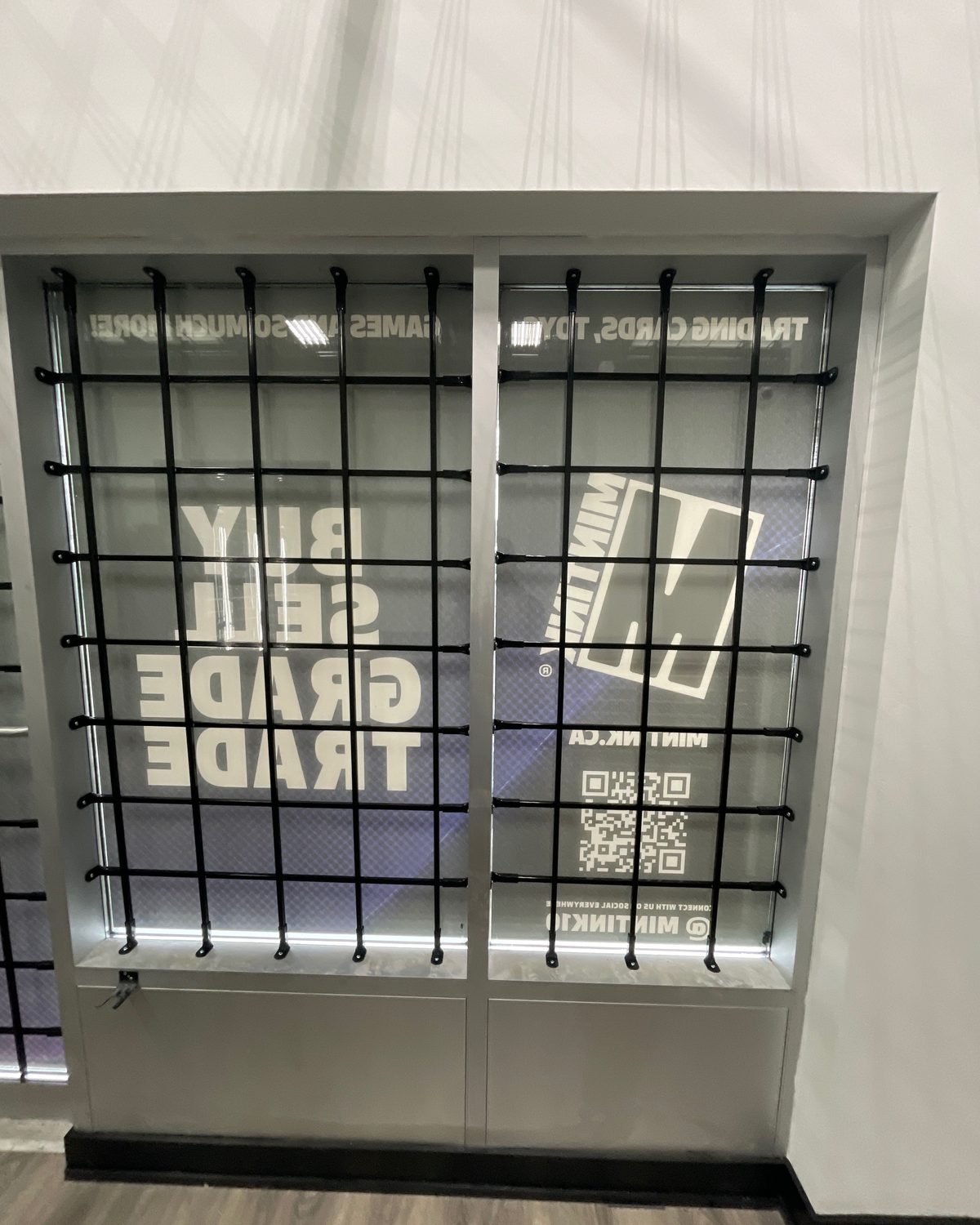
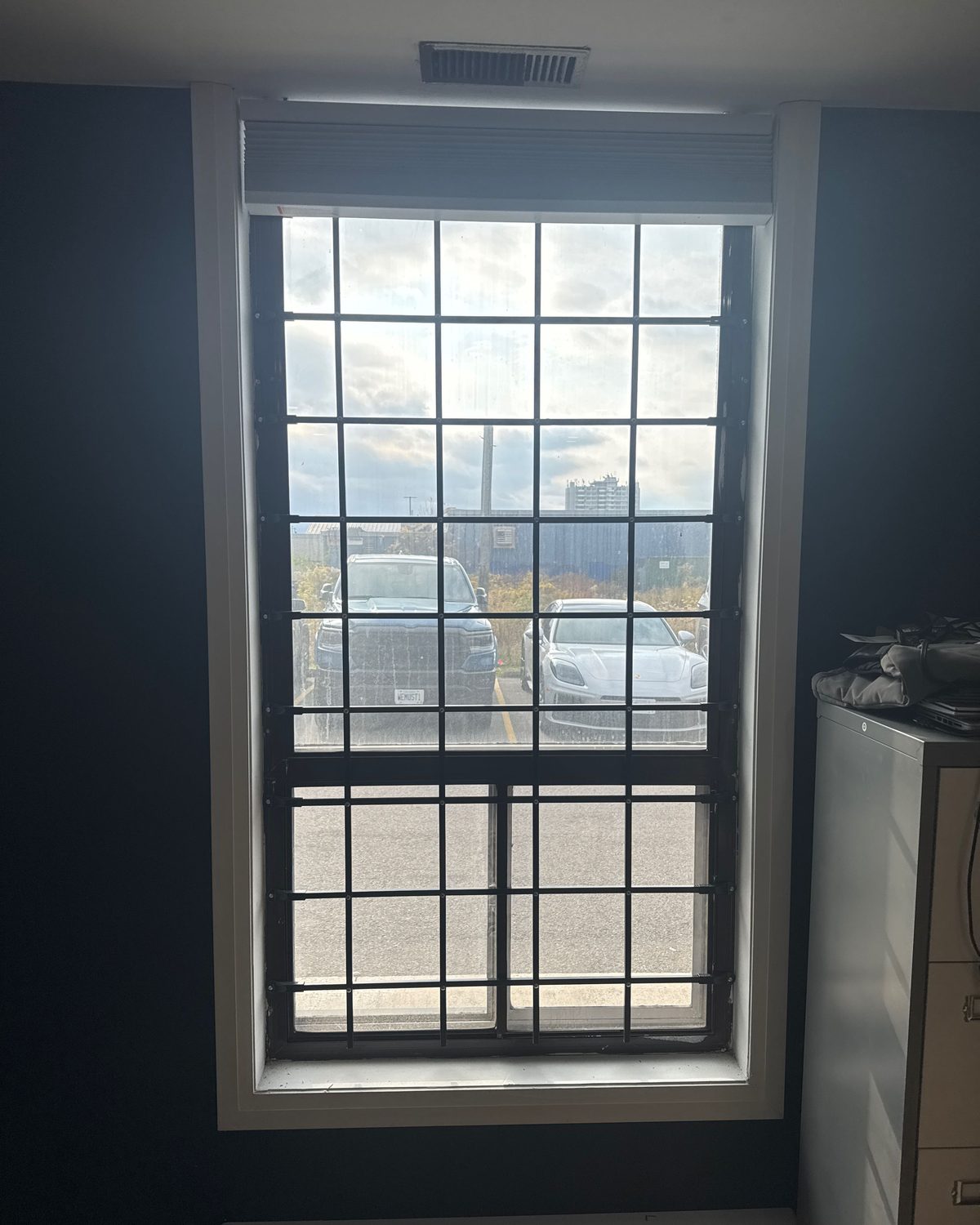
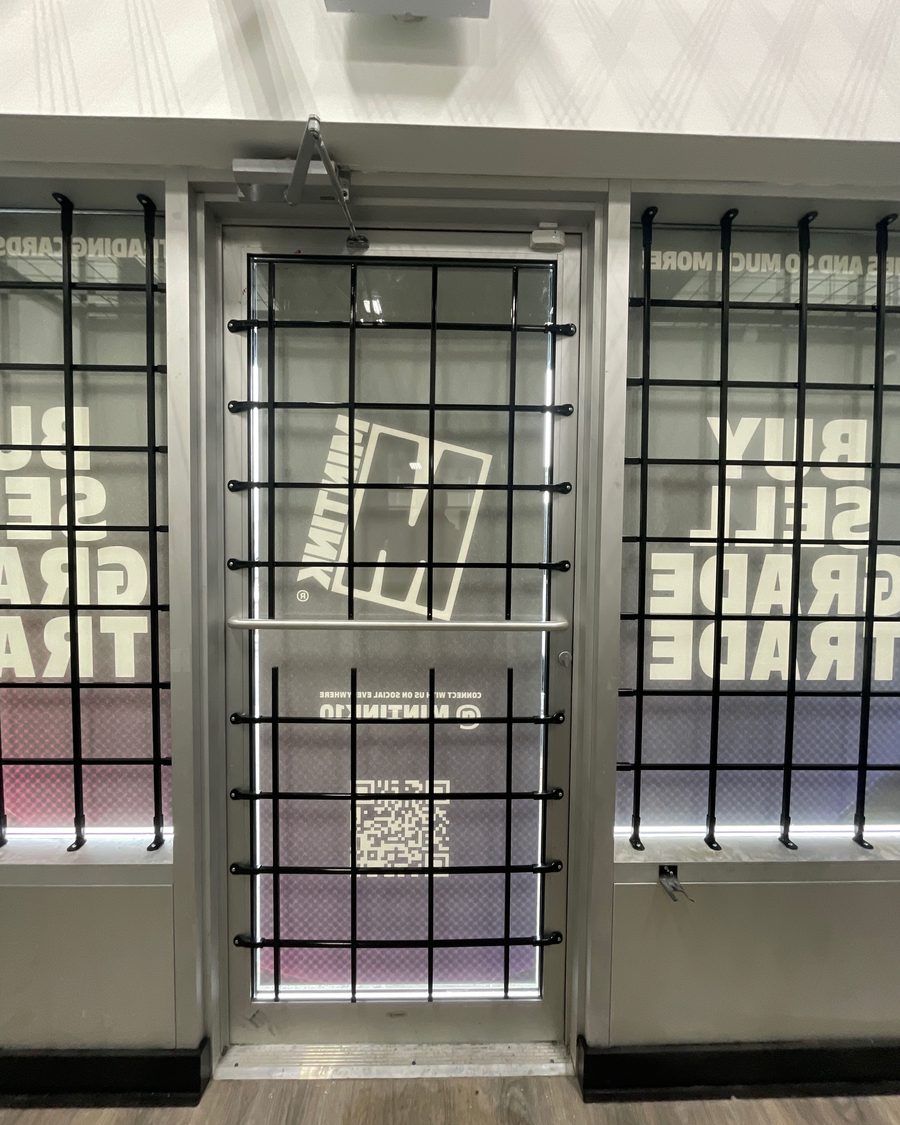
Fixed bars are the simplest and oldest answer, and they still work on the windows they suit: side and rear windows that never need to open and are never used as a way out. The common types are fixed bars anchored permanently into the frame or masonry, hinged bars that swing open from the inside, removable bars on locking brackets, and expandable bars that adjust to the opening. Decorative patterns exist if the frontage matters.
What matters more than the pattern is the anchoring. A bar screwed into a rotten wood sill or a hollow aluminum frame comes off with a pry bar. Bars should be fixed into structure — masonry, concrete or a steel frame — with fasteners that cannot be backed out from outside.
A barrier must never close off a required exit. Ontario's Building Code requires every exit door to open from the inside with no more than one releasing operation and without keys, special devices or specialized knowledge (OBC 3.4.6.16). Any grille, gate or bar on an exit route is settled at the survey, not after it is made.
Glass: laminated glass and security film
Storefront doors and much of the glass beside them are usually tempered, which is strong but breaks into small pieces that fall out of the frame. Laminated glass has a plastic interlayer that holds the broken pieces in place, so an intruder has to keep striking and tear through it before the opening is usable. Security film does a similar job on glass already in the frame; as the
overview of safety and security filmexplains, how well it performs depends a lot on how it is attached at the edges. Both delay entry. Neither is burglar-proof, and nobody honest will tell you otherwise. For the difference in detail, see tempered vs laminated glass.
How do doors, frames and locks stop break-ins?
A door stops a break-in only as well as its weakest part, and on a commercial back door that is usually the frame or the strike, not the leaf. Intruders pry the door away from the frame until the latch clears, or they attack a worn cylinder.
- Steel door, steel frame. A hollow metal door in a properly anchored steel frame is the standard for back and service doors for a reason.
- Latch protection. An astragal or latch guard stops a bar being pushed into the gap at the latch.
- Hinges that cannot be removed from outside on out-swinging doors — security studs or non-removable pins.
- A lock that latches every time. A closer too weak to pull the door shut past its seal leaves the building open all night and nobody knows.
- Key control. Old keys in unknown hands are a vulnerability. Rekeying or a restricted keyway is less expensive than a break-in.
Electronic locks and access control add a record of who opened what and remove the lost-key problem; our guide to
electronic locks for commercial buildingscovers the options. We fit and repair the whole assembly — see commercial door hardware.
Do lighting, cameras and alarms still matter if the building is hardened?
Yes — they are what turn the time a barrier buys into an arrest or an abandoned attempt. A grille on a street-facing opening that nobody is watching is a hurdle, not a solution. Police guidance recommends reliable video surveillance, motion-activated lighting at dark entrances, and visible signage that cameras are on site and no cash is kept on the premises.
Visible cameras next to a solid grille or shutter send the clearest possible message that the building is a poor target. Keep the inside visible from the street where you can: a lit, visible sales floor behind a see-through grille is harder to work in unseen than a dark one behind paper.
What should you fix first?
Fix the opening that is easiest to attack and least visible, and fix it properly, before spending on the ones that are already hard. In most buildings the order is:
- The back or side door — frame anchoring, latch protection, a lock and closer that work.
- Ground-floor glass out of sight of the street — bars, a grille, laminated glass or film.
- The storefront — a grille or shutter over the display after hours.
- Lighting and cameras covering each of the above.
- An alarm that someone actually answers.
Security closures are made to the measured opening, so plan on typically 4–6 weeks to produce once the shop drawings are approved, then 1–2 weeks to schedule and install. If a break-in happens in the meantime, the opening can be secured the same night with an
emergency board-upand repaired properly afterwards. Our 24/7 line is 800-522-6825.
The full range of closures we make, fit and repair — every make, since 1979 — is on the security shutters and grilles page.
Common questions
What is the best deterrent for break-ins at a business?
No single product. The combination that works is a physical barrier that costs an intruder time, lighting and sightlines that make them visible while they spend it, and cameras plus a monitored alarm so somebody responds. A grille or shutter without an alarm only delays a burglar nobody is coming for; an alarm without a barrier lets them in and out before anyone arrives.
Do security bars on windows work?
Yes, for what they are designed to do. Properly anchored steel bars stop a window being used as a way in and defeat the quick smash-and-grab through the glass. They do not stop the glass being broken, and they must never be fitted over a window or door that is a required way out of the building. On a storefront where the display matters, a see-through grille that retracts in the day is usually the better answer.
What do burglars hate the most?
Being seen and being slowed down. Police crime-prevention guidance focuses on lighting at entrances, removing hiding spots, keeping the inside visible from the street, and visible cameras. Physical barriers add the time element: every minute spent on a grille or a laminated pane is a minute more in the light and closer to a response.
What can I use instead of window bars?
A rolling or folding grille that retracts during business hours, a rolling shutter where you do not need to see in after hours, laminated glass in place of the existing glass, or security film applied to the glass already in the opening. Which one fits depends on headroom above the opening, whether you want the display visible at night, and whether the opening is a required exit.
What should I do right after a break-in?
Call the police first and do not disturb anything they may need. Then make the opening secure the same night: broken storefront glass or a forced door can be boarded up or temporarily secured and repaired properly afterwards. We run a 24/7 emergency line for exactly that, and the repair visit is also the time to ask why that opening was chosen.
Pricing a job like this?
Want a second pair of eyes on your weak points?
Send us photographs of the frontage, the back door and any glass at ground level, and tell us how the building is used after hours. We will say which openings to deal with first and what each one takes.