
Cost guide
What Commercial Window Replacement Costs in Ontario
Commercial glazing contractors in Canada publish roughly $800 to $2,500 per opening installed for commercial window replacement — so ten openings lands somewhere near $8,000 to $25,000 before access and making good. The homeowner figures that dominate search results are a different product and a misleading yardstick.
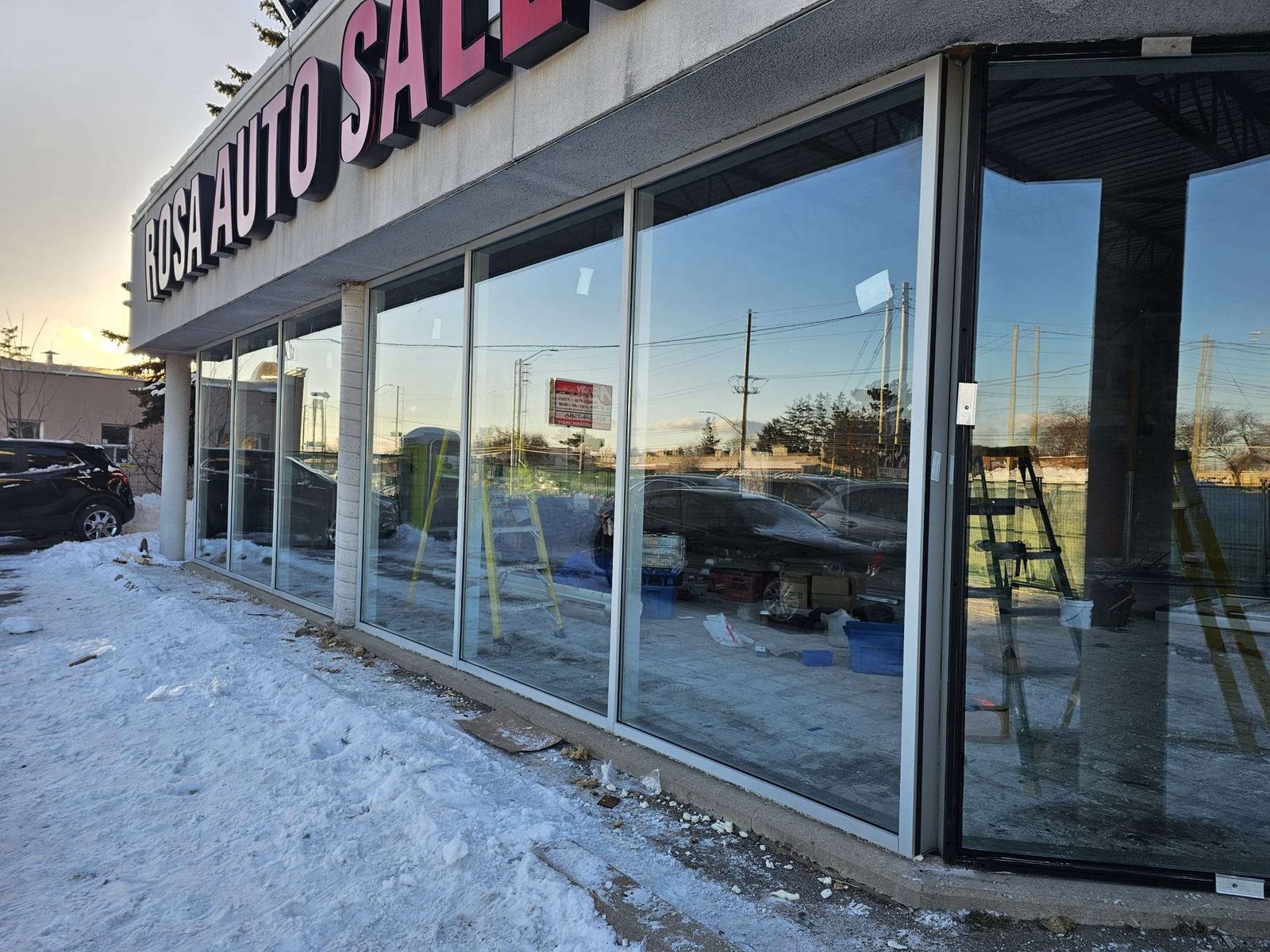
Almost every cost guide that ranks for window replacement in Ontario is written for homeowners replacing vinyl windows in a house. If you manage a commercial building, those numbers will mislead you in both directions — too low on the unit, and silent on the two thirds of a retrofit that is not the window.
This is what the market actually publishes for commercial work, what moves the number on a real quote, and how to get a figure you can put in a budget.
Four decades of windows and glazing for names Ontario knows — Canada’s Wonderland, Tim Hortons, Canadian Tire, the LCBO, Metrolinx, Marriott & Hilton hotels, the University of Toronto — plus thousands of businesses across the GTA. Dependable people, quality products, since 1979.
What does commercial window replacement cost in Ontario?
Commercial glazing contractors publishing prices in Canada quote in the region of $800 to $2,500 per opening, installed, for a standard commercial window replacement. Specialty, high-performance and oversized units are quoted above that band, and curtain wall or window wall is priced as its own project rather than per opening.
Those are other companies' published figures, checked in August 2026, not a Canuck quote — we price per unit from a site measure. They are useful for one thing only: setting the order of magnitude before anyone visits the building.
| Published range | What it covers | |
|---|---|---|
| Canadian commercial glazing contractors | $800–$2,500 per opening installed | Standard commercial units; varies with size, glazing spec and access |
| Canadian residential window sites | ~$400–$2,000 per window installed | Vinyl and stock-size units in houses — a different product |
| Specialty / high-performance commercial units | Quoted above the standard band | Oversized, acoustic, high-thermal or custom configurations |
| Curtain wall and window wall | Priced as a project | Structural glazing spanning floors; not a per-opening number |
What does it cost to replace 10 windows on a commercial building?
Taking the published commercial band at face value, ten openings sits somewhere around $8,000 to $25,000 installed — and the spread inside that range is wider than the range itself, because almost none of it is decided by the number ten.
Ten identical fixed lites at ground level, all the same size, on an unoccupied unit, is the inexpensive end and the quantity genuinely helps: one mobilisation, one measure, one delivery, one crew. Ten different openings across four elevations of an occupied building, two of them above the third floor, is a different job with the same headline count.
This is also where the homeowner figures do most damage. The commonly quoted $5,000 to $20,000 for ten windows is a residential number — it assumes stock-size vinyl units in a house, and it does not carry commercial framing, code-specified glass, access equipment or making good.
Why per-square-foot and per-window numbers mislead here
Two openings of the same glass area can be a single fixed lite and a four-vent operable assembly, at very different prices. Area is not the unit of cost on commercial work; the opening is.
The second problem is what the number leaves out. On a retrofit, removing the old frames, making good inside and out, and reaching the opening are routinely about a third of the job — and none of that scales with glass area at all. A per-square-foot rate quoted without seeing the building has priced the glass and ignored the work.
What actually moves a commercial window quote
| Unit size and count | Priced per unit; the rate per unit falls as the quantity rises |
|---|---|
| Fixed or operable | And which vent type — awning, hopper, casement or slider |
| Thermal break | It should be there on anything exterior in Ontario; it is not free |
| Glass make-up | Sealed insulating unit, low-E, argon, tempered or laminated, per opening |
| Finish | Stock anodized against a custom powder-coat colour — a price and a lead-time decision |
| Removal and making good | Taking the old frames out and finishing inside and out, versus a new opening |
| Access | Ground floor, a boom lift, or a swing stage above the third floor |
| Occupancy | After hours, phased by floor, or one tenant at a time |
Access is the line that surprises people most. The same window costs materially more at the fourth floor than at grade, because the price now includes a lift or a swing stage, the ground room to site it, and in a downtown location the permit to occupy the sidewalk while it is there.
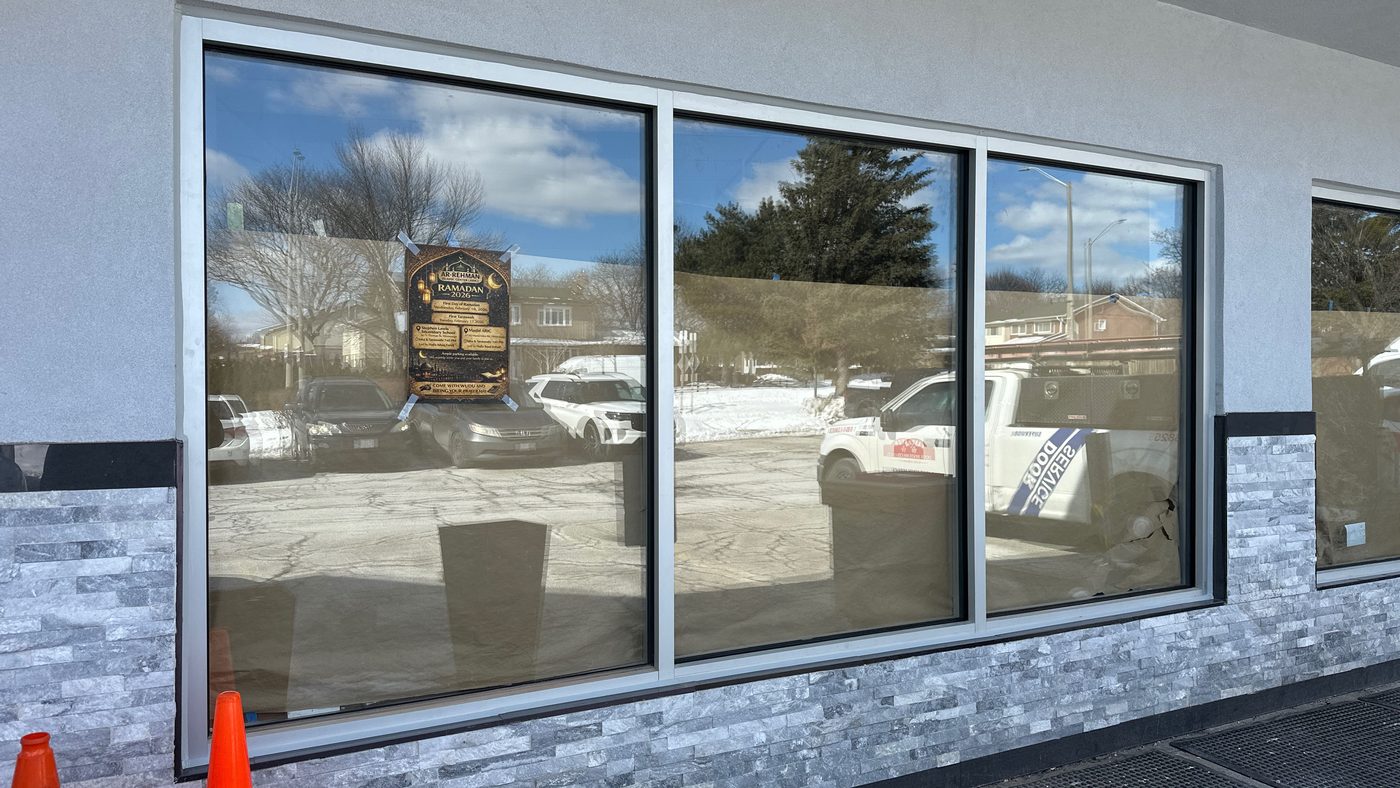
Where the money goes that is not glass
A commercial window replacement is a sequence, and the unit is one step in it:
- Site measure — every opening, individually. On an older building no two are quite the same.
- Shop drawings, approved before a single extrusion is cut.
- Fabrication — the units are made to your dimensions, not picked off a shelf.
- Removal of the existing frames, and whatever the opening turns out to be hiding.
- Installation — shimmed, anchored and set plumb before any glass goes in.
- Sealing and weatherproofing, inside and out.
- Making good — the interior and exterior finishes around the new frame.
- Debris removal.
Steps four, seven and eight are the ones missing from every per-window price online, and step one is the one that decides whether the rest goes to plan.
What a real schedule looks like, and what it costs you
Typical production is 4 to 6 weeks after the shop drawings are approved, then 1 to 2 weeks to schedule the installation itself. The elapsed time on a real job is usually longer than that, and the reason is worth budgeting for.
On a two-storey Toronto brick building we glazed for a daycare, nineteen aluminum windows and doors were awarded in August 2025 and the building was closed in by the end of December — about four months. Almost none of that was crew time on site. Measurement and shop-drawing approval took September and October. The removal then stopped while suspected asbestos in the legacy frames was tested and cleared. The front elevation could not be worked from outside at all until the City issued a permit to occupy the sidewalk.
Neither of those holds was in our scope, and neither is unusual on a pre-1990s Ontario building. Both cost money — a re-mobilisation is not free — and both are foreseeable at quote stage if somebody asks. The full write-up of that job sets out what happened and when.
Two things a building owner can do that measurably reduce the final number: have the frames tested for asbestos before the removal date rather than after it, and start any right-of-way permit application the week the order is placed. Both sit with the owner and the general contractor, and both can stop a window crew that is already mobilised.
Repair or replace?
If the frame is sound and only the glass has failed — a blown seal, a fogged sealed unit, a cracked lite — reglazing costs a fraction of a new unit, because none of the removal, anchoring or making good is involved. See commercial window glass replacement.
Replacement earns its cost when the frame itself is finished: corrosion, frames out of square, no thermal break, or persistent air and water infiltration at the perimeter that sealant no longer fixes. Age alone is not the test — a sound 30-year-old frame with failed sealed units is a reglazing job, and a 15-year-old frame that was never anchored square is not.
How to get a number you can budget against
Online ranges are for the order of magnitude. A number you can put in a capital plan needs someone on site, and it needs these nine things established:
- The count of openings, and the dimensions of each
- Which openings have to open, and which can be fixed
- The condition of the existing frames and the surrounding wall
- The glass make-up the code requires in each location
- How each opening is reached, and what equipment that needs
- Whether the building stays occupied, and what hours the work can happen in
- What making good is required inside and out
- Whether the frames pre-date the 1990s
- The finish, and whether it is stock or custom
sets out the rest. Send us the elevation and the opening count and we will measure it properly.
Common questions
How much does it cost to replace 10 windows in Ontario?
On a commercial building, published contractor ranges of roughly $800 to $2,500 per opening installed put ten openings somewhere near $8,000 to $25,000 — before access equipment, removal and making good. On a house, the Canadian residential window sites publish roughly $400 to $2,000 per window, so ten comes out far lower. The two numbers are not interchangeable, because they are not the same product.
How much does it cost to install one commercial window?
Published Canadian contractor ranges sit around $800 to $2,500 per opening installed, with specialty and high-performance units quoted well above that. The figure moves most with unit size, whether the unit opens, the glass make-up and how the opening is reached. We price per unit from a site measure rather than from a per-square-foot rate.
Is it worth replacing 30-year-old windows?
Usually yes, if the frames themselves are finished — corroded, out of square, not thermally broken, or leaking air and water at the perimeter. If the frames are sound and only the sealed units have failed, reglazing is far less expensive and we do it. The test is the frame, not the age.
Is it less expensive to repair or replace a commercial window?
Repair, whenever the frame is sound. A blown seal, a fogged sealed unit or a cracked lite is a reglazing job at a fraction of the price of a new unit, because none of the removal, anchoring or making good is involved. Replacement is the answer when the frame has to come out anyway.
Why will nobody quote commercial windows per square foot?
Because two openings of the same area can be a single fixed lite and a four-vent operable assembly, at very different prices — and on a retrofit the removal, the making good and the access routinely come to a third of the job, none of which scales with glass area. A per-square-foot number quoted without seeing the building is a guess wearing a unit.
Pricing a job like this?
Want a real number for your building?
Send us a rough count of the openings, a photograph of the elevation and whether the building stays occupied. That is enough to measure, draw and price the job properly.