
Commercial & Industrial
Security Shutters and Grilles
Four ways to close an opening when the business is shut — a slat shutter that seals it, a grille you can see through, a counter shutter over a servery, or a folding closure where there is no headroom for a coil. Supplied, installed and repaired across Toronto and the GTA since 1979, with 24/7 emergency call-out.
A security closure does one job: it makes an opening not worth attacking. Everything else about the product — slat or grille, rolling or folding, aluminum or steel, manual or motorized — follows from two questions. What does the opening physically allow? And do you want to be seen into when the business is shut?
Canuck Door Systems has been fitting shutters, grilles and gates across Toronto and the GTA since 1979, on storefronts, mall units, service counters, warehouse openings and the windows beside them. We also repair them, on every make, with 24/7 dispatch — because an opening that cannot be closed is a problem that does not wait until Monday.
Shutters, grilles and gates we supply and service
Rolling closures
These coil onto a barrel above the opening, so they need headroom and leave the jambs clear.
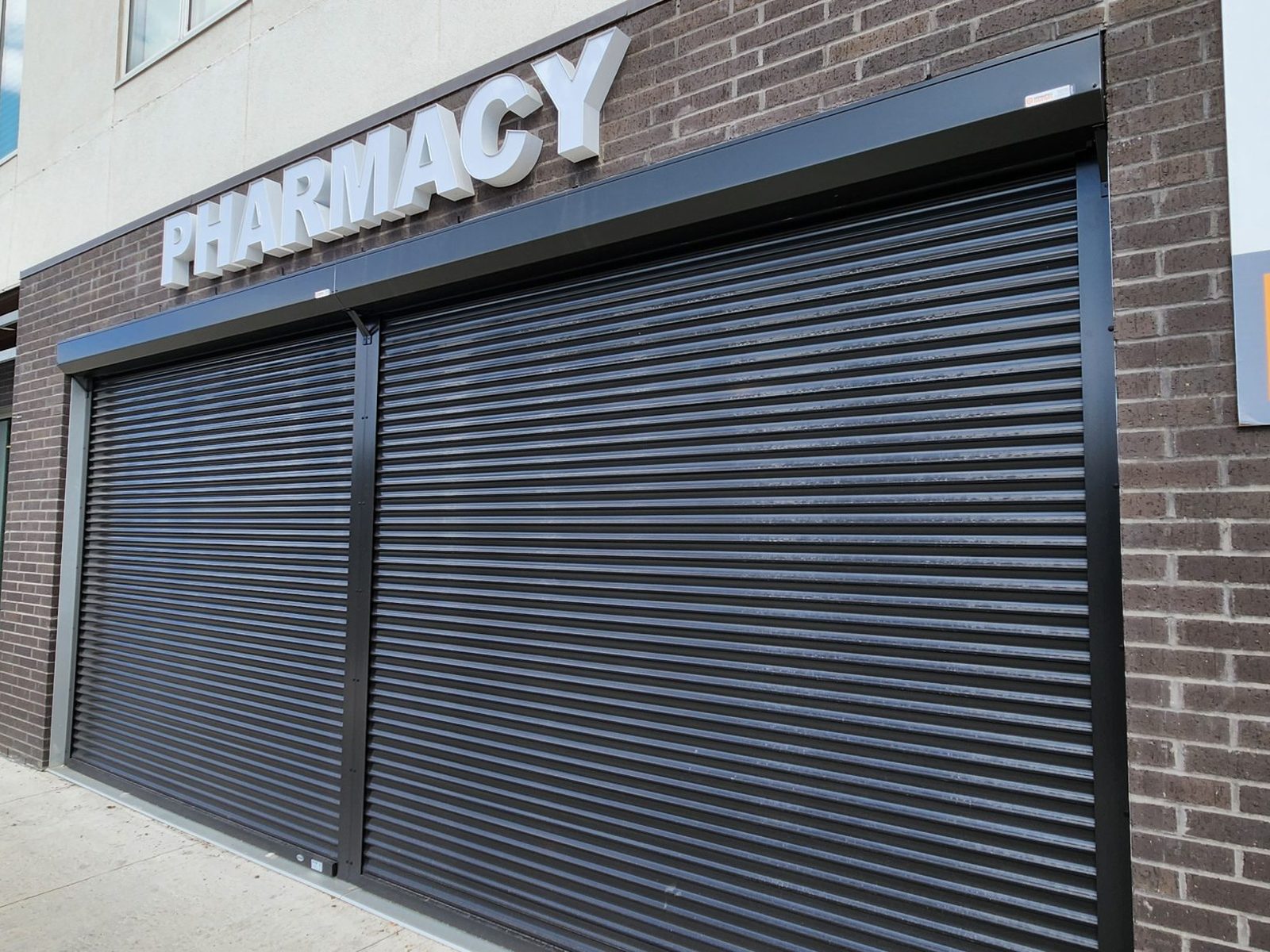
Solid aluminum slats that coil overhead and close the opening completely. The outward-facing closure, over an entrance or a shopfront.
An aluminum grille that coils overhead and you can still see through. The mall closure, across a glazed shopfront.
The closure that comes down over a service counter rather than a doorway — serveries, dispensaries, parts desks and concession windows.
Folding closures
These stack sideways instead, for openings with nothing above the head to give.
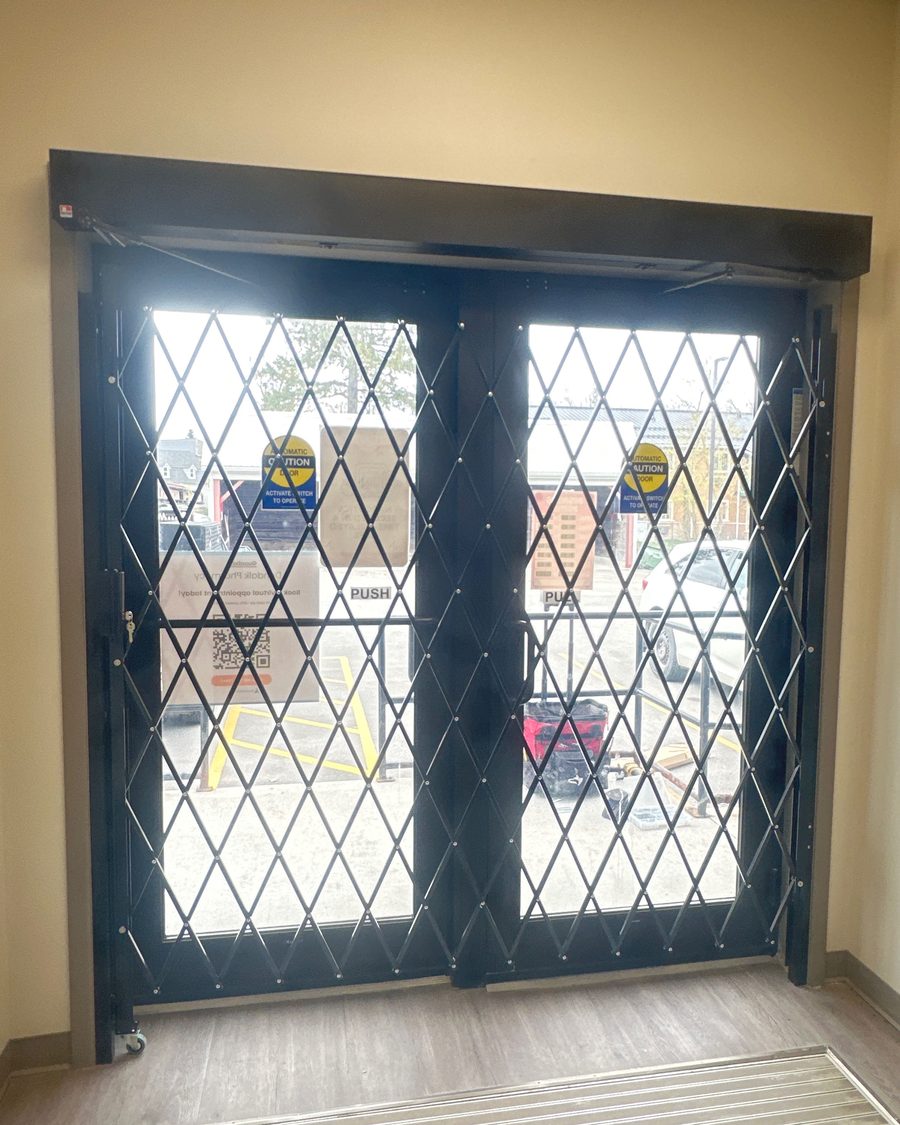
Closures that stack sideways instead of coiling, where there is no headroom for a barrel: mall grilles and street-facing gates.
Which of the four the opening takes
| Rolling shutter | Rolling grille | Counter shutter | Folding grille or gate | |
|---|---|---|---|---|
| What closes the opening | Interlocking slats | Links or rods with gaps between them | Either, over a counter | Leaves that concertina sideways |
| How it gets out of the way | Coils above the head | Coils above the head | Coils above the counter | Stacks against a jamb |
| Headroom needed | Yes | Yes | Yes, but only a little | None |
| See through it | No, unless perforated | Yes, which is the point | Depends which you choose | Yes |
| Usual position | Outside, over the entrance | Inside a mall, over glazing | Over a servery or service window | Inside, mall or street-facing |
| Weather and insulation | The only one that does either | No | No | No |
| Typical objection | A closed storefront looks closed | No privacy, no weather barrier | It is a counter, not an opening | Takes wall space at the side |
Headroom decides this more often than preference does. A coil needs somewhere to sit above the opening, and when a tenant fit-out has already used that space for ductwork or a bulkhead, a side-folding closure is not the compromise — it is the answer.
What all four have in common
The four products look different and share most of their engineering. Whichever one an opening ends up with, these are constant:
- Made to the opening. Nothing in this silo comes off a shelf. Every curtain, grille and gate is built to a measured opening, which is why lead times run in weeks rather than days.
- The guides or the track are the wear item, not the curtain. Grit and road salt collect in them, and a closure that suddenly needs two hands is nearly always telling you that.
- Most damage is a forced closure. Something is pushed or pulled while its lock is still thrown. It is the single commonest repair we attend, on every one of the four.
- Locking can key into the building. A cylinder keyed to the tenant's or the centre's system means staff carry one key rather than four.
- Egress overrides everything. Any opening on an exit route constrains what may be fitted and how it may be locked, and that is settled at the survey rather than after manufacture.
- Motorization is a duty-cycle decision. Wide, heavy, or cycled several times a day by whoever is on shift — motorize it, with a manual override for a power failure. Cycled once a day by the same person, a chain hoist lasts for years.
- Fire-rated openings are a different product. A closure in a rated wall must be a labelled fire shutter that closes on alarm and is drop-tested; a security closure does not satisfy the code. Those are covered under Fire Shutters.
What "security" actually buys you
Every product in this silo has "security" in its name, and not one of them makes a business burglar-proof. Anything with gaps can be reached through, and a determined attack with the right tools and enough uninterrupted time gets past any closure ever made. Anyone selling you one on the other promise is overselling it.
What they do buy is worth having, and it differs by which side of the wall the opening faces.
- Inside a shopping centre, a grille is an added layer on top of protection that already exists — 24-hour surveillance, staffed patrols, and a concourse nobody reaches after hours without passing something that records them. The grille makes the unit visibly shut and the stock not casually reachable, in a space where anyone working on it is conspicuous.
- On a street-facing opening, nobody is watching. What a shutter or gate buys there is time — it turns a ten-second smash-and-grab into a job that needs tools, makes noise and takes long enough for a response to arrive. That is real value, and it is only value if a response is actually coming.
On any opening facing outside, a shutter or gate is a hurdle that wins time until police arrive. It should be specified alongside 24-hour camera surveillance and an alarm monitored by a security company or connected to police — and it should never be a business's only security measure.
Where these go
Retail storefronts
Closing a shopfront overnight — the classic use, and the one where interior mounting usually wins.
Shopping malls
Mall unit closures where the landlord specifies the type, and a grille keeps the display visible after hours.
Pharmacies & convenience
High-value stock behind glass, often with a grille over the doors and a shutter over the dispensary.
Restaurants & bars
Serveries, patio bars and takeout windows shut down between services — usually a counter shutter.
Warehouses & industrial
Openings inside a building: tool cribs, parts counters, secure cages and mezzanine access.
Schools & community centres
Cafeteria serveries, kitchens and equipment rooms that close when the building stays open.
Parking garages
Entrance closures and secure storage areas, where the shutter is wide and always motorized.
Banks & cash handling
Counters, ATM vestibules and back-of-house openings, where the shutter is one part of a security plan.
Service, repair and the things that actually break
The curtain almost never fails first. What fails is the bottom bar and the guides, or the track and the carriers on a folding closure — something catches it, or it is forced while the lock is still thrown, and it comes out of its guide. After that it is motors and limit switches on powered units, springs and barrels on manual ones, and impact damage from a vehicle or a pallet truck.
Two things worth knowing before you have a problem:
- Sections replace individually. A damaged slat, link or leaf does not condemn the whole closure, and matching new sections into an existing curtain is routine work.
- We service other makes. Unlike automatic door operators, shutter and grille components are largely matched rather than brand-locked, so an old closure with no name on it is usually still repairable.
An annual service — guides and tracks cleaned, curtain checked, bottom bar and lock adjusted, motor limits reset — costs a fraction of the emergency call it prevents, and winter is when the difference shows.
Shutter and grille work across the GTA
Documented shutter, grille and gate jobs from our own project files — real clients, real openings.
Granite Shore Homes Inc
Allyant Design
Kings Restoration Group
ARJ Airparts Inc
Formtek Structures Inc
Golden Gate Contracting Inc
Four decades of doors and closures for names Ontario knows — Canada’s Wonderland, Tim Hortons, Canadian Tire, the LCBO, Metrolinx, Marriott & Hilton hotels, the University of Toronto — plus thousands of businesses across the GTA. Dependable people, quality products, since 1979.
“I called Canuck Door systems regarding my security gate at our retail store, I cannot recommend them enough. Quick turn around … Fixed the problem, called to make sure it was done to my expectations.”
Bryce M., Google review
Security shutter work across Toronto & the GTA
We install and service shutters, grilles and gates right across the core GTA and out into the Southern Ontario belt, from our shop in Mississauga. A shutter that will not close is an opening that cannot be secured overnight, which is why this is 24/7 work.
Core GTA
- Toronto
- Mississauga
- Brampton
- Vaughan
- Markham
- Scarborough
- North York
- Etobicoke
- Richmond Hill
- Oakville
- Burlington
- Milton
Southern Ontario belt
Retail chains and franchise groups rarely have one location. We quote a whole portfolio on a single specification so every store gets the same shutter, the same key and the same spare slats — which makes the tenth site far simpler than the first. See all service areas
What these cost — and what moves the number
Every one of the four is priced by the opening and by how hard it has to work, and none of them comes off a shelf. What actually moves the number:
- Opening width and height, and how much headroom there is for the coil
- Curtain type — solid slat, perforated slat, or an open grille you can see through
- Material and finish — galvanized, aluminum, stainless, or powder-coated to a colour
- Manual chain or crank against a tube motor, and whether it needs a key switch or remote
- Insulated or uninsulated, on an opening in the building envelope
- Interior or exterior mounting, which changes the guides, the finish and often the permit
- Whether the structure above the opening can carry the barrel, or needs steel added
- Locking — centre lock, slide bolts, or an integrated cylinder keyed to your system
- Fire rating, where the opening is in a rated wall — a different, labelled product
The measurement that decides most of this is the headroom above the opening. A coil needs somewhere to live, and where there is none the answer is a different product — a side-folding gate or a grille — rather than a smaller shutter.
Common questions about security shutters & grilles
What is the difference between a shutter, a grille and a gate?
A shutter is a solid or perforated curtain of interlocking slats that rolls up into a coil above the opening — it closes the opening completely. A grille is the same idea built from links or rods you can see through, so a window display stays visible after hours. A folding gate does not roll at all: it slides sideways along a track and stacks like a concertina, which is the answer when there is no headroom for a coil. All three secure an opening; the choice is usually made by headroom and by whether you want to be seen into.
Should a security shutter go inside or outside?
Inside where you can. An interior shutter is out of the weather, out of reach of vandalism and graffiti, keeps the shopfront looking like a shopfront, and rarely needs a permit or landlord approval for appearance. Exterior mounting wins when there is no interior room for the coil and guides, when the glass itself needs protecting from impact rather than the goods behind it, or when the opening has no glazing at all. Heritage and BIA districts often have a view on this, and it is worth asking before ordering.
Do rolling shutters actually stop break-ins?
No — and nobody should sell one as if it did. A shutter or grille slows a break-in down: it turns a ten-second smash-and-grab into a noisy job with tools, and it is plainly visible, so most opportunists pick somewhere else. A determined attack with the right equipment still gets through. The time it buys is only worth something if the rest of the building uses it — cameras covering the opening, an alarm with contacts and glass-break sensors, and a security company monitoring it so somebody is on the way. Treat the closure as one layer of that plan, not the plan.
Do you install and service Pentagon security shutters?
Yes — Pentagon is one of the three makes we buy from. We supply and fit DefendaGuard on windows, doors and garages, EntrexGuard on retail storefronts and TambourGuard over shelving and dispensaries, and we service Pentagon shutters whoever put them in: motors, limits, springs, slats, locks and bottom bars.
Can security shutters be fitted to a house?
Yes. Rolling shutters go on basement and ground-floor windows, patio and entry doors, garages and cottages closed for the winter, and Pentagon build a residential line for exactly that. For a sliding patio door an expandable folding gate locked from inside is the simpler option. Any window or door that is a way out in a fire has to stay openable from inside, which we check before quoting.
Can a security shutter be motorized, and should it be?
Yes, and the honest test is how often it cycles and who cycles it. A shutter opened and closed once a day by staff can stay on a chain hoist for years. One that opens several times a day, is very wide or very heavy, or is operated by whoever is on shift, should be motorized — manual operation is where the damage comes from. A motor also brings a key switch, remote or timer, and a manual override for a power failure, which is not optional on an opening people leave through.
What goes wrong with them?
Almost always the guides and the bottom bar, not the curtain. Something catches the bottom bar, or the shutter is forced when its lock is still engaged, and the slats come out of the guide. After that: motors and limit switches on powered units, springs and barrels on manual ones, and slats damaged by an impact. Grit and salt in the guides is the winter version of the same problem. Most of it is repairable in place, and slats can be replaced individually rather than replacing a whole curtain.
How long does a security shutter take to supply and install?
Typically 4–6 weeks to produce once the opening is measured and the finish is confirmed, then 1–2 weeks to schedule and install — around 5–8 weeks in total, depending on the size of the project. Every one of these is made to the opening, so nothing is off a shelf. Repairs are a different clock: common slats, guides, motors and locks are stocked, and most faults are put right in a single visit. The installation of a single shutter is usually a day, done outside trading hours where it has to be.
Can you service a shutter another company installed?
Yes — most of the shutters we look after came from somebody else. Slats, guides, bottom bars, locks, springs and motors are largely cross-compatible or can be matched, which is not true of automatic door operators. Where a curtain is genuinely beyond economical repair we will say so and quote a replacement against the guides and structure you already have, which is much less expensive than starting from nothing.
Do I need a fire-rated shutter?
Only if the opening is in a fire-rated wall or separation — and then it is a legal requirement rather than a choice. A fire shutter is a different, labelled product that closes automatically on alarm and has to be drop- tested to prove it still does. A security shutter in the same opening does not satisfy the code. We build both, and the fire-rated ones live on their own page with the inspection they require.
Opening to secure, or a shutter that will not close?
Send us the opening width and height and a photo of what is above it. That is usually enough to say whether it takes a shutter, a grille or a gate — and to quote it.